
- Collection type
- Object
- Description
- Spear with oryx horn point set into a long wooden shaft, with a tooled hide sheath and hair tassel [RTS 5/8/2005].
- Long description
- Spear consisting of a narrow, straightened point made from oryx horn with a naturally ridged surface and oval section; the surface is a streaky yellowish brown and dark brown colour (Pantone 466C and Pantone 440C). The base of this rests against the top of a long, straight shaft of orangey brown wood (Pantone 730C), also slightly oval in section that tapers to the butt. Both point and haft have been polished, and the junction between them covered with a dark brown cylindrical sheath (Pantone 440C), cut from a section of animal's tail with the hair removed. This was stretched over the body whilst wet and then shrunken in place, with the surface tooled all over, leaving a series of long lentoid-shaped impressions in horizontal rows around the circumference. The lower part of the shaft has been decorated with a brass cylinder, cut from a recycled cartridge and fitted over the wood (Pantone 871C), and a small tassel of brown hair (Pantone 7532C), made from a cut segment of animal tail, just below. The spear is complete, except for a small hole at the base of the point, with a weight of 730.2 grams. It has a total length of 2231 mm, with an upper shaft diameter of 22 by 21.5 mm; the point measures 500 mm from its tip to the top of the sheath, and has a diameter of 45.5 by 35.5 mm; the sheath below is 189 mm long with an upper diameter of 47.5 by 38.2 mm [RTS 5/8/2005].
- Geographical reference
- Cultural groups
- Shilluk
- Date / Period
- Date made: Before 1929
- Date collected
- By 1929
- Acquisition information
- Donated: 1929
- Materials and processes
- Material Wood Plant, Material Antelope Horn Animal, Material Animal Hide Skin, Material Animal Hair, Material Animal Tail, Material Brass Metal, Process Carved, Process Stained, Process Covered, Process Tooled, Process Decorated, Process Recycled, Process Impressed
- Dimensions
- Diameter: max 47.5 mm, Length: max 2231 mm, Length: max 189 mm sheath, Length: max 22 mm horn, Weight 730.2 g
- Object numbers
- Accession number: 1929.58.1
- Research and responses
For an essay on the variety and cultural significance of spears in South Sudan, particularly among the Dinka and Nuer, see ‘“Spears” that are not Spears’, by Jok Madut Jok, in Pieces of a Nation: South Sudanese Heritage and Museum Collections, edited by Zoe Cormack and Cherry Leonardi (Leiden: Sidestone Press, 2021), pp. 110–114.
Although the term 'Upper Nile' is now used to refer to a modern administrative district, covering a stretch of the Bahr el Abiad from Geigar to Malakal, and the Sobat River to Nasir, at the time this object was collected the term was used differently. Up until 1981, it was the name of a province that covered the districts now known as Upper Nile, Jonglei, Wahda and part of el Buheyrat. It may also have been used to describe the Bahr el Abiad and/or Bahr el Jebel rivers.
For other Shilluk spears with horn points, see 1919.13.17-18. Spears tipped with straight, or straightened animal horn are also used by the Nuer (see 1931.66.9 and 1936.10.1), Dinka (1913.15.5) and Mandari (1973.16.2), usually using materials such as antelope or onyx. The Nuer hafted these points as follows: 'The giit ... is fixed at the joint with an unsewn leather collar made from the tail skin of an ox. This is soaked and stretched round the haft, where it shrinks as it dries' (P.P. Howell, 1947, "On the Value of Iron Among the Nuer", Man 47, p. 132-3).
Domville Fife discusses Shilluk weaponry, as he saw it in the 1920's: ""The Shilluk warrior is never seen outside his tukl without a long spear, having a broad, leaf-shaped blade, and an ostrich feather tuft near the butt end. These spears are always kept scrupulously clean… In addition to this long, stabbing weapon, two small throwing spears are usually carried..." (C.W. Domville Fife, 1927, Savage Life in the Black Sudan, p. 69 and sketch on p. 68). This may be an example of the throwing spear type [RTS 15/8/2005].
Search terms: Weapon, Spear, Spear-head
Further items to explore
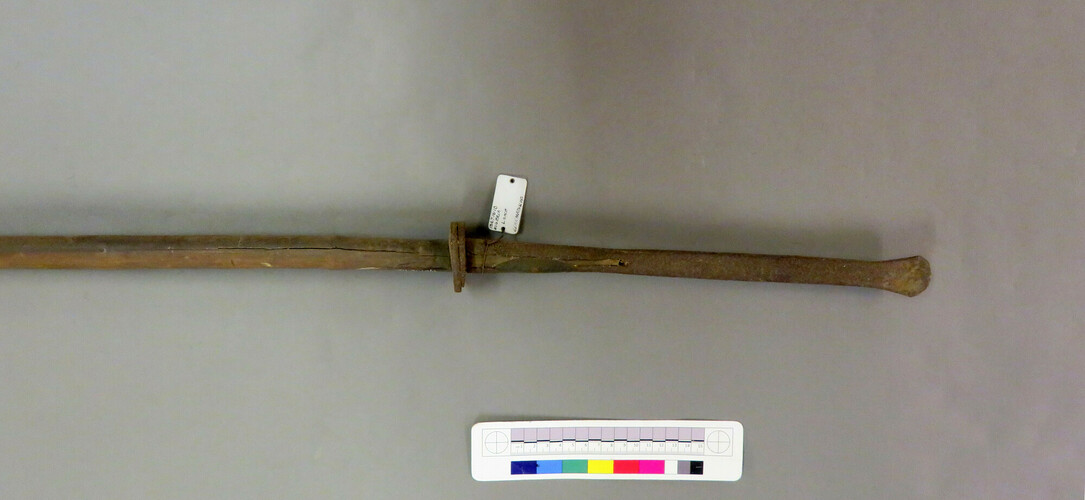 1967.16.10Spear with iron head, with geometric decoration round neck. Attached to wood shaft by nails and brass clamps. [JMC [OPS move] 24/8/2018]1967.16.10
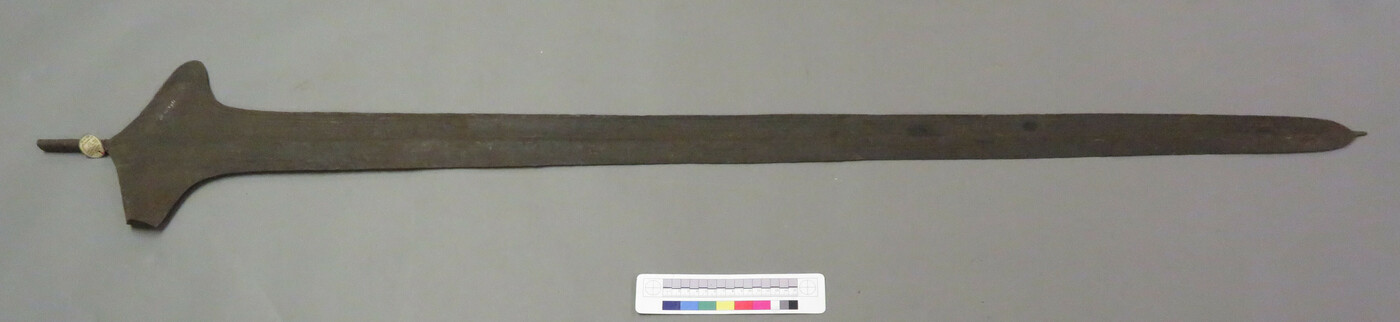 1963.10.23Currency spear head1963.10.23
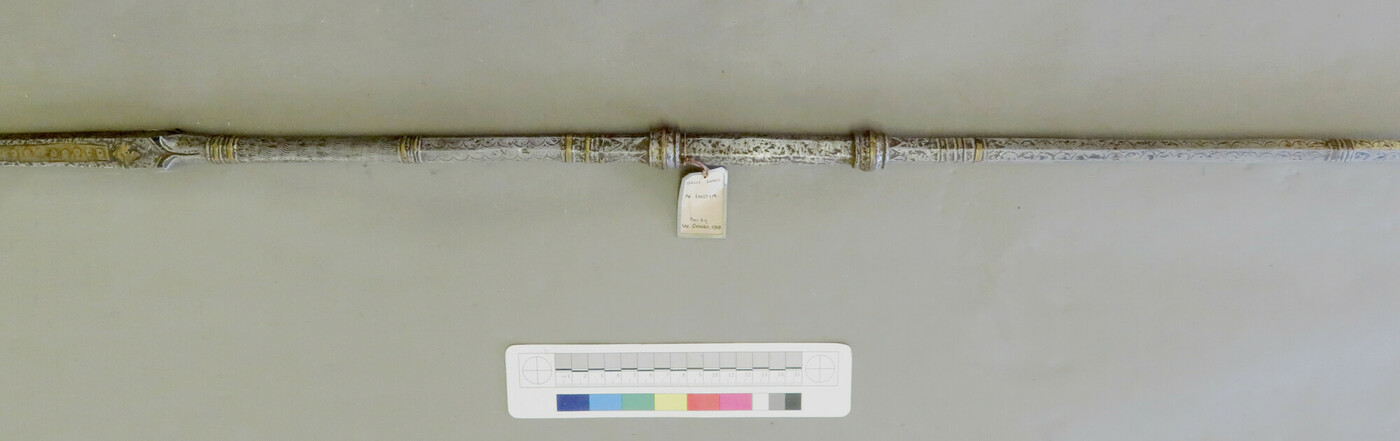 1918.19.33Steel spear. With a pointed head, square in section. There is a knob towards the butt spike. Decoratively incised and with inlaid copper alloy metal. [AB [OPS move] 7/8/2018]1918.19.33
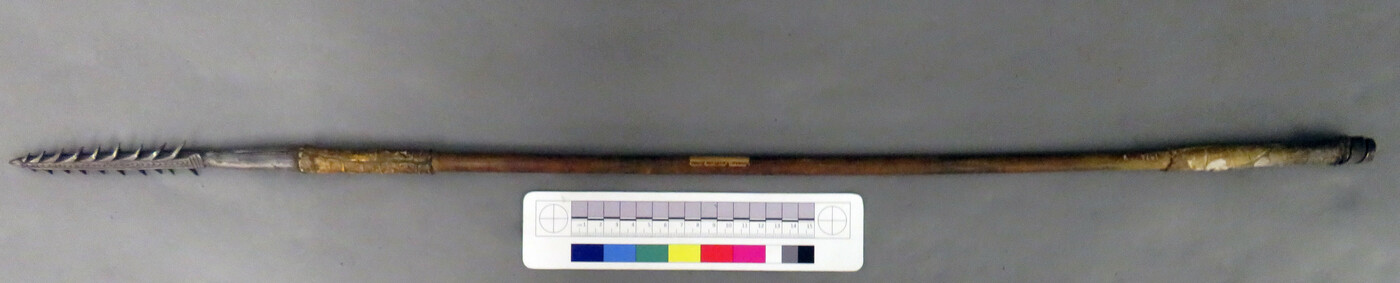 1926.90.7Short stabbing spear with short wooden shaft and socketed barbed iron head. The shaft is bound with crocodile skin at each end. [RH [OPS move] 10/7/2018]1926.90.7
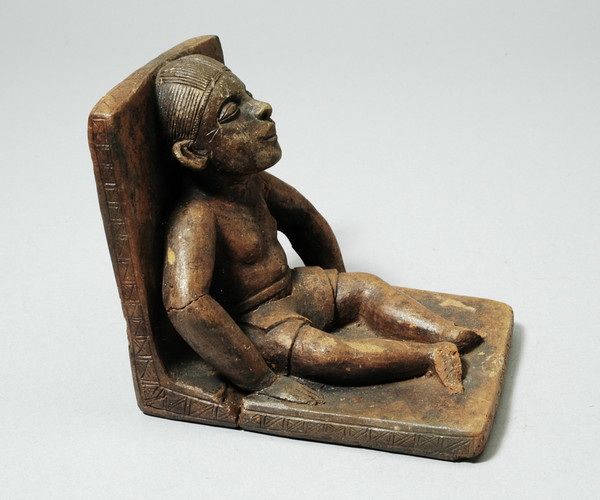 1934.8.135L-shaped pottery book-end with a seated male figure wearing shorts sculpted in high relief [RTS 28/1/2005].1934.8.135
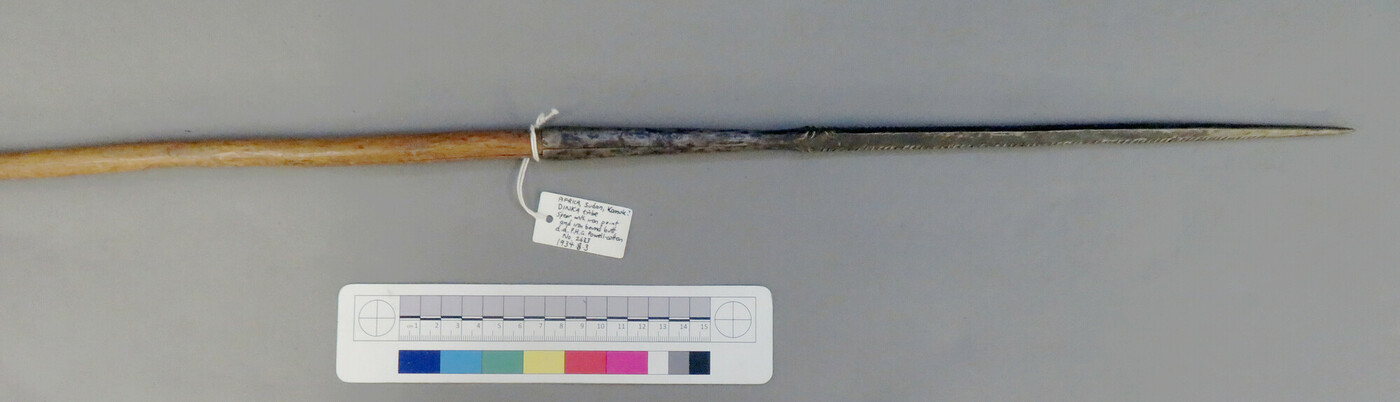 1934.8.3Spear with wooden shaft and socketed, serated metal spike with a square section. Bound metal butt. [DV [OPS move] 4/7/2018]1934.8.3
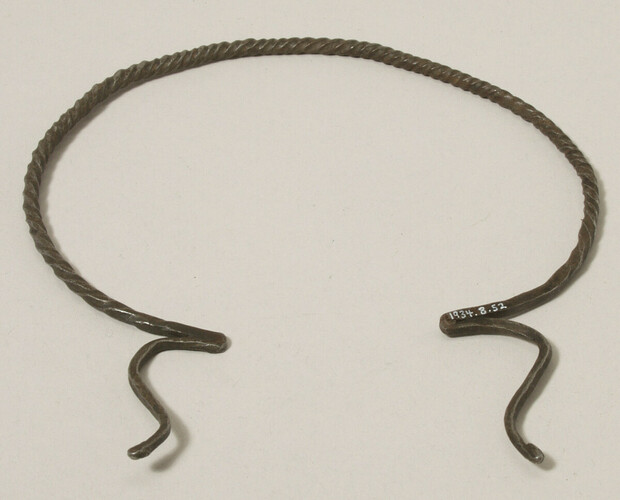 1934.8.52Twisted penannular iron torque with curved, projecting ends, bent over at their tips [RTS 29/4/2004].1934.8.52
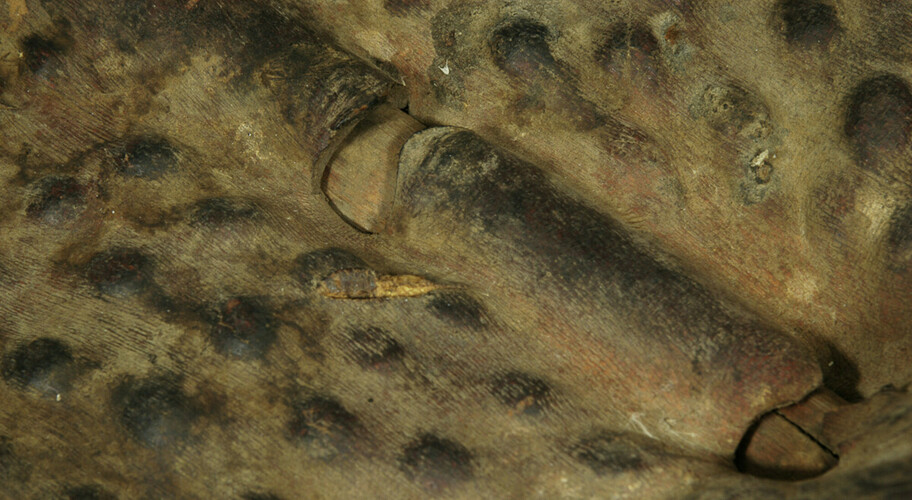 1937.34.43Hide shield with lentoid-shaped body on a central wooden support, with raised central boss and dimpled surface [RTS 18/1/2005].1937.34.43