
- Collection type
- Object
- Description
- Carved and painted lenticular shaped ‘shield’.
- Long description
- Carved and painted lenticular shaped ‘shield’. The shield has a carved arm hole at one end. There is a rhombus shaped hole in the centre. One side has a white back ground with painted design. There reverse has carved and painted rows of zigzags around the centre.
- Geographical reference
- Cultural groups
- Kikuyu
- Date / Period
- Date made: Before 1933
- Date collected
- By 1933
- Acquisition information
- Donated: 1933
- Materials and processes
- Material Wood Plant, Material Pigment, Process Carved, Process Painted
- Dimensions
- Length: max 630 mm, Width: max 432 mm
- Object numbers
- Accession number: 1933.26.5
- Research and responses
Ndome relate to Irua. Irua refers both to the initiation ceremony between childhood and adulthood, and the physical operation of circumcision central to it. Ndome are carved from wood with a ring which is worn under the left armpit, and the shield itself rises up over the shoulder. By contrast to this, practical Kikuyu war shields bear very little resemblance to the ndome, being leather and painted as close copies of the shields manufactured by their warrior-cultured Masai neighbours. For boys, Irua it takes place between the ages of 15 and 18. An uncircumcised boy (Kihi) could not own any possessions of their own; they were not permitted to socialise with circumcised youths (Mwanake); they could not fight as warriors for the clan; they could not marry; and they were not permitted to sleep in the Thingira – a house for initiated young men, where initiated boys and girls were permitted to have non-penetrative sexual relations. Several years of boys were circumcised at a single Irua. Children undergoing Irua were known as Ihoro. After circumcision, each new year of Mwanake are considered to belong to an Age Set (rika). Each rika is given a group name and has a local leader; members of the rika behave towards each other like brothers for life, and fight together in battle. The ceremony of Irua is lengthy, and the early parts comprise a number of dances, which culminate in the Matuumo or ‘Great Dance’. The ndome displayed here are an integral part of this phase. This is followed by the surgical operation itself, which takes place at a special ritual location known as the Iteri. Boys are expected to undergo the operation in silence, without flinching – in order to preserve their family honour. The operation is performed by a hereditary male specialist known as a muruithia. A period of seclusion follows, inside a closed house known as the Kiganda. The boys stay in the Kiganda for 4 to 9 days, and are taken care of by older initiated boys, before being allowed to return home to their parents. The Kiganda is burned down after each year. After circumcision, boys wear a skin robe to cover their genitals until the penis has healed, called nguo ya maribi. The removal of this robe shows they are open to the advances of initiated girls. Relevant Reading: Joyce, T.A. (1906) Note on a Series of Kikuyu ‘Ndomi’. In: Man, Vol.6, No.33, pp.49-51. Orde Brown, G.St.J. (1925) The Vanishing Tribes of Kenya. London: Seeley, Service & Co. Cagnolo, C. (1933) The Akikuyu: Their Customs, Traditions & Folklore. Nyeri, Kenya: Catholic Mission of the Consolate Fathers. Middleton, J. & Kershaw, G. (1965) The Kikuyu & Kamba of Kenya. London: International African Institute. Research Conducted for DCF Cutting Edge 2006/2007 [AM].
Search terms: Weapon, Ritual and Ceremonial, Status, Shield, Ceremonial Object
Further items to explore
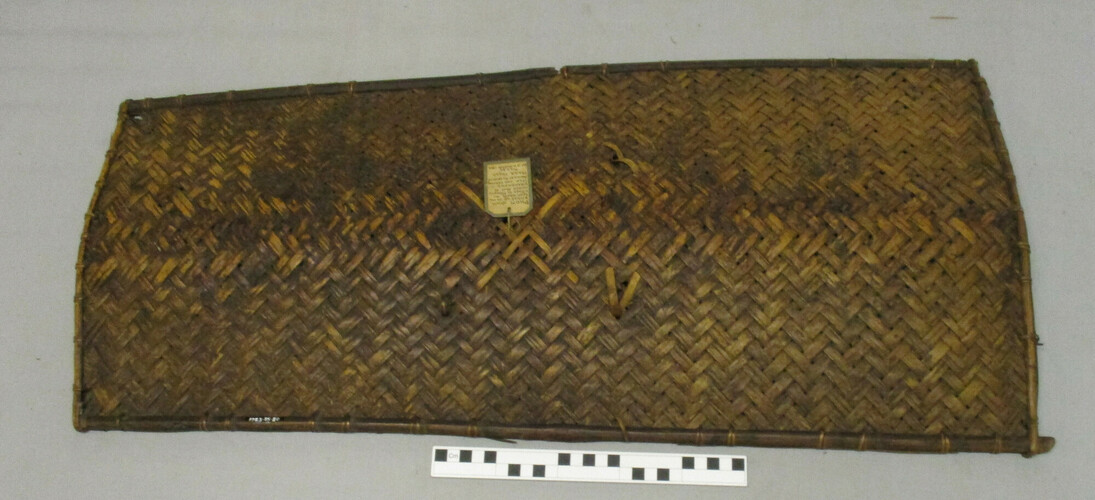 1923.85.80Shield. Made from woven cane. It is rectangular in shape with the sides sloping downwards from a central point along the length of the shield. There is a cane handle on the underside. It has been stained in a brown colour. [AB [OPS Move] 22/8/2016]1923.85.80
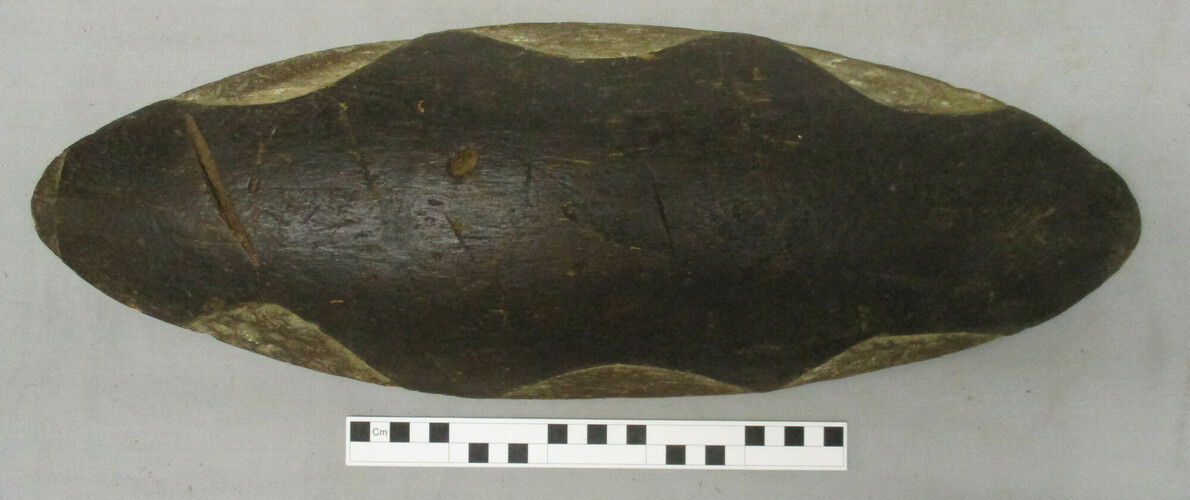 1931.78.12Pointed shield, elliptical, has several scars from blows. Decorated with 6 carved arcs, 3 along each side that still have traces of being painted with white ochre. The grip is bound with bark and string. [ZM 19/2/2004]1931.78.12
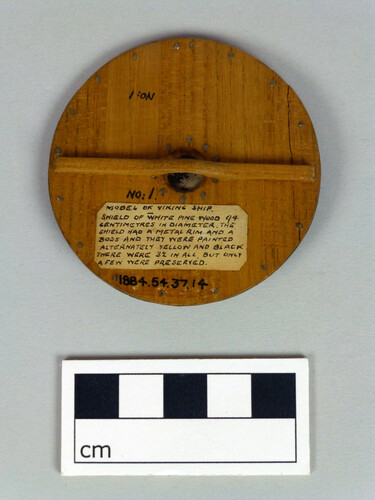 1884.54.37.14Round metal-edged wooden shield with a raised boss or umbo on the front and carved handle at the back, part of Viking ship model 1884.54.37 [ZM 7/3/2016]1884.54.37.14
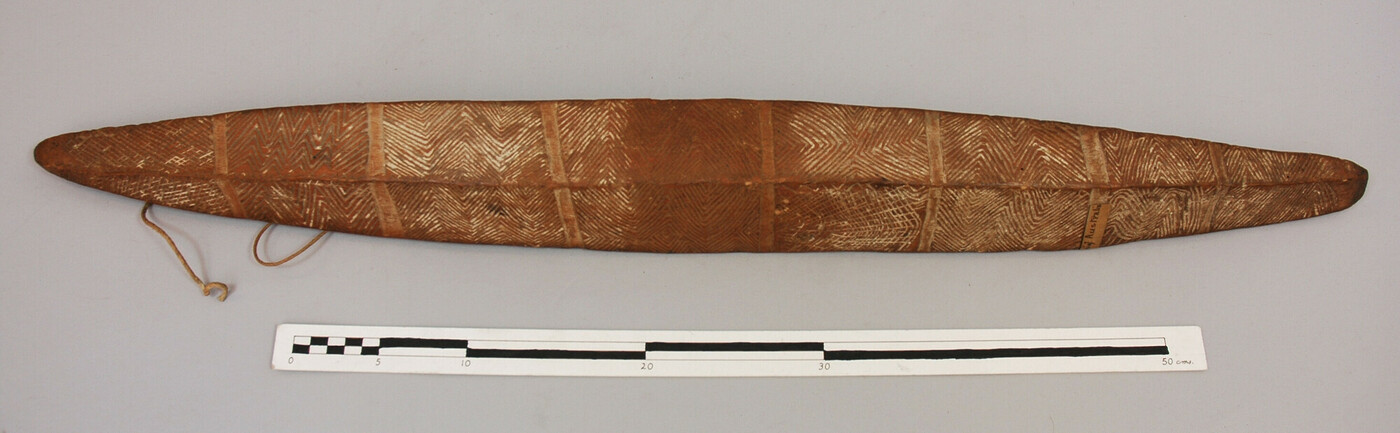 1930.78.3Parrying-shield with grip cut from the solid. Front carved with zig-zag pattern painted white with seven plain bands alternating between the design. [MJD 05/04/2013]1930.78.3
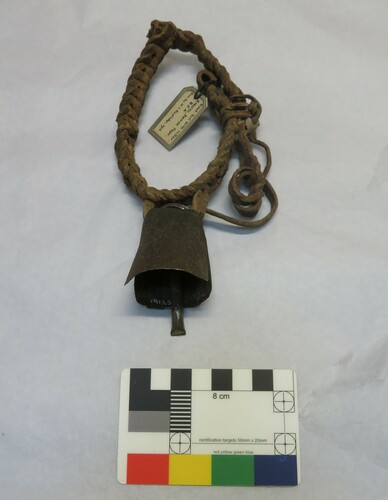 1913.5.61Clapper bell of iron, very rusty, made of a sheet of metal which has been folded. The sides have been left open and the iron clapper is suspended from a strip of iron bent to form a circle round the crown of the bell. The suspension cord, or collar, is of plaited leather. Collar broken. [HLR]1913.5.61
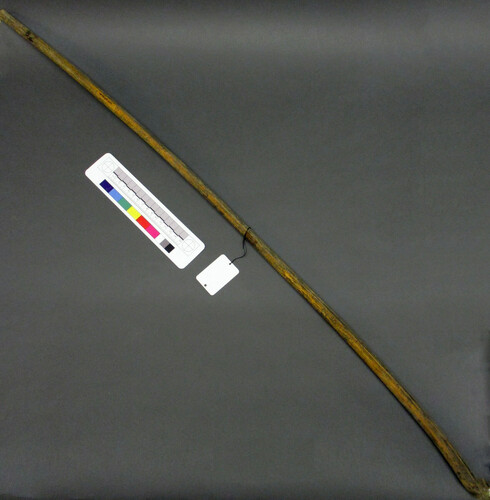 1978.20.236Gourd cleaner made from a long, slightly curved strip of wood, frayed at one end. [JC [OPS Move] 9/11/2016]1978.20.236
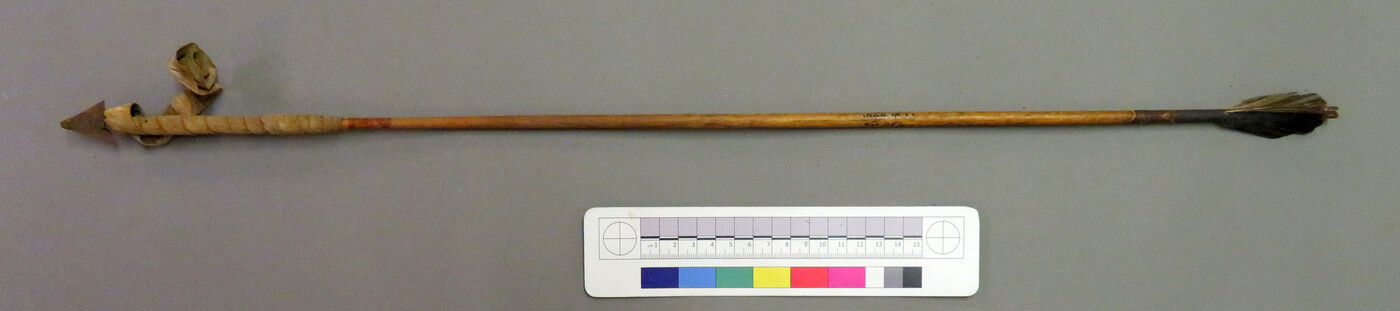 1944.10.1.6Poisoned arrow. See [1944.10.1 .1 - .10] for the associated components of this object. [BS [OPS move] 20/9/2017]1944.10.1.6
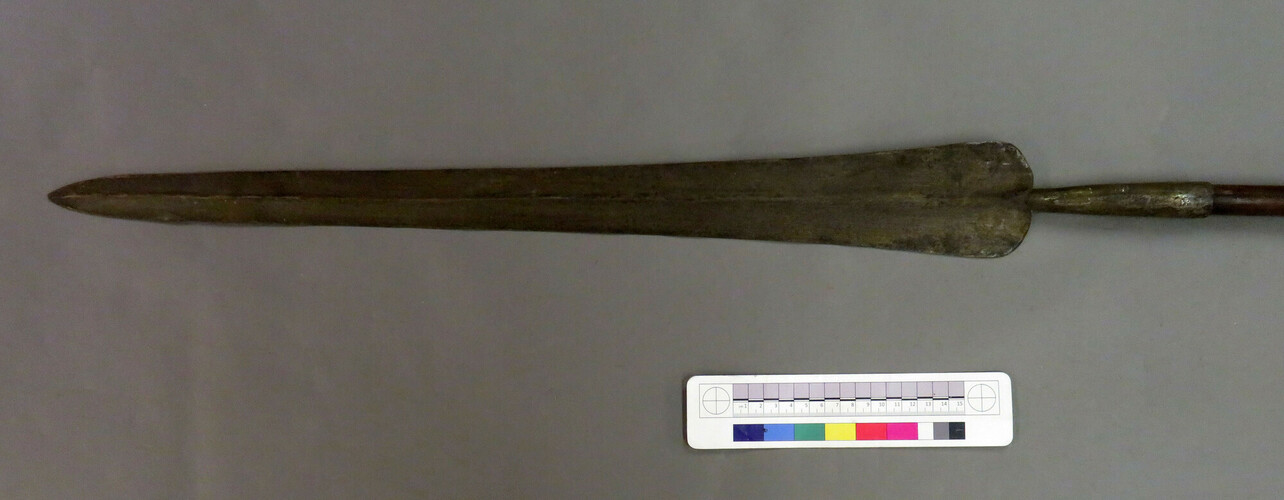 1903.61.5Spear with elongated, sub-triangular metal blade and butt spike, both socketed onto a wooden shaft. [JMC [OPS move] 28/8/2018]1903.61.5