
- Collection type
- Object
- Description
- Iron armlet with sharp spikes around the edge, worn by boys for fighting and wrestling [RTS 3/3/2004].
- Long description
- Armlet made from a single piece of iron with square section, hammered and bent into a loop with the ends not touching, some 28 mm apart. This have been cut at an angle. The upper surface has been worked with a chisel to form 45 sharp pointed spikes around its outer edge; each of these has been pulled away from the surface and angled downwards; some have also been slightly twisted. The inner surface, which rests against the skin, and the underside are both flat. The object is complete and intact; there is no obvious poison on the barbs. The length across the armlet is 76.8 mm with spikes, and 69 mm without, while the width across it is 66.3 mm with spikes, and 55 mm without. The width and thickness of the bar from which the armlet has been made is 3 mm, and it weighs 14.3 grams. The metal is currently a silvery gray colour (Pantone 422C) [RTS 4/3/2004].
- Geographical reference
- Cultural groups
- Nuer
- Date / Period
- Date made: Before 1931
- Date collected
- 1930 - 1931
- Acquisition information
- Donated: 1931
- Materials and processes
- Material Iron Metal, Process Forged (Metal), Process Hammered
- Dimensions
- Width: max 66.3 mm, Depth: max 3 mm, Length: max 76.8 mm, Weight 14.3 g
- Object numbers
- Accession number: 1931.66.34
- Research and responses
This object was probably collected during his first or second season of fieldwork amongst the Nuer, e.g.: in 1930 or 'the dry season' of 1931. In the former, he spent around three and a half months in Leek territory at Yahnyang and Pakur on the Bahr el Ghazal, in Lou territory at Muot Dit, and at Adok, amongst the Dok Nuer. In the latter, he spent five and a half months at Nasir, on the Nyanding River, and at Yakwat on the Sobat River (see E.E. Evans-Pritchard, 1940, The Nuer, and the map of Evans-Pritchard's fieldwork in D.H. Johnson, "Evans-Pritchard, the Nuer, and the Sudan Political Service", African Affairs 81 no. 323, p. 233).
Evans-Pritchard, writing in 1940, commented on the scarcity of iron amongst the Nuer and the high value consequently placed on objects made from it: 'Nuer have always been poor in iron objects ... Iron bells ... are rare and highly prized even at the present time, and in the old days iron rings and bracelets were important pieces of property' (E.E. Evans-Pritchard, 1940, The Nuer, p. 86).
Lindblom suggests that this type of fighting bracelet developed out of metal arm rings, and can be found among a number of African groups, including the Nuer, Dinka, Shilluk, Jibbeh, Bongo, Jur, Acholi, Madi, Latuka, Irenga, Jibbeh, Abukaya and Mittu. He illustrates an example similar to this one, said to come from the Mbum, in Cameroon (K.G. Lindblom, 1927, ‘Fighting-bracelets and Kindred Weapons in Africa’, Smärre Meddelanden, p. 7 and fig. 6). Although Evans-Pritchard associates this object with wrestling fights, and also with boys (see The Nuer, p. 151), in other groups they could be associated with men (the Lotuko), or women, who used them for both fighting and dance (the Moru; C. Spring, 1993, African Arms and Armour, p. 116) [RTS 26/2/2004].
In J. G Wood (1874) The Natural History of Man, Vol. 1 (London: Routledge) p.522, in a chapter about the Nuer, the author asserts: 'On the right wrist they carry an iron ring armed with projecting blades, very similar to that which is worn by the Latookas (Lotuko). Joctian, the chief of the Nuehr [sic] tribe, was asked by Sir. S. Baker what was the use of this weapon, and by way of answer he simply pointed to his wife's arms and back, which were covered in scars produced by this primitive wife-tamer. He seemed quite proud of these marks, and evidently considered them merely as ocular proofs that his wife was properly subservient to her husband.' [DCF Cutting Edge Research, HA 20/02/2008]
Search terms: Weapon, Sport, Ornament, Arm Ornament
Further items to explore
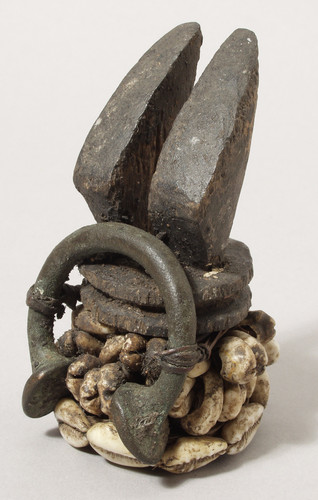 1916.45.110Conventionalized horned figure (horns and pedestal alone remaining); base covered with cowrie-shells and surmounted in front by a bronze 'manilla'.1916.45.110
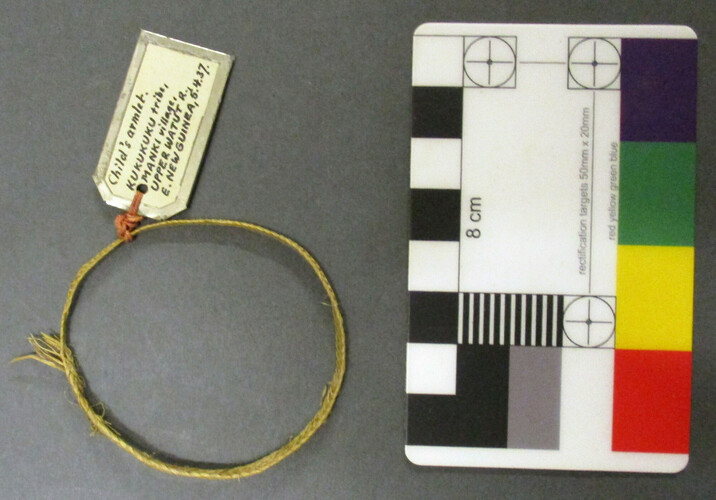 1938.36.641Armlet made from pandanus plant fibre. Used for children. Roughly round in shape and plaited with a chevron design. [ASh [OPS move] 14/11/2016]1938.36.641
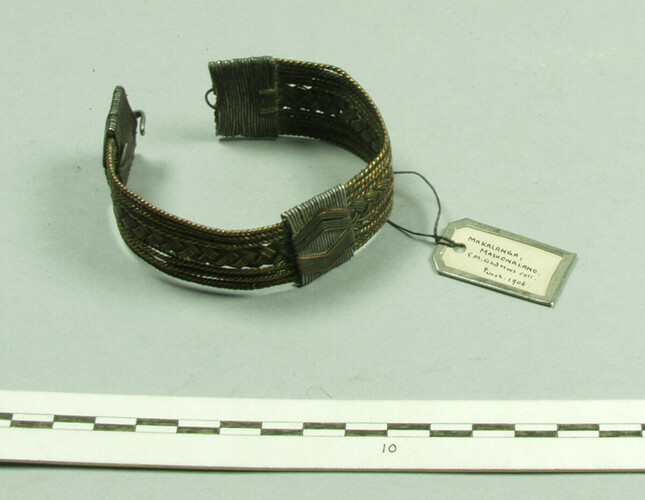 1906.78.24Metal arm ornament; elaborate band of copper, iron & brass metal wires plaited and twisted together. [EC 'DCF 2004-2006 What's Upstairs?' 12/10/2005]1906.78.24
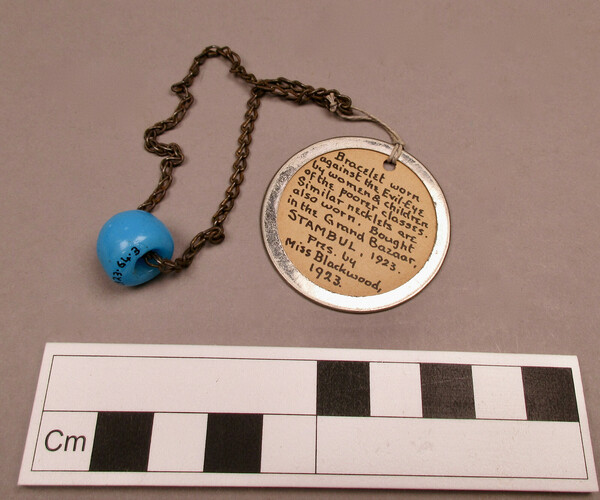 1923.64.3Metal chain bracelet with one blue glass bead.1923.64.3
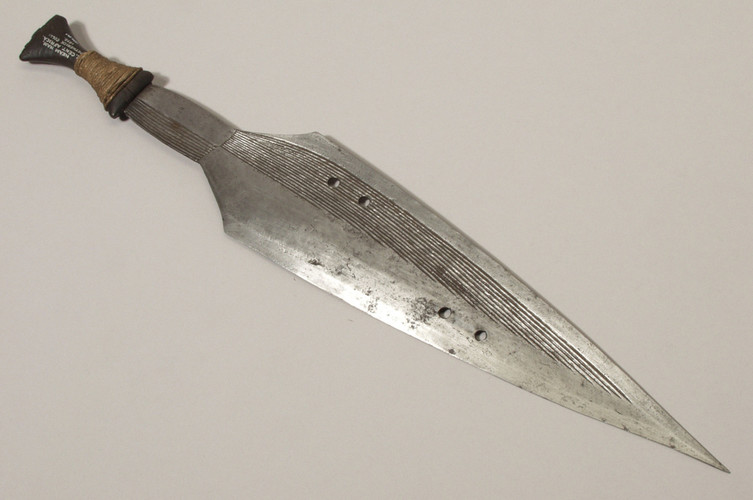 1884.34.1Knife with decoratively grooved and perforated two edged blade and small wooden handle bound with string. [SM 25/10/2007]1884.34.1
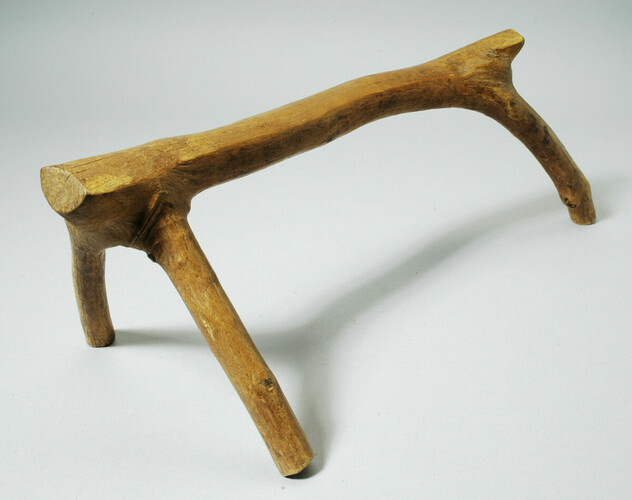 1979.20.161Wooden 3 legged stool, used by women [RTS 13/5/2005].1979.20.161
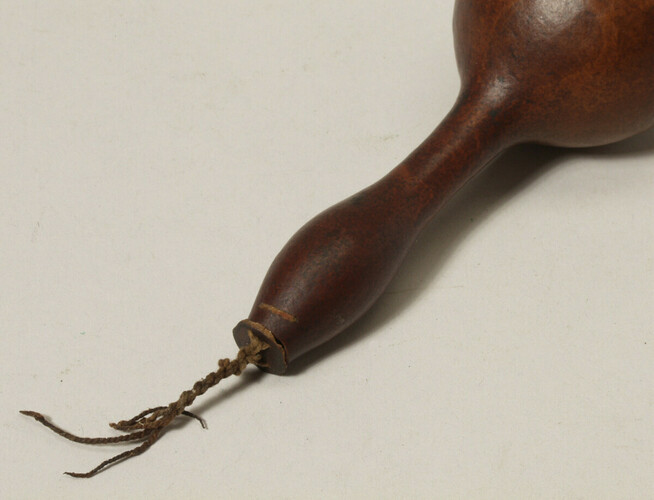 1936.10.76Small flask made from a gourd, with disc shaped lid attached to the neck with fibre cord; used for castor-oil or cosmetics [RTS 30/6/2004].1936.10.76
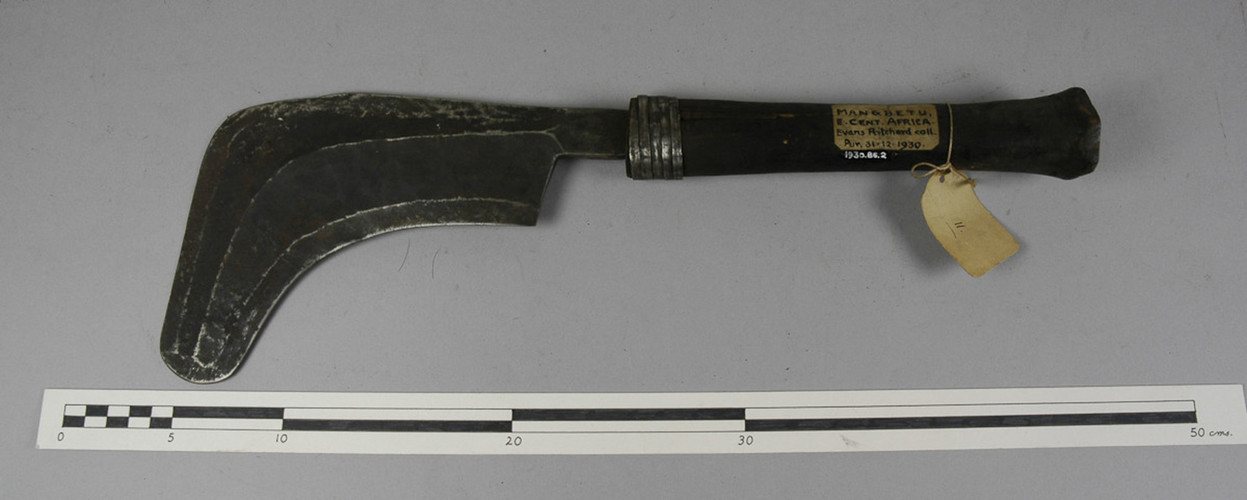 1930.86.2Knife with curved blade, visible tang and long wooden handle bound with a strip of iron at the join with the blade. [SM 07/06/2007]1930.86.2