
- Collection type
- Object
- Description
- Knife with decoratively grooved and perforated two edged blade and small wooden handle bound with string. [SM 25/10/2007]
- Long description
- Knife consisting of a short, dark brown, polished wooden handle with strongly concave sides (Pantone 440C), and a handle guard of similar width to the end; the handle is lentoid in section throughout. A piece of yellowish brown plant fibre string (Pantone 465C) has been bound around the handle just below the guard to form a grip, with the ends tucked underneath. This has a very greasy surface. The end of the handle guard has a long rectangular slot cut into it to receive the blade tang. This extends through the body of the handle, and out through the other end, where it has been hammered over back into the wood to secure it. On one side of this, two smaller metal tabs protrude from the wood, one of which has also been hammered over. There is a split in the wood on the other side, where another tab may once have existed. The hafting has not been entirely successful, as the handle is split down the centre of one side, and one arm of the guard has broken away. Above the handle, the iron blade is in better condition, currently a silver gray colour (Pantone 422C), and consists of a long, slightly convex sided rectangular tang, turning into the concave sided shoulders of the blade itself, which is broadest at the shoulders, then tapers to a sharp point at the other end. The blade has an ogee-shaped section, with the upper and lower concave surfaces covered with a series of incised grooves that follow the shape of the cutting edges on each side. These edges have been bevelled on the undecorated faces. The rectangular sectioned tang has similar grooving covering half the upper and half the lower surface - in each case, the side opposite the blade grooving. The blade is pierced by two groups of two holes, one just above the shoulder, and the other set on the opposite side, closer to the point. Total length of object 489 mm, length of handle 83.7 mm, width of handle end 38.8 mm, thickness of handle 13.9 mm, width of tang 32 mm, width of blade at shoulders 83.6 mm, maximum thickness of blade 1.7 mm, and thickness of blade at cutting edge 0.1 mm [RTS 19/3/2004].
- Geographical reference
- Cultural groups
- Zande
- Person
- Maker Unknown Maker
- Field collector John Petherick
- PRM source Augustus Henry Lane Fox Pitt Rivers founding collection
- Date / Period
- Date made: Possibly before 1858
- Date collected
- 1858
- Acquisition information
- Donated: 1884
- Materials and processes
- Material Wood Plant, Material Iron Metal, Material Plant Fibre, Material String, Process Forged (Metal), Process Grooved, Process Carved, Process Perforated, Process Bound
- Dimensions
- Length: max 489 mm, Width: max 38.8 mm handle, Depth 13.9 mm handle, Width: max 83.6 mm blade
- Object numbers
- Accession number: 1884.34.1
- Research and responses
Petherick lived in Khartoum from 1853-1858, mounting several trading expeditions into the Sudanese interior during this period. He entered Zande territory for the first time on 24th February 1858, while on his fifth such expedition, visiting the villages of Mundo, Kangamboo and Baranj. This object was probably collected during this trip, as Petherick did not venture into this region again. This would seem to be confirmed by the appearance of this knife in Petherick's sketchbook, which seems to have been compiled by 1861 (Wellcome library MS 5789, p. 14, although under the erroneous general caption of 'Dor'). His collection was shipped back to England in 1859 [RTS 11/10/2004].
Further items to explore
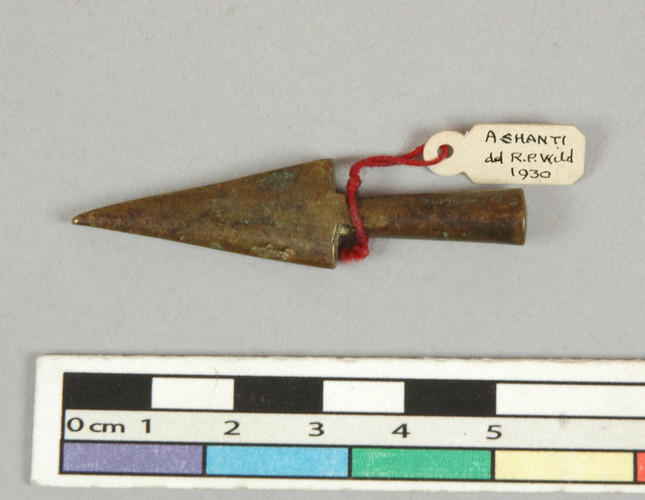 1930.44.397Copper alloy weight for weighing gold, representing a dagger. [MJD 01/06/2011]1930.44.397
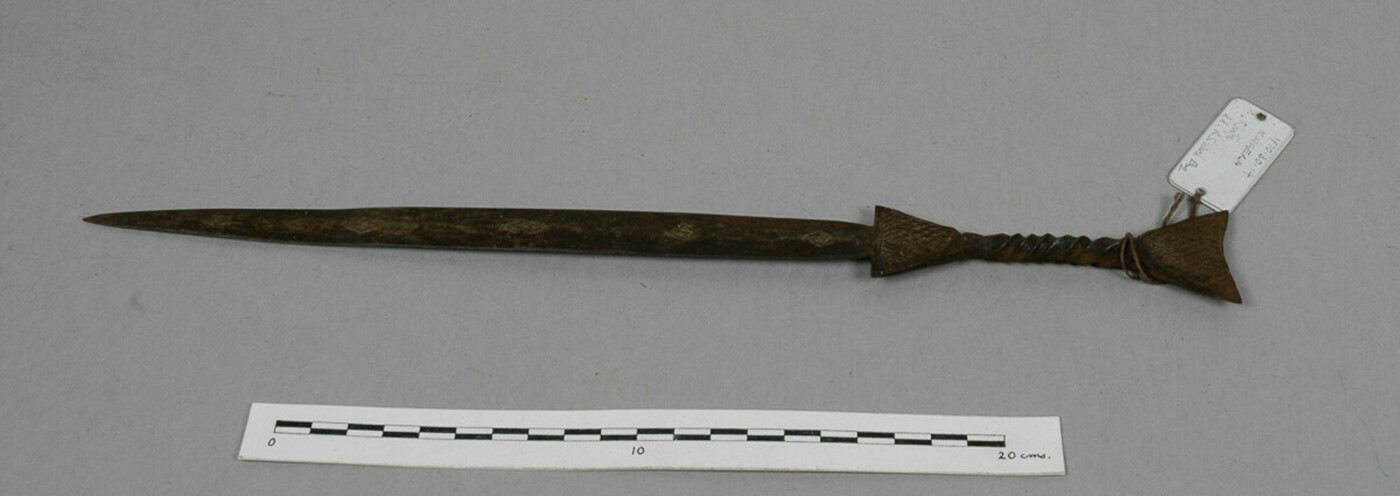 1970.30.14Iron knife: two-edged blade with incised lozenges on both sides. Forged in one piece with handle, which has cross-hatched triangles above and below a twisted grip. [LM 04/07/2007]1970.30.14
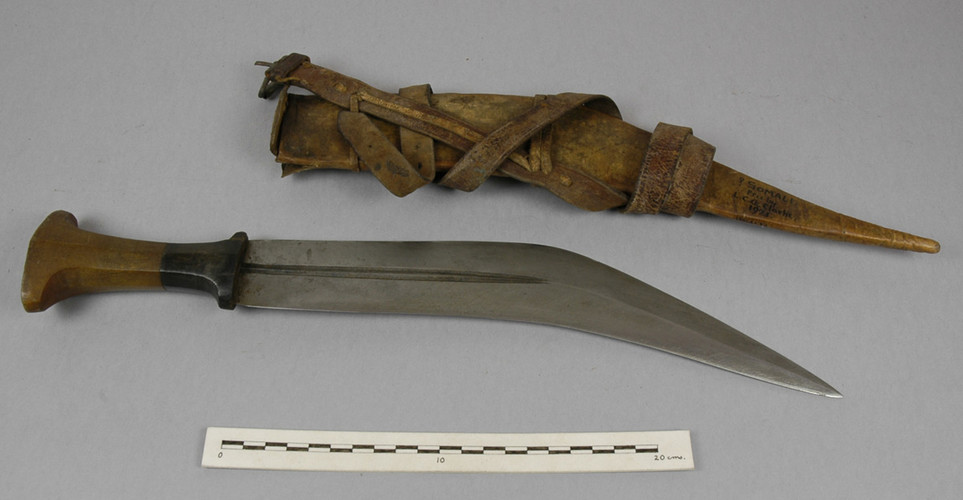 1921.53.9.1Dagger with pointed and curved blade and rhinoceros horn hilt [.1], with hide sheath [.2] [SM 20/06/2007]1921.53.9.1
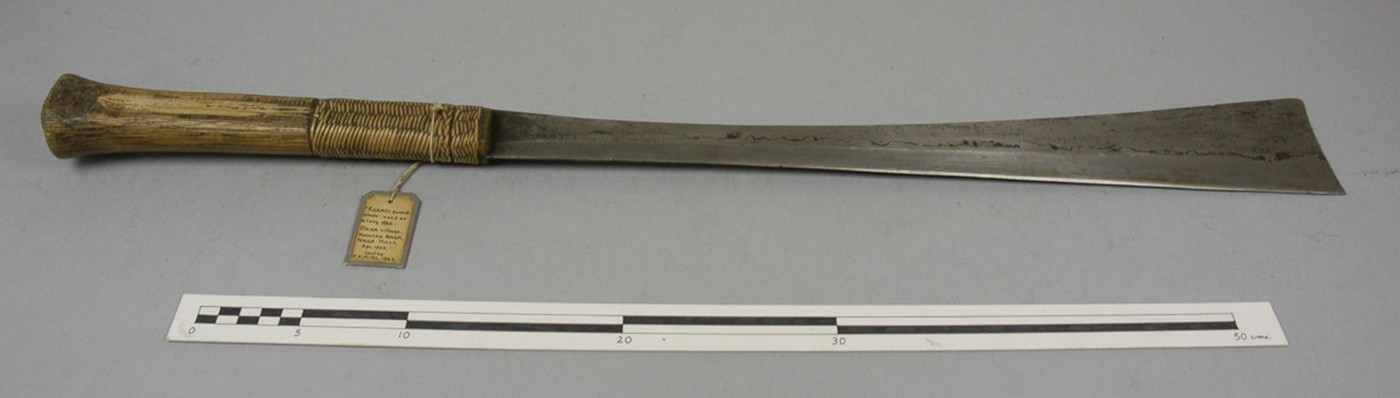 1928.69.395Dao with long, single edged blade and bamboo handle with cane bound grip. [SM 07/09/2007]1928.69.395
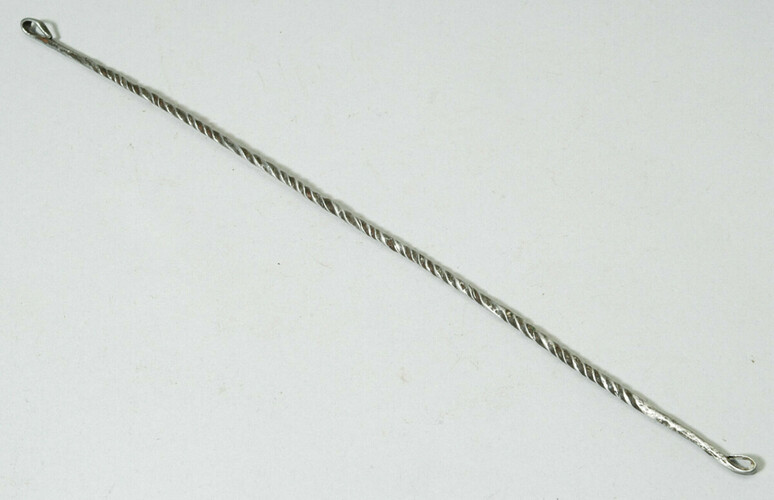 1940.7.020Unfinished leg ornament, consisting of an iron rod with twisted body and looped ends, not yet bent into anklet shape; type used by women [RTS 28/2/2005].1940.7.020
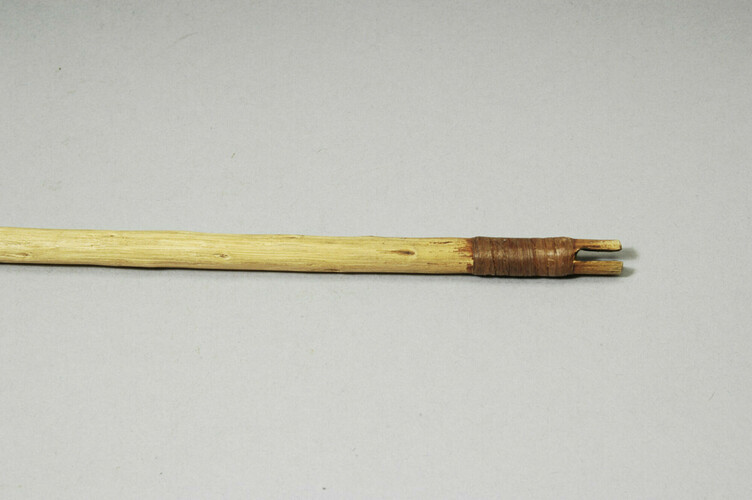 1979.20.21Triangular iron arrowhead with long tang, set in a wooden shaft with bound and nocked end [RTS 3/6/2005].1979.20.21
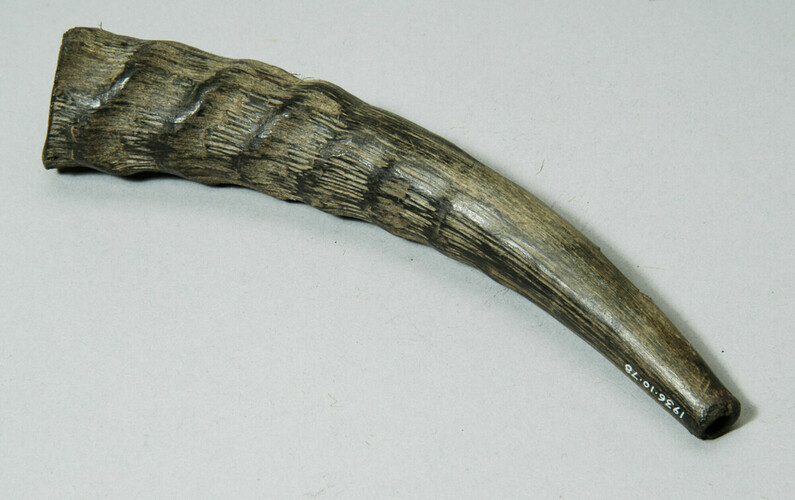 1936.10.78Small side-blown trumpet of antelope horn with embouchure and large thumbhole cut into convex face, and smaller finger-hole at proximal end, used for hunting, signalling or escorting persons of high rank [RTS 2/12/2004].1936.10.78
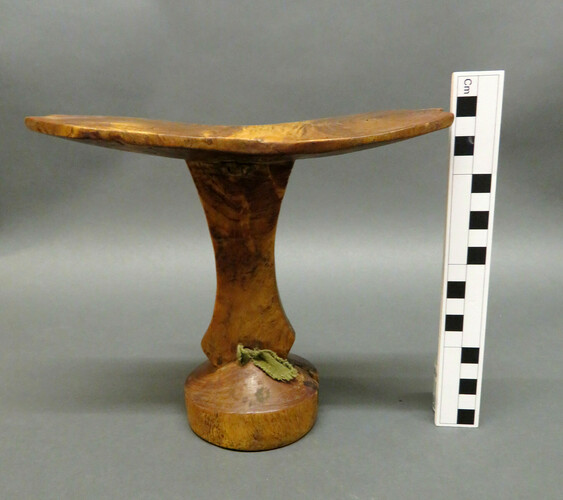 1979.20.201Wooden headrest with notched, bilobed seat on a flat pedestal with thick concave disc base and plaited hide carrying loop, mended with a scrap of textile [RTS 11/4/2005]1979.20.201