
- Collection type
- Object
- Description
- Spear with ebony point set into a long wooden shaft, with the junction covered by a hide sheath and the butt decorated with animal hair [RTS 11/1/2005].
- Long description
- Spear consisting of an narrow, elongated ebony point, with varicoloured dark brown (Pantone 4625C) and reddish brown surface (Pantone 7526C), roughly circular in section. The base of this rests against the top of a long, narrow shaft made from reddish brown wood (Pantone 470C), slightly oval in section. This tapers to a pointed butt. Both wooden parts have been polished. The junction between the two has been covered with a cylindrical sheath, cut from a section of animal's tail with the hair removed; this was shrunken in place over the base of the point and top of the shaft to keep these parts together, and the surface lightly tooled using at least 2 types of implement, one producing a lentoid shaped mark, the other with a much smaller leading edge that has produced a finer, rope-like design that may be intended to be decorative. The sheath is a dark brown colour (Pantone 412C), and is complete except for a lentoid-shaped cut in the surface. At the base of the spear, a cut section of animal tail with long dark brown hair has been fitted over the shaft as a decorative tassel (Pantone black 6C). The spear is complete and intact, with some possibly modern paint flecks on the shaft. It has a weight of 748.2 grams and a total length of 2368 mm, of which the point measures 645 mm to the top of the sheath, and the sheath itself is 130 mm long and 31 mm in diameter. The point has a maximum diameter of 29.5 mm, while the shaft is 21.6 mm wide [RTS 11/1/2005].
- Geographical reference
- Cultural groups
- Nuer
- Date / Period
- Date made: Before 1931
- Date collected
- 1930 - 1931
- Acquisition information
- Donated: 1931
- Materials and processes
- Material Ebony Wood Plant, Material Animal Hide Skin, Material Animal Hair, Material Animal Tail, Process Carved, Process Polished, Process Covered, Process Socketed, Process Tooled
- Dimensions
- Diameter: max 29.5 mm point, Diameter 21.6 mm shaft, Length 2368 mm, Length 645 mm point, Length 130 mm sheath, Weight 748.2 g
- Object numbers
- Accession number: 1931.66.6
- Research and responses
For an essay on the variety and cultural significance of spears in South Sudan, particularly among the Dinka and Nuer, see ‘“Spears” that are not Spears’, by Jok Madut Jok, in Pieces of a Nation: South Sudanese Heritage and Museum Collections, edited by Zoe Cormack and Cherry Leonardi (Leiden: Sidestone Press, 2021), pp. 110–114.
This object was probably collected during Evans-Pritchard's first or second season of fieldwork amongst the Nuer, e.g.: in 1930 or 'the dry season' of 1931. In the former, he spent around three and a half months in Leek territory at Yahnyang and Pakur on the Bahr el Ghazal, in Lou territory at Muot Dit, and at Adok, amongst the Dok Nuer. In the latter, he spent five and a half months at Nasir, on the Nyanding River, and at Yakwat on the Sobat River (see E.E. Evans-Pritchard, 1940, The Nuer, and the map of Evans-Pritchard's fieldwork in D.H. Johnson, "Evans-Pritchard, the Nuer, and the Sudan Political Service", African Affairs 81 no. 323, p. 233).
Evans-Pritchard, writing in 1940, said of the Nuer: 'Till recently they possessed very few iron spears, cherished as heirlooms, but used instead the straightened horns of antelope and buck, ebony wood, and the rib-bones of giraffe, all of which are still used to-day, though almost entirely in dances ...’ (E.E. Evans-Pritchard, 1940, The Nuer, p. 86). Howell gives the Nuer term for these spears as giit, while the iron headed spears were known as mur. He states that the giit were regarded 'with considerable amusement' by younger Nuer, but that a few were retained as they were 'considered particularly effective in war, and the Nuer hope they may one day be able to use them ... although it required greater skill and strength to inflict a wound with a giit, the wounds once inflicted are more severe'. He goes on to describe the method of hafting them: 'The giit ... is fixed at the joint with an unsewn leather collar made from the tail skin of an ox. This is soaked and stretched round the haft, where it shrinks as it dries'. (P.P. Howell, 1947, "On the Value of Iron Among the Nuer", Man 47, p. 132-3).
The term 'White Nile' is now used to denote an administrative district immediately south of Khartoum, bordered by the districts of Northern and Southern Kordofan to the west, El Gezira and Sennar to the East, and Upper Nile to the south. However this term has been used more loosely in the past to refer to the Bahr el Abiad and Bahr el Jebel rivers or the areas around them.
Note that 1931.66.6-9 and 1936.10.2 are all made in a very similar fashion, with shafts carved from the same type of wood, which has a very distinctive grain to it. 4 of these spears have hard wood heads (in this case, probably ebony) and 1 has a head of straightened antelope horn [RTS 3/1/2005].
Search terms: Weapon, Spear, Spear-head
Further items to explore
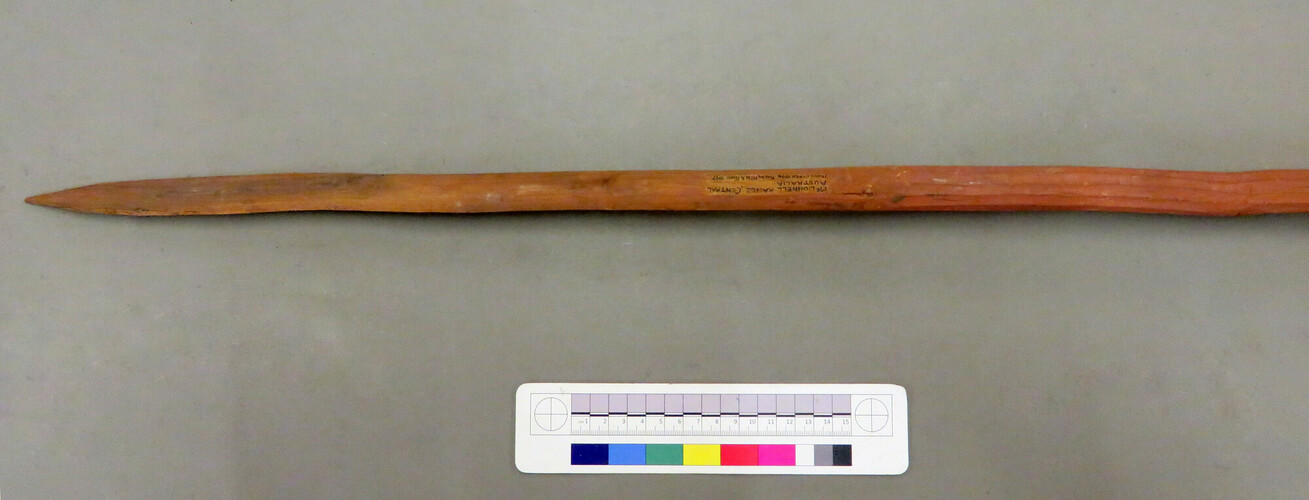 1897.36.11Spear made from a single piece of wood. The head is flattened and carved with a point. Painted with a red pigment. [AB [OPS move] 14/8/2018]1897.36.11
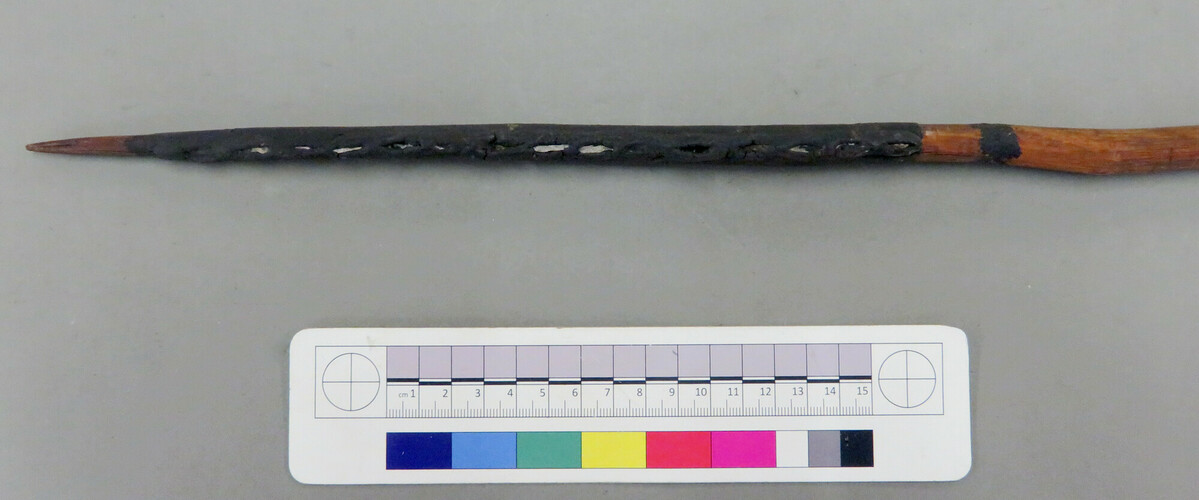 1884.19.16Spear that once had small splinters of quartz set in gum at one end of a naturally shaped wooden shaft. The glass points have all broken off, but parts are still embedded in the resin. [MOBB [OPS move] 13/8/2018]1884.19.16
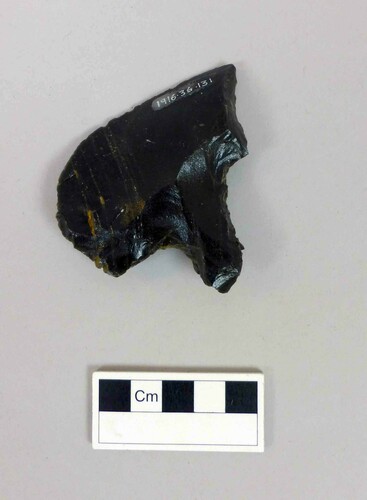 1916.36.131Obsidian spear-head.1916.36.131
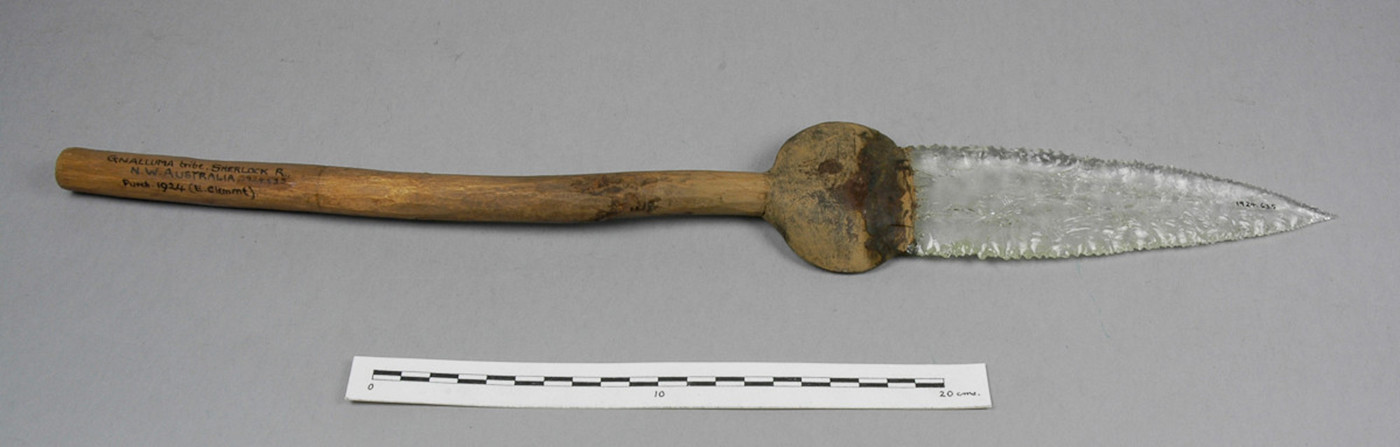 1924.63.5Large glass spear head set in gum and with a short wooden haft.1924.63.5
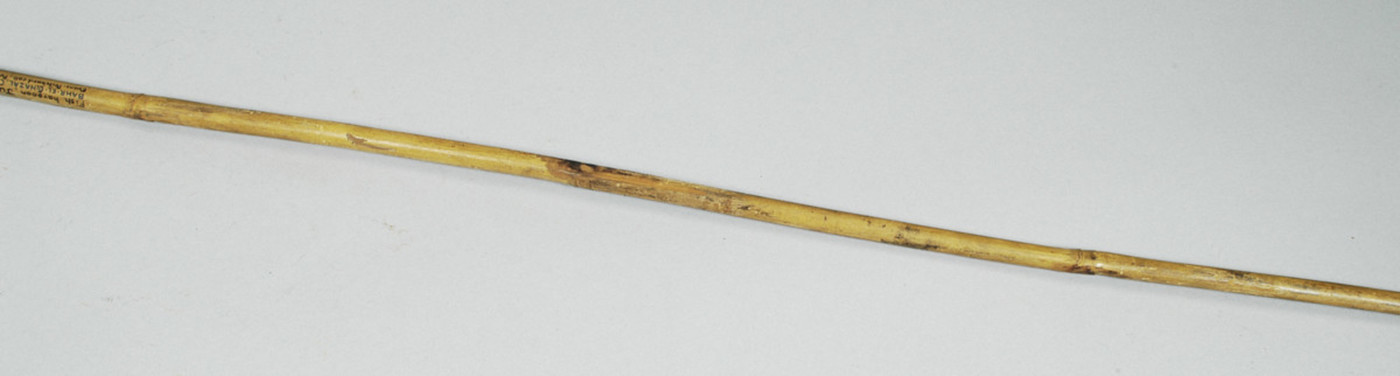 1930.86.23Fishing harpoon with long, slender shaft with twisted fibre cord attached, broken at the end where the detachable head would have been found [RTS 13/12/2004].1930.86.23
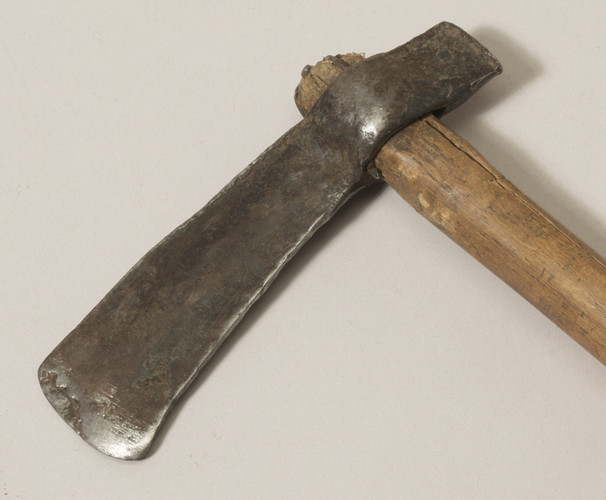 1934.8.39Axe with socketed iron blade, wooden handle and a brass 12 gauge cartridge reused as a ferrule on the end [RTS 29/6/2004].1934.8.39
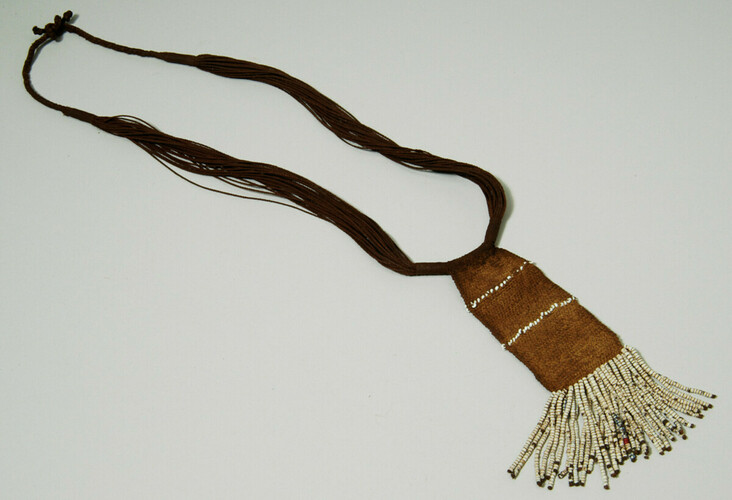 1934.8.95Multistranded carrying loop, hung with a narrow rectangular woven fibre tobacco bag with beaded base fringe [RTS 29/9/2004].1934.8.95
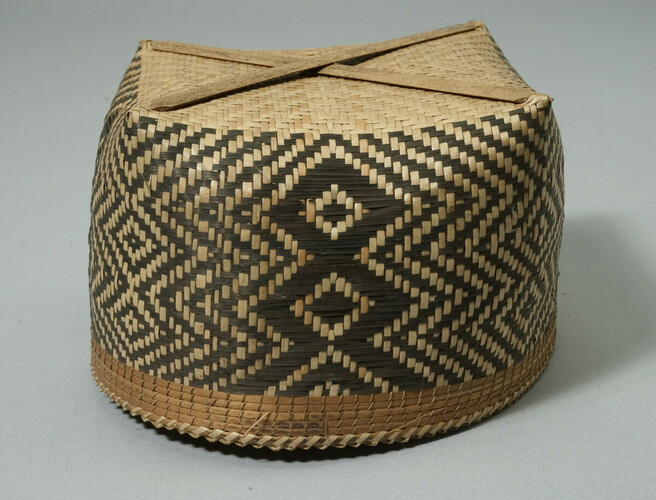 1942.8.88Brimless basketry hat with square crown strengthened with cane cross-pieces, and a circular 3 colour body with vertical zigzag designs [RTS 2/2/2005].1942.8.88