
- Collection type
- Object
- Description
- Brimless basketry hat with square crown strengthened with cane cross-pieces, and a circular 3 colour body with vertical zigzag designs [RTS 2/2/2005].
- Long description
- Basketry hat consisting of a flat, square crown woven from strips of narrow yellow coloured palm fibre in a twill pattern of over 2, under 2. This has been stiffened across the top with 2 narrow strips of cane that cross over one another at the centre, with sharpened ends that are pushed through the hat surface at each corner to hold the strips in place. These have a slightly convex upper surface and flat cut underside, and are a yellowish brown colour (Pantone 7509C). The body of the hat becomes increasingly circular below the crown, where the twill weave continues over most of the surface, varying with a looser weave at the centre of each side; this is made up of vertical and horizontal strips arranged in a geometric design in which the natural yellow of the fibre (Pantone 7509C) is contrasted with strips that have been dyed a darker brown (Pantone Black 7C). The latter provides the background colour, over which a series o f vertical zigzags, lozenges and triangles are picked out in yellow. The design consists of a vertical column at the centre of each side, composed of 2 stacked lozenges over a group of concentric triangles, their points facing upwards. On 2 adjacent sides, these lozenges have a yellow dot at their centre. These columns are flanked by closely spaced parallel zigzags, which meet at each corner to frame groups of additional lozenges, this time with the triangular motif at the top of the column, point facing down. Each lozenge has smaller lozenges stacked inside, rather than being filled with solid blocks of colour. Just above the base the weaving pattern changes yet again to form a neat circular band around the lower edge of the hat. This is made up of vertical elements on the inside face in yellow, and 6 rows of orangey brown fibre strips running horizontally around the outside face (Pantone 730C). These two layers have been sewn together using a very fine, orangey fibre thread. The bottom row has been finished with short strips of yellow palm fibre, plaited obliquely around the edge with the loose ends of each strip turning upwards at an angle on the inside face. The hat is complete, with very minor damage to the surface in the form of broken fibre sections; both interior and exterior have been well finished. It has a weight of 20.1 grams and is 102 mm high. The crown measures 110 by 122 mm along the sides, while the lower edge has an internal diameter of 160 mm. The cross pieces are 8 mm wide, and the narrow fibre strips that make up the body are 2 mm wide [RTS 3/2/2005].
- Geographical reference
- Northern Bahr el Ghazal Western Bahr el Ghazal Warab Lakes Western Equatoria
- Cultural groups
- Zande
- Person
- Field collector Robert Grenville Gayer-Anderson
- PRM source Robert Grenville Gayer-Anderson
- PRM source Henry Balfour
- Date / Period
- Date made: Before 1917
- Date collected
- By 1917
- Acquisition information
- Donated: 1917
- Materials and processes
- Material Palm Fibre Plant, Material Cane Plant, Process Basketry, Process Twill Woven, Process Woven, Process Carved, Process Stitched, Process Decorated, Process Dyed
- Dimensions
- Width 110 mm crown, Length 122 mm crown, Height 102 mm, Diameter 160 mm internal, Weight 20.1 g
- Object numbers
- Accession number: 1942.8.88
- Research and responses
At the time this object was collected, the Bahr el Ghazal province was much larger than it is today, extending from roughly the Bahr el Arab all the way to the border with the Belgian Congo; this area is now divided into the districts of Western Bahr el Ghazal, Northern Bahr el Ghazal, and parts of Warab, El Buheyrat and Western Equatoria.
Evans-Pritchard discusses Zande hats in his book, The Azande; his comments presumably refer to the situation back in 1926-1930, when he conducted his fieldwork amongst this group: “In sketches by early travellers Azande men are shown wearing straw hats. Schweinfurth describes them as using ‘a cylindrical hat without any brim, square at the top and always ornamented with a waving plume of feathers; the hat is fastened on by large hair-pins, made either of iron, copper, or ivory, and tipped with crescents, tridents, knobs and various other devices [In the Heart of Africa II, p. 8; This type of hat is depicted being worn at the top of the head, see vol. I p. 439]. The same kind of cylindrical, brimless straw hat was still worn in 1906 when Gezer visited the Azande of Tembura’s kingdom and of the old kingdom of Ezo. This is the old Mbomu hat, called kutuku, and some of the older men still keep to a version of it. The hat which is today fashionable, and has been for some years, is of much the same shape but with two new features: black lateral patterns, often wavy lines, and a broad brim, the first being copied from the Mangbetu and the second from the earliest Europeans” (Evans-Pritchard 1971, pp 70-71). Brock stated that Zande hats were worn from greenish white split grass, being round at the base and square at the top, with patterns around the top in blackened grass. He suggests that the presence or absence of brims was according to fashion, which also determined how the hat's feathers were arranged (R.G.C. Brock, Sudan Notes and Records 1, 1918, 254).
Note that this hat does not show signs of having had any feathers attached, but does have the Mangbetu-inspired colouring without the then fashionable brim. Almost identical hats were collected by Evans-Pritchard in the late 1920's to 1930 period, and described as being used by boys in circumcision rites (see the entries for 1930.86.32-33 and also 1948.2.162-4), the only difference in style being in the presence of a straw fringe around the lower edge. Descriptions of the circumcision process made by Brock suggest that special grass hats were worn as part of the associated dances, in a period that is probably contemporary with when this particular example was collected, so it may well belong to this class (R.G.C. Brock 1918, "Some Notes of the Zande Tribe as Found in the Meridi District", Sudan Notes and Records 1, 251-2). However we don't know if this same period corresponded to a time when brimless hats were once again in fashion for Zande men as well [RTS 4/2/2005].
Search terms: Clothing Headgear, Basketry, Hat, Headgear
Further items to explore
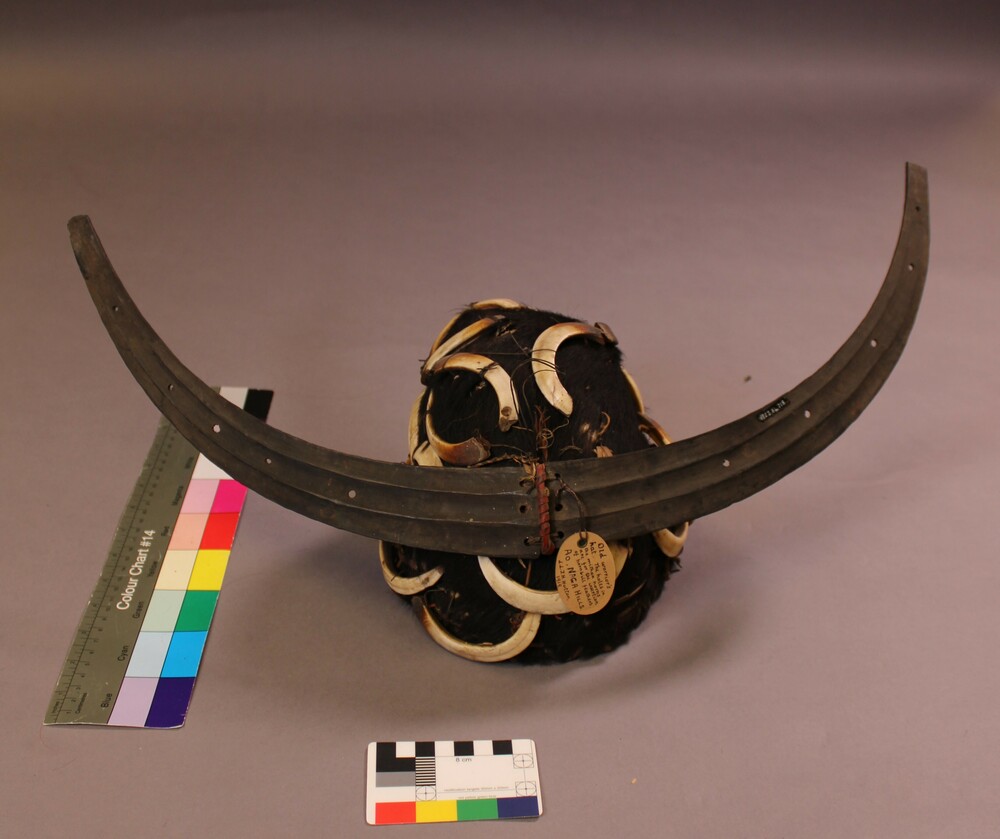 1923.84.718Hat of open cane work covered with skin with hair on, ?bear, numerous boars tusks are fastened on this forming circles.1923.84.718
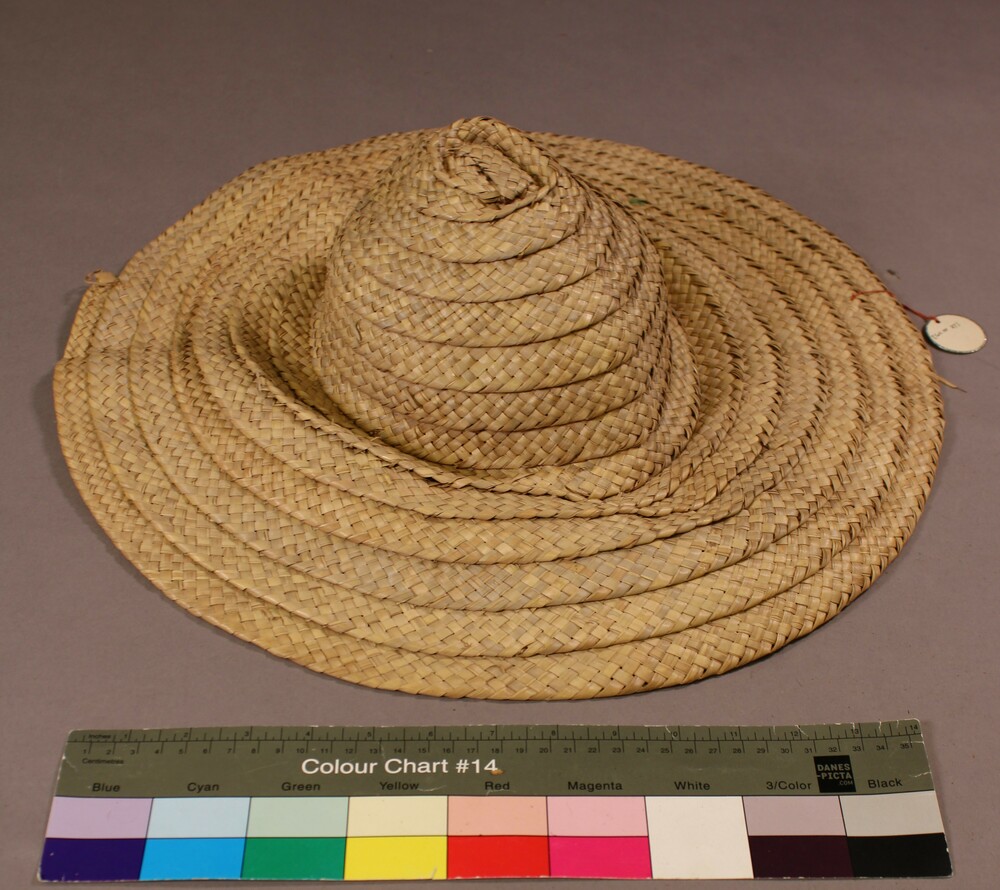 1942.13.947Soft wide rimmed hat.1942.13.947
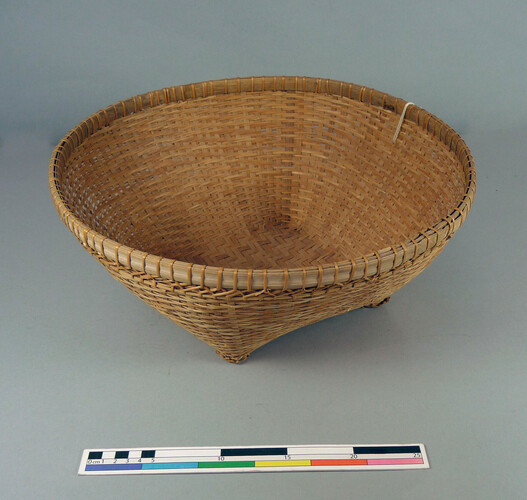 2011.42.10Basket worn as a hat or used as a basket in rice fields, made from bamboo, 2/2 twill woven base and sides. [FC 20/09/2011]2011.42.10
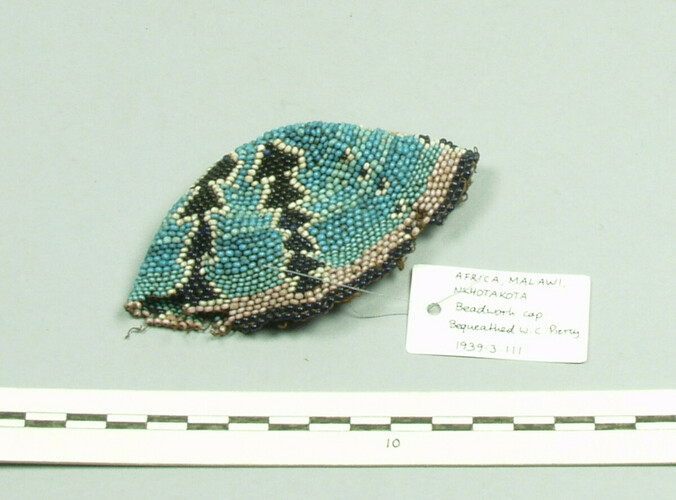 1939.3.111Model beadwork cap, light blue with rows of black and pink triangles. [El.B 'DCF 2004-2006 What's Upstairs?' 8/7/2005]1939.3.111