
- Collection type
- Object
- Description
- Paddle club, Culacula, with broad carved blade.
- Long description
- Paddle club, Culacula, with broad carved blade. The club is made from a dark wood and has a broad blade with raised strengthening bar across base of blade. The blade has been carved at the lower end on both sides with a series of serrated zigzag teeth. [FB 05/03/2012]
- Person
- Field collector Henry Nottidge Moseley
- Field collector HMS Challenger
- PRM source Amabel Nevill Sollas
- Date / Period
- Date made: Before 11/08/1874
- Date collected
- 25 July to 11 August 1874
- Acquisition information
- Donated: 1915
- Materials and processes
- Material Wood Plant, Process Carved
- Dimensions
- Length: max 1170 mm, Width: max 225 mm
- Object numbers
- Accession number: 1915.25.87
- Research and responses
Paddle club. See F Clunie 'Fijian Weapons and Warfare' 1977 Fiji Museum, Suva, Bulletin of the Fiji Museum no.2 and R. Ewins, Fijian Artefacts: Tasmanian Museum and Art Gallery collection' Australia 1982: p.44 "Paddle Clubs - Culacula and Kinikini. These broad-bladed clubs were of two types, war clubs and ceremonial. They are said to be possibly Tongan or Samoan in origin but some of the oldest surviving Fijian clubs are of the Culacula type. The war-clubs were used like broadswords, the sharp edges on the very hard wood being sufficient to snap, if not cut through bone. The ornately decorated ceremonial clubs were often excessively broad, almost fan-like, and were exclusive to chiefs and priests. They were handed down as heirlooms, and long use has often worn the carved designs almost away from the handle., even the blades in some cases. They were probably seldom used to strike with, being so thin in the blade that they would break easily - though not, it must be admitted, before doing very considerable damage..." [FB 14/02/2012]
Search terms: Weapon, Ritual and Ceremonial, Club, Ceremonial Object
Further items to explore
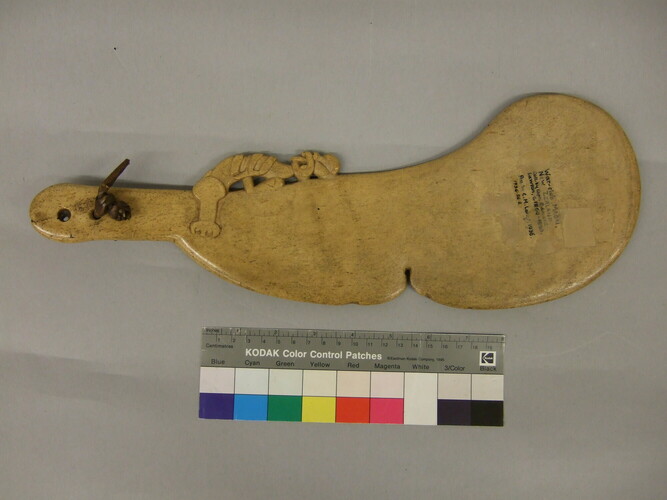 1936.26.2Carved bone club.1936.26.2
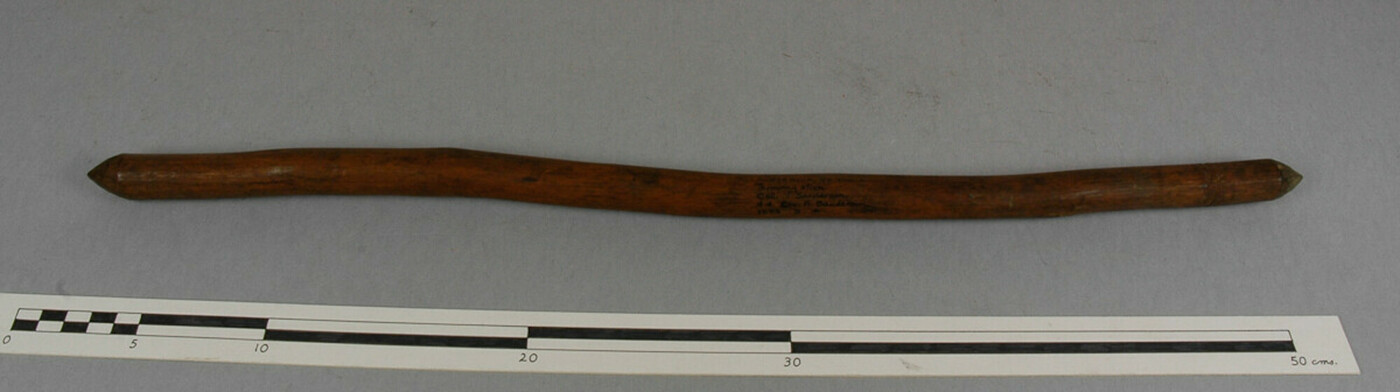 1952.3.4Wooden throwing stick with pointed ends and transverse notches near one end. [LM 07/08/2007]1952.3.4
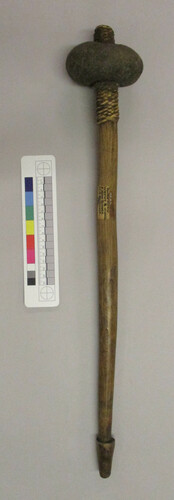 1938.36.404Club with elliptical, perforated stone head. The wooden shaft is bound at the distal end with strips of plaited plant fibre. Between the stone head and the shaft is a possibly resinous substance. The handle tapers towards the base where there is an expanded conical butt. [JC [OPS Move] 05/08/2016]1938.36.404
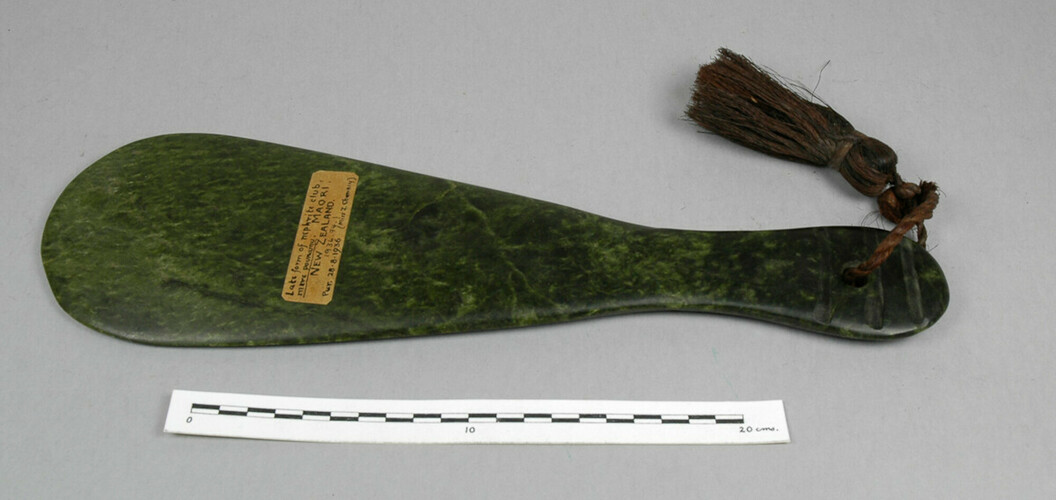 1936.74.1Club of nephrite, shaped like a shoe-horn, the handle perforated and with three grooves on each side. With a tassel of plant fibre. [El.B 20/08/2007]1936.74.1
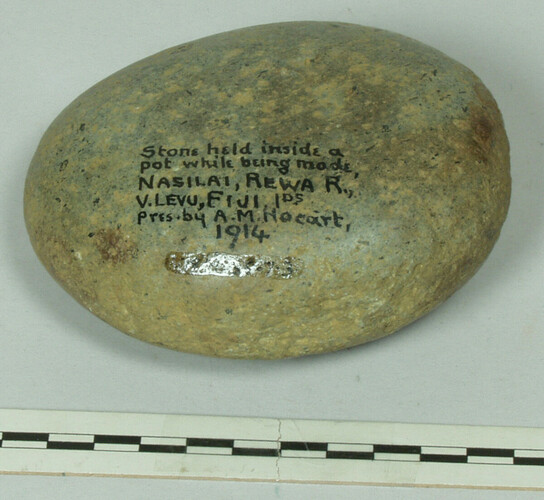 1914.56.7.3Stone.1914.56.7.3
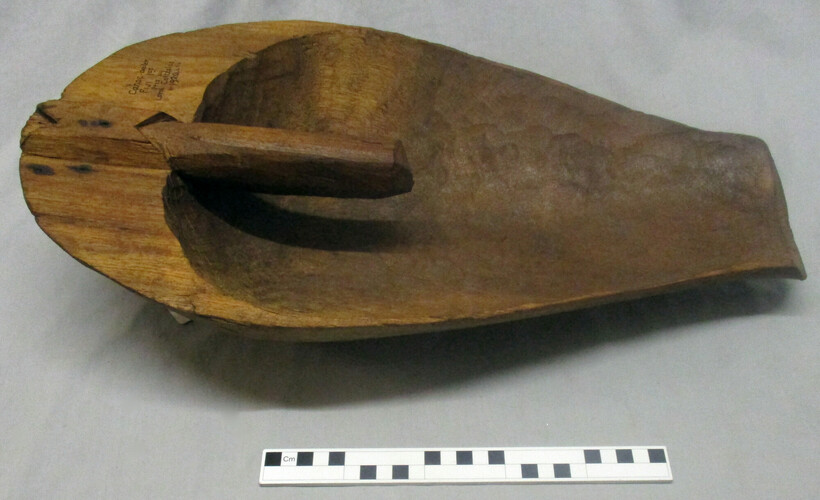 1920.43.6Large wooden canoe-bailer of dark wood with a handle carved over the basin of the bailer. There is a small metal ring attached to the bottom of the bailer. Some perforations to the wood near to the handle. [LKG 13/05/2010]1920.43.6
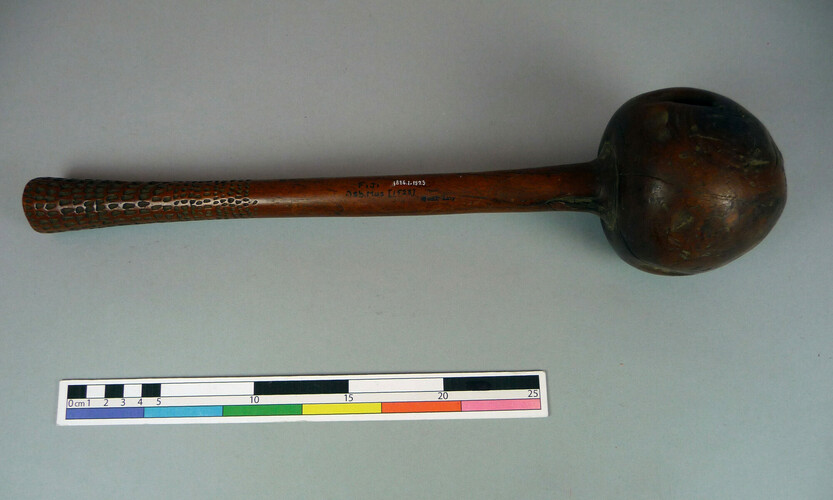 1886.1.1523Throwing club with plain ball head. [FC 02/08/2011]1886.1.1523
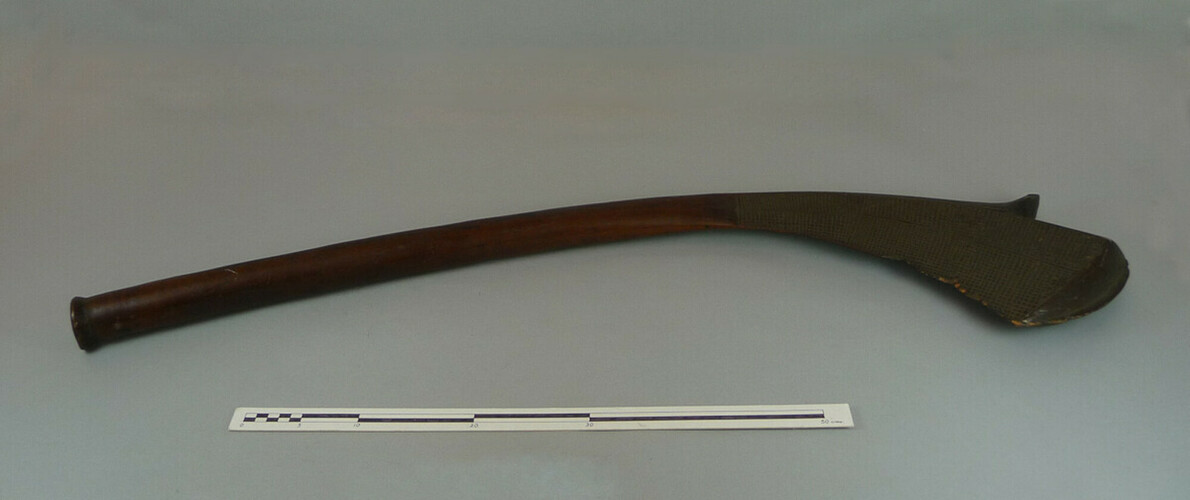 1966.1.223Wooden club with broad flattened blade and pronounced spur, (Sali) [FC 08/08/2011]1966.1.223