
- Collection type
- Object
- Description
- Carved bone club.
- Geographical reference
- Cultural groups
- Māori
- Date / Period
- Date made: Before 1840
- Date collected
- 1819 - 1840
- Acquisition information
- Donated: 1936
- Materials and processes
- Material Whale Bone Animal, Material Animal Skin, Process Carved
- Dimensions
- Length: max 401 mm, Width: max 135 mm
- Object numbers
- Accession number: 1936.26.2
- Research and responses
Janet West of the Scott Polar Research Institute, Cambridge, has identified Edward Lawson as being active in the South Seas from 1819-1840, rather than 1800-1820 as given in the original accession record (see her letter in RDF/ Collectors/Lawson). [JC 1996 1 30]
- Associated publications
- Referred to (with 1936.26.1 and 1936.26.9) on page 154 of Tracking Travelling Taonga: A Narrative Review of How Maori Items Got to London from 1798, to Salem in 1802, 1807 and 1812, and Elsewhere up to 1840, by Rhys Richards (Paremata: Paremata Press, 2015): ‘In the Pitt Rivers Museum in Oxford there are three Maori items “collected by Edward Lawson in the period 1819 to 1840”, or on another card “from 1800 to 1820”. A carved wooden waka huia is item 1936.26.1.1.2 [sic; the object 1936.26.1 is in two parts 1936.26.1.1 and 1936.26.1.2], item 1936.26.2 is a whalebone club with poor balance and item 1936,26,9 is an end-blown flute, koauau, with three stops.’ Richards discusses (pages 154/155) the possible sources: ‘Captain Lawson was at the Bay of Islands in the London whaleship Eliza Francis from 18 to 27 March 1833; and 5 November to 23 December 1834; and from 5 April to 15 May 1834; and again in the London whaleship Bombay from 21 December 1836. (Richards and Chisholm 1992 [Bay of Islands Shipping Arrivals and Departures, 18031840, by R. Richards and J. Chisholm (Wellington: Paremata Press, unpaginated)]. He had ample time to collect those items. Edward Lawson was the owner of several whaleships and donated [to the PRM] a large collection of scrimshaw and articles made from whale bone and whale ivory. Another shipping list gives Andrew Lawson as the master of the Magnet in 1827 and Edward Lawson as the master of the Seringapatam in 1815 and the Thames in 1816. (Jones 1986 [Ships Employed in the South Seas Trade, 17751861, by A. G. E. Jones (Canberra: Roebuck Society, 1986)]: 240.) However, a court case of mutiny on the Eliza Francis gives Captain Lawson the personal name of George. (Sydney Gazette 1 January 1833.) Whether Edward, / Andrew and George were fathers and sons, or otherwise related, is not yet known, but the Maori items clearly came to the Pitt Rivers Museum via the Lawson whaling family.’ [JC 12 5 2017]
Further items to explore
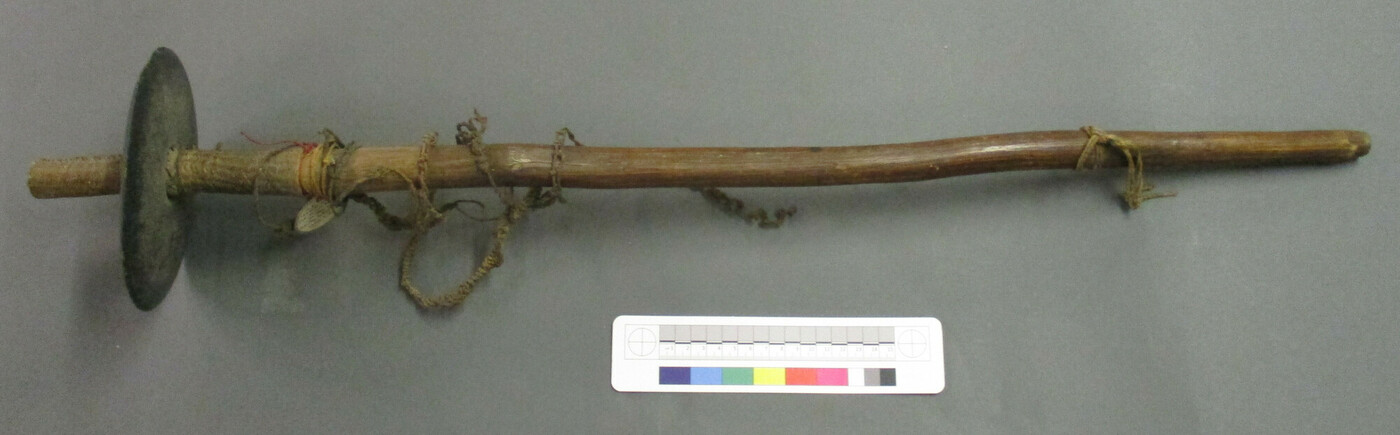 1960.3.61Wood club with cylindrical shaft and perforated, discoidal stone head. [JC [OPS Move] 14/09/2016]1960.3.61
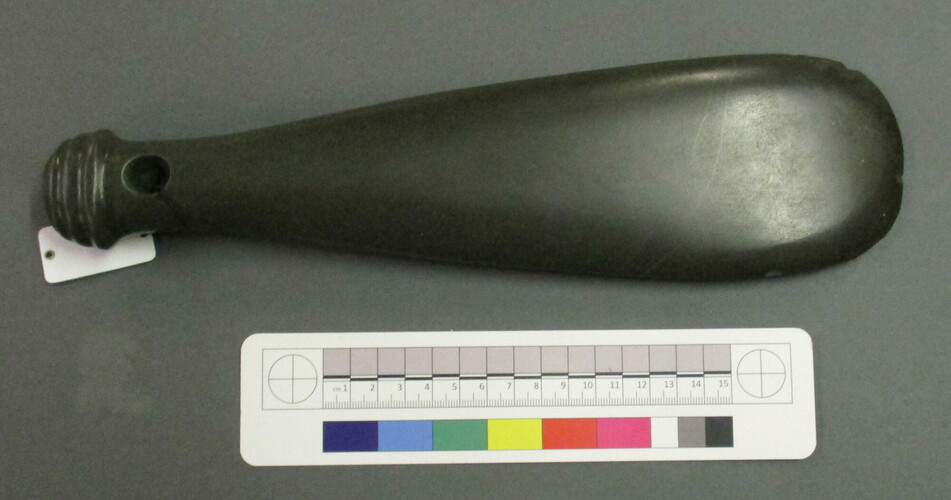 1969.34.526Spatulate stone club with convex blade tip and tapered handle with perforated and ridge carved butt. [BS [OPS Move] 14/09/2016]1969.34.526
 1891.50.22Club with flattened cylindrical head set perpendicular to the shaft on the curved edge. [BS [OPS Move] 13/10/2016]1891.50.22
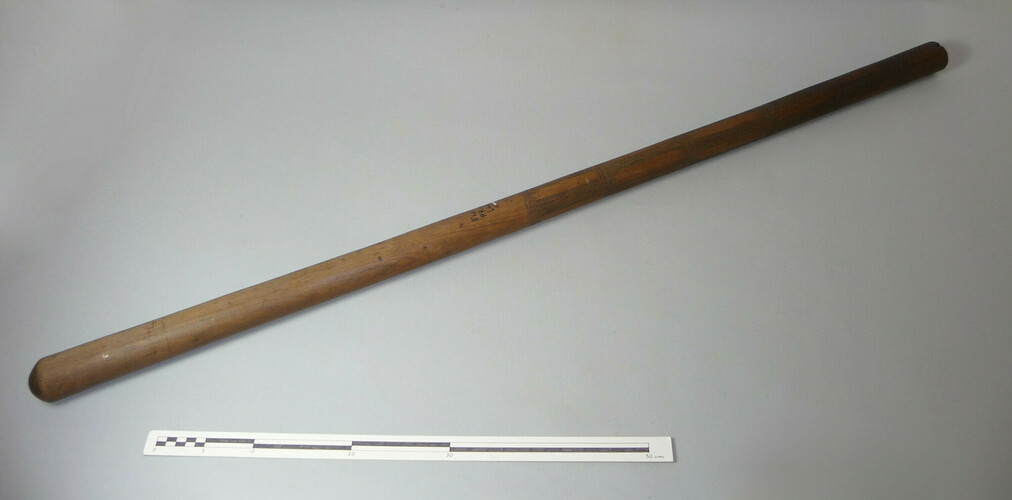 1884.12.111Wooden cylindrical club with carving. [FB 17/10/2011]1884.12.111
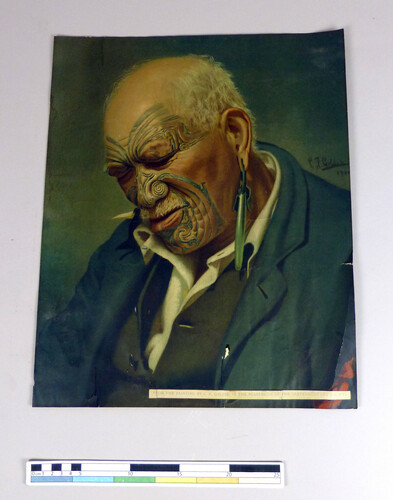 2017.28.1Print of the painting 'A Hot Day: Wiremu Pātara Te Tuhi (Ngāti Mahuta)' by Charles Frederick Goldie.2017.28.1
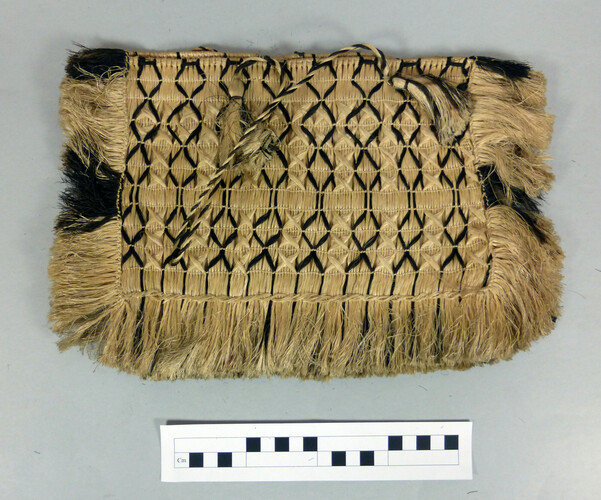 1923.87.174Bag of New Zealand flax Phormium tenax fibre in crossed-warp twining, part of the warp being dyed black. Fringed at sides and base. Twisted handles of black and natural phormium ending in tassels.1923.87.174
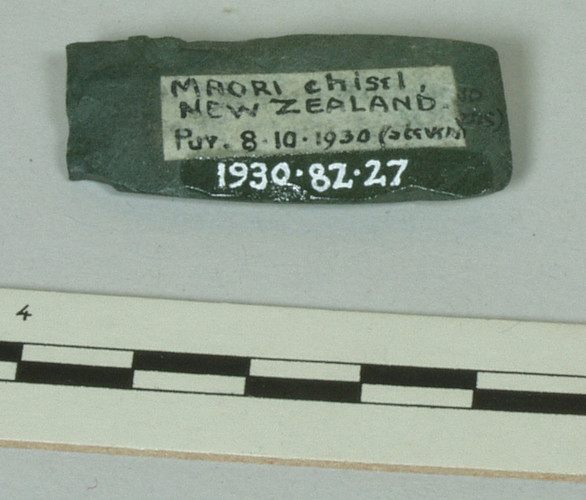 1930.82.27Small ground stone chisel of dark stone [?green].1930.82.27
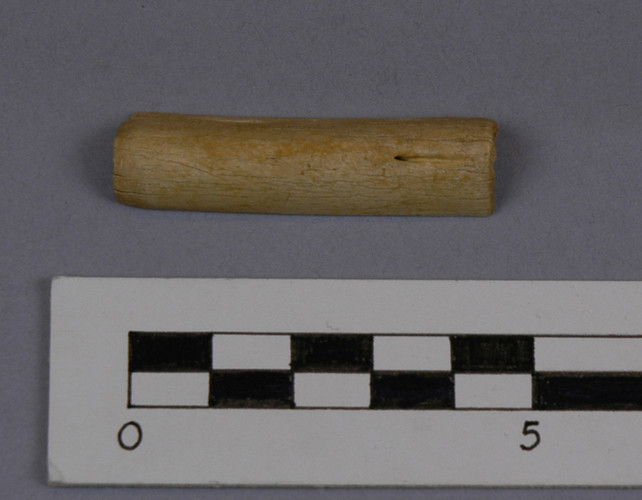 1930.82.74Half of a small bone cylinder, possibly a toggle. The bone is cut at either end. [SM 12/02/2008]1930.82.74