- Collection type
- Object
- Description
- Trophy head; the skull of a warrior attached to a long loop of cane.
- Long description
- Human skull of a warrior. There are thirteen teeth present. A length of cane has been inserted through a perforation in the top of the cranium, with another length of cane threaded through and looped around the jaw bone.
- Cultural groups
- Phom Naga
- Date / Period
- Date made: Before 1915
- Date collected
- By 1915
- Acquisition information
- Donated: 1915
- Materials and processes
- Material Human Bone, Material Human Tooth, Material Pigment, Material Cane Plant, Process Looped, Process Stained
- Dimensions
- Width: max 105 mm, Length: max 210 mm, Height: max 510 mm including cane
- Object numbers
- Accession number: 1923.84.159
- Research and responses
The accession book entry for this remain states that it is the skull of a renowned warrior named Yankai of Niengching village (Chagyik tribe) who was killed by Kaolem, a Chang Naga of Yangiemdi village, who kept the skull as a trophy, and gave it to J.H. Hutton when he settled in a village within the British frontier.
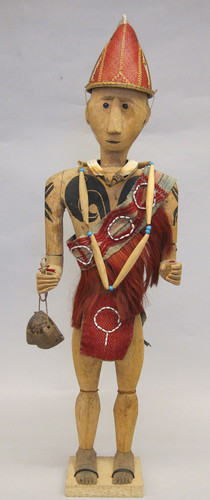
Donated to the PRM by Hutton at a later date are models of a Chang warrior and a Chang woman said to be made by Kaolum of Hukpong (see 1923.84.690 & 1923.84.691). The warrior was named by him Yankai (of Niengching village), ‘the name of a noted warrior whose head he took’. Although two different village names are given (Yangiemdi and Hukpong), it seems probable that Kaolem/Kaolum are the same person.
A number of photographs of Kaolem/Kaolum are also part of the PRM collection. Taken by Hutton between 1914 and 1923, they depict at least four different views of him in warrior dress. In the notes accompanying these photographs he is identified as ‘Kaolum of Hukpang’ and as being a Phom Naga (See 1998.327.3.241, 1998.327.3.242.1, 1998.327.3.242.2 and 1998.327.3.443).
In his tour diaries Hutton writes that “Chagyik” is a term applied by Chang Naga to a sub-tribe of the Konyak Naga people.
There is confusion in the records about whether Kaolum/Kaolem was a Chang or Phom Naga, and also about whether he was from Yangiemdi or Hukpong. In other documentation from Hutton, J.P. Mills, and Henry Balfour, Yangiemdi is variously spelled Yonyemdi, Yongemdi and Yongyemdi, and has been tentatively matched to the modern-day village of Yaongyimti in Mokokchung district. In the entry for a hoe donated by Henry Balfour (1928.35.15), Yongyemdi is noted as “a Chang village with Phom admixture”. Hukpong (now Hukpang in Longleng district) is a Phom Naga village. If Kaolum/Kaolem are the same person it is possible that he was both Phom and Chang Naga and may have had associations with both villages.
Following consultations with Naga elders in June 2025 (see research note below), Niengching has been identified as Yangching, a Phom Naga village, and Kaolum of Hukpang village has been identified as a Phom Naga.
[JMC 08/04/2025; JMC 26/06/2025]
During a visit of Naga elders and tribal leaders in June 2025, members of the delegation identified misspellings of village names and provided updated tribal affiliations for objects and ancestors associated with certain villages. In consultations with Mr Ngongba Tange Thamlong Phom, Vice President of the Phom Peoples’ Organization, and A. Peihwang Wangsa of the Konyak Union, the following information was confirmed: ‘Niengching’ village, named in the primary documentation, corresponds with the modern place-name ‘Yangching’, a Phom Naga village in Longleng District, Nagaland. Kaolum of Hukpang village was also identified as Phom Naga rather than Chang Naga. It was agreed that ‘Yangching’ would be added to the region field and that the cultural group for the ancestor would be changed from Konyak/Chang/Phom uncertain to 'Phom Naga'. [JMC 26/06/2025]
Search terms: Physical Anthropology, Death, Headhunting, Skull, Trophy Head