
- Collection type
- Object
- Description
- Sword [.1] with plaited and bound brass wire hilt and carved sheath [.2] with brass wire mountings. [SM 26/04/2007]
- Long description
- Sword [.1] with plaited and bound brass wire hilt and carved sheath [.2] with brass wire mountings. The sword has a double edged blade. One half of the blade is recessed and a dark colour, possibly from a pigment? This occurs on each side of the blade. The hilt is decoratively bound with brass wire and has a small pommel, which is also bound. The sheath is made of two pieces of wood. The back is lighter and has no carved decoration. The front is a very dark wood and is carved along its length with a geometric design. It also has a carved projection with a hole for attaching a loop or belt to. The sheath has a carved tip which projects forward. It is bound with three bands of brass wire. The lower section of the sheath is also bound with a larger band of wire with the same decorative detailing as the hilt of the sword. [SM 26/04/2007]
- Geographical reference
- Cultural groups
- Shona
- Date / Period
- Date made: Before 1905
- Date collected
- By 1905
- Acquisition information
- Donated: 1905
- Materials and processes
- Material Iron Metal, Material Wood Plant, Material Brass Metal, Material Metal Wire, Material Pigment, Process Forged (Metal), Process Carved, Process Bound, Process Plaited, Process Decorated
- Dimensions
- Width: max 42 mm sword, Length: max 785 mm sword, Length: max 625 mm sheath, Width: max 48 mm sheath
- Object numbers
- Accession number: 1905.45.1.1 Accession number: 1905.45.1.2
- Research and responses
The following notes are drawn from research compiled by Andy Mills as part of the DCF Cutting Edge Project 2006-2007. This is a ceremonial Mashona sword, termed a bakatwa, displayed with its carved ebony sheath (hara) (see African Arms & Armour by C. Spring, published 1988 by British Museum Press. p.134). The ceremonial bakatwa is distinguished from more utilitarian Shona blades (banga) due to its double-edged form, and the presence of intricate brass wire interlace decoration (see AK-47s for the Ancestors by W. J. Dewey, in ‘Journal of Religion in Africa’. Vol. 24. Fasc.4. Published in 1994. pp.360-1). Such Shona knives also bear the stepped ogee section I discussed for the Kuba Ikul above. Dewey (ibid.) has written a highly informative article on these artefacts, which combine utilitarian functions with prestige value and a strong religious importance within traditional Shona religious practice.
In historical times, all Shona men carried a knife or sword of some form, for use in self-defence and hunting. However, Dewey remarks that the traditional carrying of bakatwa dwindled under the influence of Christian missionaries and Government drives to prevent men travelling armed during the civil unrest of the 1970s, although they have enjoyed a considerable renaissance in recent years, as symbols of Zimbabwean independence and traditional cultural identity, and have proliferated (Dewey 1994 p.359). He discusses, for example, the recent construction of bakatwa which are forged to resemble AK-47s, with the blade sheathed inside the gun’s barrel.
Bakatwa were and are passed down from generation to generation in a lineage, and were traditionally used in religious rituals to symbolise the presence of the ancestors who had previously owned them, and addressed as a surrogate for the ancestors. This link between the ancestors and bakatwa also meant that n’angas (diviner-healers) and svikiros (spirit-mediums) carried bakatwa as the insignia of their special status. Certain Shona men were believed to be under the spiritual influence of deceased hunters, known as shave spirits – and such men also often carried bakatwa as a symbol of this hunter-spirit affiliation. [SM 16/06/2008]
Further items to explore
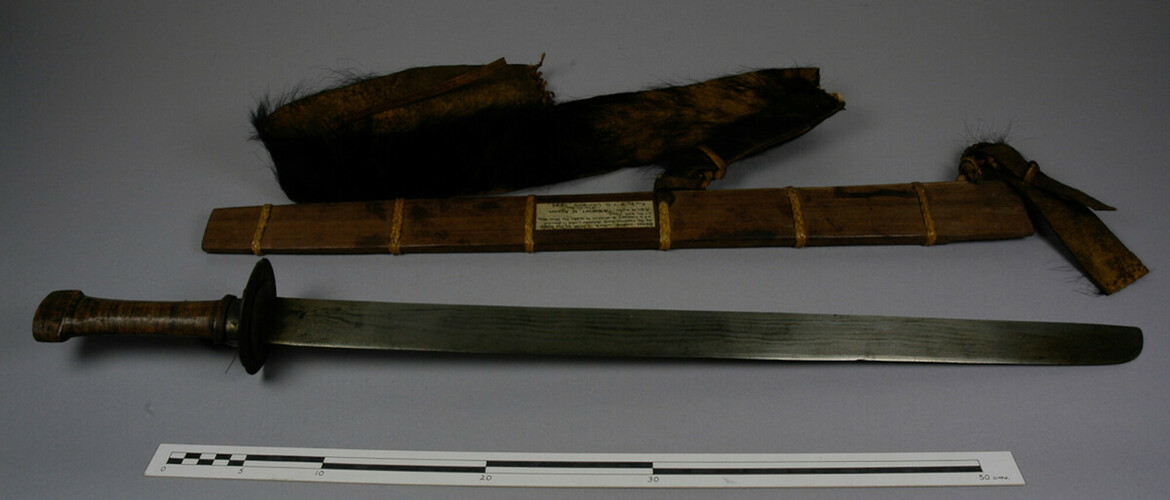 1936.36.94.1Short sword [.1] with loose brass discs on hilt. Wooden scabbard [.2] open on one side with a strap, which is broken, of animal hide with patches of dark fur. [ZM 29/3/2004]1936.36.94.1
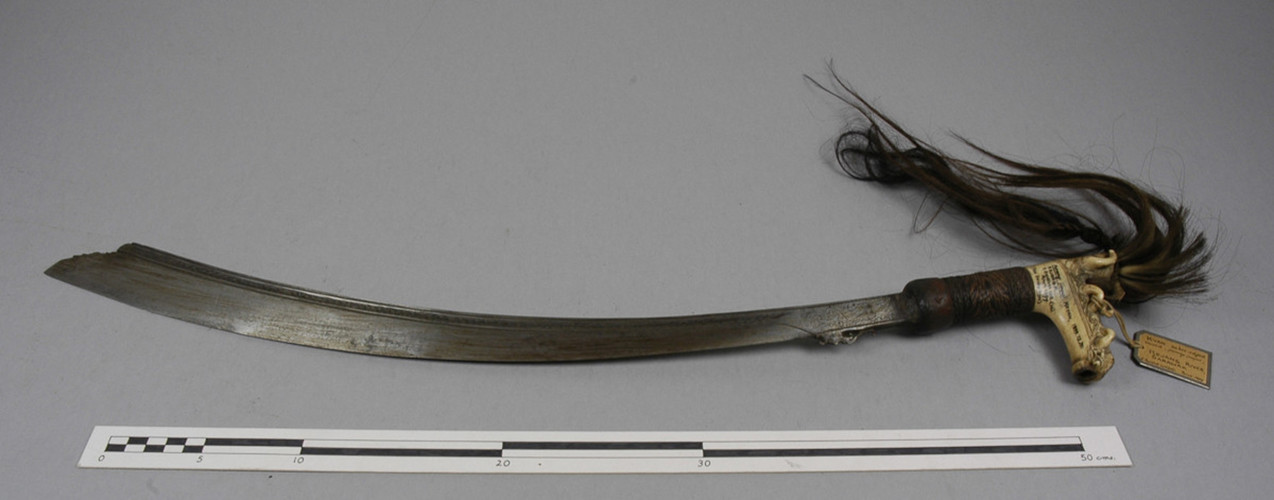 1899.72.29.1Sword [.1] with curved, decorated blade and carved ivory or antler hilt with dyed hair tassels. [Sheath 1899.72.29 .2] [SM 06/09/2007]1899.72.29.1
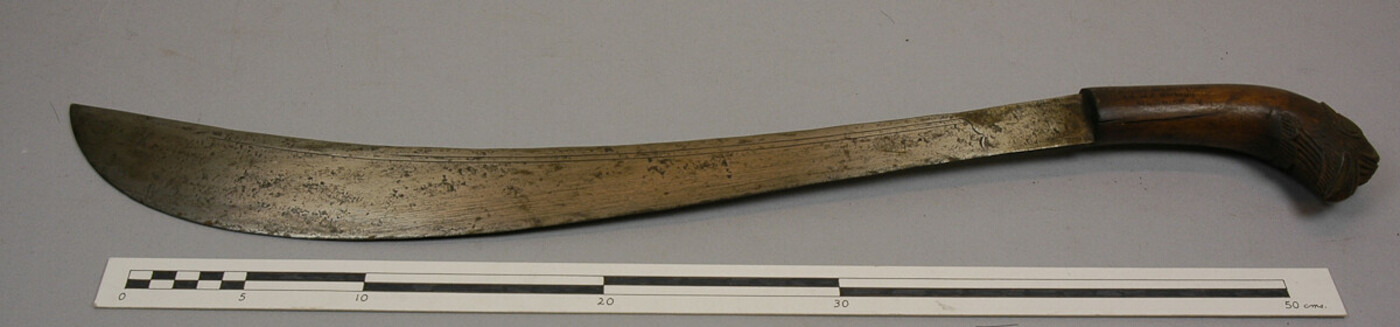 1945.6.55Sword with curved, single edged blade and wooden hilt carved in the shape of a bird's head. [SM 04/01/2008]1945.6.55
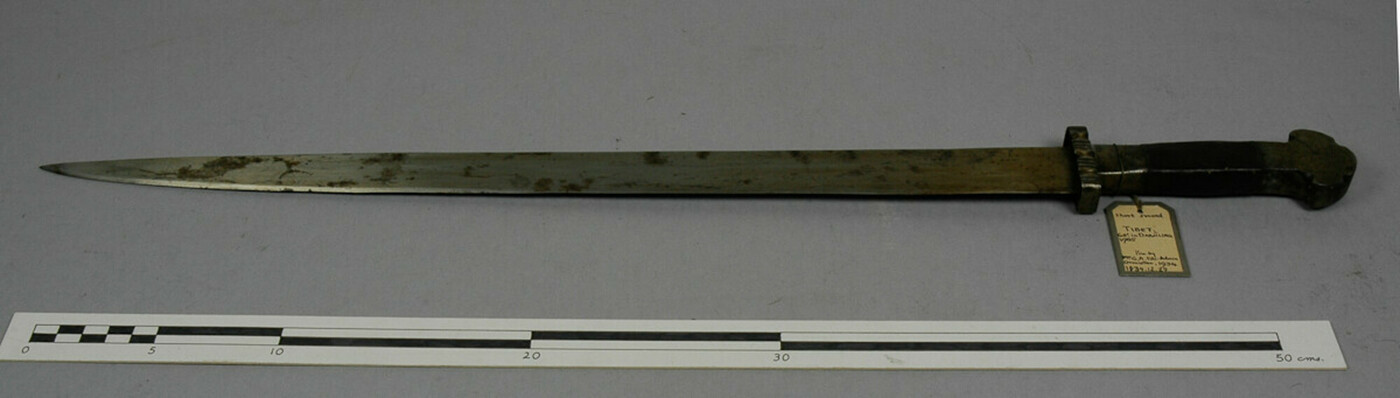 1934.12.29Short sword, single-edged, with hilt covered with iron and grip bound with leather. [El.B 14/11/2007]1934.12.29
 1906.78.41Metal arm ornament; circlet of coiled brass wires worn smooth on upper and lower edges. [EC 'DCF 2004-2006 What's Upstairs?' 12/10/2005]1906.78.41
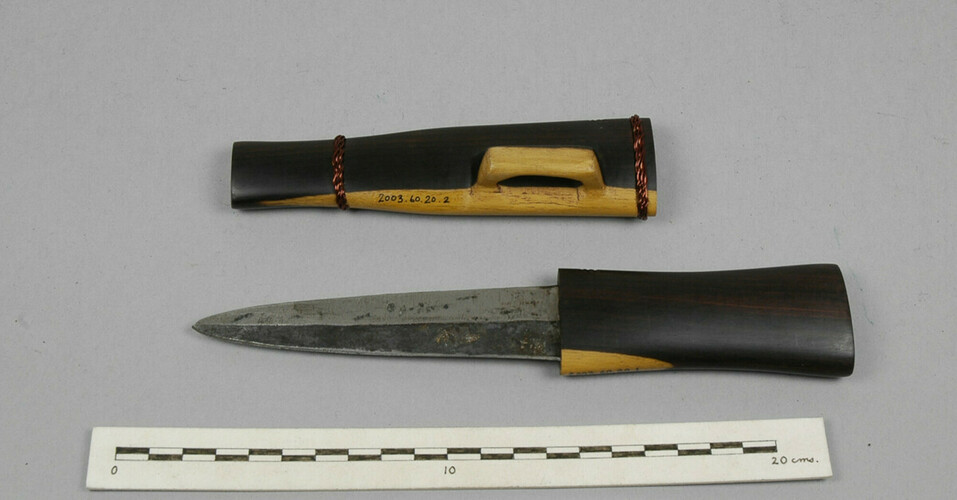 2003.60.20.1Knife [.1] set into a wooden handle, and with sheath [.2]. Part of a set of objects that traditionally belong to the father of each rural household. [JP 5/3/2004]2003.60.20.1
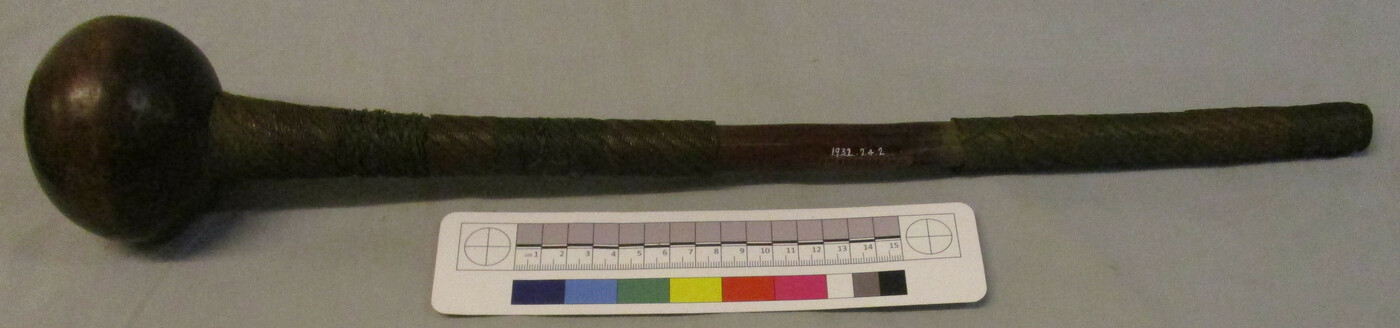 1932.24.2Ball-headed wooden club bound with brass and copper wire on the handle and the shaft. Made from one piece of wood. [ASh [OPS move] 25/5/2016]1932.24.2
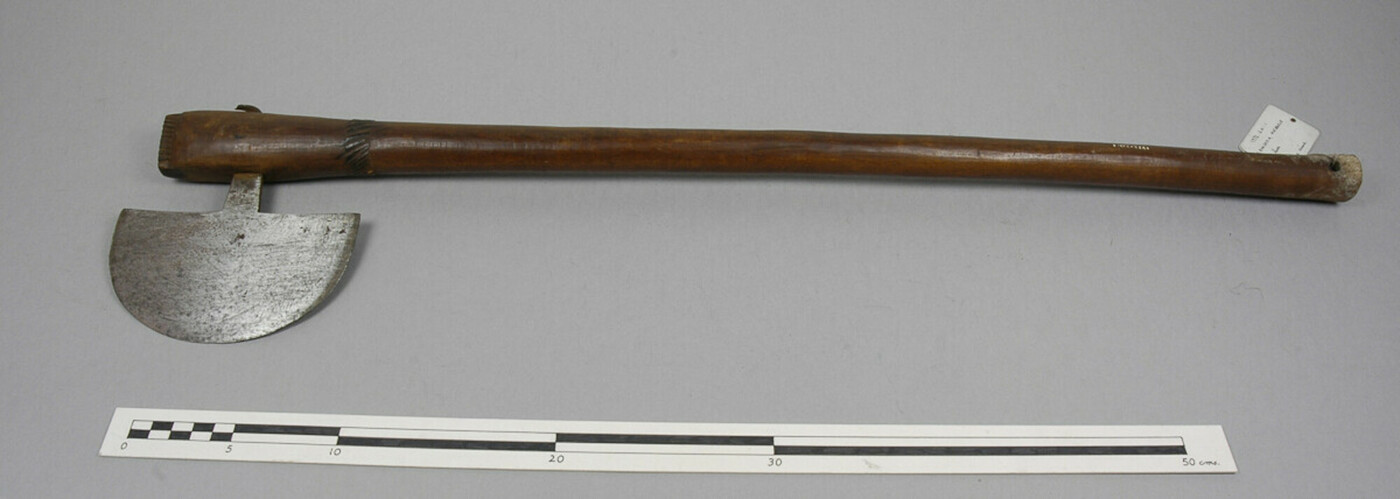 1972.20.1Axe with tanged semicircular iron blade, hafted in a straight wooden handle with two bands of incised decoration near the blade. The butt is pierced for a suspension loop. [LM 11/07/2007]1972.20.1