
- Collection type
- Object
- Description
- Carved and painted helmet mask of a face. The mask is made of carved wood with basketry framework forming the top of the head. The face is carved with elaborate designs and painted black, white and orange. There are perforations for the mouth, nostrils and eyes. The ears are elongated with slits in them. The top of the head is half covered with black yarn and half with wooden pins, the halves are divided by a strip of red fabric. [AB [OPS Move] 16/9/2016]
- Geographical reference
- New Ireland Bismarck Archipelago
- Person
- Field collector H.A. Tufnell
- Field collector Henry Archibald Tufnell
- Field collector Sir William MacGregor
- PRM source Henry Anson
- Date / Period
- Date made: Before 1899
- Date collected
- By 1899
- Acquisition information
- Donated: 1899
- Materials and processes
- Material Wood Plant, Material Pigment, Material Wool Yarn Animal, Material Textile, Material Plant Fibre, Process Carved, Process Painted
- Dimensions
- Width: max 340 mm, Height: max 590 mm, Depth: max 86 mm
- Object numbers
- Accession number: 1899.62.408 Other numbers: 74
- Research and responses
This is probably a tatanua mask. The following account is taken from Michael Gunn's caption to the reproduction of another tatanua mask from the PRM (1899.62.405) as figure 7 in Transformations: The Art of Recycling, by Jeremy Coote, Chris Morton, and Julia Nicholson (Oxford: Pitt Rivers Museum, University of Oxford, 2000): 'Such crested masks are known as tatanua. According to early accounts, they were representations of the spirit or soul (tanua) of dead people. Today this idea is rejected by New Irelanders, who say that tatanua masks are representations, portraits even, of living individuals. As with many art forms around the world, it seems tatanua were designed to portray the locally conceived criteria of human, in this case, manly beauty. So this mask, like the other tatanua preserved in museum collections, is characterized by an elaborate coiffure, a wide, projecting nose, pierced and distended earlobes, side whiskers, a big mouth, and sound teeth. The tatanua were worn in public dances in which groups or lines of men were disguised by the masks and garlands of leaves and foliage reaching to their knees.' [JC 23 3 2001]
Further items to explore
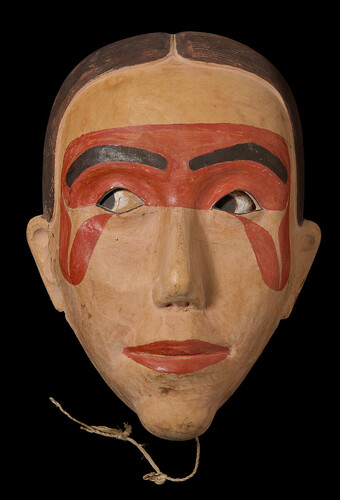 1891.49.3Wooden mask of a male face with moveable eyes and red paint around the eyes and extending down each cheek. [CAK 24/08/2009]1891.49.3
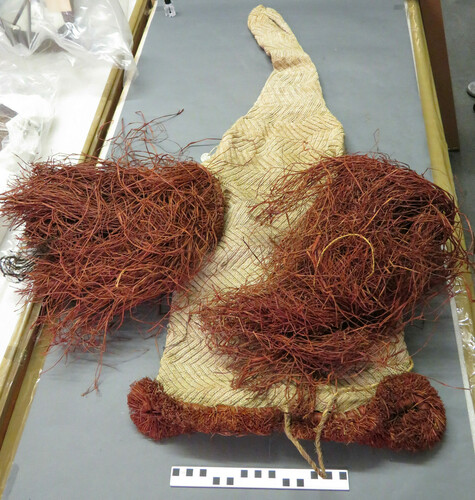 1942.13.1587Plant fibre upper garment with face covering.1942.13.1587
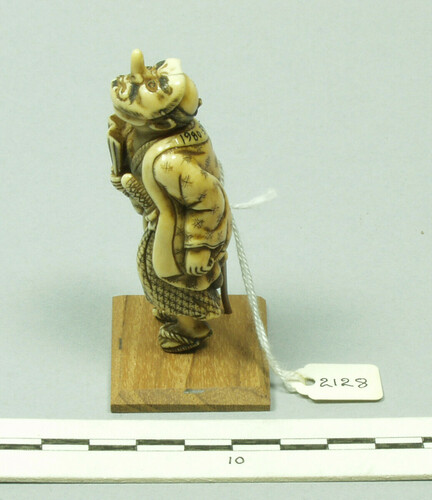 1980.34.2128Ivory netsuke of a man standing, wearing a mask and holding a fan. [N.B. 'DCF 2004-2006 What's Upstairs?' 27/4/2005]1980.34.2128
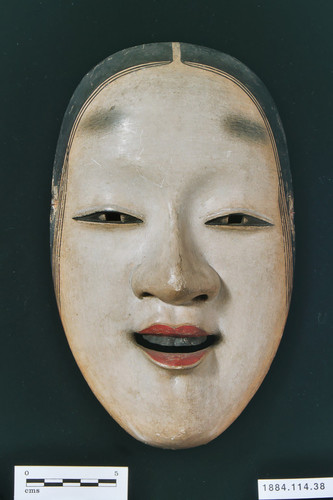 1884.114.38Noh mask of a young woman between the ages of twenty and twenty five.1884.114.38
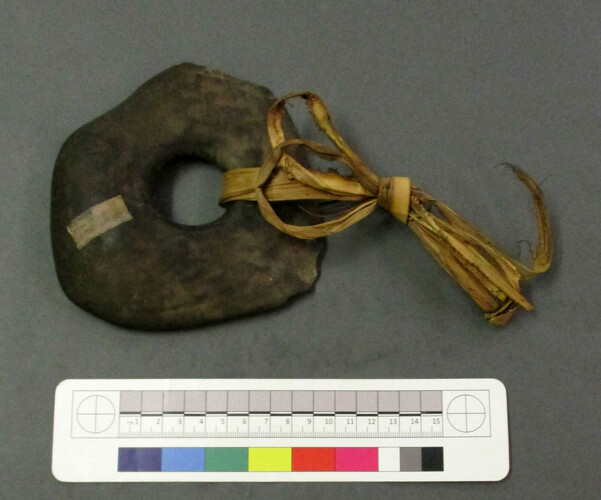 1938.36.332Perforated stone club-head with plant fibre threaded through central hole and secured in a knot. [FB 20/02/2014]1938.36.332
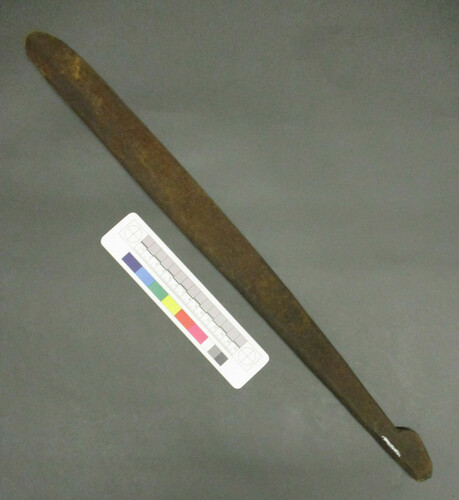 1938.36.1405Agricultural knife of palm wood. The knife has a thin rectangular section and consists of a long pointed blade which tapers down to an expanded asymmetrical butt. [JC [OPS Move] 2/12/2016]1938.36.1405
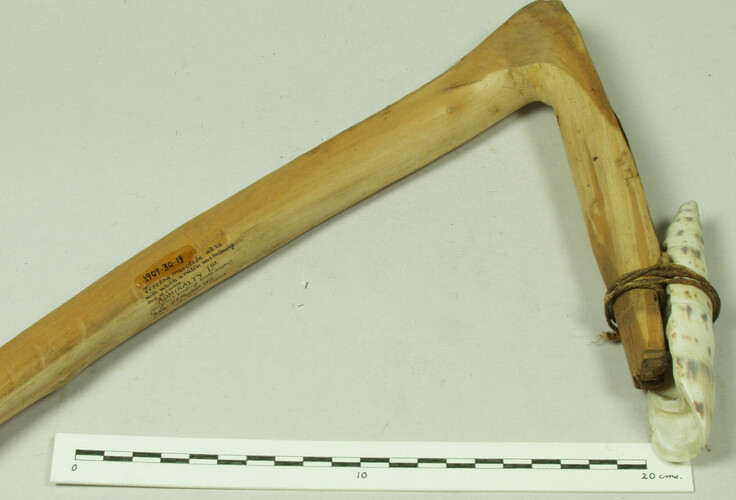 1909.30.19Adze with terebra shell blade, bound to wooden shaft with plant fibre. [L.Ph 'DCF 2004-2006 What's Upstairs?' 22/11/2004]1909.30.19
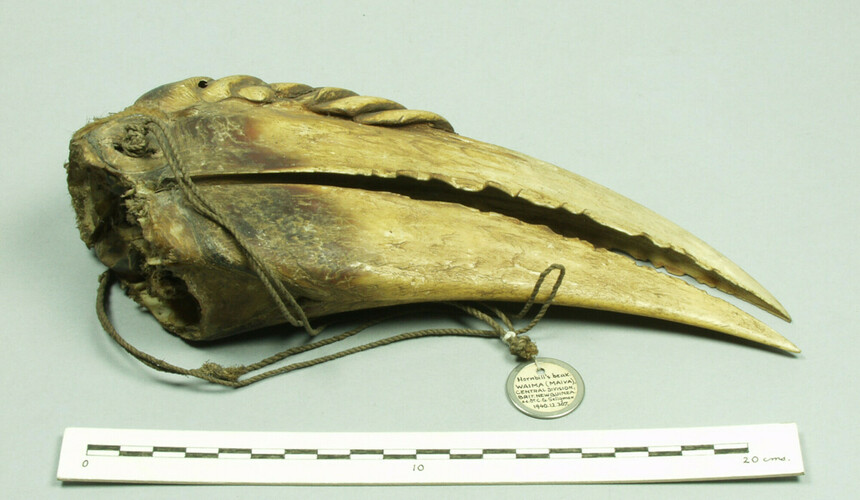 1940.12.307Ornament, consisting of a natural hornbill's beak suspended on a string which passes through the eye holes. [N.B. 'DCF 2004-2006 What's Upstairs?' 20/6/2005]1940.12.307