
- Collection type
- Object
- Description
- Part of a model reindeer pack. For the other parts of the pack see 1896.71.4.1-2.
- Long description
- Miniature chest reindeer pack. Hollow wooden chest with two parallel metal strips, metal lock and handle. The front of the chest has a loop of string which can hook onto another part of the reindeer pack (see 1896.71.4.2) to be carried on the back of a model reindeer (see 2003.33.1).
- Geographical reference
- Cultural groups
- Saami
- Date / Period
- Date made: Before 1896
- Date collected
- By 1896
- Acquisition information
- Purchased: 1896
- Materials and processes
- Material Wood Plant, Material String, Material Metal, Process Carved, Process Tied
- Dimensions
- Height 50 mm, Length 87 mm, Width 50 mm
- Object numbers
- Accession number: 1896.71.4.3
- Research and responses
Barbara Sjoholm is the author of "From Lapland to Sápmi: Collecting and Returning Sámi Craft and Culture". Sjoholm's research has shown that whilst imprisoned Hætta made two sets of Sámi models, probably 160 in all, as educational tools for professors J.A. Friis and Ludwig Daa. Daa gave a number of the models to Robert Latham, ostensibly for the Crystal Palace Museum exhibits. Latham gave Daa objects in exchange for the new Ethnographic Museum in Oslo. Silje Mathisen Opdahl’s “A record of ethnographic objects procured for the Crystal Palace exhibition in Sydenham,” (2019) provided details about Ludwig Daa’s connection with Robert Latham and the Crystal Palace Exhibition, as well as the early years of the Ethnographic Museum in Oslo. Sjoholm's research also used a history in Norwegian of the University of Oslo’s Ethnographic Museum by director Yngvar Nielsen: Universitetets ethnografiske Samlinger 1857–1907, (1907) where he discusses Ludwig Daa’s travels to England and the Continent in order buy and trade exotic objects. On pages 35-36 he discusses then-director of the museum Ludwig Daa’s visit to England in 1864. With him Daa carried Sámi objects to exchange for ethnographic artefacts from around the world. In London he made the acquaintance of “Mr. Wareham” who dealt in curiosities and did business with him. A William Wareham is listed as a possible dealer who dealt with Pitt Rivers: https://web.prm.ox.ac.uk/rpr/index.php/article-index/12-articles/139-dealers-and-auctioneers.html. He is another way that the Sámi models made by Hætta could have become part of the Pitt Rivers Museum collection, rather than coming through Robert Latham and the Crystal Palace exhibit.
Anne May Olli (director of RiddoDuottarMuseat), Johan Ashlak (Ailo) Hætta (head of the museum's branch in Kautokeino), and Anna Mossolova (MSCA postdoctoral fellow at Museum of Cultural History, University of Oslo) digitally reviewed some objects in the Pitt Rivers collection which may have been made by Lars Hætta during the time he was imprisoned in Oslo (1856–1867) for participation in the Kautokeino rebellion. Anne May and Ailo looked at this model reindeer with pack online and had doubts that it was all made by Hætta. The reindeer head itself was made by Henry Balfour in 1898, presumably to display the pack which is most probably Hætta's work. Hætta objects are usually very distinctive thanks to the handwritten labels in Sámi and Norwegian made by Hætta himself. He had very beautiful handwriting and it looks like it is his handwriting on the storage containers around the reindeer. Anna wondered if this model could therefore be some sort of bricolage. Anna also confirmed that the reindeer pack is called beassegiisá in Sámi.
Search terms: Model, Animal Gear, Transport and Travel
Related
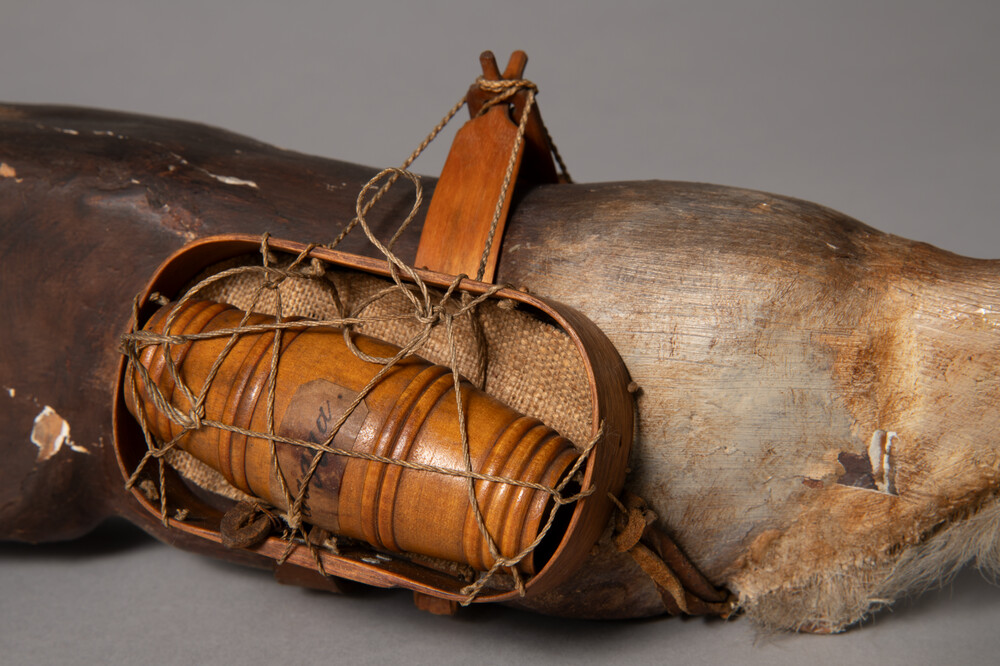 1896.71.4.2Part of a model reindeer pack. For the other parts of the pack see 1896.71.4.1 and 1896.71.4.3.1896.71.4.2
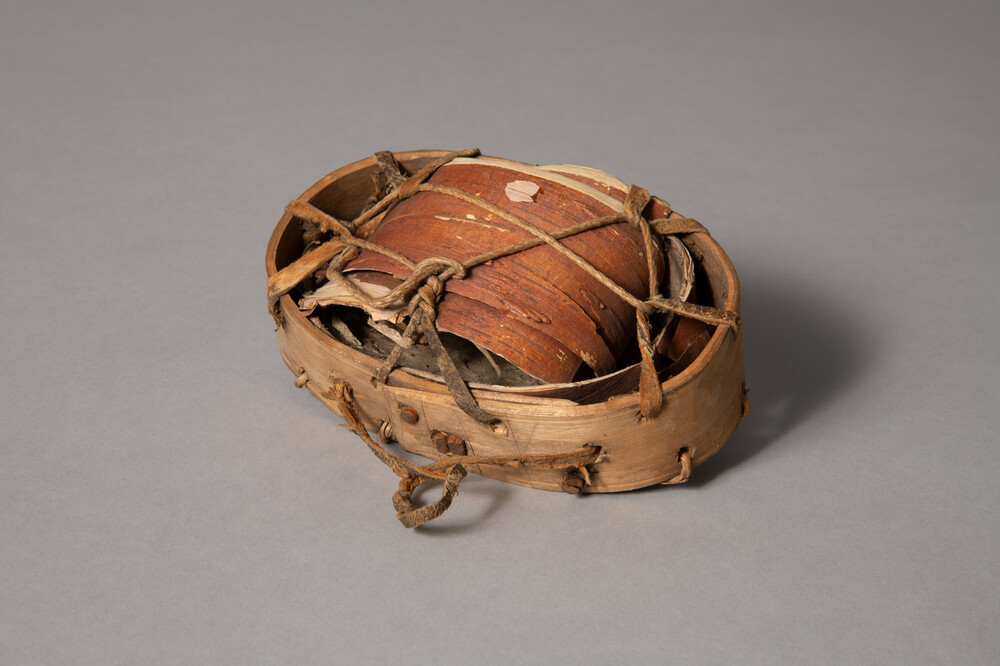 1896.71.4.1Part of a model reindeer pack. For the other parts of the pack see 1896.71.4.2-3.1896.71.4.1
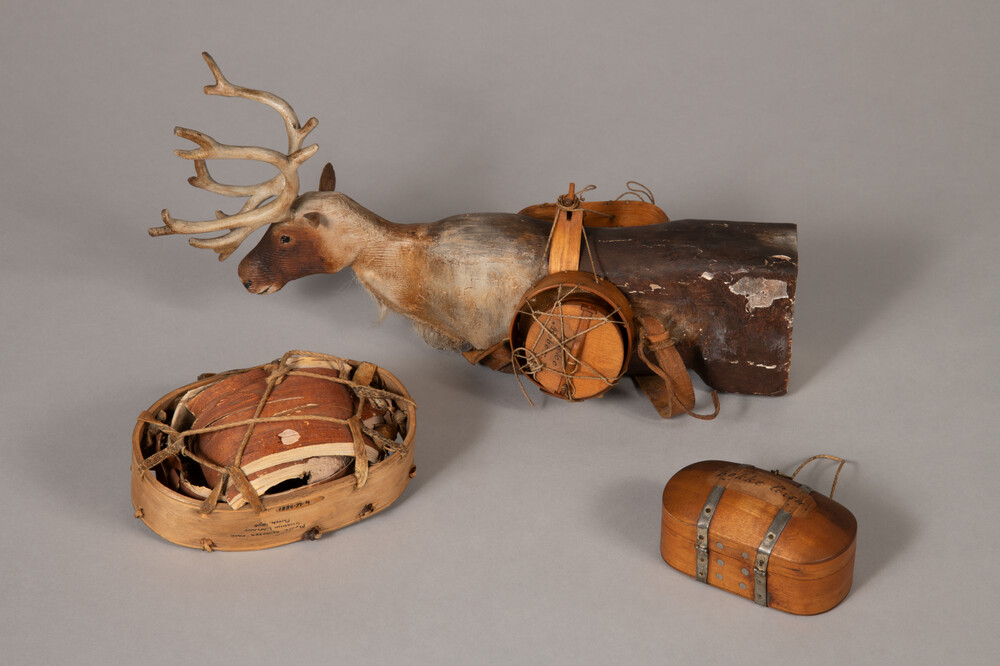 1896.71.4Model of a reindeer pack. For the individual parts see 1896.71.4.1-3.1896.71.4
Further items to explore
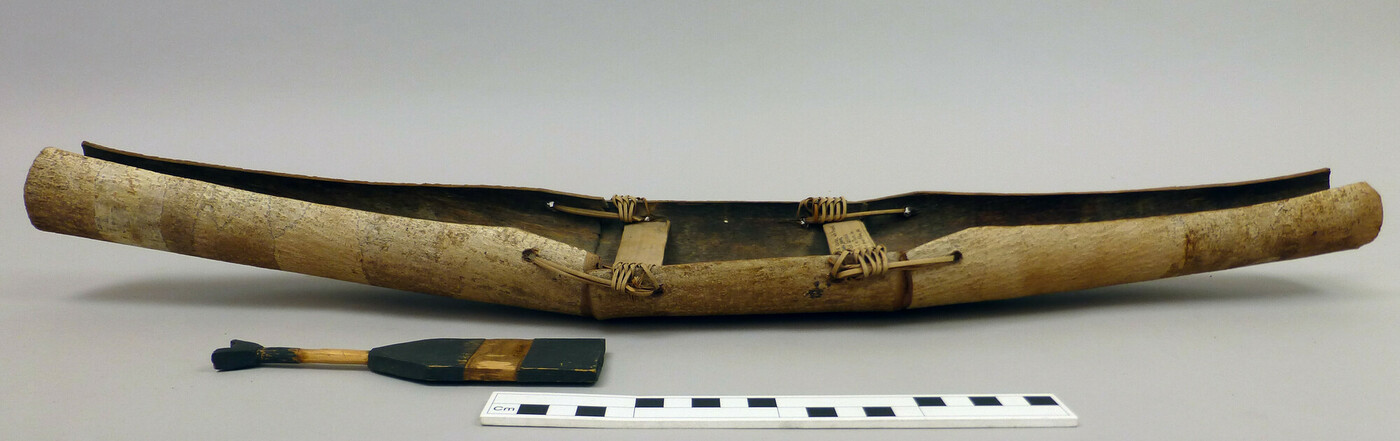 1901.19.2.1Model canoe [.1] and paddle [.2] [SM (Verve) 09/06/2014]1901.19.2.1
 1884.81.10.2Wooden figure of a rower, part of an Egyptian funerary boat model [see 1884.81.10 .1]. [FB 09/01/2013]1884.81.10.2
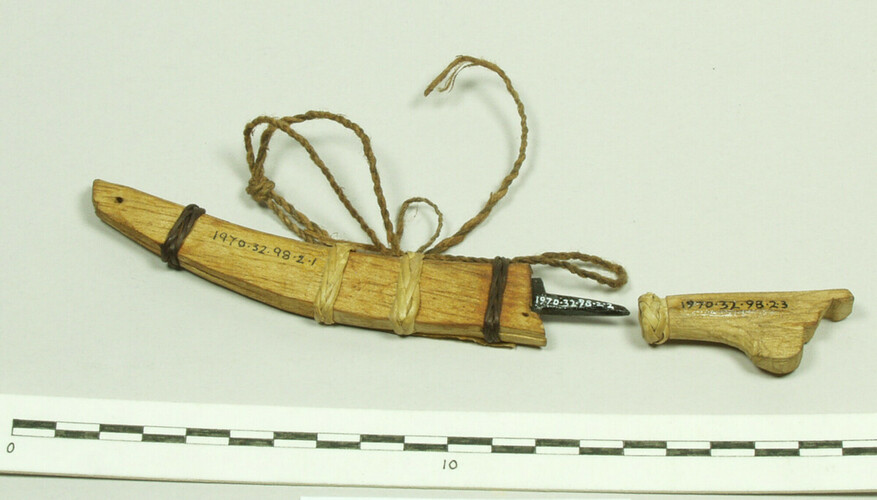 1970.32.98.2.1Miniature sword [.2] and sheath [.1] bound with plaited cane, with plant fibre carrying sling. Detached hilt [.3]. [El.B 'DCF 2004-2006 What's Upstairs?' 30/3/2005]1970.32.98.2.1
 2017.64.1.1Architectural model of a design for a new Pitt Rivers Museum.2017.64.1.1
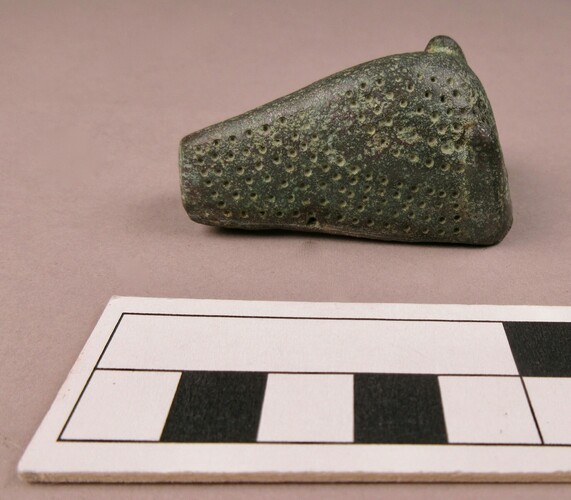 1917.53.246Bronze fibula, pyrimidal shape with tiny holes punched over body. [E.S-R 'DCF 2004-2006 What's Upstairs?' 20/12/2004]1917.53.246
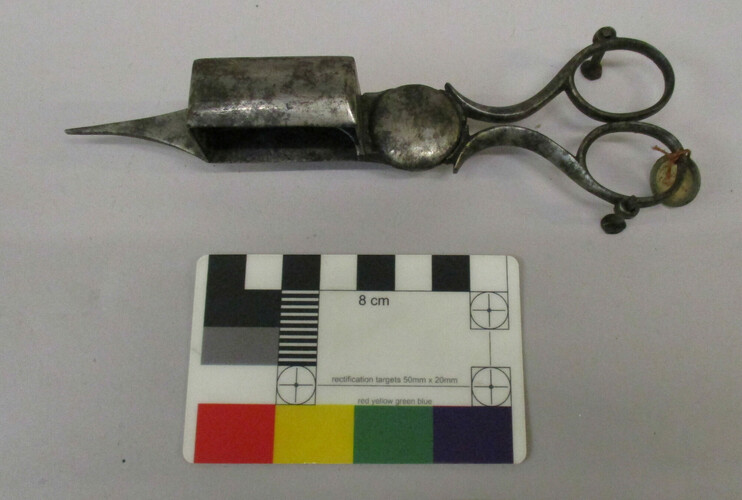 1938.35.1310Metal scissor candle snuffers. Oval finger holes. Crescent shaped arms or finger-blades curved outwards. There is a disc boss over the screw. The snuffer box is rectangular with a bevelled top with rectangular central section. The wick blade is spring action. There are three feet. The tip is bent. [MOBB [OPS move] 06/07/2016]1938.35.1310
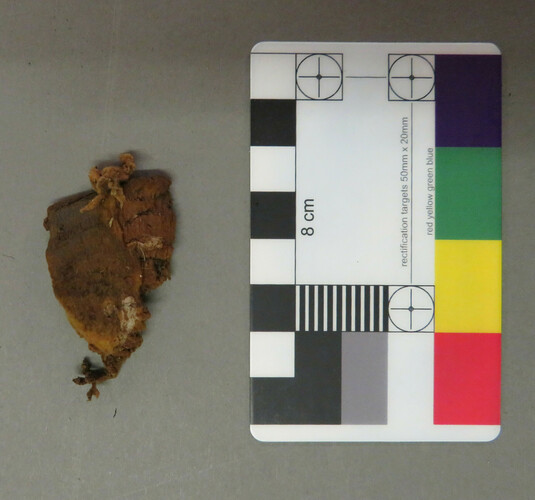 1938.35.1888.4Light brown fungal tinder. For associated pouch and contents see [1938.35.1888 .1 - .4] [EH [OPS move] 9/8/2017]1938.35.1888.4
 1938.35.1132.2Wooden damper belonging to a tinder box. Square-based with a carved knob. For the other component parts see [1938.35.1132 .1] and [1938.35.1132 .3 - 6]. [CW [OPS Move] 30/3/2017]1938.35.1132.2