
- Collection type
- Object
- Description
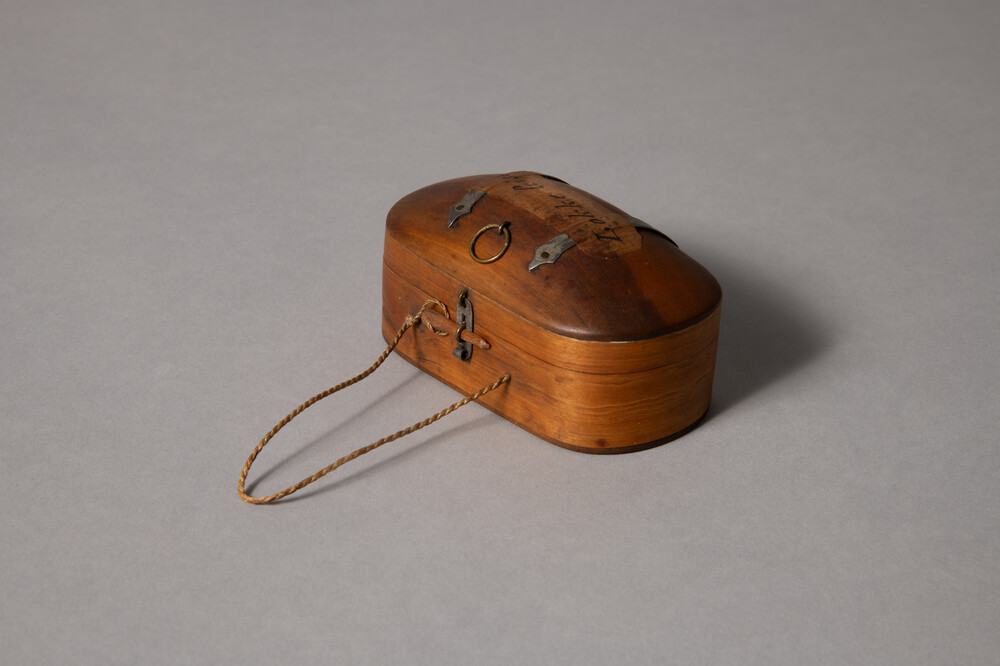
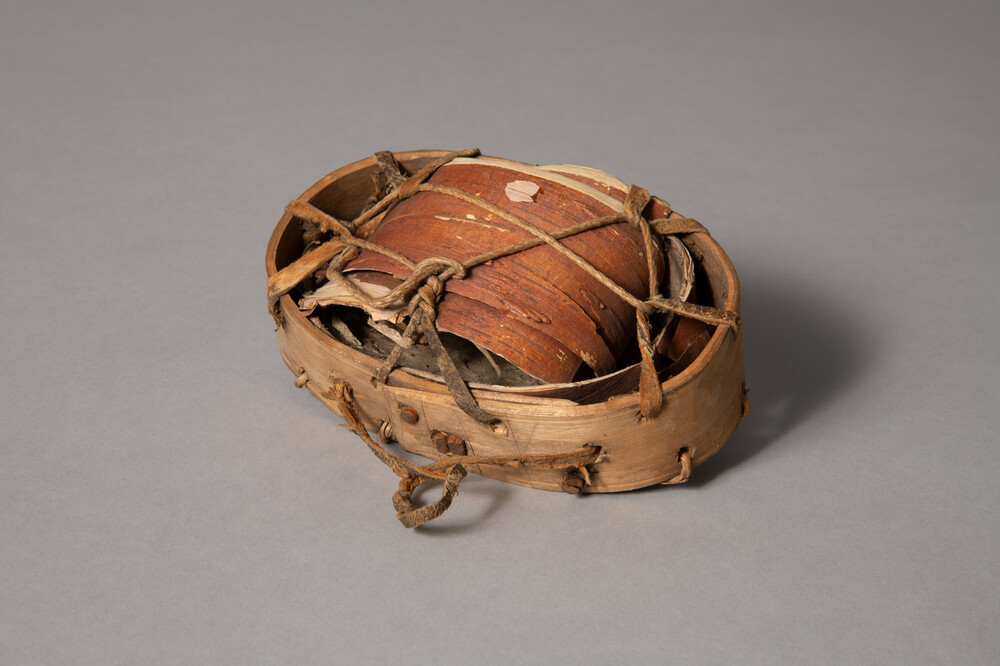
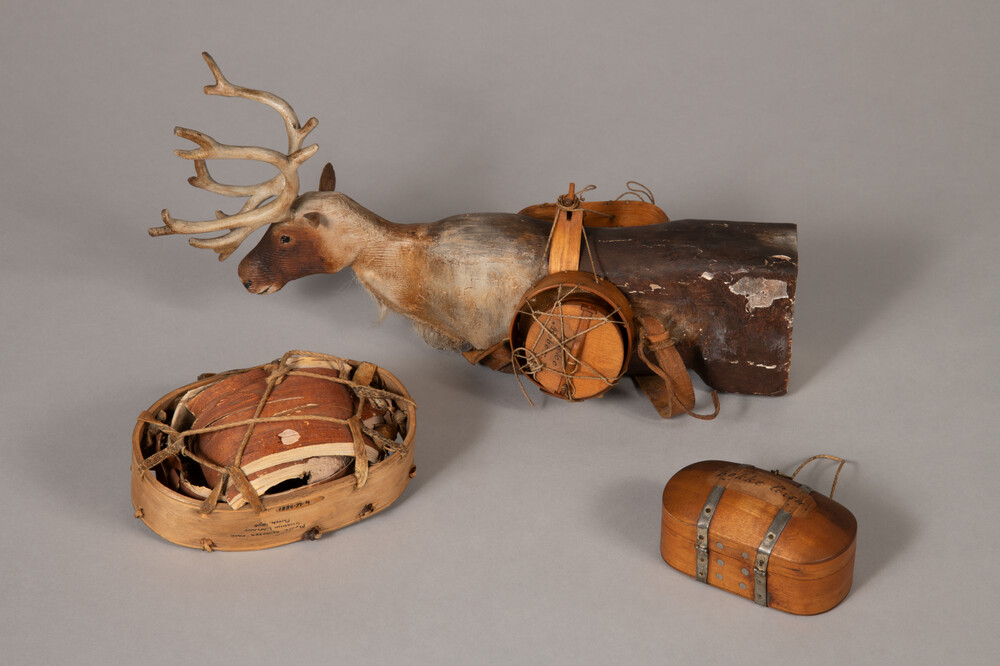
- Part of a model reindeer pack. For the other parts of the pack see 1896.71.4.1 and 1896.71.4.3.
- Long description
- Reindeer pack made of wood, leather and string. The pack sits on the back of a model reindeer (see 2003.33.1) and constitutes two parts - one on either side of the model reindeer. The part sitting on the left side of the model reindeer has a round storage container with a handle inside a circular frame. The part on the right side of the reindeer model has a barrel container within a rectangular frame with rounded corners. Both packs have string tied over the top to secure their respective storage containers, thin sticks of wood in a grid to form the base of the pack and cloth backing, probably hessian. The pack has three leather straps which secure underneath the reindeer model. Both parts of the pack are connected by pieces of wood secured above the reindeer back with string.
- Geographical reference
- Cultural groups
- Saami
- Date / Period
- Date made: Before 1896
- Date collected
- By 1896
- Acquisition information
- Purchased: 1896
- Materials and processes
- Material Wood Plant, Material String, Material Animal Leather Skin, Material Metal, Process Carved, Process Tied, Material Plant Fibre Textile
- Dimensions
- Diameter 63 mm Circular part, Height 100 mm Measured part sitting on model reindeer, Height 35 mm Circular part, Length 85 mm Rectangular part with cylindrical container, Width 60 mm Rectangular part with cylindrical container, Height 30 mm Rectangular part with cylindrical container, Width 135 mm Measured part sitting on model reindeer
- Object numbers
- Accession number: 1896.71.4.2
- Research and responses
Barbara Sjoholm is the author of "From Lapland to Sápmi: Collecting and Returning Sámi Craft and Culture". Sjoholm's research has shown that whilst imprisoned Hætta made two sets of Sámi models, probably 160 in all, as educational tools for professors J.A. Friis and Ludwig Daa. Daa gave a number of the models to Robert Latham, ostensibly for the Crystal Palace Museum exhibits. Latham gave Daa objects in exchange for the new Ethnographic Museum in Oslo. Silje Mathisen Opdahl’s “A record of ethnographic objects procured for the Crystal Palace exhibition in Sydenham,” (2019) provided details about Ludwig Daa’s connection with Robert Latham and the Crystal Palace Exhibition, as well as the early years of the Ethnographic Museum in Oslo. Sjoholm's research also used a history in Norwegian of the University of Oslo’s Ethnographic Museum by director Yngvar Nielsen: Universitetets ethnografiske Samlinger 1857–1907, (1907) where he discusses Ludwig Daa’s travels to England and the Continent in order buy and trade exotic objects. On pages 35-36 he discusses then-director of the museum Ludwig Daa’s visit to England in 1864. With him Daa carried Sámi objects to exchange for ethnographic artefacts from around the world. In London he made the acquaintance of “Mr. Wareham” who dealt in curiosities and did business with him. A William Wareham is listed as a possible dealer who dealt with Pitt Rivers: https://web.prm.ox.ac.uk/rpr/index.php/article-index/12-articles/139-dealers-and-auctioneers.html. He is another way that the Sámi models made by Hætta could have become part of the Pitt Rivers Museum collection, rather than coming through Robert Latham and the Crystal Palace exhibit.
Anne May Olli (director of RiddoDuottarMuseat), Johan Ashlak (Ailo) Hætta (head of the museum's branch in Kautokeino), and Anna Mossolova (MSCA postdoctoral fellow at Museum of Cultural History, University of Oslo) digitally reviewed some objects in the Pitt Rivers collection which may have been made by Lars Hætta during the time he was imprisoned in Oslo (1856–1867) for participation in the Kautokeino rebellion. Anne May and Ailo looked at this model reindeer with pack online and had doubts that it was all made by Hætta. The reindeer head itself was made by Henry Balfour in 1898, presumably to display the pack which is most probably Hætta's work. Hætta objects are usually very distinctive thanks to the handwritten labels in Sámi and Norwegian made by Hætta himself. He had very beautiful handwriting and it looks like it is his handwriting on the storage containers around the reindeer. Anna wondered if this model could therefore be some sort of bricolage. Anna also confirmed that the reindeer pack is called beassegiisá in Sámi.
Search terms: Model, Animal Gear, Transport and Travel
Related
Further items to explore
 1915.50.136Model of shaman’s staff. Made of length of wood, with a separate piece of curved wood tied to one end with string, forming a fork shape at top. There are four carved faces along the length of the wood and three smaller faces carved at the three forked ends. The bottom end has been carved to form the shape of legs. [AF [OPS move] 25/4/2017]1915.50.136
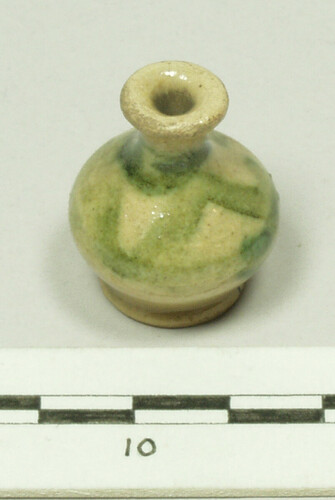 1951.11.180.35Miniature pottery vessel, white jug with green decoration [N.B. 'DCF 2004-2006 What's Upstairs?' 8/3/2005]1951.11.180.35
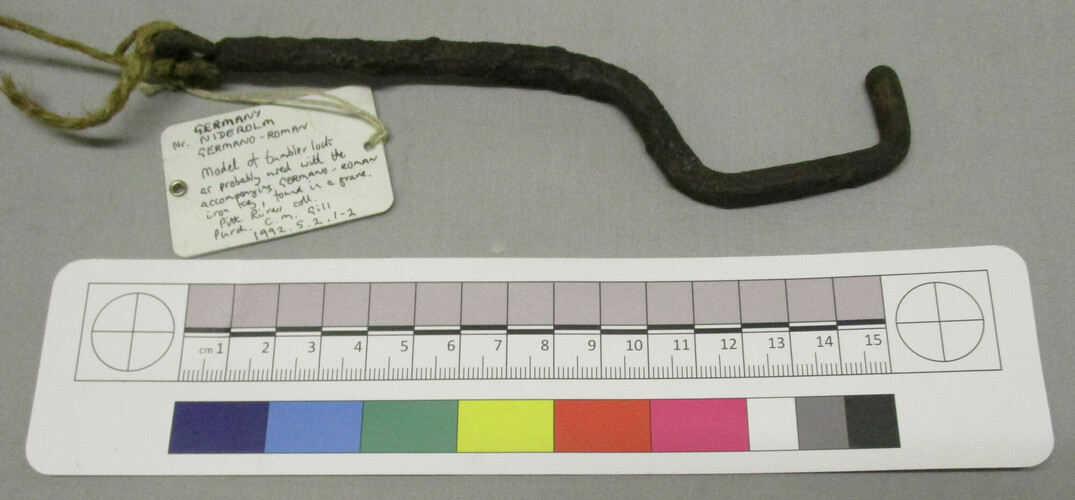 1992.5.2.2Key, made from iron. The key has a long handle with a ring at the end and a metal protrusion pointing upwards that acts as a single tooth. This key was found in a Germano-Roman grave near Nieder-Olm [Niederolm]. This type of key was used with the lock 1992.5.2 .1 [ASh [OPS move] 07/09/2016]1992.5.2.2
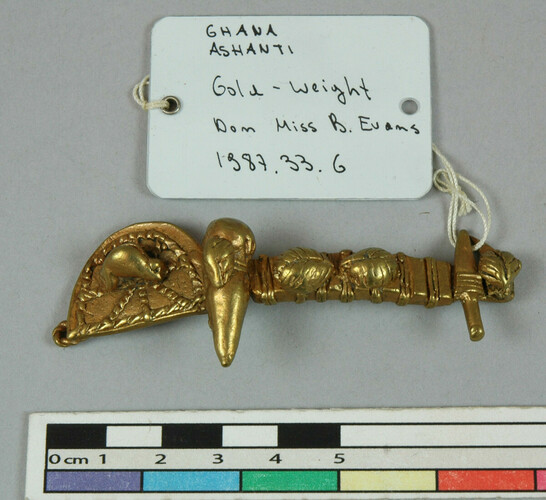 1987.33.6Copper alloy weight used for weighing gold in the shape of a belt with a flask, pouch and knife attached. [MJD 19/04/2011]1987.33.6
 1938.35.757.9Strip of fungus tinder. Roughly square in shape and dark yellow. For the associated components of this object see 1938.35.757 .1 - .8 [BS [OPS move] 31/8/2017]1938.35.757.9
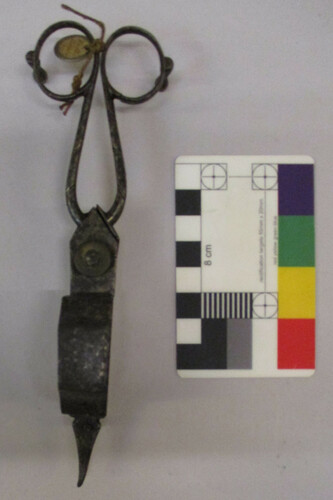 1938.35.1270Candle snuffer. The snuffer box is rectangular with two convex corners and the top is decorated with three pairs of incised lines. The oval shaped finger holes are attached to narrow elongated handles which have each been decorated with three pairs of horizontal incised lines. [CW [OPS move] 05/07/2016]1938.35.1270
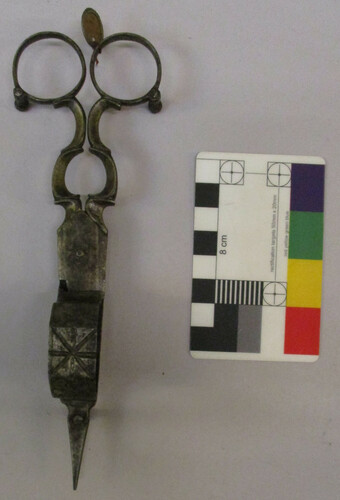 1938.35.1318Candle snuffer. The snuffing box is rectangular with chamfered corners and convex sides and an incised star pattern consisting of of four lines. The round finger holes are attached to handles constructed from curved sections. [CW [OPS move] 05/07/2016]1938.35.1318
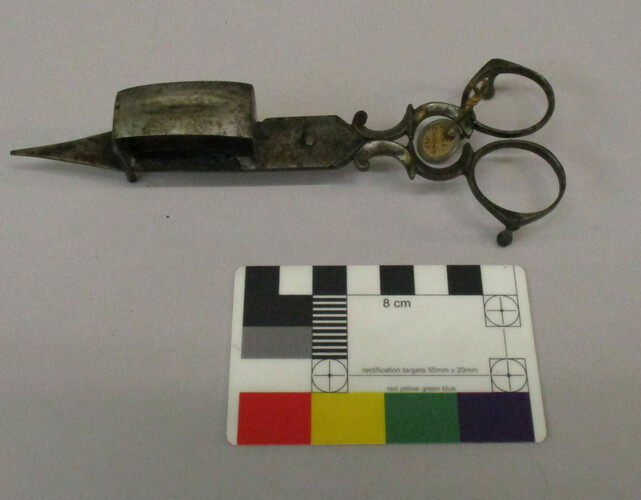 1938.35.1241.2Metal scissor candle snuffers. Oval finger holes. The arms or finger-blades comprise one crescent curved inwards and another crescent curved outwards. There is no boss around the screw. The snuffer box is rectangular with a rounded top and central oval depression. There are two globular feet and one which is simply a post. [MOBB [OPS move] 06/07/2016]1938.35.1241.2