
- Collection type
- Object
- Description
- Narrow wooden throwing club with pointed head, grooved lower body and tapering flat butt [RTS 11/5/2005].
- Long description
- Throwing club carved from a single piece of ebony, consisting of a pointed head with flattened tip, swelling out below into a narrow, oval-sectioned body that reaches its maximum diameter about one third the way along its length, with the shaft then tapering in to a flat ended butt. The lower half of the club has been decorated with a series of parallel v-shaped grooves running down the sides. The wood is a orange brown colour (Pantone 4635C) banded with darker reddish brown (Pantone black 4C); this has been polished throughout. The club is complete, and intact, except for a small area of surface damage on the lower body. It has a weight of 657.1 grams and is 740 mm long, with a maximum diameter of 36.2 by 34 mm, and a minimum diameter at the end of 20 by 19.5 mm [RTS 11/5/2005].
- Cultural groups
- Shilluk
- Date / Period
- Date made: Before 1903
- Date collected
- By 1903
- Acquisition information
- Donated: 1903
- Materials and processes
- Material Ebony Wood Plant, Process Carved, Process Polished
- Dimensions
- Length 740 mm, Diameter: max 36.2 mm, Weight 657.1 g
- Object numbers
- Accession number: 1903.16.118
- Research and responses
Bor is located on the Bahr el Jebel river, in the modern Sudanese administrative district of Jonglei, close to the border with El Buheyrat. Shir is an alternative name for the Mandari, who occupy the area south of Bor; however the cultural attribution of the object was changed to Shilluk when the club was accessioned; a later ebony club of very similar form, 1966.1.214, also said to be Shilluk. According to Jeremy Coote, both the Mandari and Shilluk use clubs of this type, and either would be possible in this context; Gunn did however collect a lot of Shilluk material [RTS 6/4/2005].
Further items to explore
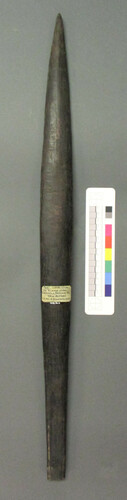 1938.36.6Palm-wood club with flat pointed blade and handle of hemispherical section, undecorated. [JC [OPS Move] 06/09/2016]1938.36.6
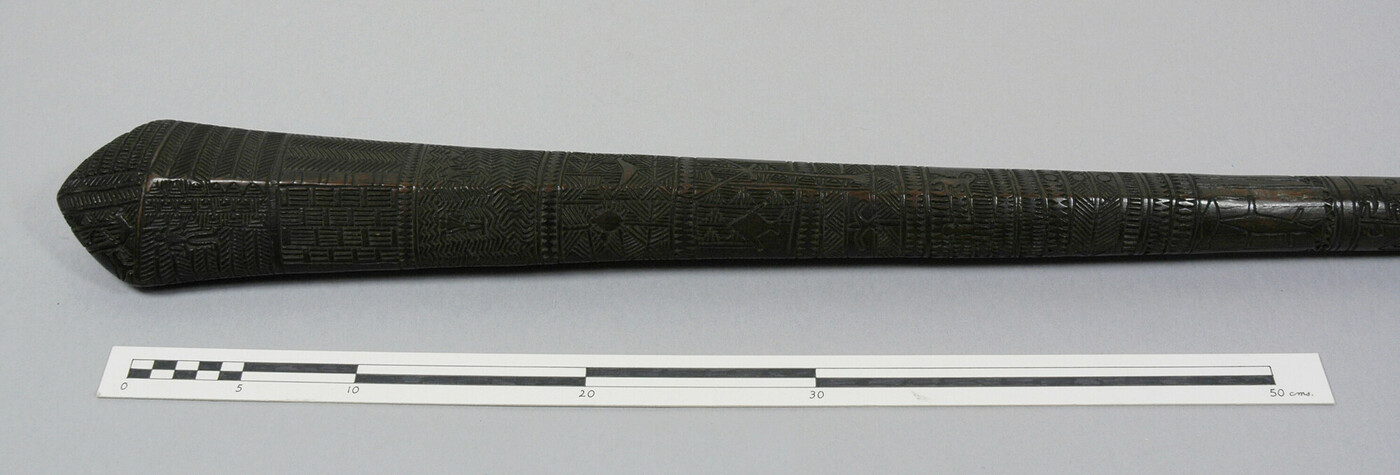 1884.98.51Wooden club with elaborately carved head and shaft. [SM 23/03/2007]1884.98.51
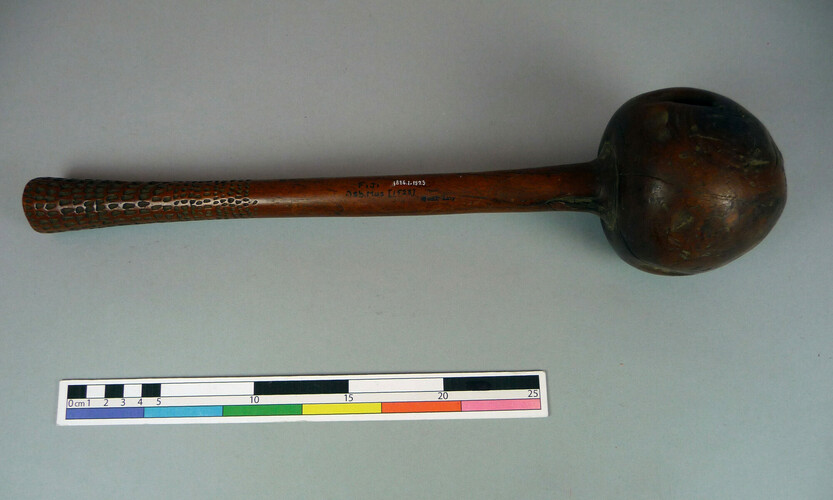 1886.1.1523Throwing club with plain ball head. [FC 02/08/2011]1886.1.1523
 1933.18.33Club with long wooden shaft and irregular, perforated stone head, knobbed in a grid-like fashion. The shaft is bound at the head with various strips of plaited plant fibre. [JC [OPS Move] 18/08/2016]1933.18.33