
- Collection type
- Object
- Description
- Wooden club with elaborately carved head and shaft. [SM 23/03/2007]
- Long description
- Wooden club with elaborately carved head and shaft. The club has a diamond shaped head and is carved with bands of decoration along the entire head and shaft. The head is primarily decorated with bars, chevrons and triangles but also has carved men, dogs, fish, turtles and birds as well. The shaft is less densely carved. It contains men, bird, turtles and fish, as well as being carved with rows of triangles, diamonds and lines. The handle is almost undecorated with only very faint occasional incised lines around it. There is a hole in the butt for attaching a carrying or hanging strap to. [SM 23/03/2007]
- Person
- Maker Unknown Maker
- Field collector Unknown Collector
- PRM source Augustus Henry Lane Fox Pitt Rivers founding collection
- Date / Period
- Date made: Before 1874
- Date collected
- By 1874
- Acquisition information
- Donated: 1884
- Materials and processes
- Material Wood Plant, Process Carved, Process Incised
- Dimensions
- Width: max 80 mm, Length: max 970 mm
- Object numbers
- Accession number: 1884.98.51 PR Cat other PR nos: 2821
- Research and responses
The following notes are drawn from research compiled by Andy Mills as part of the DCF Cutting Edge project in 2006-2007.
This is not a lapalapa as asserted on the Display Label, but an apa‘apai. This piece is of particular interest due to the unfinished nature of its surface decoration. This surface decoration was known as tata, and the professional artists who carved it were termed tufunga tata. The decoration was achieved through the use of a graver/gouge tool constructed by hafting the tooth of a mako shark into a short handle, which permitted the tufunga to make a series of shallow cuts and gouges to achieve the decorative scheme. Conventionally, the tata on a Tongan club is complete, and forms a clearly-demarcated Frieze of carving, either entirely or partially covering the weapon’s surface. However, on this example, as on a few others that can be found in museum collections around the world, the tufunga tata has passed the weapon back to its owner, or sold it to the foreigner who introduced it into the ethnographic curiosities market through which Pitt Rivers acquired it, without finishing his commission. As a consequence, we are very fortunate to be able to see the means by which the tufunga tata has undertaken the composition of his work, breaking the weapon’s surface into rectilinear zones, and then columns, before incising these zones and sub-zones with the chosen decorative motifs, or kupesi as they are known. It is unfinished weapons such as this which have substantially permitted me to reconstruct the working practices and thought processes of the tufunga tata over recent years – practices and processes documented in Mills (Mills, A. (2007) Tufunga Tongi ‘Akau: Tongan Club-Carvers & Their Arts. Unpublished Ph.D. Thesis, University of East Anglia). [El.B 29/02/2008]
- Associated publications
- Reproduced in black and white in figure 1 on page 144 of 'Tonga', by Adrienne L. Kaeppler, in The Dictionary of Art, edited by Jane Turner (London: Macmillan, 1996), pp. 142-144. [JC 28 11 2000]
Search terms: Weapon, Figure, Club, Fish Figure, Bird Figure
Further items to explore
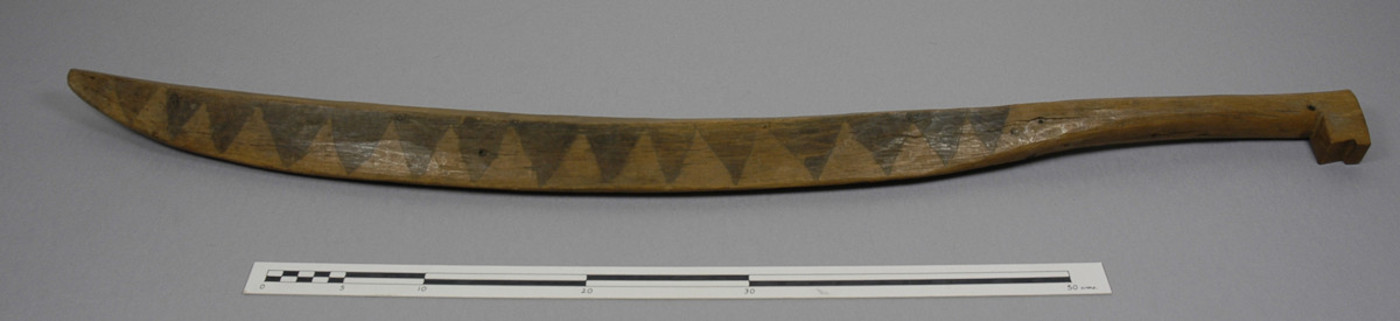 1913.17.1Curved wooden club with sharp edge decorated with black triangles on both sides. [SM 22/03/2007]1913.17.1
 1900.55.407Long flat club with a central panel on one face incised with spiral and geometric designs, traces of white pigment remaining in the decoration. Beyond this the plain blade extends and tapers to a blunt point. There is a rounded triangular butt at the opposite end. [JC [OPS Move] 14/09/2016]1900.55.407
 1884.12.152Wood club with four rows of elaborately carved projections on the head. [JC [OPS Move] 29/07/2016]1884.12.152
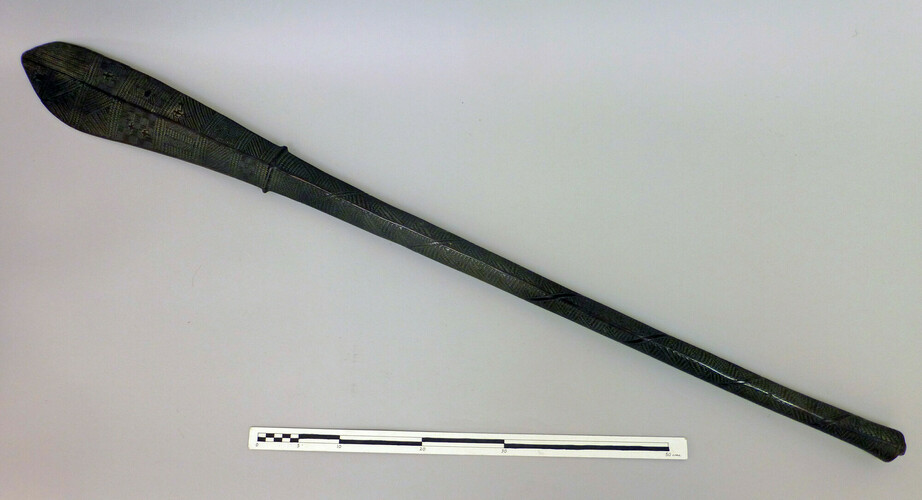 1953.12.2BWooden club or pakipaki. [ZM 26/7/2016]1953.12.2B
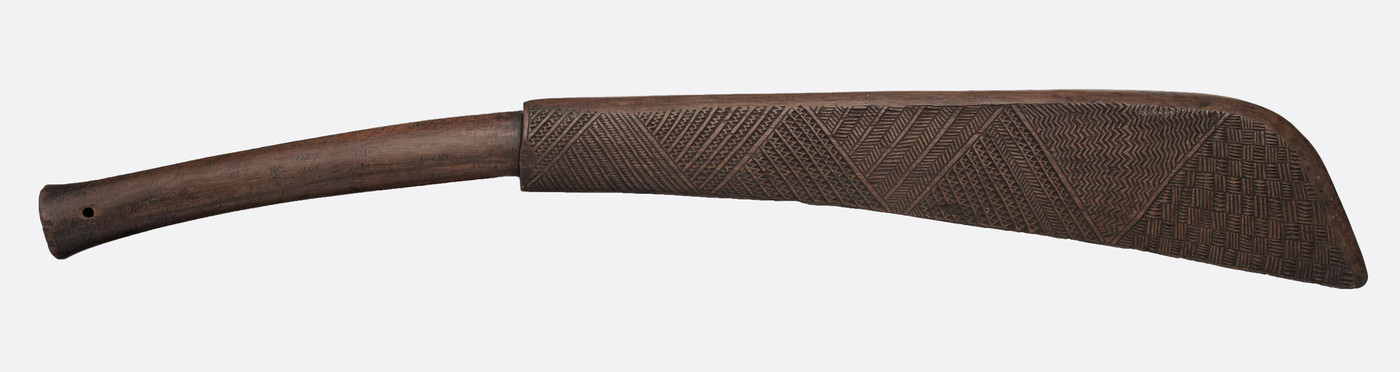 1884.63.19Wooden club slight curved and carved with linear and zigzag designs within triangular sections. 1884.63.19
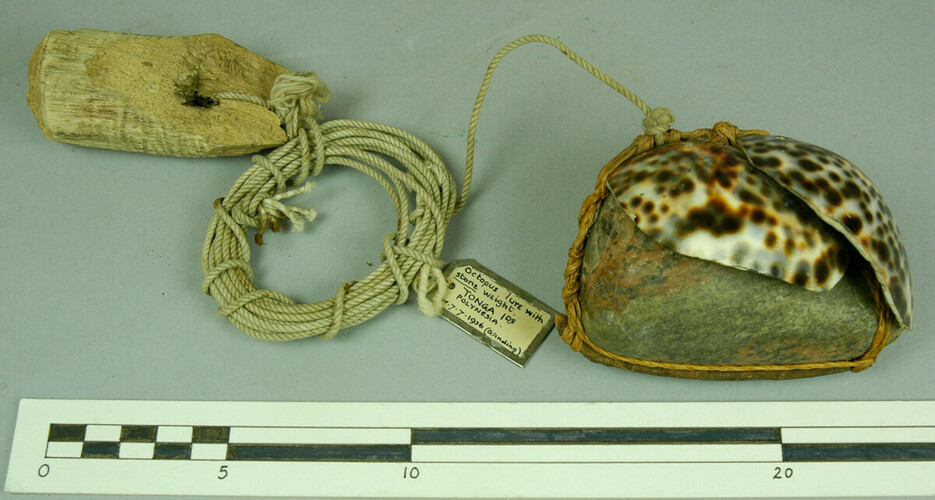 1936.72.11Stone weight covered with two pieces of cowrie shell and tied to string line and wooden float. [MJD 20/03/2009]1936.72.11
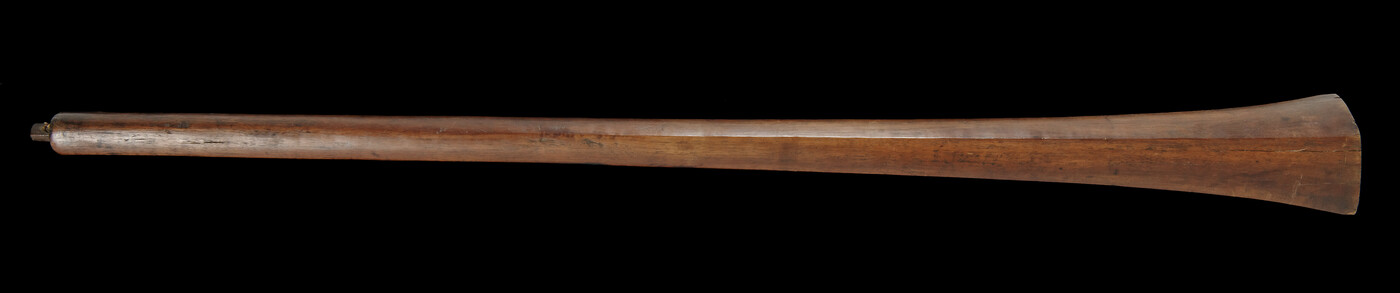 1886.1.1445Wooden club. Leaf-stalk shaped. Undecorated.1886.1.1445
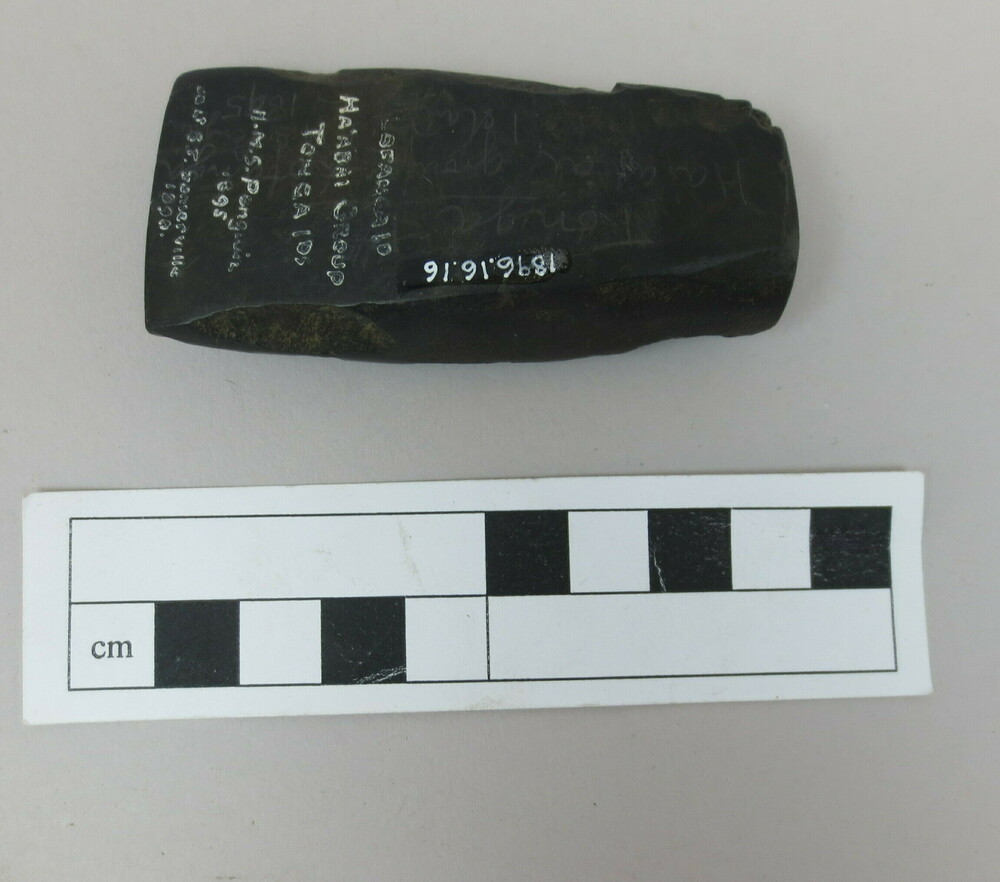 1896.16.16Stone axe.1896.16.16