
- Collection type
- Object
- Description
- Penannular ivory arm ornament, mended in three places with string and giraffe? hair [RTS 2/11/2004].
- Long description
- Heavy penannular arm ornament carved from a single piece of yellowish to yellowish cream ivory (Pantone 1345C to 7401C). This is oval in plan view, and consists of a narrow flat upper surface, and a flat inner surface where the object would rest against the owner's arm. The outer surface has a corrugated profile with concave sides above and below a broad, rounded, raised rib that runs around the middle of the circumference. The surfaces have been polished; this polish is particularly marked around the inside edges, where it may be the result of use-wear. The armlet appears to have either broken or been cut down on the sides, in two places around the circumference, not quite opposite each other, to create two joining parts. On one side, two pairs of holes have been bored through the upper and lower edges of this break, and threaded with lengths of black giraffe? hair, wound horizontally across the join several times to bind each pair of holes together. On the inside face of the armlet, this hair has faded to a paler colour. On the other side, there are similar sets of holes, this time bound with twisted hide string, plus an additional hole that may be a manufacturing error. These joins have sprung slightly apart and the two pieces no longer align perfectly. There is some kind of vegetative matter filling the crack between the parts on this side. While these bindings could be simple mends, both breaks are rather vertical and straight and may be deliberate cuts, introduced to make the armlet easier to fit onto the owner. However a third area of binding looks more clearly like a local repair. This occurs near the top of the armlet, where a crack can be seen developing vertically down the side, but which has not yet reached the base of the object. A pair of holes has been bored across the top of this crack, and a length of hide string tied through it. Further 'repairs' may be evident in a series of shallow circular depressions that have been bored in rows along some surface cracks - there are two such rows on the underside, one very short and one long on the upper surface, and a more enigmatic cluster of depressions around the latter that do not seem to be associated with splits. Similar depressions are found on other objects in the museum, such as 1979.20.122, from the Dinka Tuich, amongst whom this technique is thought to prevent the object breaking, or on 1925.62.1, a possibly Nuer object, where it may be more decorative in intent. The object is complete, with numerous cracks across the surface, particularly on the inside face where the surface is slightly damaged in some areas. It measures 121.3 by 108 mm across its outer edges, and 92 by 78 mm across its inside edges, with a rim thickness of 17 mm, a height of 62 mm and a weight of 405.5 grams. The mend holes have diameters of 4 mm, while the bored depressions measure from 1.5 to 1 mm in diameter [RTS 3/11/2004].
- Cultural groups
- Shilluk
- Date / Period
- Date made: Before 1903
- Date collected
- By 1903
- Acquisition information
- Donated: 1903
- Materials and processes
- Material Elephant Tooth Ivory Animal, Material Animal Hide Skin, Material String, Material Giraffe Hair Animal, Process Carved, Process Polished, Process Perforated, Process Drilled, Process Repaired (local), Process Twisted, Process Tied
- Dimensions
- Width 108 mm, Width 78 mm internal, Length 121.3 mm, Thick 17 mm rim, Height 62 mm, Length 92 mm internal, Weight 405.5 g
- Object numbers
- Accession number: 1903.16.106
- Research and responses
Although the term 'Upper Nile' is now used to refer to a modern administrative district, covering a stretch of the Bahr el Abiad from Geigar to Malakal, and the Sobat River to Nasir, at the time this object was collected the term was used differently. Up until 1981, it was the name of a province that covered the districts now known as Upper Nile, Jonglei, Wahda and part of el Buheyrat. It may also have been used to describe the Bahr el Abiad and/or Bahr el Jebel rivers.
A similar arm ornament is illustrated in A. Fisher, 1984, Africa Adorned, p. 64 no. 5, where it is given the rather generic provenance of 'Upper Nile'. Domville Fife suggests that amongst the Shilluk ivory armlets were worn by men who had speared an elephant, a lion or a leopard (C.W. Domville Fife, 1927, Savage Life in the Black Sudan, p. 82) [RTS 15/8/2005].
Search terms: Ornament, Arm Ornament
Further items to explore
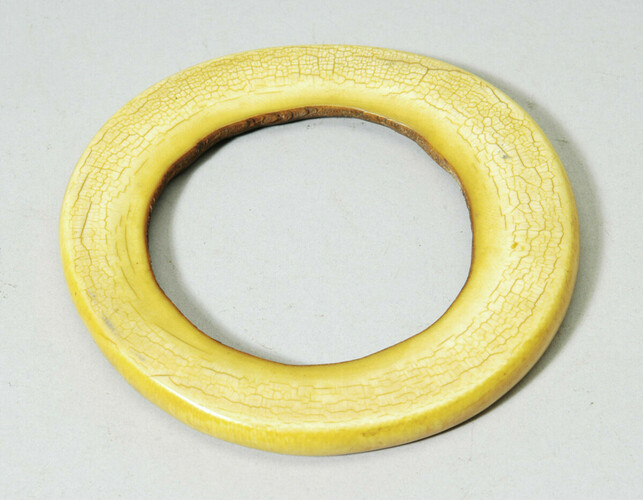 1940.7.0106Annular ivory arm ornament with rectangular section [RTS 1/3/2005].1940.7.0106
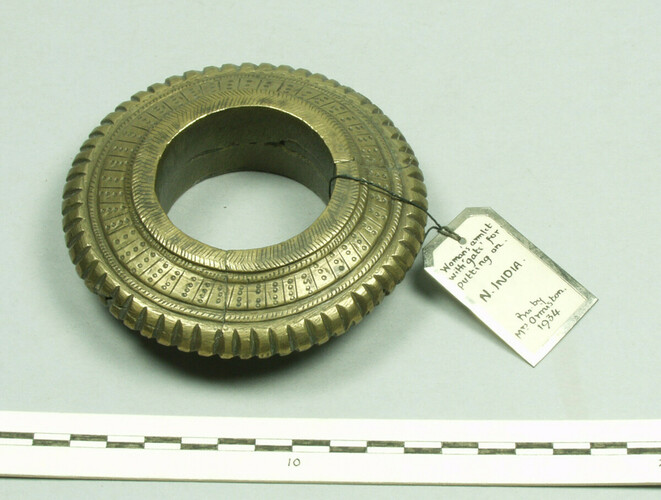 1934.12.69Cast brass armlet with incised lines and impressed dots and incisions round the outside, with removable piece for putting it on. [El.B 'DCF 2004-2006 What's Upstairs?' 5/8/2005]1934.12.69
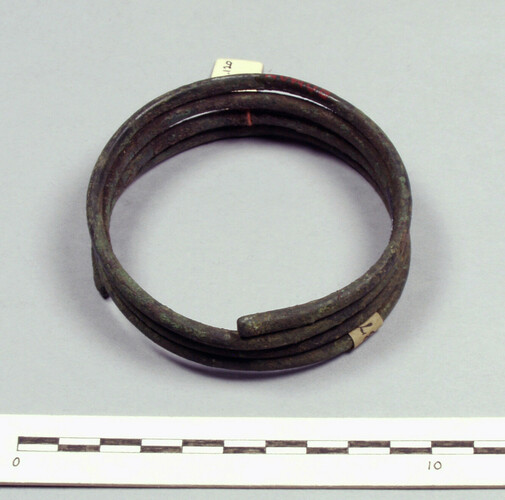 1884.82.120Spiral bronze bracelet of 4 coils, with incised linear decoration on terminals. [LM 'DCF 2004-2006 What's Upstairs?' 6/10/2005]1884.82.120
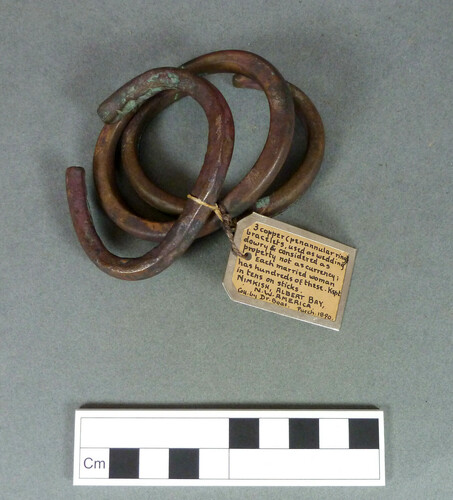 1890.39.15.2One [see 1890.39.15 .1 - .4] of a set of copper bracelets. [FB 17/09/2012]1890.39.15.2
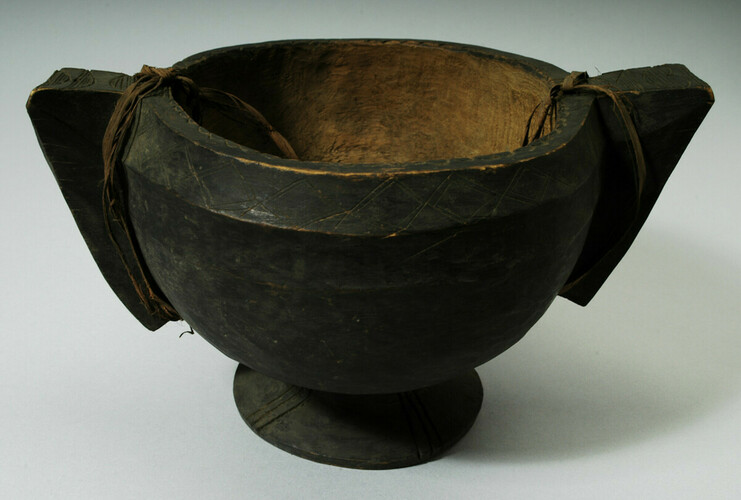 1948.2.136Deep wooden bowl with 2 lug handles and a hemispherical body on a short splaying foot, with bark carrying loop [RTS 13/5/2005].1948.2.136
 1979.20.197Light yellow wooden spoon with long pierced handle and shallow bowl, tied to 1979.20.195-6 by hide thongs [RTS 21/6/2004].1979.20.197
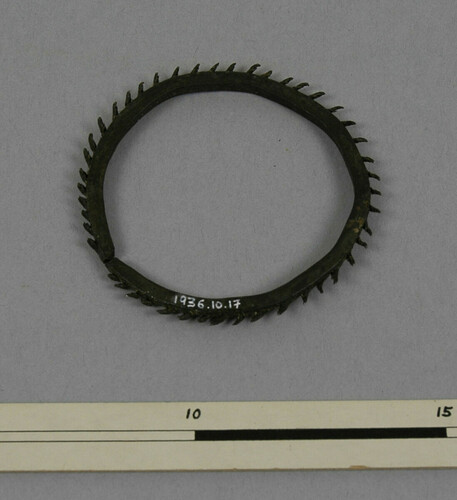 1936.10.17Iron armlet with short spikes around the edge, worn by boys during wrestling fights [RTS 4/3/2004].1936.10.17
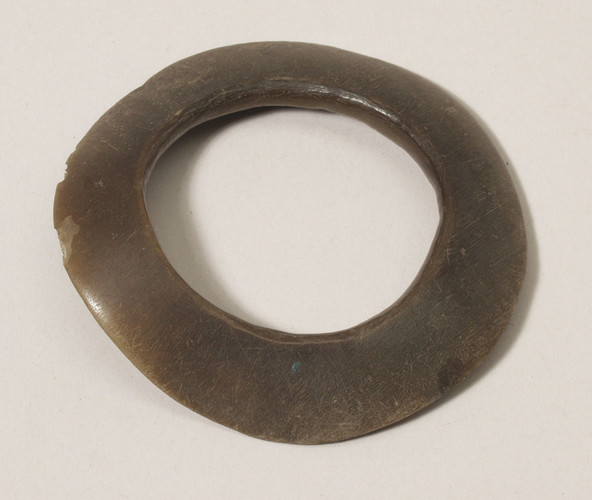 1917.25.84Annular armlet made from elephant hoof [RTS 25/3/2004].1917.25.84