
- Collection type
- Object
- Description
- Sword [.1] and sheath [.2]. [El.B 26/02/2008]
- Long description
- Sword [.1] and sheath [.2].The sword has a circular guard (tsuba) with perforations in a floral pattern, a scabbard sleeve (habaki) of copper and two brass spacers (seppa) on either side of the guard. The metal sleeve underneath the guard (fuchi) and the buttcap (kashira) have a pattern of birds. The handle is bound with textile with a gold pattern and above that with black silk braid. The sheath is of wood lacquered black with a grainy surface pattern. [El.B 26/02/2008]
- Geographical reference
- Cultural groups
- Japanese
- Date / Period
- Date made: 1700-1725
- Date collected
- By 1913
- Acquisition information
- Donated: 1913
- Materials and processes
- Material Steel Metal, Material Wood Plant, Material Copper Metal, Material Metal, Material Textile, Material Silk Yarn Animal, Material Lacquer Varnish, Process Forged (Metal), Process Carved, Process Bound, Process Perforated, Process Lacquered Varnished
- Dimensions
- Length: max 960 mm, Length: max 740 mm
- Object numbers
- Accession number: 1913.48.1.1 Accession number: 1913.48.1.2
- Research and responses
This object was examined by Francesco Civita during a visit on 5th March 2009. He agreed with Colin Langton's notes regarding the blade. In his opinion the blade is from the Takada school and it was forged 1700-1725. The blade has suffered a stress in the centre as it is slightly bent to one side. The tsuba (circular guard) is signed, but he was unable to read it. He noted that this blade is similar to 1886.1.120.1 and that they were both possibly manufactured in the south of Japan. [SM 06/03/2009]
The sword alone was the subject of neutron defraction analysis by Francisco Grazzi on the INES machine, part of ISIS, at the Science and Technology Research Council (STRC) complex at Harwell, Oxfordshire in December 2009. When the results are available the analysis will show the composition of the metal. [HR 14/12/2009]
The results of the analysis of the blade at Harwell are published in the Journal of the Institute of Conservation, Vol. 35, No. 1, 2012, 'Time-of-flight neutron diffraction: a new analytical technique for conservation?' [JU 15/10/2012]
Related Documents File - Information supplied by Colin Langton in 1998 "RESERVE COLLECTION OF JAPANESE SWORDS. BOX 1, No. 6.... Long sword, overall length, 98 cm. Black hilt braid, Black scabbard. TYPE. KATANA [sword worn in the obi, cutting edge up] blade, in BUKE [military man, samurai] ZUKURI [sword] KOSHIRAE [sword mountings or fittings]. SUGATA [sword mountings or fittings]. SHINOGI [ridgeline of the blade] ZUKURI [sword], high IHORE MUNE [peaked back ridge], very shallow KOSHI SORI [curve of the blade is near the hilt] (deepest part of the blades curvature is just above the hilt), almost KO [old or small] KISSAKI [point of blade]. NAGASA [blade length]. 70.4 cm, MOTOHABA [blade width near habaki] 29 mm, SAKIHABA [blade width at yokote] 19 mm, KASANE [thickness of blade] 6.5 mm. HI [grooves in the blade]. fullers, KOSHI BI (short fuller with round ends) on the URA [side of the nakago facing toward the body] side, GOMABASHI [parallel grooves] (two short thin fullers like chop sticks) on the OMOTE [signature side of the nakago] side. JIHADA [surface pattern of the hada]. is not visible, probably MOKUME HADA [burl like hada]. HAMON [temper pattern along blade edge]. O MIDARE [large irregular hamon], YAKI KUZURE [crumbling or disintegrating], lots of TOGARI [pointed] BA mixed in with GUNOME [undulating hamon] in NIOI [cloud like hamon] DEKI [composed of nioi], thin HABUCHI [the line of the hamon], see diagram, NIOI DEKI is a very fine crystalline structure of the steel at the border of the hardened edge, which is what one would expect to find on a blade of this school. BOSHI [temper line in kissaki (point)]. is not clear but looks to be CHU SUGUHA [straight, medium width temper line], which again is what would be expected, KO MARU [small round boshi] with short KAERI [turnback (refers to the boshi at the mune)], see diagram. NAKAGO [sword tang]. On the short side and very tapered, sharp HA [cutting edge] AGARI KURI JIRI [rounded nakago jiri], KATTE SAGARI YASURIME [file marks on nakago] on the OMOTE [signature side of the nakago] side, KATTE AGARI on the URA [side of the nakago facing toward the body] side, i.e. the file lines are gently sloping on both sides of the tang, but in opposite directions, one MEKUGE [sword peg] ANA [hole for mekugi] see diagram. [Drawing] MEI [swordsmith's signature]. smiths working name, 2nd or 3rd generation circa 1661 to 1716 i.e. TOMOYUKI OF BUNGO PROVINCE. Bungo province is located on the island of KYUSHU, second of the main islands found in southern Japan, it is common to find blades made in this province to have TEMESHI MEI i.e. the results of cutting tests inscribed on the tang. Comments on the blade. The shape of this blade reflects the period of its manufacture quite well it has a strong MINO DEN (Mino school), influence in the Hamon with TOGARI BA in NIOI DEKI, Bungo blades are generally known for their practical qualities rather than their artistic ones, and the maker of this blade is not highly rated, the blade has suffered some stress as there is slight bending at its centre, though blades of the above province from the 13th to the 16 cent are highly regarded. KOSHIRAE [sword mountings or fittings]. Is typical in style for a Katana though plain and not in to good a condition, the Saya is plain black lacquered in a MOKUME (burl wood grain) pattern, and is faceted along the URA side, the KOJIRI [end of the scabbard] is missing. Tsuka [sword handle]. hilt, a gold material instead of SAME [rayskin used for tsuka (handle) covering] under the ITO [silk or cotton hilt wrapping] MAKI, which has suffered some damage, there are no MENUKI [hilt ornaments]. TSUBA [sword guard]. of a plain and round form, one RYO HITSU [holes in the tsuba for the kozuka or kogai] and a pierced decoration unidentified form." [Drawing] [EB 5/11/2001]
-The results of the analysis of the blade are published in the Journal of the Institute of Conservation, Vol. 35, No. 1, 2012, 'Time-of-flight neutron diffraction: a new analytical technique for conservation?' [JU 15/10/2012]
- Associated publications
- The results of the analysis of the blade are published in the Journal of the Institute of Conservation, Vol. 35, No. 1, 2012, 'Time-of-flight neutron diffraction: a new analytical technique for conservation?' See RDF [JU 15/10/2012]
Further items to explore
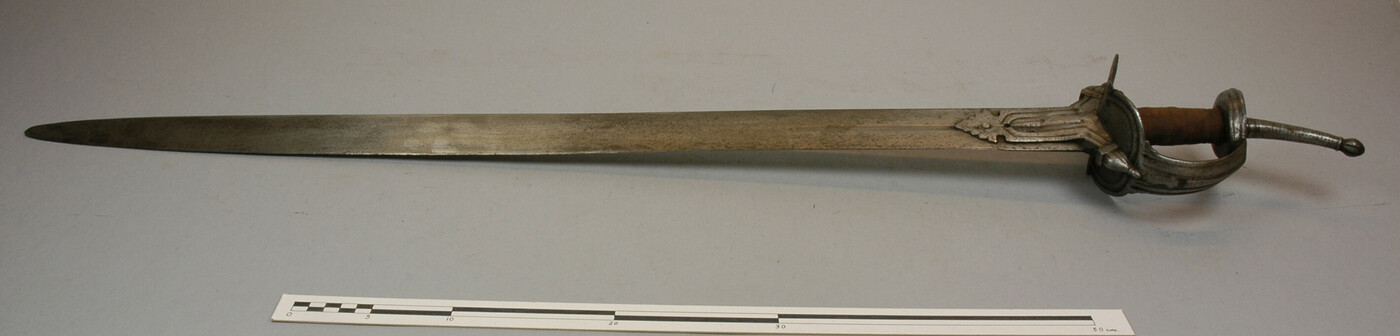 1909.78.18Sword with straight, tapering, double-edged pointed blade (probably European), decorative langets, 'Hindu Basket' hilt and cloth-bound grip. [LM 07/11/2007]1909.78.18
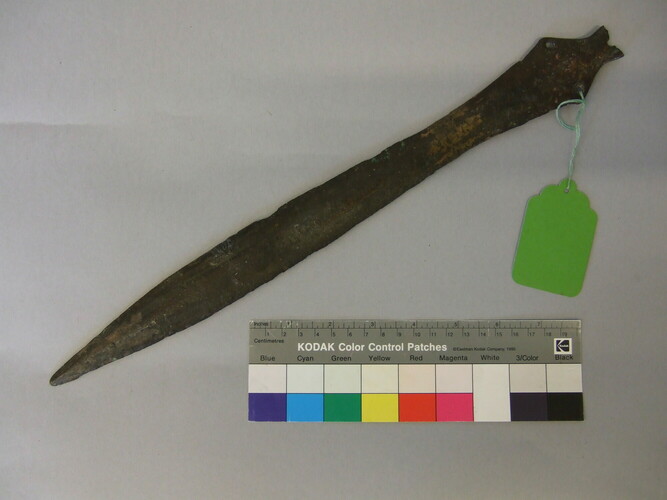 1884.119.298Bronze sword blade.1884.119.298
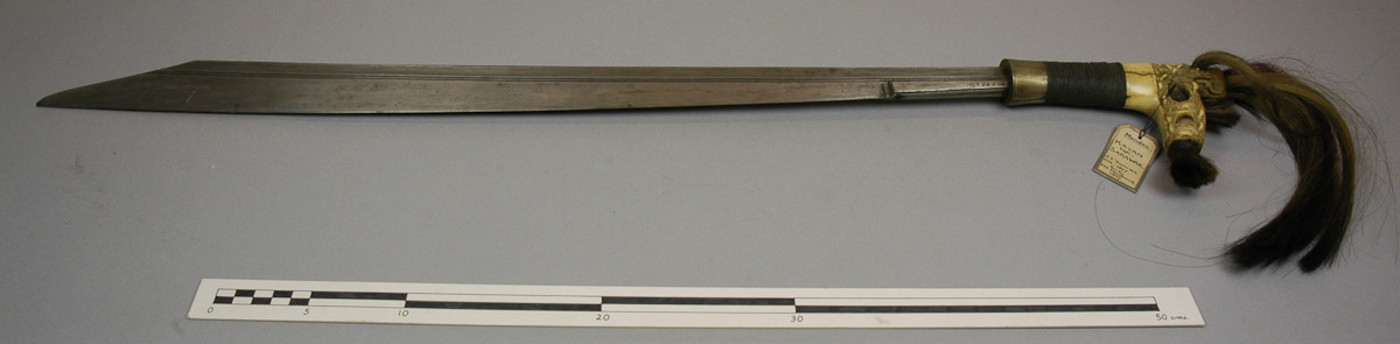 1927.54.2Sword with grooved blade and carved hilt. The hilt is inlaid with ?shell also has a dyed hair decoration. [SM 19/12/2007]1927.54.2
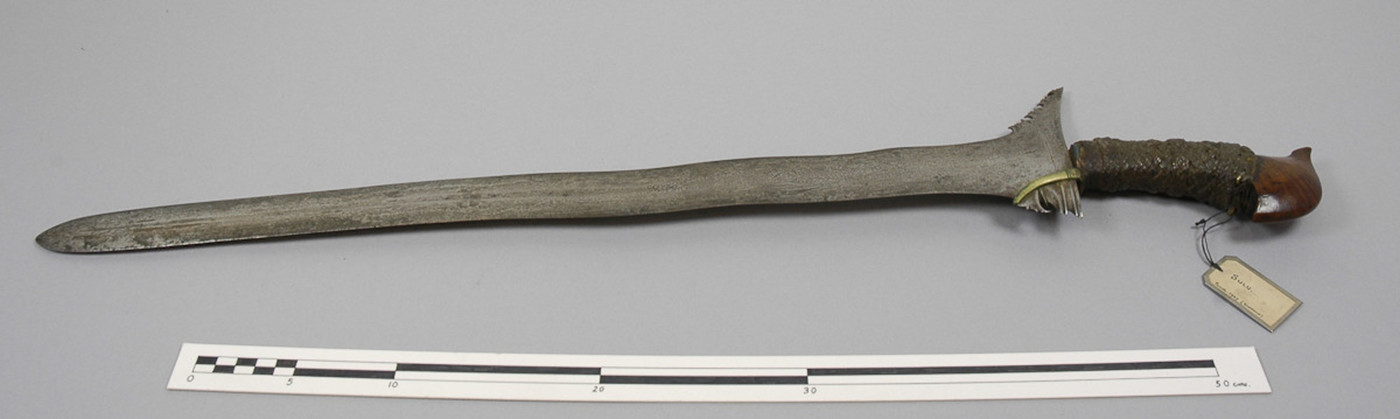 1907.72.45Sword or dagger with very slightly wavy blade with fretted projections at the hilt. The grip is wound with plaited string and seems to be varnished, the pommel is of wood and carved into a curved shape. [El.B 2/3/2007]1907.72.45
 1920.16.13.11.2Blade of a short Japanese sword, wakizashi. Part of complete suit of Japanese armour. [El.B 25/4/2007]1920.16.13.11.2
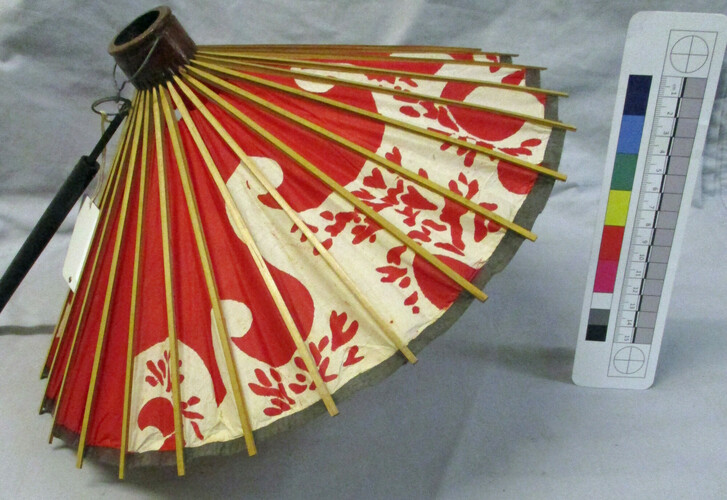 1989.44.52Paper lantern which opens to a conical form and is suspended from a telescoping bamboo handle. When closed, the bamboo ribs form a cylinder with the metal candle prick at the open end of the body below the metal wire suspension arch. To open, the bamboo ribs are splayed slightly to reveal a wooden knob which is pulled down bringing the candle into the body and opening the paper lantern. The paper body is red with white flowers on the upper section and the base is white with red flowers around the knob/candle holder. [MOBB [OPS move] 20/06/2016]1989.44.52
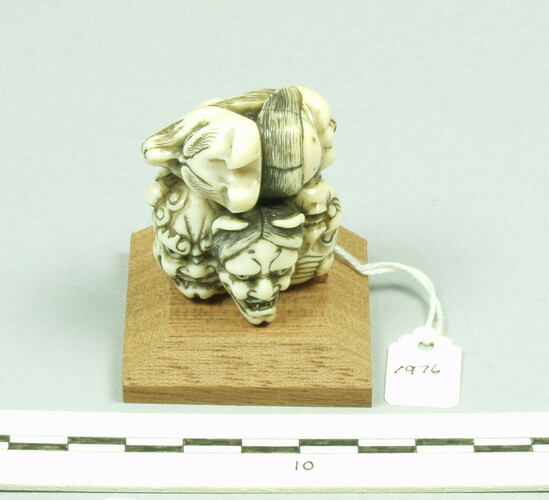 1980.34.1976Ivory netsuke of group of 7 masks. [N.B. 'DCF 2004-2006 What's Upstairs?' 28/4/2005]1980.34.1976
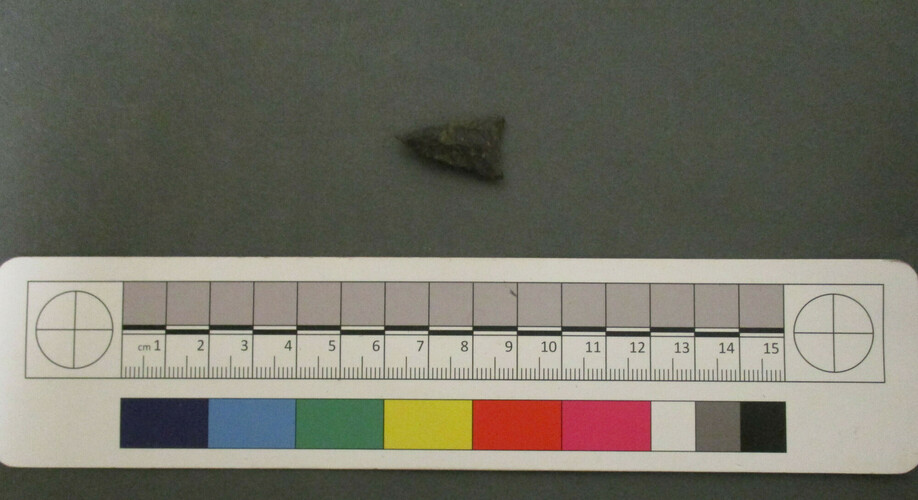 1985.53.991Arrowhead of black flint, triangular. [El.B 16/12/2013]1985.53.991