
- Collection type
- Object
- Description
- Sword or dagger with very slightly wavy blade with fretted projections at the hilt. The grip is wound with plaited string and seems to be varnished, the pommel is of wood and carved into a curved shape. [El.B 2/3/2007]
- Geographical reference
- Sabah Sulu Archipelago
- Date / Period
- Date made: Before 1907
- Date collected
- Before 1907
- Acquisition information
- Purchased: 1907
- Materials and processes
- Material Steel Metal, Material Wood Plant, Material String, Material Varnish, Process Carved, Process Bound, Process Plaited, Process Forged (Metal)
- Dimensions
- Length: max 710 mm
- Object numbers
- Accession number: 1907.72.45
- Research and responses
The large number of keris forms reflects the wide distribution of this weapon across Malaysia and Indonesia. There are seven major recognised areas of keris manufacturing: Java, Bali, Madura, Sumatra, the Malay Peninsula, Moro (Mindanao, Philippines) and Sajen. As far as can be deduced from bas relief depictions of warriors on the friezes of Buddhist temples, the keris had its origin on Java some time around the 14th century, spreading westwards and eastwards in following centuries (Egerton, 1896; Maisey 1998). The keris is a distinctive weapon, with an asymmetrical rapier-like blade adapted for stabbing, and a quite unique ‘pistol-grip’ hilt – significantly more ergonomic for the actual act of stabbing than almost all other rapier forms. We see such asymmetrical hilts in later European cavalry sabres, although this was a late development, and never popular. Keris were also used for rapid execution in certain Malay states, being thrust down diagonally behind the collarbone, through the lung and into the heart. Death was instantaneous. Perhaps the most distinctive characteristic of keris after the unique blade shape is that of pamor or pattern-welding. This is often mistakenly described as a form of damascening, although the two processes are completely different. Whereas damascening in the true Indo-Persian tradition is achieved through the slow cooling of the forged steel over days, encouraging the natural formation of crystalline structures of Martensite steel and Cementite iron, pamor is achieved through the artificial layering of wires or plates of pig iron and meteoric nickel steel, which are then folded and rippled into specific patterns. This technique is only known outside of the range of the keris in Japan, although the Japanese technique is considerably more limited than the Malay-Indonesian. Several different forms of pamor patterning are achievable, which can give the blade a wood-like grain, spots like leopardskin, and so on. The pamor was historically believed by Javanese people to impart certain mystical powers to the blade (Maryon, 1960; Frankel, 1963). Keris were traditionally understood to have great mystical power among the Malay people, and each was believed to be inhabited by a spirit. The nature of the keris’ spirit is reflected by its pamor, and by the blade shape or dapur. It was considered important for a prospective owner to acquire a keris whose spiritual persona was compatible with his own. Some keris were transmitted through family lineages as heirlooms. Keris Parts Terms: Blade (Wilah); Asymmetrical Blade Base (an additional welded fillet) (Ganja); Pistol-Gripped Hilt (Ukiran); Scabbard (Sampir or Warangka); Wide Scabbard-Mouth Piece (Batang). Research Conducted for DCF Cutting Edge 2006/2007 [AM].
Recommended Reading: Annandale, N. & Robinson, H.C. (1903) Fasciculi Malayenses: Anthropology Part I. London: Longmans, Green & Co. Frankel, J.P. (1963) The Origin of Indonesian ‘Pamor’. In Technology & Culture, Vol.4, No.1, pp.14-21. LaRocca, D. (1996) The Gods of War: Sacred Imagery & the Decoration of Arms & Armour. New York: Metropolitan Museum of Art. Maisey (1998) Keris Website: www.nikhef.nl/~tonvr/keris/keris2/origin.html. Maryon, H. (1960) Pattern-Welding & Damascening of Sword-blades – Parts 1 & 2. Studies in Conservation, Vol.5, No.1. Shelford, R. (1901) A Provisional Classification of the Swords of the Sarawak Tribes. In Journal of the Royal Anthropoogical Institute, Vol.31, pp.219-28. [2006/2007 AM]
Further items to explore
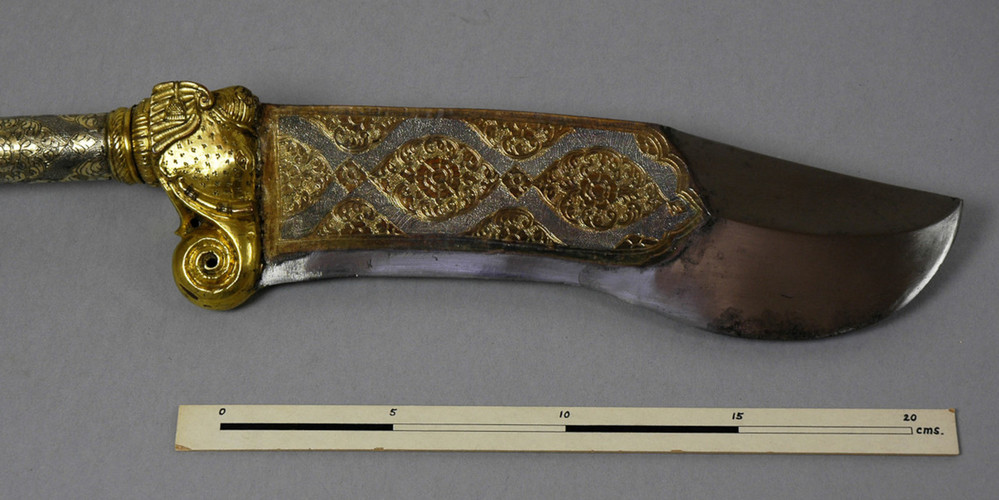 1915.48.69.1Battle-axe gilt and silvered with ogee-outlined blade [.1], the haft contains a small dagger [.2]. [SM 12/04/2007]1915.48.69.1
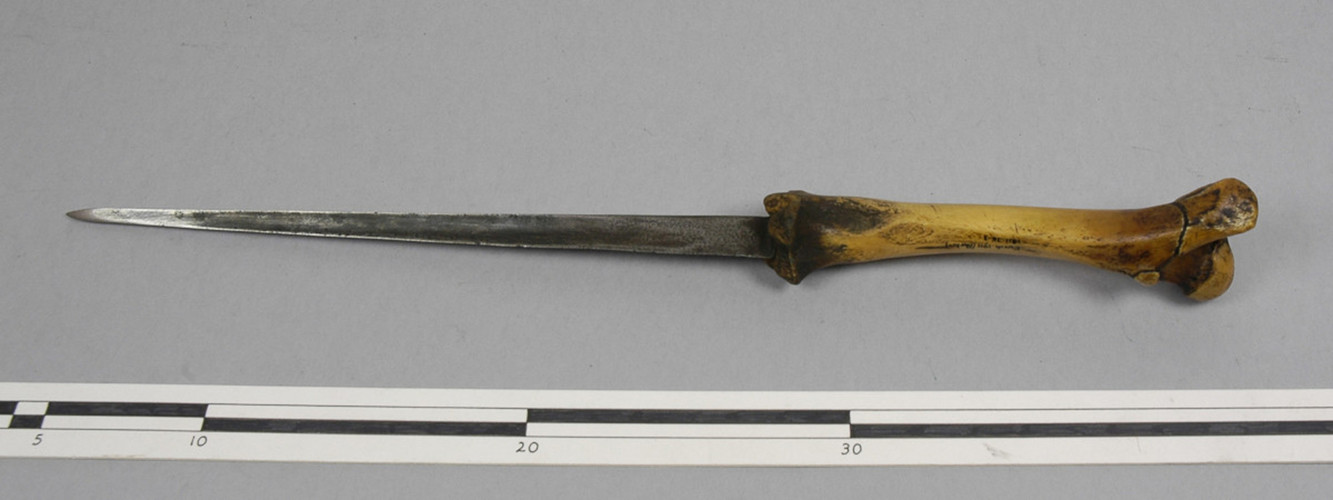 1911.74.3Dagger with blade with triangular section (recycled from a bayonet blade) fitted with a bone as a handle. [El.B 26/06/2007]1911.74.3
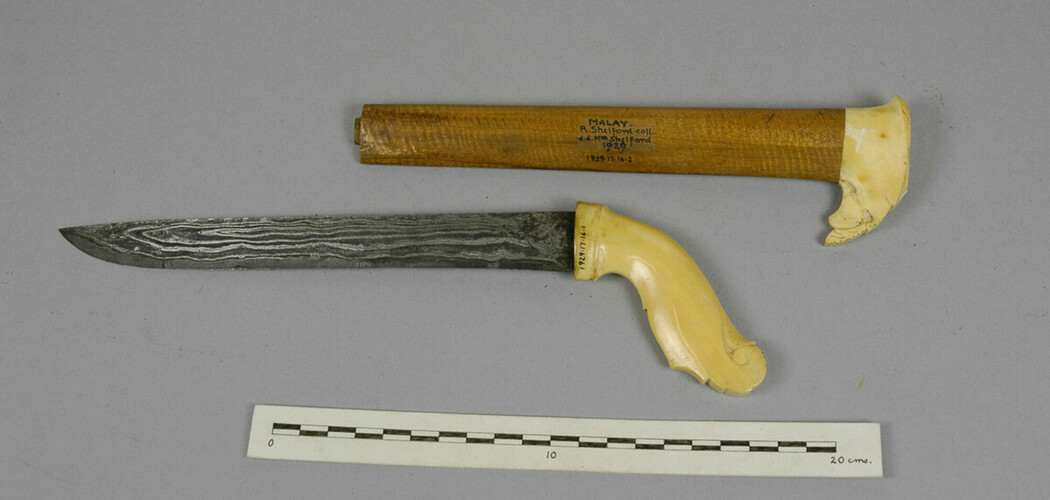 1929.17.16.1Kris [.1] with straight blade, with ivory handle shaped like a pistol grip. With wooden sheath [.2] with ivory crosspiece. [El.B 30/5/2007]1929.17.16.1
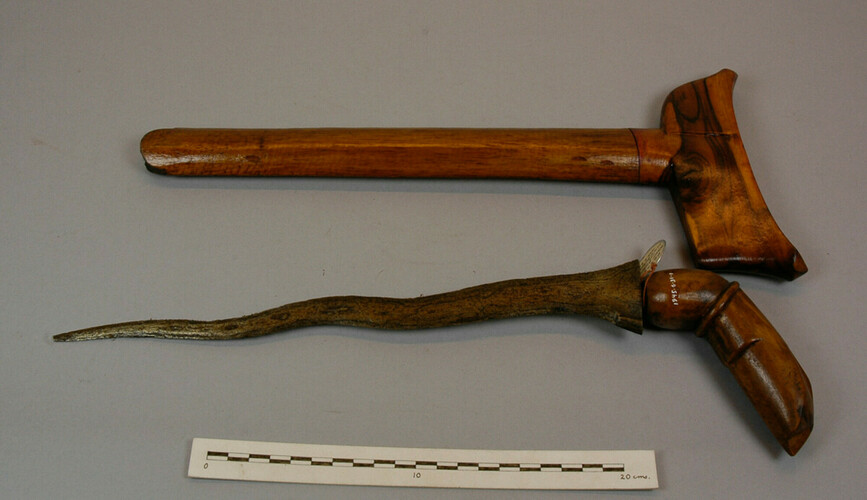 1945.6.31.1Keris [.1] with wavy blade, wooden hilt and wooden sheath [.2]. [El.B 12/12/2007]1945.6.31.1
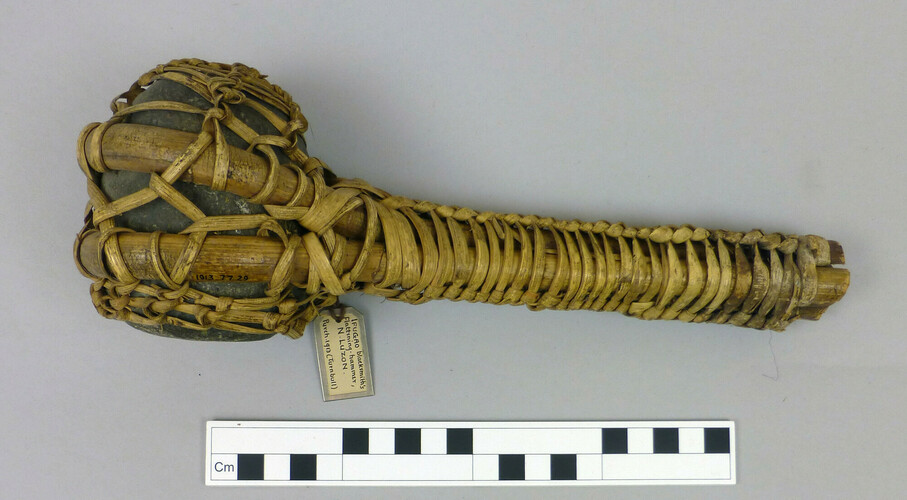 1913.77.29Blacksmith's hammer with stone head and cane haft. [SM (Verve) 28/07/2014]1913.77.29
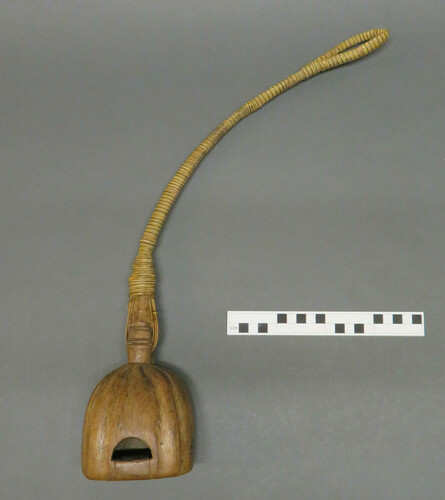 1935.69.23.3Wooden stirrup. The stirrup is domed and hollowed out with a flat base, with a panel of carved decoration on a flat edge and a cut out semi-circular piece on the curved face. A long strap of cane is attached to the top of the stirrup through a circular hole in the wood. One of a pair of stirrups, the other being [1935.69.23 .4] [EH [OPS Move] 31/3/2017]1935.69.23.3
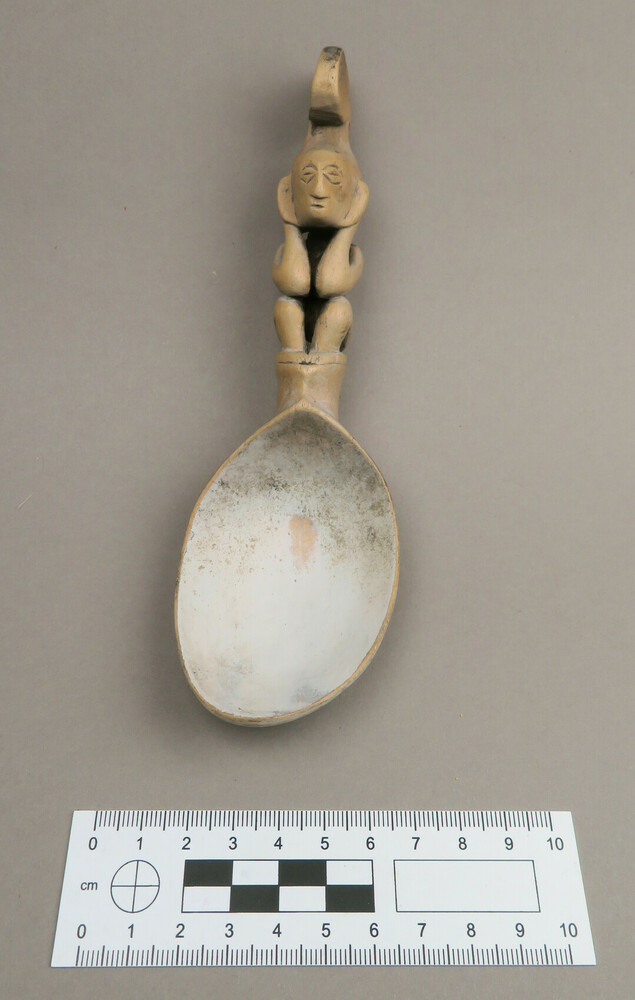 1913.77.12Rice spoon with handle carved in human form. [DCF Court Team 6/11/2002]1913.77.12
 1935.69.12Bow, made from palm wood. [ASh [OPS move] 10/7/2017]1935.69.12