
- Collection type
- Object
- Description
- Tzute, a square cloth made from two woven lengths of red cotton decorated with supplementary weft brocaded motifs in various colours.
- Long description
- Tzute, a square cloth made from two woven lengths of cotton decorated with single-faced supplementary weft brocading. The ground-cloth is red with yellow pinstripes and narrow decorative stripes in yellow, green, and shades of blue and purple. The two panels are joined by a blanket stitch in yellow, green and magenta cotton. The single-faced supplementary weft brocading comprises six rows of repeated motifs in yellow, green, blue, purple and pink cotton. The motifs include a repeating maize design, interlocking chevrons and M-shapes, human figures and other complex designs.
- Geographical reference
- Cultural groups
- Mam
- Date / Period
- Date made: By 1979
- Date collected
- Purchased between 1977 and 1979
- Acquisition information
- Donated: 19 June 2023
- Materials and processes
- Material Cotton Textile Plant, Material Cotton Yarn Plant, Process Woven, Process Stitched, Process Supplementary Weft Woven, Process Brocaded Woven
- Dimensions
- Length x Width 1210 x 1110 mm
- Object numbers
- Accession number: 2023.37.23 Other numbers: C 30
- Research and responses
Information supplied by the collector/donor Krystyna Deuss:
The municipality of Colotenango includes not only the lower lying lands around the town but also hamlets in the high Cuchumatán mountains to the north at altitudes of over 2,000 metres.
The township of San Rafael Petzal used to belong to Colotenango before 1890, so people there use the same dress. However, changes in dress styles have been slower in San Rafael than in Colotenango and in the late 1980s there were several men still dressed in white with traditional home woven sashes (2023.37.18) and su’tes (2023.37.22).
There is no difference in design between male and female sashes (2023.37.19, 2023.37.20), or in the red striped and brocaded su’tes (2023.37.23). However, the oldest sash and su’te in my Colotenango collection came from Diego Sales, an old man in San Rafael Petzal. The ground cloth of both items was woven by his wife in solid red German rayon, either without or with barely distinguishable orange stripes (2023.37.18, 2023.37.22). There is a difference in how men and women wear their su’tes and sashes. Women tie their sashes at the back and use their su’tes to carry shopping, cover their baskets, or shield their heads from the sun. Men tie their sashes in front, sometimes tucking the ends out of sight, and wear their su’tes slung over one or both shoulders.
See Related Documents File for more detail. [JMC 26/11/2024]
Search terms: Clothing Textile, Clothing, Textile
Further items to explore
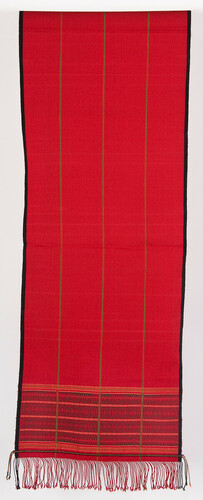 2008.54.6.2Woman's shawl to be worn with skirt 2008.54.6 .1 [MdeA 25/07/2008]2008.54.6.2
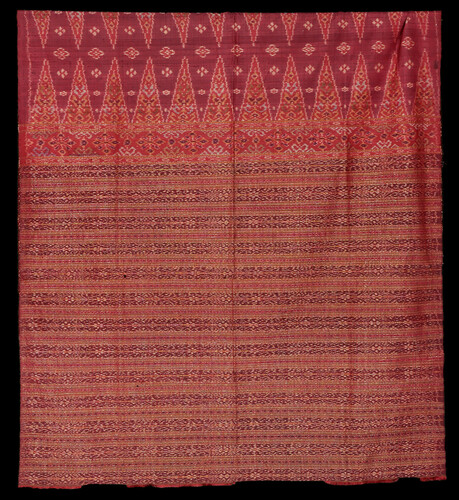 2003.69.82Maroon coloured silk textile decorated with ikat and gold thread. [JP 16/5/2003]2003.69.82
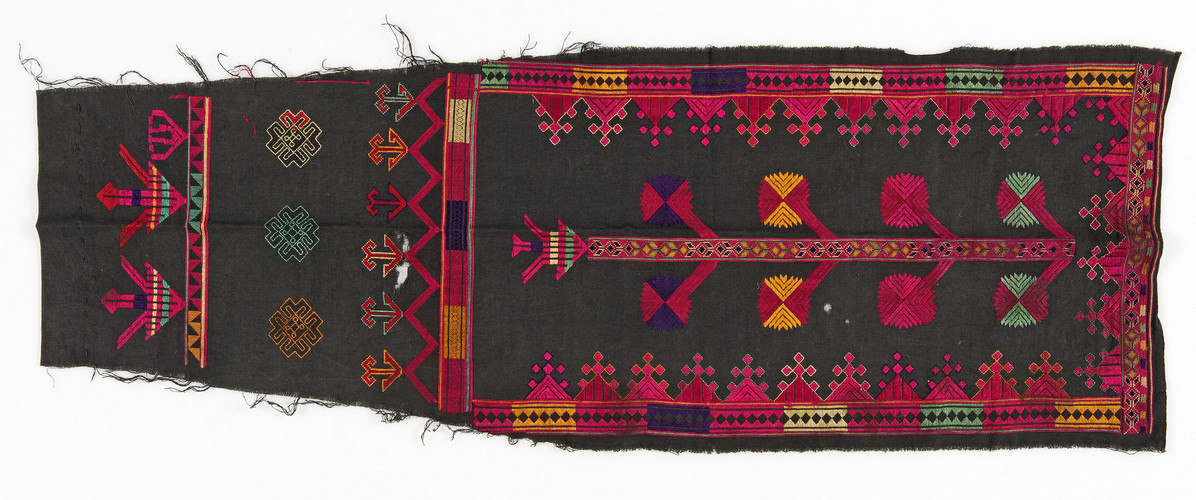 2008.116.8Black cotton embroidered rifle cover. [FC 14/12/2009]2008.116.8
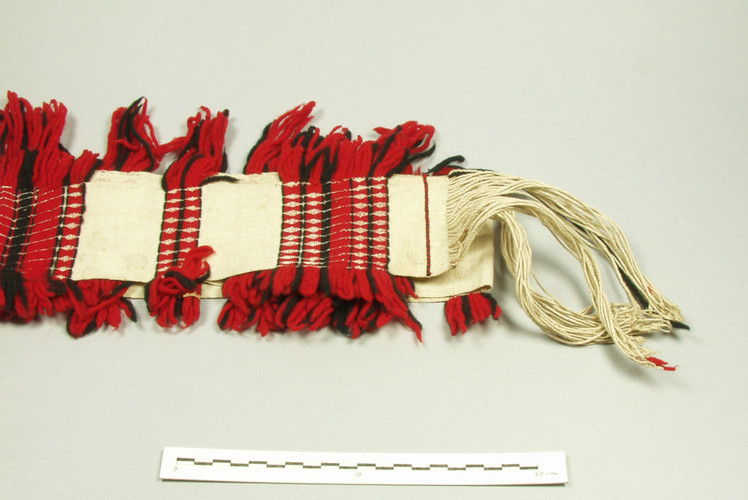 1923.54.4.1A pair of sashes [.1 - .2] or baldrics with end and side fringes [L.Ph 'DCF 2004-2006 What's Upstairs?' 1/7/2005]1923.54.4.1
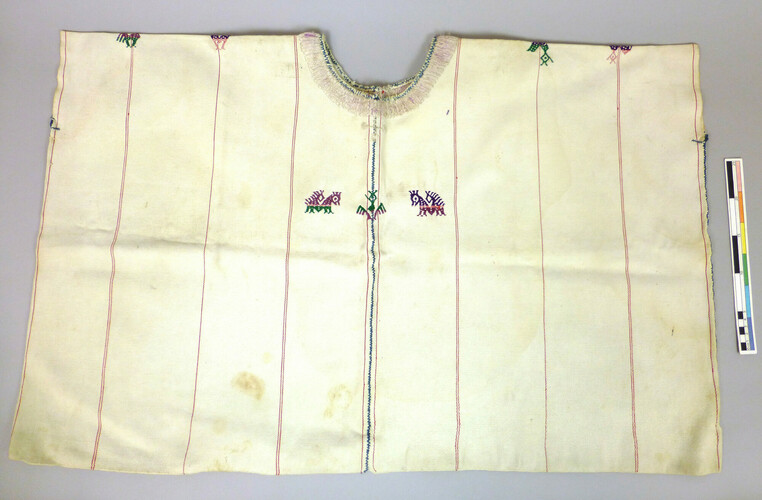 2012.104.12Woman's blouse, huipil. [FB 01/11/2013]2012.104.12
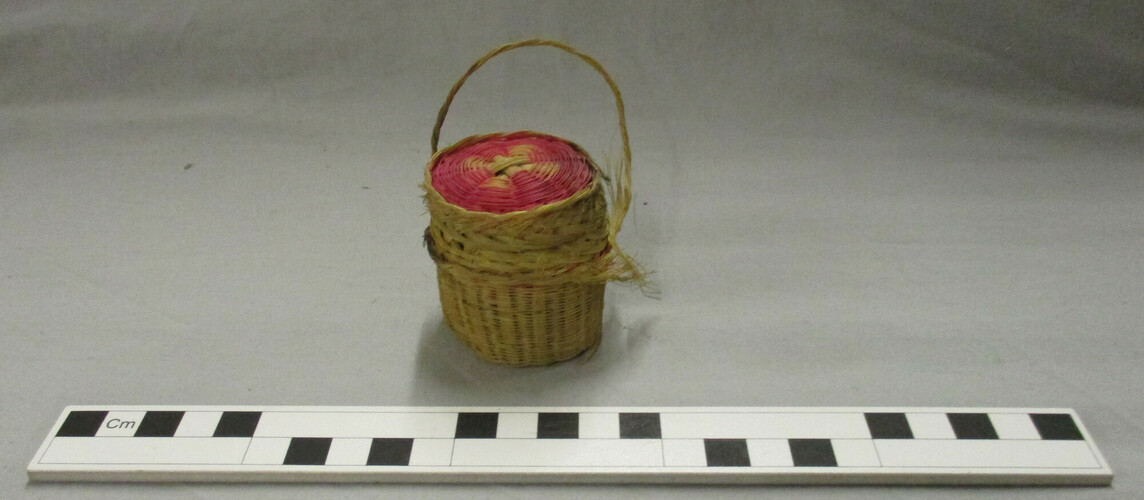 1985.36.196Round basket with a fine handle for carrying, with a lid. [ASh [OPS move] 02/06/2016]1985.36.196
 1951.11.127Gourd cup painted in bright colours [N.B. 'DCF 2004-2006 What's Upstairs?' 14/3/2005]1951.11.127
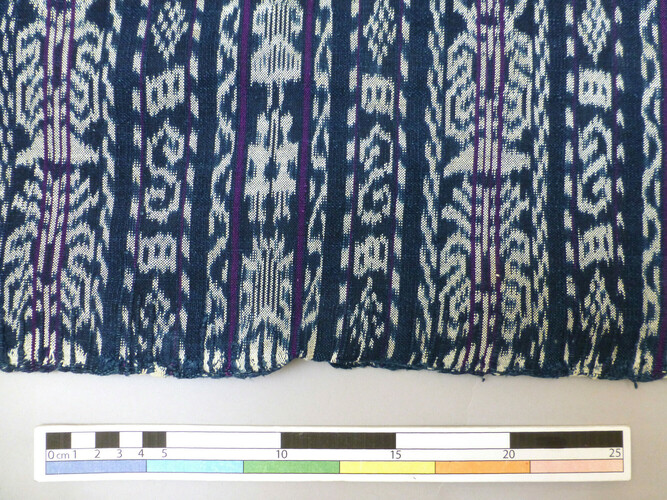 2012.104.33Tubular skirt of indigo cotton with resist-dyed patterns in bands. [FB 05/03/2014]2012.104.33