
- Collection type
- Object
- Description
- Knife or shortsword. The short broad leaf-shaped blade of 'modified ogee' section, with central ridge, curving grooves or fullers and black paint, is tanged into a wooden handle. The pommel is cylindrical with a thick carved ring below it. [LM 04/09/2007]
- Geographical reference
- Kasai District Kwilu River Region
- Cultural groups
- Kuba
- Date / Period
- Date made: Before 1905
- Date collected
- 1905 - 1906
- Acquisition information
- Donated: 1907
- Materials and processes
- Material Iron Metal, Material Wood Plant, Material Pigment, Process Forged (Metal), Process Carved, Process Grooved, Process Painted
- Dimensions
- Length: max 347 mm, Width: max 95 mm
- Object numbers
- Accession number: 1907.21.26
- Research and responses
This Kuba knife / shortsword is an Ikul – the ubiquitous knife of all adult men. The sword served as a symbol of adult masculinity for the Kuba. The Kuba are notable for the importance of blacksmithing, and the bearing of weaponry, within their cultural elaboration of the institutions of class, gender, and the Kuba kingship as a whole. Smithing was (alongside weaving and a select few other arts) considered a royal art. There are certain kinds of Ikul (those bearing a conical pommel) which were first designed and created by King Shyaam aMbul aNgoong in the early 17th century (Spring, 1993: 88-9), and carried by those Kuba of the ruling Bushoong clan as a symbol of peaceful reign. This, however, is the more conventional form of Ikul, worn by those men of the other Kuba clans, which has a flat pommel incised with an attractive interlaced design very reminiscent of the weaving to be seen on Kuba mats and the Kuba spear across the gallery. This shortsword exhibits a distinctive feature of a number of Central African blades, which is the Z-shaped section termed ogee by some scholars. The blade has attractive curved fullers, and the two sides of the blade on each side present a negative of each other, enhanced by the application of black paint. Research Conducted for DCF Cutting Edge 2006/2007 [AM].
Search terms: Weapon, Tool, Ritual and Ceremonial, Knife, Sword
Further items to explore
 1906.1.5Straight Dervish knife [1906.1.5], with two other knives [see entries 1906.1.4, 1906.1.6.1] and a triple sheath [see entry 1906.1.6.2] [SM 20/06/2007]1906.1.5
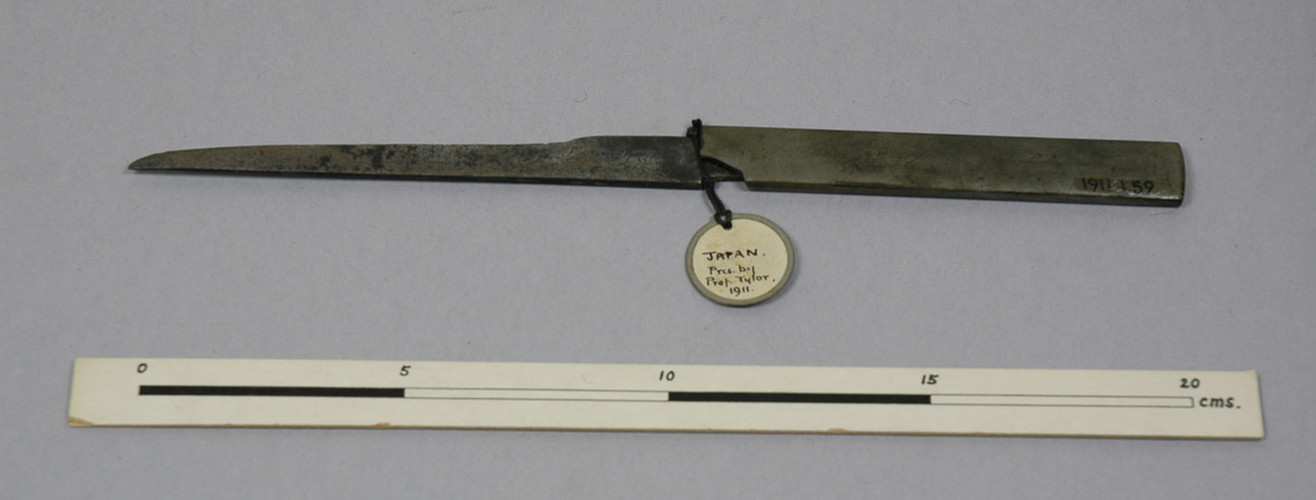 1911.1.59Knife with single edged iron blade and non-magnetic metal handle. [SM 30/03/2007]1911.1.59
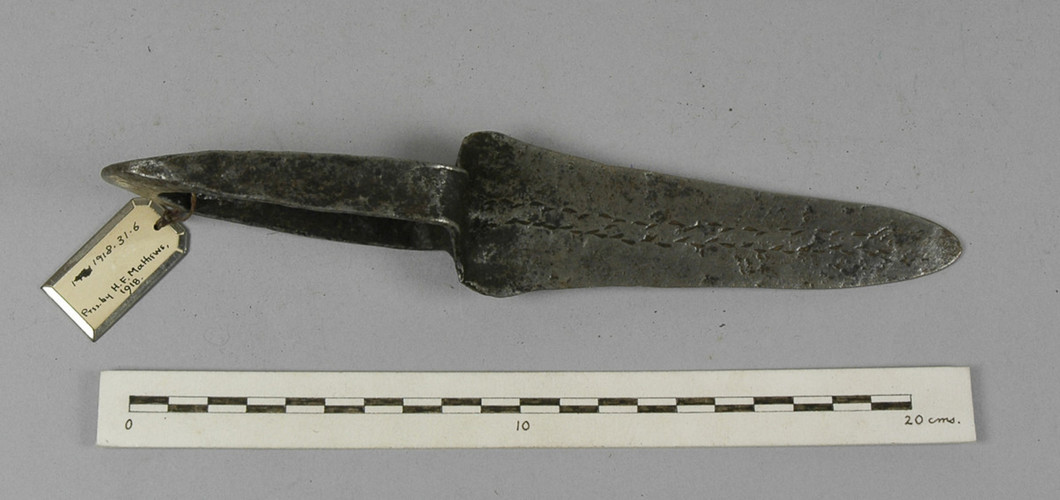 1918.31.6Ring-handled iron dagger with blade with rounded tip and lines incised on it. [El.B 7/6/2007]1918.31.6
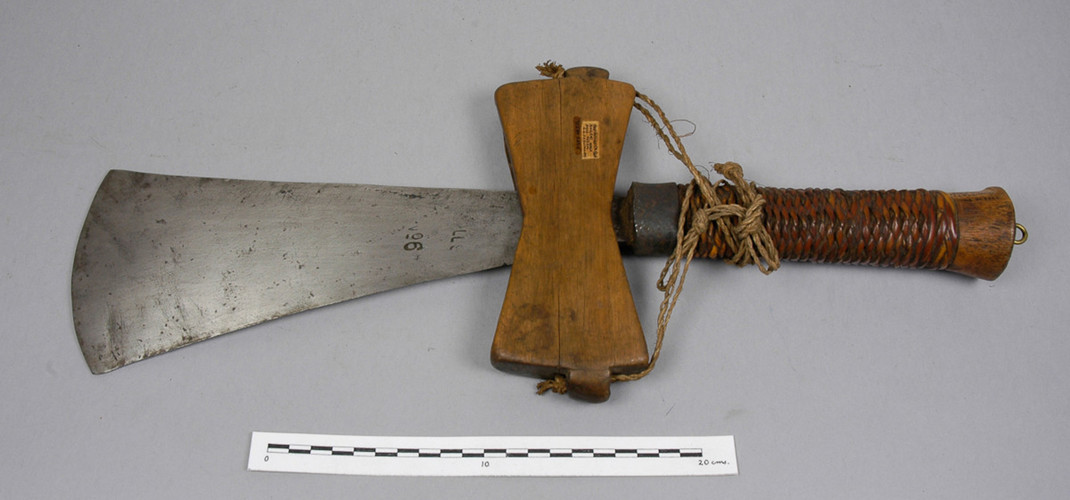 1923.84.535.1Dao [.1] with flared single edged blade and wooden handle bound with cane, in a wooden sheath [.2]1923.84.535.1