
- Collection type
- Object
- Description
- A house beam styled after a soul-catcher, with a killer whale design. [CAK 26/05/2010]
- Long description
- A house beam styled after a soul-catcher, with a killer whale design. The beam is displayed vertically in the museum as a post, although its proper orientation is horizontally as a beam or lintel. The two halves of the beam are mirror images, with a killer whale head on each end and a symmetrical human figure in the centre. The whales are depicted with a large round black eye set within a white circle. Between the eye and the snout is a split-U design with brown and green elements. The snout is brown as is the outline of the mouth. Within the mouth are two rows of teeth - top and bottom - painted white. Under the eye is a split-U design featuring green cross-hatching. Each killer whale has a fin that runs along the bottom of the beam. The fin is decorated with a face in black and white, with a mouth with teeth, small nose and ovoid eyes. Moving to the tip of the fin from the face is a green and brown design. Behind the killer whale heads are white S-shaped patterns with a central green S-shape outlined with a thin brown line. In the centre of the beam is a crouched human figure with knees tucked under the chin and hands tucked under the jaw. The mouth is closed and decorated with brown paint, while the nose, eyes, and eyebrows are accented with black paint. What would be the bottom of the beam is plainly carved and painted white. As it stands vertically, the 'bottom' of the beam consists of an unpainted carved segment that may have been where the beam was attached to the structure of the house. At the top of the beam are two cut-aways where two fins would likely have been attached (see Research Notes). [CAK 26/05/2010] Previous description: A large house post, carved with totems, used as a support in an Indian house at Fort Simpson which belonged to a sub-chief of the Kit-spak-lots branch of the Tsimshian. This one represents the killer whale with the demon Skana inside it.
- Geographical reference
- British Columbia Haida Gwaii (Queen Charlotte Islands) Massett Fort Simpson
- Person
- Field collector Edward Burnett Tylor
- PRM source Edward Burnett Tylor
- PRM source Oxford University Museum of Natural History
- Date / Period
- Date made: Before 1887
- Date collected
- By 1887
- Acquisition information
- Donated: 1887, uncertain Transferred: 1887, uncertain
- Materials and processes
- Material Wood Plant, Material Pigment, Process Carved, Process Painted
- Dimensions
- Height: max 2805 mm, Width: max 610 mm approx
- Object numbers
- Accession number: 1887.22.2
- Research and responses
The following information comes from Haida delegates who worked with the museum’s collection in September 2009 as part of the project “Haida Material Culture in British Museums: Generating New Forms of Knowledge”:
This beam was viewed on Monday Sept 14, 2009. Delegates characterised this as ‘definitely Haida carving’. Christian White explained that the eyes are definitely Haida, and that the colours suggest it was a Kaigani Haida house beam. Jaalen Edenshaw offered that even if this pole was collected in another group’s territory, it was made by a Haida carver.
The orientation of this ‘pole’ should be as a ‘beam’ or lintel. It was described as being modelled after a soul-catcher. Delegates thought it likely this was originally paired with another lintel, perhaps the one shown in George MacDonald’s ‘Haida Art’ book, held in the collections of the Canadian Museum of Civilization (CMC). The similarity between the two beams is so great that Jaalen Edenshaw and Kwiaahwah Jones (both familiar with the photo in the book) thought that this was the same object. Ruth Gladstone Davies wondered if the two beams fit together at one time, to create a beam in the round, rather than two separate beams. The fins are missing from the killer whale. Kwiaahwah Jones added that if the fins were painted solidly black, then the killer whale is an Eagle crest, however if they were striped or spotted white, then they the whale would be a Raven crest. The example in ‘Haida Art’ has solid black fins, indicating that one belonged to an Eagle person. Delegates suggested that measurements be taken of this beam and the beam at the CMC, including dimensions for where the fins would have been attached, to see if they match.
Delegates requested the label describing the killer whale as a ‘demon’ spirit be removed as this is extremely offensive. This is a mistranslation of the word sgaana, which translates as both killer whale and spirit. However, as killer whales are the most revered supernatural being for Haidas, it is deeply troubling and inaccurate for them to be described as demons.
The research session with this beam can be viewed on Tape 8, time 33:00 to 36:00 and at the start of Tape 9, which can be found in the Haida Project Related Documents File. [CAK 01/06/2010]
These were previously thought to be Haida, from Masset, Queen Charlotte Island, but Dr. Douglas Cole of Simon Fraser University, BC, identified them through the Tylor correspondence. (See RDF).
.1 HOORTS the bear killing TOIVATS the hunter - the ancestral totem of the 'Bear' clan. .2 the killer whale (ORCA ATER) represented with the demon SKANA residing within it.
The Canadian Museum of Civilization has in its collections what appears to be a duplicate, or very similarly carved, house post in its collections. In "Haida Art", by George MacDonald, this post is both described and illustrated. MacDonald has orientated the post as a beam, and draws attention to its similarities with soul catchers. He attributes its collection to George Emmons, and identifies the beam as Haida. A copy of the image and description from the book have been placed in the RDF. The beam in the CMC's collection still has two dorsal fins. Examination of the post/beam in PRM's collection shows two locations where dorsal fins may have at one time been attached. [CAK 02/09/2009]
It should be noted that Tylor's 1898 publication on the house post recognises a dual meaning for the word 'Skana' (or 'Sgaana') in the Haida language. Tylor is accurate in his translation of the word as 'killer whale', though less accurate in his translation of the word as 'demon'. He does, however, note that the second meaning of 'skana' can be 'spirit'--a much less malicious connotation, and closer to the Haida usage of the word. It is unclear where the description of the post (using Haida vocabulary) originated. [CAK 02/09/2009]
- Associated publications
- Illustrated in black-and-white and discussed at length in 'On Two British Columbian House-Posts with Totemic Carvings, in the Pitt-Rivers Museum, Oxford by E. B. Tylor in Journal of the Anthropological Institute, Vol. I (1898), pp. 136-7. [JC 22 5 1996] Illustrated (sketch only) on page 7 of Birds and Animals: A Pitt Rivers Museum Colouring Book, by Francia Turner and Julia Cousins (Oxford: Pitt Rivers Museum, University of Oxford, 1986). Caption (same page) reads: 'Whale. This is a killer whale with the demon, Scana, living unside. It was made by the Haida people of British Columbia. Each group of the Haida has a special animal which is their emblem.' [JC 10 9 2004] Discussed briefly on pages 538-40 of Totem poles, by Marius Barbeau (Hull, Quebec: Canadian Museum of Civilization, 1990 [1950]). [CW 16 5 2001] Illustrated in colour on page 13 of The Pitt Rivers Museum: A World Within, by Michael O’Hanlon (London: Scala, 2014). Caption (page 12) reads: ‘4 (opposite) House beam (tip) with killer-whale design. Haida people, British Columbia, Canada Height 2805 mm Donated by E.B. Tylor 1887.22.2’ [MJD (Verve) 18/2/2016]
Search terms: Dwelling, Insignia, Figure, House-ornament, Animal Figure
Further items to explore
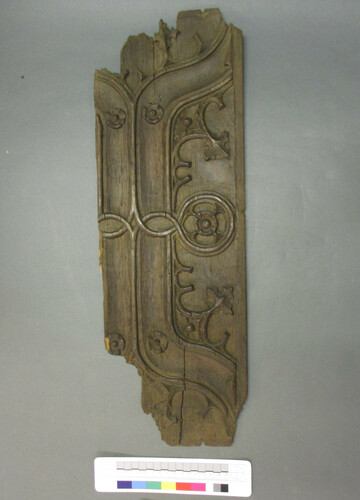 1884.67.141Wood panel. [BS [OPS Move] 10/7/2017]1884.67.141
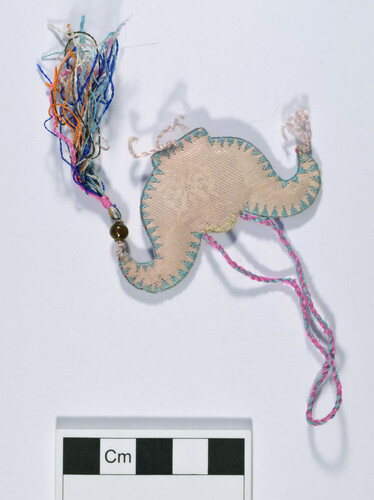 1985.52.2669Amulet, padded textile object with tassel of multicoloured yarn. [El.B 07/08/2012]1985.52.2669
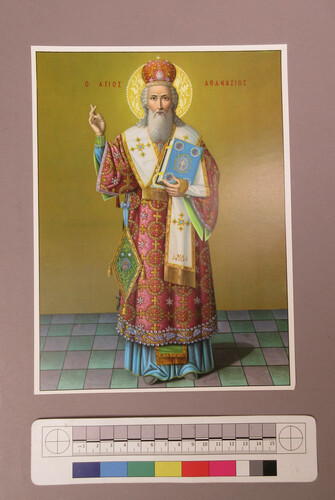 1978.16.46Saint with book.1978.16.46
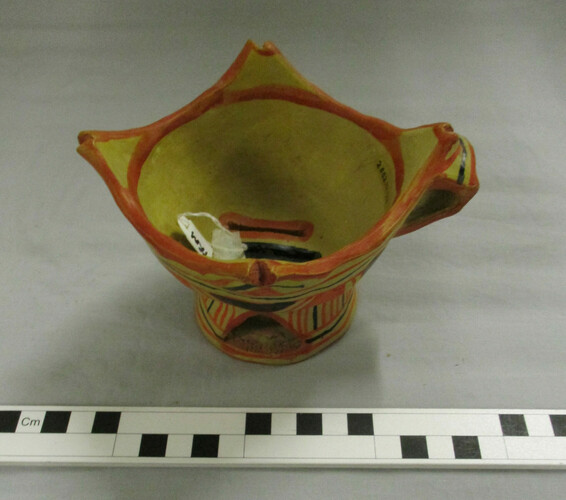 2003.11.22Incense pot. Made of clay. Rounded bowl with a circular hollow base with a triangular hole in the side for the flame to be placed. Painted on the exterior in red and black in a triangular and stripe pattern. [Alicia Bell [OPS move] 28/06/2016]2003.11.22