
- Collection type
- Object
- Description
- Shield of hide. Elliptical in shape with a supporting stick woven through the underside of the hide. The front of the hide is black and incised with rectangular shapes with a white hide woven through. There is fur covered hide wrapped around the top of the stick. [AB [OPS Move] 17/8/2016]
- Long description
- .2 Leather shield with wooden supporting stick vertically through middle. The shield still has some of the hair left on the skin. The supporting stick projects from each end. The stick is laced through loops cut in the leather of the shield. On one side the leather is all black and the loops are white, making a decorative effect. The other side is spotted in appearance. One end of the shield has a 'plume' of fur.
- Geographical reference
- Cultural groups
- Zulu
- Person
- Field collector Wilfred Patrick Thesiger
- PRM source Wilfred Patrick Thesiger
- PRM source Alex Maitland
- Date / Period
- Date made: Before 1998
- Date collected
- By 1998
- Acquisition information
- Donated: 1998
- Materials and processes
- Material Wood Plant, Material Animal Leather Skin, Process Carved, Process Incised, Process Woven
- Dimensions
- Length: max 1444 mm, Width: max 624 mm, Height: max 73 mm
- Object numbers
- Accession number: 1998.26.2
- Research and responses
Zulu shields were made by a specialist shield-maker. The first stage in its manufacture was skinning a cow (only two shields could be made from one skin – making them very expensive) and pegging the skin out in the sun to dry. Then the skin was buried in acidic kraal manure for two days, pounded with stones, and washed it in the soapy lather of the Incukudwane lily. Then it was cut to shape, mounted on the long vertical supporting pole behind, and finally greased with cattle fat or brains. Two distinctive columns of horizontal slashes appear on Zulu shields, which allow two long strips of leather to be woven in and out – giving the central part of the shield a double thickness. In traditional Zulu thinking, the skin and hair of an animal are traditionally understood to ‘remember’ something of the animal’s power and life-essence (uloya). Animal furs, hairs and skins are consequently very important in formal Zulu dress – unlike woven cloth, which is viewed as lifeless. Like many southern and eastern African peoples, the Zulu were traditionally cattle pastoralists. The Isihlangu was developed from a much smaller and lighter shield in the early 19th century by the Zulu warrior-king Shaka kaSenzangakhona. Shaka developed a new large and heavy shield (the Isihlangu), and a new short and heavy stabbing spear form (the Ikwa) – and a new style of fighting to go with them. This involved barging the enemy off balance with the shield, or hooking the rim of your shield around his, and pulling his shield across his body, in order to stab him between the ribs under his left arm. This, along with tactical brilliance, proved immensely effective, and allowed the Zulu to consolidate the political and military power that allowed them to resist European invasion for such a long period. The skin colouration on this isihlangu is the insignia of a specific ibutho – a Zulu regiment. Amabutho (pl. of Ibutho) were formed from Age Sets - all the young Zulu men aged 18 and 19 in a particular year – 350-400 men in each. Each Ibutho was given a year of basic training, and then sent home to work their family herds, being called up for active service for three to four months a year thereafter. Amabutho were disbanded when the men reached their late thirties, who only then were allowed to marry. Each Ibutho had its own kraal of cattle, and were assigned each a specific hide patterning. When amabutho charged, they were trained to keep their shields turned face-inwards under their arms until the last moment. Then, as the men reached within a few meters of the enemy, the entire ibutho turned their shields to face the enemy – who would only realise which of Shaka’s regiments they faced with seconds to spare. This idea that the shield represented the military group one belonged to is enshrined in the Zulu expression “To be under somebody’s shield” – meaning to be under their rule, and their protection. The Zulu traditionally believed in a supernatural force known as Itonya – a power which guaranteed one individual success in battle over another. Extensive rituals were performed to prepare Zulu warriors, increase their itonya and the power of their weapons – including hardening their shields. Each warrior also carried small charms with him which were intended to divert the spears of the enemy.Relevant Reading: Morris, D.R. (1965) The Washing of the Spears. London: Sphere Books Ltd. Spring, C. (1993) African Arms & Armour. London: British Museum Press. Papini, R. (1996) Some Zulu Uses for the Animal Domains. In: Zulu Treasures: Of Kings & Commoners. Natal: KwaZulu Cultural Museum. Knight, I. (1999) Great Zulu Commanders. London: Arms & Armour Press. Research Conducted for DCF Cutting Edge 2006/2007 [AM].
For a brief account of the collections donated to the PRM by Wilfred Thiesiger, see 'An Incidental Collection: Objects Donated by Wilfred Thesiger to the Pitt Rivers Museum', by Jeremy Coote, in Wilfred Thesiger in Africa, edited by Christopher Morton and Philip N. Grover (London: Harper Press, 2010), pp. 116-26. [JC 21 12 2010]
Further items to explore
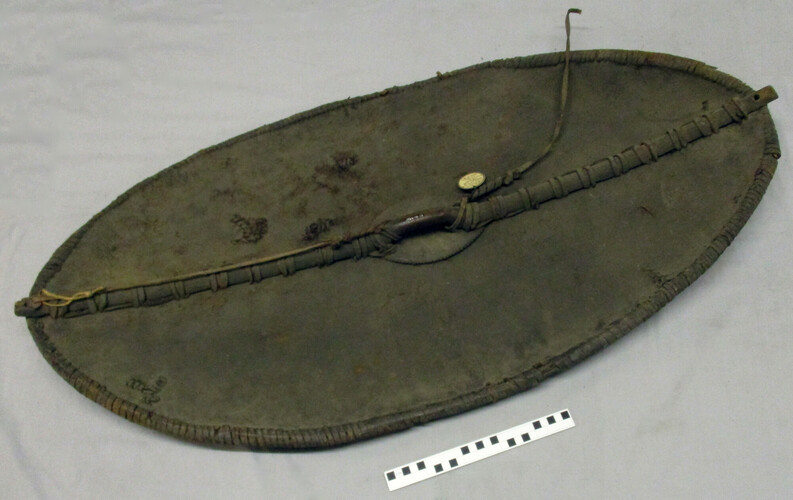 1944.10.12Painted shield of buffalo hide. Oval in shape and curved. There is a band of wood stitched along the length on the underside, the handle is carved from this. The edges of the shield are bound in hide. The front is decorated with red, black and white pigment. There is a central band of red and black and semi-circles either side of this. [AB [OPS Move] 16/8/2016]1944.10.12
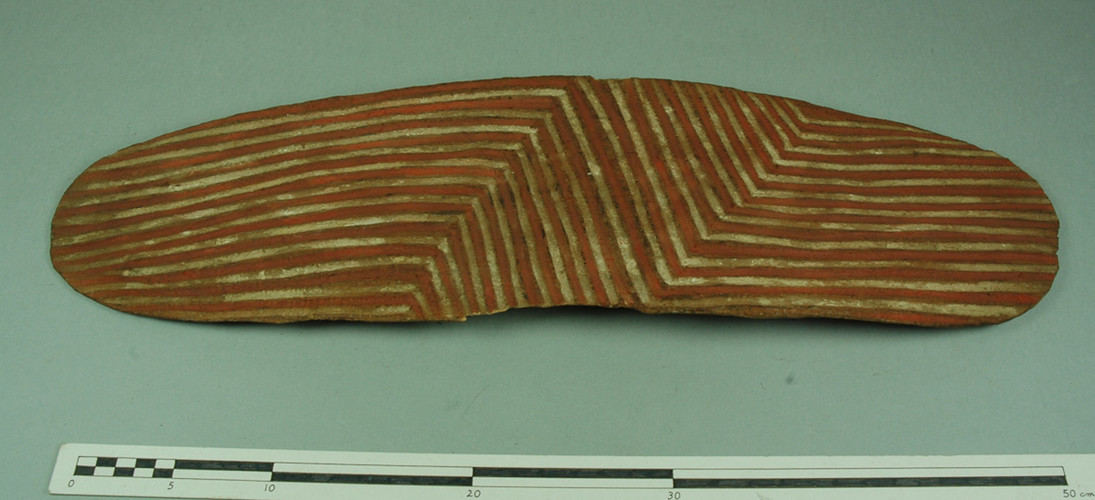 1931.78.10Narrow parrying-shield with flat outer surface carved with parallel grooves painted red and white. [MJD DDF Body Arts Project 2010/2011 06/08/2010]1931.78.10
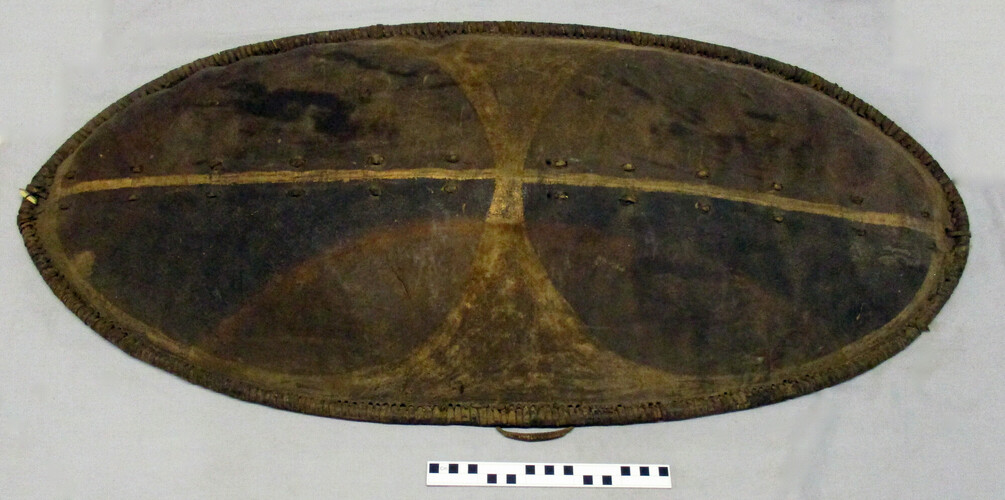 1933.26.16Hide shield. It is elliptical in shape and curved. [AB [OPS Move] 15/8/2016]1933.26.16
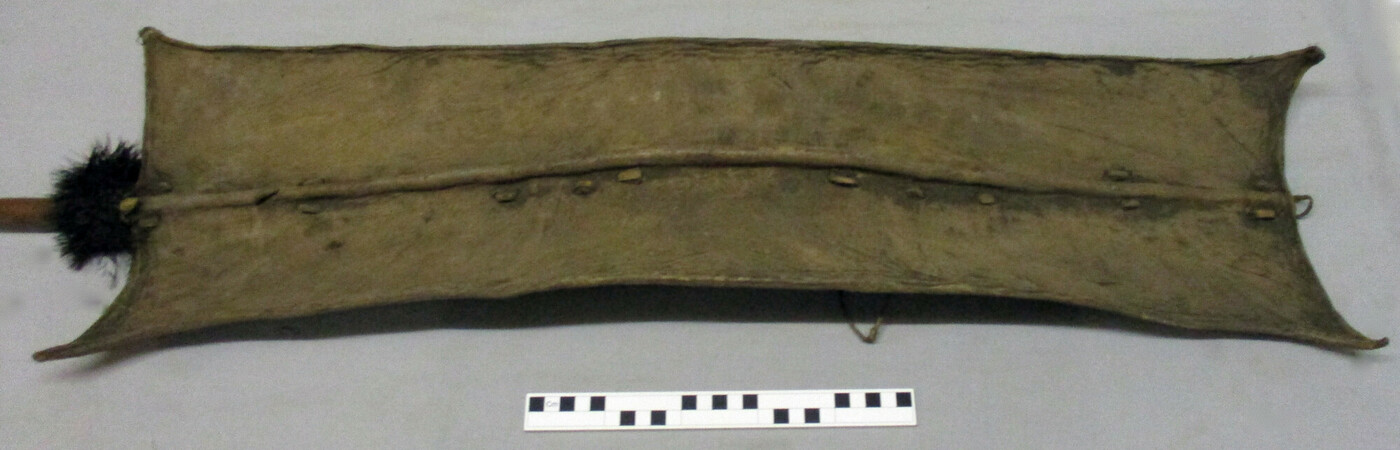 1966.1.12Rectangular hide shield. With backing stick decorated with black feathers. [AB [OPS Move] 12/8/2016]1966.1.12
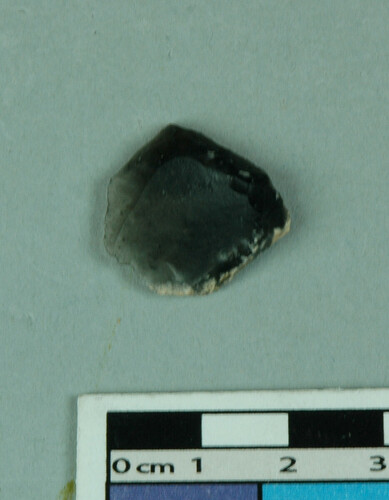 1946.6.92.21Stone tool; side-scraper, black in colour. [MJD 16/07/2010]1946.6.92.21
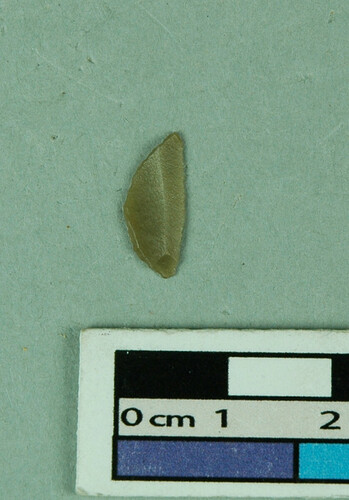 1937.10.33Stone flake, crescent shaped and light grey in colour. [MJD 09/06/2010]1937.10.33
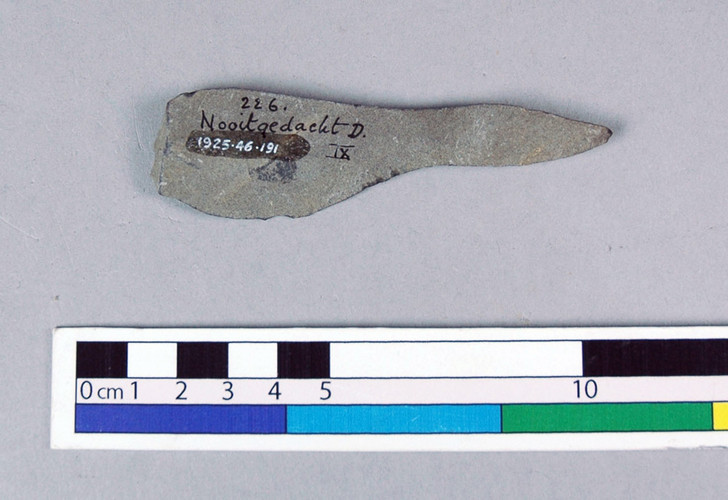 1925.46.191Stone tool. [LKG 17/02/2010]1925.46.191
 1953.2.81.61Rhombus shaped ostrich eggshell bead, with central hole. [MJD 03/08/2010]1953.2.81.61