
- Collection type
- Object
- Description
- Wickerwork headdress.
- Long description
- A cylinder of woven plant material, probably the split aerial rootlets of the 'ie'ie (Freycinetia arborea), with an attached frontal shield-shaped section covered with black feathers, rimmed with white feathers, with short bar of yellow feathers across front. The tail feathers of tropic birds have been used to ornament the edge of the frontal shield. [JU 18/12/2013]
- Geographical reference
- Society Islands Tahiti
- Person
- Field collector Johann Reinhold Forster
- Field collector Georg Forster
- PRM source Ashmolean Museum, University of Oxford
- Date / Period
- Date made: Before 04/06/1774?, uncertain
- Date collected
- Between 17 August and 18 September 1773, or between 22 April and 4 June 1774?
- Acquisition information
- Transferred: 19/04/1886
- Materials and processes
- Material Plant, Material Bird Feather, Material Bark Cloth Textile Plant, Process Wicker Woven, Process Basketry
- Dimensions
- Height 1250 mm approx
- Object numbers
- Accession number: 1886.1.1683 Other numbers: Forster 5 Other PRM accession number: 1886.1.1637.1
- Research and responses
Surface swabs from the original feathers and from those added in 1970 were taken and sent to Andrew Charlton at FERA for analysis of pesticide residues. [JU 13/08/2013]
The surface of the feathers at the base, and the replacement feathers on the front shield were analysed by Kelly Domoney, Researcher at Cranfield Forensics Institute, using an Oxford Instruments X-MET501 Handheld XRF. [JU 13/08/2013]
- Associated publications
- Illustrated in black and white on page 8 of 'Following Captain Cook around Europe', by Ernest S. Dodge, in Expedition: The Bulletin of The University Museum of the University of Philadelphia, Vol. VIII, no. 2 (Winter 1966), pp. 4-11. [JC 20 6 2001] Listed according to the 'Forster list' numbering system in 'From the Islands of the South Seas, 1773–4': An Exhibition of a Collection Made on Capn. Cook's Second Voyage of Discovery by J. R. Forster—A Short Guide (Oxford: Pitt Rivers Museum, no date [1970]): '5. The Helmet, (Whow) of Wickerwork four feet and a half high, covered with pigeons feathers in front, and ornamented with tropic birds feathers on the edges. The conical wickerwork top of the central cylinder is missing. A section of the featherwork has been restored. Helmets of this type were seen in use on 26 April 1774 during the review of war canoes at Pare (see fig. 2). Cook commented that some of the helmets were "...of such a length as to greatly incumber the wearer".' [NMM; JC 5 11 1999] Illustrated in black and white (frontal view) as 'Fig. 387 - Military Headdress (fau)' on page 1,643 of 'The Material Culture of Ancient Tahiti', by Roger Rose (Cambridge, Mass.: Harvard University, Ph.D. thesis, 1971). Described on page lxi of the 'List of Illustrations' (pp. xxii-lxxxix): '387. Military Headdress (fau). Pitt-Rivers Museum, Oxford, A. M. 1637a. Ex coll. Ashmolean Museum. Collected by J. R. Forster on Cook's second voyage. Height, 130 cm. Fig. in Dodge 1966.' [JC 2 11 2012] Described on pages 817-18 of 'The Material Culture of Ancient Tahiti', by Roger Rose (Cambridge, Mass.: Harvard University, Ph.D. thesis, 1971): 'split 'ie'ie warps are arranged in an open cylinder about 130 cm tall and bent over a bottom hoop of similar material shaped to fit the head. The head band itself consists of four rows of coiled 'ie'ie rods with at least three white barkcloth cords tied to this foundation for securing the fau to the head. The shield is covered with thin barkcloth and small and whole iridescent greenish-black feathers by binding together several quills with bast thread and tying them to the shield in two rows of running hitch knots. Except for two peripheral rows of black and white feathers that outline the shield and project outward, the feathers are attached in horizontal rows to point upward. The remnants of a few yellow feathers in eight quill holders adorn the center section of the frontal shield, but the tropic bird tail feathers that formerly radiated from the brim are now bedraggled and mostly disappeared.' (See page 189 of 2007 article by Stevenson and Hooper referenced below.) [JC 18 4 2008] Listed as number 2 under ‘Tahiti...Feathered Headdresses’ on page 128 of 'Artificial Curiosities': Being an Exposition of Native Manufactures Collected on the Three Pacific Voyages of Captain James Cook, R.N. at the Bernice Pauahi Bishop Museum, January 18, 1978–August 31, 1978 on the Occasion of the Bicentennial of the European Discovery of the Hawaiian Islands by Captain Cook—January 18, 1778 (Bernice P. Bishop Museum Special Publication 65), by Adrienne L. Kaeppler (Honolulu: Bishop Museum Press, 1978); and reproduced in black and white as figure 217 on page 126. [JC 5 11 1999] Discussed on page 93 of 'Taumi Gorgets from the Society Islands', by Roger G. Rose, in Artistic Heritage in a Changing Pacific, edited by Philip J. C. Dark and Roger G. Rose (Bathurst, NSW: Crawford House Press, 1993, pp. 91-105): 'The Oxford headdress presumably came from one of the most powerful chiefs of Tahiti, named Pohuetea...who exchanged a fau on 28 April 1774 for some highly coveted red feathers that Cook's men had aquired on Tonga a few months previously. Observed G. Forster, "Potatow brought on board his monstrous helmet of war of five feet high, and sold it for red feathers; some others followed his example, and targets without number were bought by almost every sailor"'. (The reference to G. Forster is to page 71 of Volume 2 of his A Voyage round the World in His Britannic Majesty’s Sloop, Resolution, Commanded by Capt. James Cook, during the Years 1772, 3, 4, and 5 (2 vols) (London, 1777); see also pages 360–61 of the edition edited by Nicholas Thomas and Oliver Berghof (Honolulu: University of Hawaii Press, 2000).) [JC undated; revised JC 22 6 2001] Listed on page 552 of 'Appendix A: Catalogue of Society Island Objects with Secure Eighteenth-Century Provenance' in 'Shaping the Body Politic: Gender, Status, and Power in the Art of Eighteenth-Century Tahiti and the Society Islands', by Anne Elizabeth D'Alleva (New York: Columbia University, Ph.D. thesis, 1997): 'Wickerwork crest covered with black feathers, rimmed with white feathers, with short bar of yellow feathers across front.' Also reproduced in black and white as figure 6.13 on page 776. For D'Alleva's discussion of fau headdresses, see pages 370–84. This particular headdress is discussed in detail on page 371: 'One in the Pitt Rivers Museum forms part of the "Warrior's Dress" donated to the Ashmolean Museum by Reinhold Foster (Figure 6.13 [on page 775]). Rose plausibly identifies it with the "monstrous helmet of war of five feet high" that Potatau, the ari'i of Punaauia district, traded to the Forsters in 1774 for red feathers (1971: 817; see also G. Forster 1777: II: 73). It is composed of a wickerwork cylinder of 'ie'ie vine supporting a front panel of 'ie'ie wickerwork that expands and curves over at the top. This front panel is covered with a layer of barkcloth, to which closely set, glossy black pigeon feathers were attached. [D'Alleva's note 29: 'A section of this featherwork has been restored (see Gathercole n.d.).' A band of white feathers circles the panel near its outer edge. A short strip of whitish-yellow feathers is centered on the front panel about one-third up its length. Tropic-bird feathers ornament the perimeter.' (The reference to Rose is to his 'The Material Culture of Ancient Tahiti' (4 vols), Harvard University (Department of Anthropology), Cambridge, Mass.: Ph.D. thesis, 1971.) [JP 2/8/2002; JC 23 7 2003] Discussed and illustrated in 'The Significance for Polynesian Ethnohistory of the Reinhold Forster Collection at Oxford University', by Peter Gathercole (edited with an introduction by Jeremy Coote), written in 1971 and published online in 2004 on the Forster Collection website at http://projects.prm.ox.ac.uk/forster/polynesian.html. [JC 4 3 2005] Published as part of the Forster Collection on a dedicated website at www.prm.ox.ac.uk/forster (from February 2001). [JC 7 7 2005] This object was featured in the Museum's audio guide produced during the DCF-funded 'What's Upstairs?' project, 2004–2006. [BR 'DCF 2004-2006 What's Upstairs?' 8/11/2005] Illustrated in black and white, as figures 5 (front view), 6 (right profile), and 7 (detail) on pages 190, 191, and 195 respectively, of 'Tahitian Fau: Unveiling an Enigma', by Karen Stevenson and Steven Hooper, in The Journal of the Polynesian Society, Vol. 116, no. 2 (June 2007; Special Issue: 'Polynesian Art: Histories and Meanings in Cultural Contexts'), pp. 181-211. The object itself, as well as its provenance, is discussed in detail on pages 189-97. (Photocopy in RDF.) [JC 18 4 2008] Listed as catalogue number 66 and illustrated in colour on page 145 of James Cook and the Exploration of the Pacific, by Adrienne l. Kaeppler et al. (London: Thames & Hudson, 2009): '66 Helmet fau | Society Islands, French Polynesia (probably Tahiti), by 28 April 1774 (?) | Wicker, barkcloth, feathers, h 137.5 cm | Pitt Rivers Museum, University of Oxford, 1887.1.1683 (Forster 5) | Listed by George Forster as part of ‘The Warrior’s Dress’: ‘The Helmet, (Whow) of Wickerwork four feet and a half high, covered with pidgeons feathers in front, and ornamented with tropic birds feathers on the edges’. The framework—comprising a cylinder and a ‘shield’—is made of the split rootlets of the ‘ie ‘ie (Freycinetia arborea), a type of screwpalm. The front of the shield is covered with thin barkcloth and adorned with feathers: small, iridescent greenish-black ones in the main, along with a few yellow ones at the centre and a border of black and white ones. Many of the feathers (especially the tropic-bird tail-feathers that formerly radiated from the brim) have been lost and some of those that remain were apparently added later as part of a ‘restoration’. This may be the ‘monstrous helmet of war’ that George Forster records Potatow (Potatau) selling for red feathers on board the Resolution on 28 April 1774 (Forster 1777, II, p. 71–2). Forster also provides a close description: ‘These helmets were of an enormous size, being near five feet high. They consisted of a long cylindrical basket of wicker-work, of which the foremost half was hid by a semicylinder of a closer texture, which became broader towards the top, and there separated from the basket, so as to come forwards in a curve. This frontlet, of the length of four feet, was closely covered with glossy bluish green feathers of a sort of pigeon, and with an elegant border of white plumes. A prodigious number of the long tail feathers of tropic birds diverged from its edges, in a radiant line, resembling that glory of light with which our painters commonly ornament the heads of angels and saints’ (Forster 1777, II, p. 63–4). J[eremy]. C[oote].' [JC 10 12 2010] Illustrated in colour as Figure 6.3 on page 146 of Tuhituhi: William Hodges, Cook's Painter in the South Pacific, by Laurence Simmons (Dunedin: Otago University Press, 2011). Simmons discusses William Hodges's depiction of a fau in his painting The War-Boats of the Island of Otaheite... (1777) and comments (pages 146-7): 'There is a similar fau in the Pitt Rivers Museum in Oxford... Indeed, this could possibly be the same helmet depicted by Hodges.' [JC 10 1 2013] For an account of the history of the collection of which this is part, see 'The Cook-Voyage Collections at Oxford, 1772–1775', by Jeremy Coote, in Jeremy Coote (ed.), Cook-Voyage Collections of 'Artificial Curiosities' in Britain and Ireland, 1771–2015 (MEG Occasional Paper No. 5), Oxford: Museum Ethnographers Group (2015), pp. 74–122. (Copy in RDF: Researchers: Jeremy Coote (Cook-Voyage Collections).) [JC 9 6 2016]
Search terms: Ornament, Ritual and Ceremonial, Clothing Headgear, Basketry, Headdress, Ceremonial Object, Headgear
Further items to explore
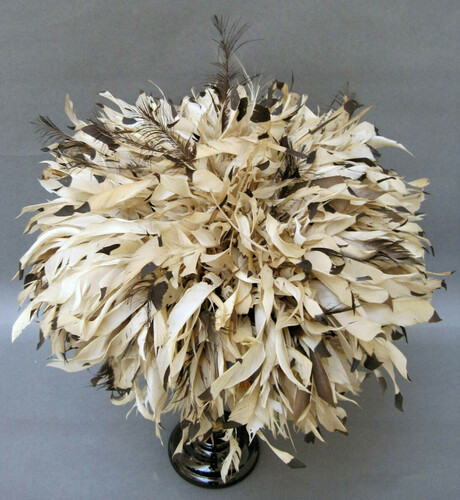 1942.13.440Headdress of coiled basketry covered with white and brown feathers. [LM 'DCF 2004-2006 What's Upstairs?' 6/12/2005]1942.13.440
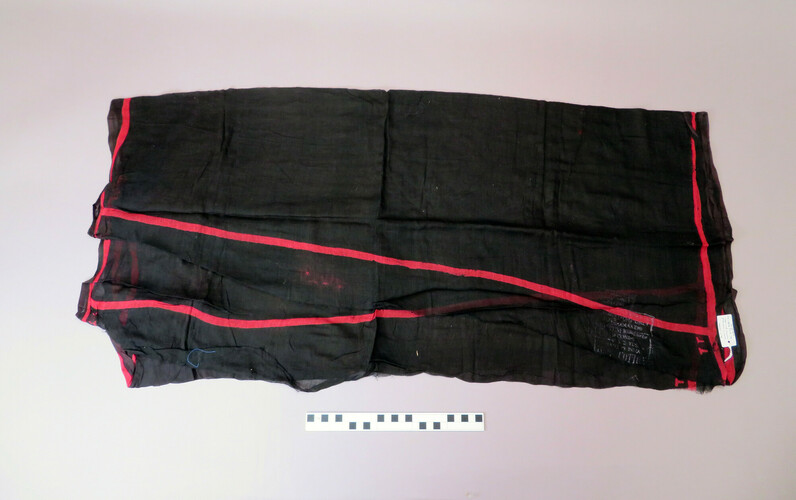 2018.37.72Woman's cotton head scarf, dyed indigo with a red border. [AFS [OPS move] 15/7/2019]2018.37.72
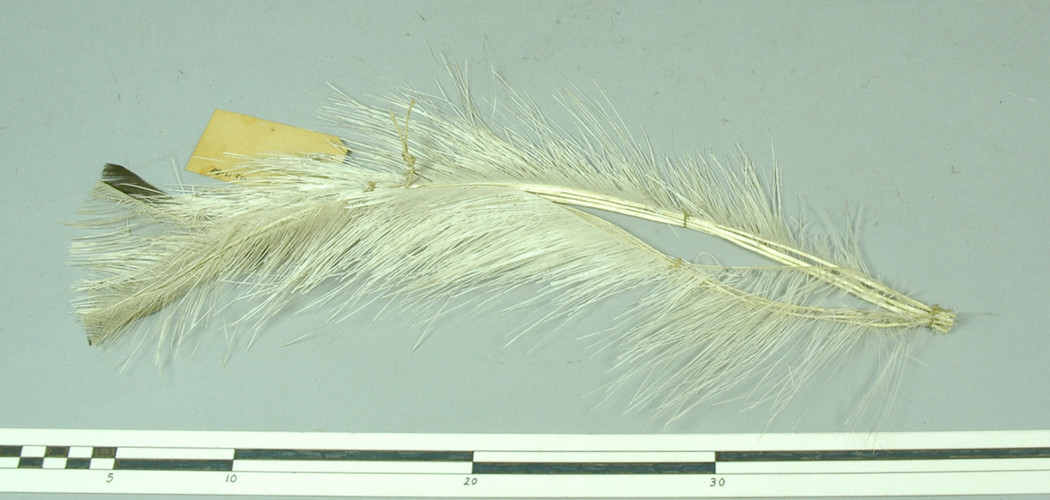 1903.19.58Head ornament of rhea feathers.1903.19.58
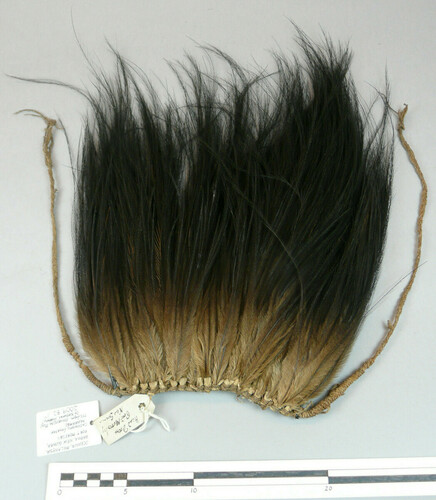 2009.82.1Headdress of dark brown cassowary feathers, four rows bound together with plant fibre and with string ties at the sides. [MJD 21/07/2009]2009.82.1
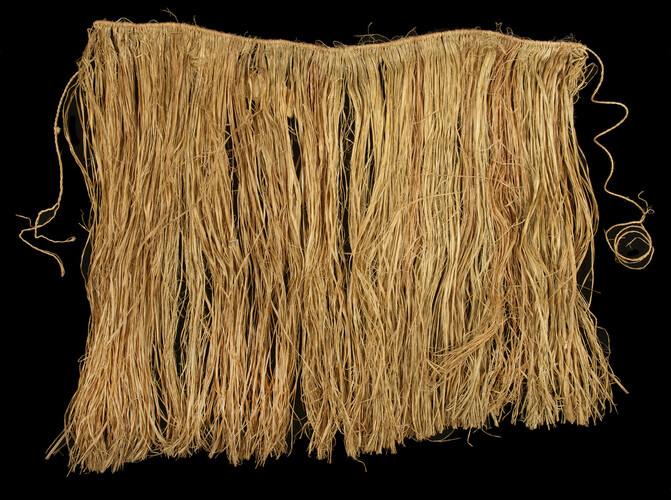 1886.1.1179Plant fibre skirt made from bundles of fibre tied to a waistband. [FB 06/11/2014; JC 14 3 2015]1886.1.1179
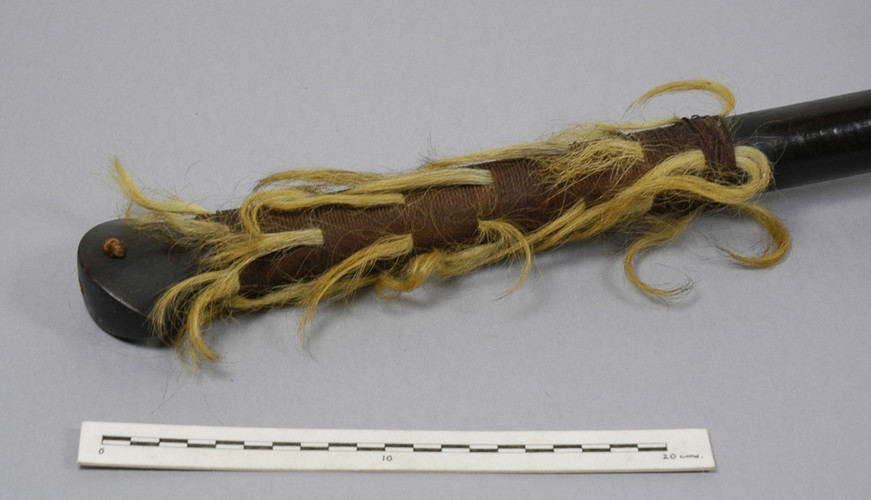 1884.12.269Club of highly polished dark wood with wide carved head. [SM 23/03/2007]1884.12.269
 1884.85.5Tattooing tool1884.85.5
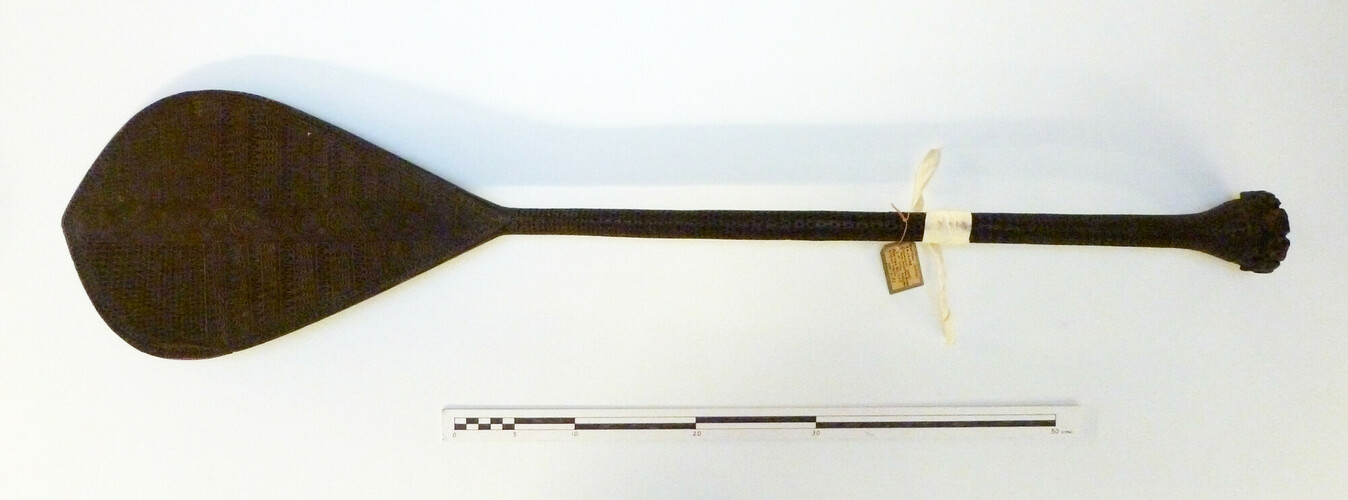 1953.12.3BPaddle of brown wood, chip carved all over. [El.B 21/02/2012]1953.12.3B