
- Collection type
- Object
- Description
- Club of highly polished dark wood with wide carved head. [SM 23/03/2007]
- Long description
- Club of highly polished dark wood with wide carved head. The head bears an abstracted face design on both sides with small human heads carved in relief for the eyes and nose and simple ears projecting out with blunt ends. The handle is decorated with tufts of light coloured hair bound on with sennit. There is a hole in the butt with a small amount of sennit cord stuck inside it. [SM 23/03/2007]
- Geographical reference
- Marquesas Islands
- Person
- Maker Unknown Maker
- Field collector Unknown Collector
- PRM source Augustus Henry Lane Fox Pitt Rivers founding collection
- Date / Period
- Date made: Before 1874
- Date collected
- By 1874
- Acquisition information
- Donated: 1884
- Materials and processes
- Material Wood Plant, Material Animal Hair, Material Sennit Coconut Seed Fibre Plant, Process Carved, Process Bound, Process Decorated
- Dimensions
- Length: max 1440 mm, Width: max 182 mm
- Object numbers
- Accession number: 1884.12.269 PR Cat other PR nos: 1740
- Research and responses
The following notes are drawn from research compiled by Andy Mills as part of the DCF Cutting Edge project in 2006-2007: 'The u‘u is the best-known Marquesan weapon form, and they are among the commonest type of Marquesan material culture to be found in ethnographic museum collections. This reflects the cultural prominence of the toa or warrior in Marquesan society (as elsewhere in Polynesia), and the importance of the culture of arms-bearing. The u‘u was to some extent the mark of toa (warrior) status, and was carried in daily life, as well as in battle. These objects were carved by tuhuka – specialist woodcarvers, cognate terms and institutions to the tufunga of Tonga (from which the Marquesas were anciently settled) and the tufuga of Samoa. The head implied in their name is well justified, and many examples contain upwards of fifteen different sets of eyes or a face, nested within the overall anthropomorphic structure of the club’s head. The ‘fractal’ or nested structure of these anthropomorphic representations has sparked much discussion in the Polynesian art historical community, and is a feature which can be recognised in a multitude of artforms and cultures across the Pacific. The facial motifs in general are known as tiki, and Kjellgren & Ivory (Kjellgren, E. & Ivory, C. (2005) Adorning the World: Art of the Marquesas Islands. London: The Metropolitan Museum of Art, p. 33) have discussed the cultural significance of faces within Marquesan society, remarking that mata‘enana (n. ‘face people’) are the ancestors, and matatetau (vb. ‘to count faces’) is the recitation of one’s genealogy; from this, they argue quite plausibly that the face must be seen as the instantiation of ancestrally-derived efficacy or mana. In this way, we can recognise the weapon as decoratively empowered to contain the ancestral mana of the warrior, thus enabling it to be brought and applied to the battlefield.' [El.B 29/02/2008]
- Associated publications
- Illustrated twice in black and white as numbers 1a (from PRM000081346) and 2 (from PRM000081343) in Plate Gamma G in Die Sammlungen, Volume 3 of Die Marquesaner und ihre Kunst: Studien über die Entwicklung Primitiver Südseeornamentik nack Eigenen Reiseeergebnissen und dem Material der Museen, by Karl von den Steinen (Berlin: Verlag von Dietrich Reimer / Ernst Vohsen, 1928): 'OXFORD-D II' and 'OXFORD-D I'. [JC 26 3 2015] Listed on page 421 of 'Appendix F. Accession and Collection Dates for Canoe Models, Bowls, Paddles, and Clubs' in 'Marquesan Art in the Early Contact Period, 1774–1821', by Carol Susan Ivory (Seattle: University of Washington, Ph.D. thesis, 1990): 'IV. Clubs A. Traditional Clubs... [Collection Date] 19thC [Collector] [Accession Date] [Museum] PITT [Museum ID] 1740 (399) [sic] [Object Type] Club'. [JC 19 3 2015]
Further items to explore
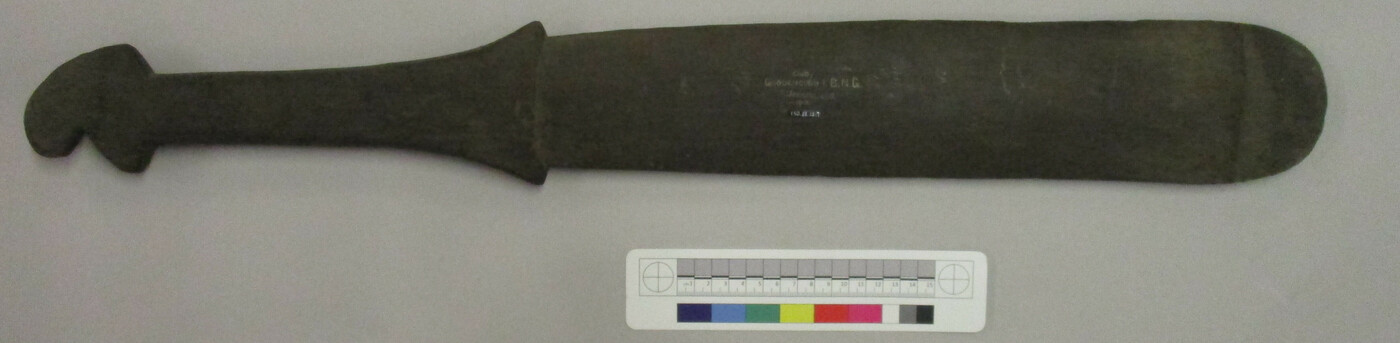 1913.88.231Palm-wood club in the shape of a cricket bat. [JC [OPS Move] 29/07/2016]1913.88.231
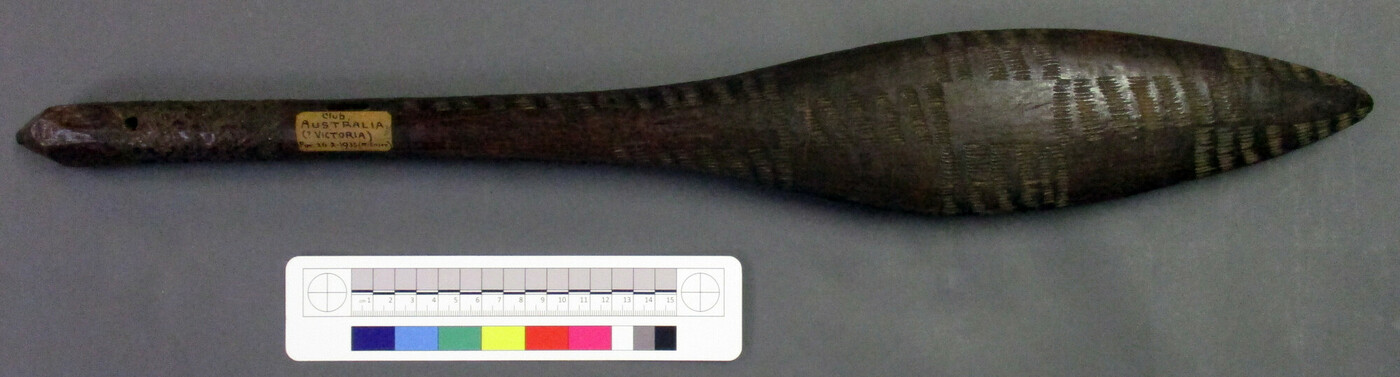 1935.56.100Wood club with cylindrical handle expanding into a flattened fusiform head. [JC [OPS Move] 19/10/2016]1935.56.100
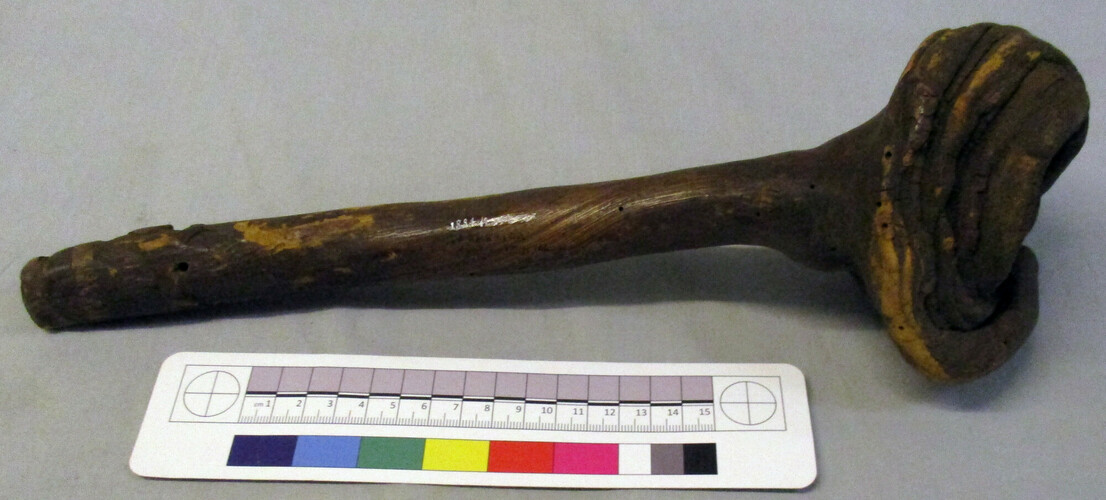 1884.12.44Wooden club with gnarled knob of tree making up the business end. [ASh [OPS move] 24/5/2016]1884.12.44
 2016.89.1Black painted wooden club with discoidal stone head. [BS [OPS Move] 26/09/2016]2016.89.1
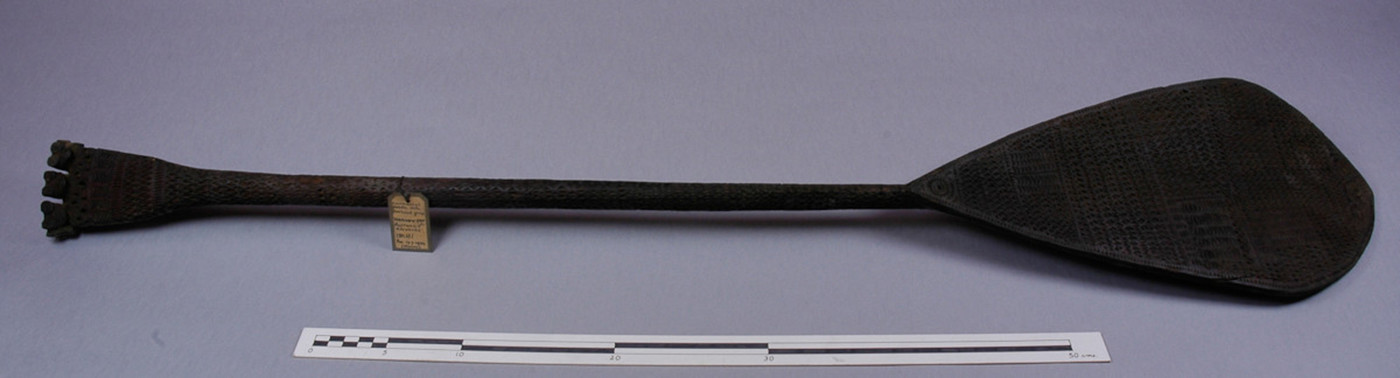 1934.69.1Paddle carved all over with geometric designs using triangles and scallops [SM 12/09/2008]1934.69.1
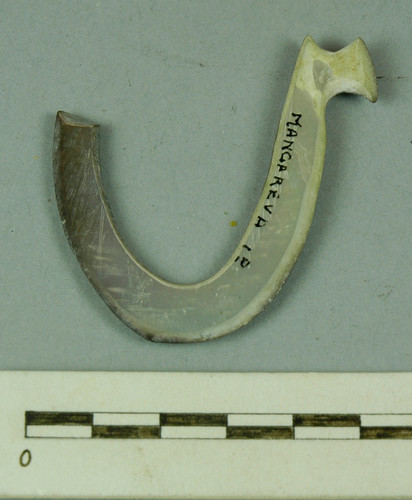 1925.29.24Pearl shell fish-hook, 'U' shaped with notch to tie line, point is broken. [MJD 16/03/2009]1925.29.24
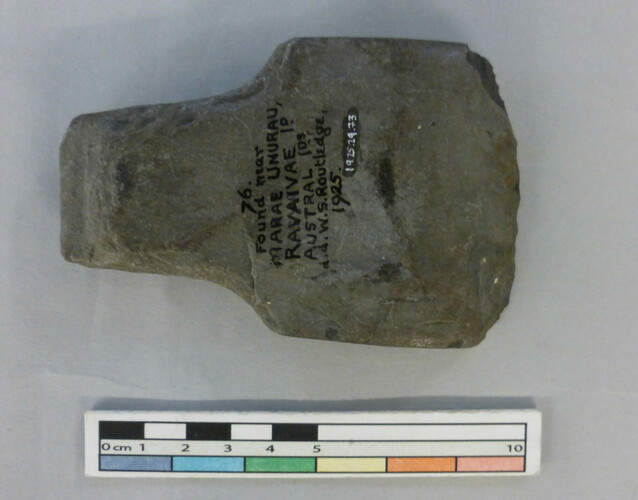 1925.29.73Stone adze blade; identified by Figueroa and Sánchez as an Eastern Polynesian Adze Type 1-B (finished). [Dan Hicks 06/06/2012]1925.29.73
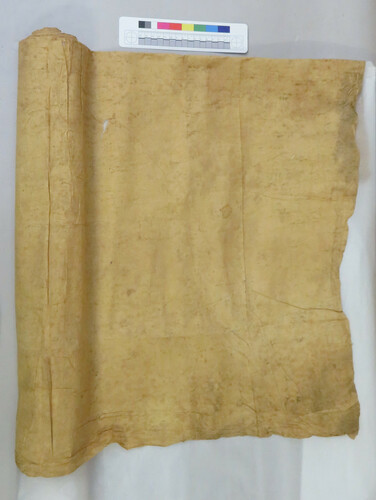 1886.1.1243Sheet of barkcloth. It is beige in colour, thin with a fine texture. There is some surface discolouration and watermarks.1886.1.1243