
- Collection type
- Object
- Description
- Headrest. Carved from a single piece of wood. There are thin braces or cross-rails between the front two and back two legs. [NM 2/3/97]
- Long description
- Headrest. Carved from a single piece of wood. There are thin braces or cross-rails between the front two and back two legs. [NM 2/3/97]
- Person
- Field collector Johann Reinhold Forster
- Field collector Georg Forster
- PRM source Ashmolean Museum, University of Oxford
- Date / Period
- Date made: Before 29/06/1774
- Date collected
- Between 2 and 7 October 1773 or between 26 and 29 June 1774
- Acquisition information
- Transferred: 19/04/1886
- Materials and processes
- Material Wood Plant, Process Carved
- Dimensions
- Length 560 mm, Width 112 mm
- Object numbers
- Accession number: 1886.1.1418 Other numbers: Forster 94 Other numbers: Duncan 262 Other numbers: [Ashmolean] AM1418
- Research and responses
For an account of Tongan headrests with a useful bibliography, see 'Tongan Headrests: Notes on Terminology and Function', by Jeffry Dhyne, in Journal of the Polynesian Society, Vol. 108, no. 4 (December 1999), pp. 411-16. [JC 14 8 2015]
- Associated publications
- Listed as number 262 on page 185 of A Catalogue of the Ashmolean Museum Descriptive of the Zoological Specimens, Antiquities, Coins, and Miscellaneous Curiosities (Oxford, 1836): 'South Sea Islands, &c.... 261. 262. Wooden stools used as pillows.' [JC 8 7 2005] Listed according to the 'Forster list' numbering system in 'From the Islands of the South Seas 1773–4: An Exhibition of a Collection Made on Capn. Cook's Second Voyage of Discovery by J. R. Forster—A Short Guide (Oxford: Pitt Rivers Museum, no date [1970]): 'The Friendly Isles (Tonga)...94. 95. Two stools or pillows to rest the head upon. Designed to leave dressed hair undisturbed. Made from the solid wood. Lengths: 72 cm.; 56 cm.' [JP; JC 8 7 2005, 14 8 2015] Listed (with 1886.1.1419; Forster 95) under numbers 5-6 under ‘Tonga..Neck Rests’ on page 228 of 'Artificial Curiosities': Being an Exposition of Native Manufactures Collected on the Three Pacific Voyages of Captain James Cook, R.N. at the Bernice Pauahi Bishop Museum, January 18, 1978 - August 31, 1978 on the Occasion of the Bicentennial of the European Discovery of the Hawaiian Islands by Captain Cook - January 18, 1778 (Bernice P. Bishop Museum Special Publication 65), by Adrienne L. Kaeppler (Honolulu: Bishop Museum Press, 1978): '5-6. Two neck rests with four feet, Oxford (94-95). Lengths 72 cm, 56 cm. Evidence: Forster collection, second voyage. Literature: Gathercole, n.d. (1970) [see above]'. [JP 24/7/2002; JC 8 7 2005] Published as part of the Forster Collection on a dedicated website at www.prm.ox.ac.uk/forster (from February 2001). [JC 7 7 2005] Listed as number 255 and illustrated in colour on page 263 of Pacific Encounters: Art & Divinity in Polynesia, 1760-1860, by Steven Hooper (London: British Museum Press / Wellington, New Zealand: Te Papa Press, 2006); caption (same page) reads: '255 Headrest | Tonga | Mid-/late eighteenth century | Wood| L. 56.0 cm | Oxford, PRM: 1886.1.1418 | Acquired 1886; ex. Ashmolean Museum; donated 1776 by Johann Reinhold and George Forster to Oxford University; collected 1773-4 by the Forsters during Cook's second voyage.... Carved from a solid block, this headrest (kali) was used as a pillow to prevent the elaborate hairdressing of high-status people from becoming disarranged. A fine ridge is found at each end of the bar and another runs along the centre of the underside. Short flat linking bars between the feet are broken. Most known headrests of this type appear to have been collected on Cook's second and third voyages...suggesting that the style went out of fashion by the nineteenth century, being replaced by others.' Also illustrated in colour in exhibition brochure (copy in RDF). Also listed and illustrated, with the same number on the same page and with the same details, in the French edition of the catalogue: Polynésie: Arts et Divinités, 1760-1860, by Steven Hooper (Paris: Musée de quai Branly and Réunion des musées nationaux, 2008). [JC 22 12 2006, 29 12 2006, 10 7 2008] For an account of the history of the collection of which this is part, see 'The Cook-Voyage Collections at Oxford, 1772–1775', by Jeremy Coote, in Jeremy Coote (ed.), Cook-Voyage Collections of 'Artificial Curiosities' in Britain and Ireland, 1771–2015 (MEG Occasional Paper No. 5), Oxford: Museum Ethnographers Group (2015), pp. 74–122. (Copy in RDF: Researchers: Jeremy Coote (Cook-Voyage Collections).) [JC 9 6 2016]
Search terms: Furniture Dwelling, Headrest
Further items to explore
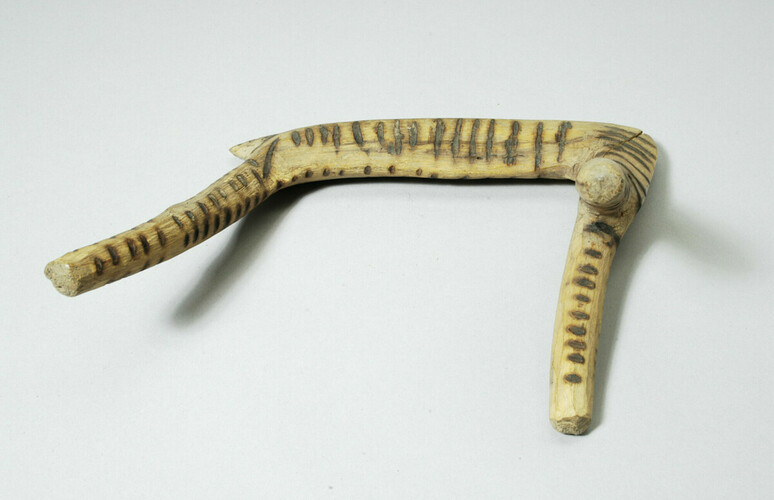 1948.2.128Wooden headrest with three legs and linear pyroengraved decoration [RTS 18/3/2005].1948.2.128
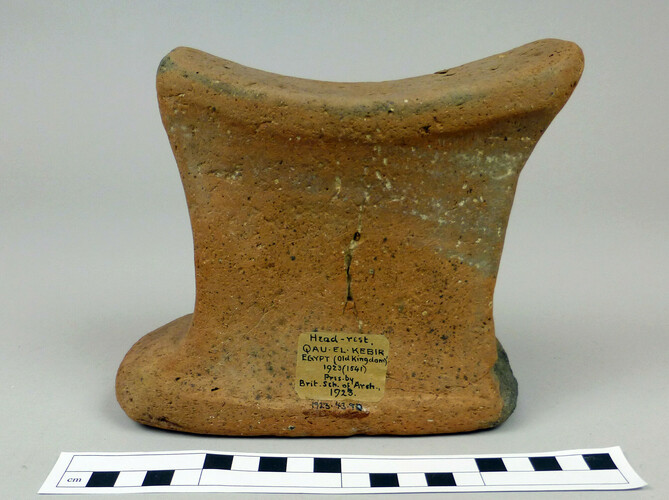 1923.43.70Pottery headrest [SM (Verve) 03/02/2014]1923.43.70
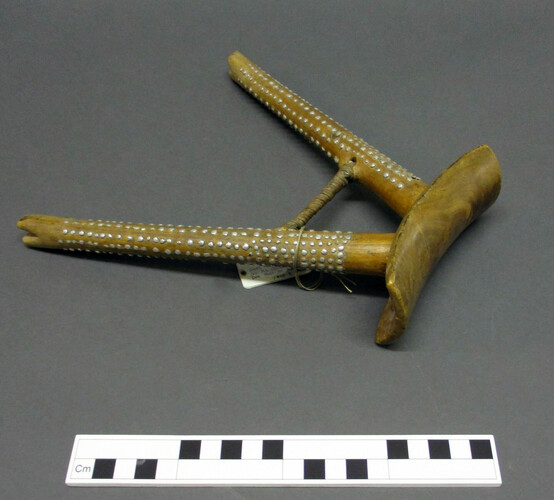 1978.9.2Headrest or stool, carved from a single piece of wood. Curved rectangular seat and two legs, decorated with solder. [EH [OPS Move] 17/3/2017]1978.9.2
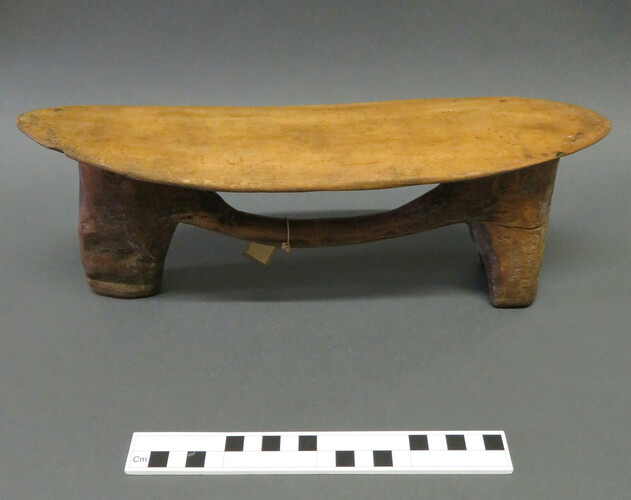 1942.1.437Wooden stool or headrest or combined stool and shield carved from a single piece of wood. Long, lenticular seat, slightly curved with one wide leg with two deep, wide grooves, and one bifurcated foot connected by a curved, rounded bridge. [MOBB [OPS move] 21/3/2017]1942.1.437
 1965.3.197Barkcloth.1965.3.197
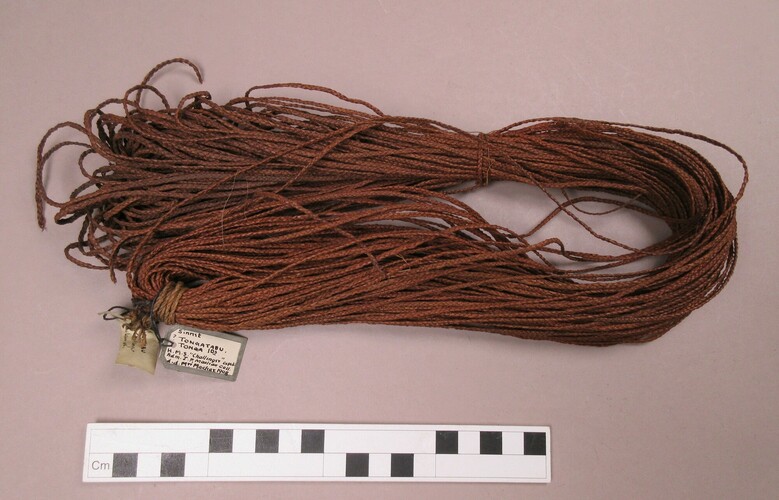 1908.31.8Plaited sinnet.1908.31.8
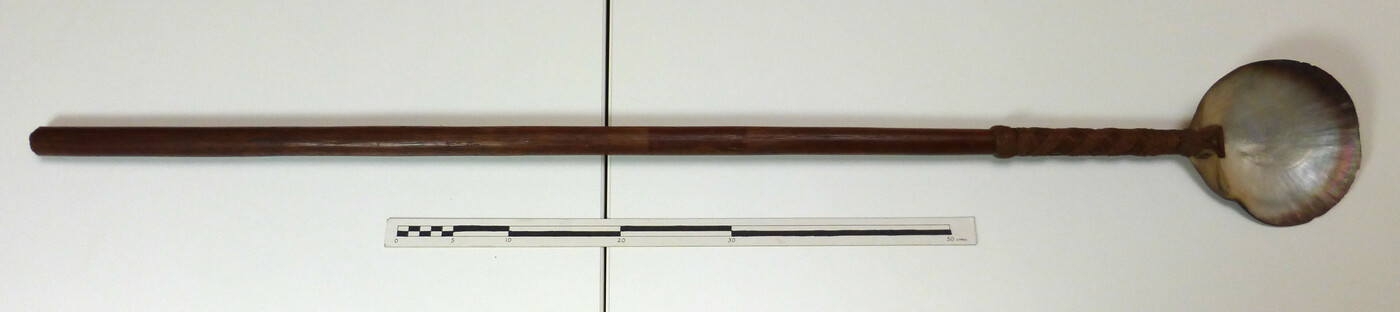 1897.83.26Tool consisting of a cylindrical wooden shaft on to which has been bound with plaited sennit a single valve of a pearl-shell. [JC 20 12 2002]1897.83.26
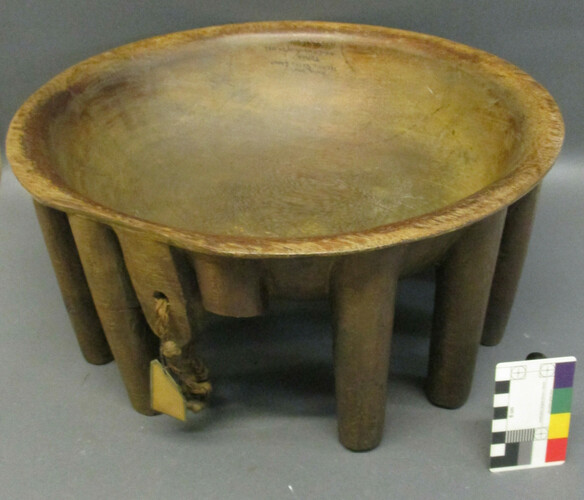 1922.47.1Fine old kava bowl on 14 legs. One leg broken.1922.47.1