
- Collection type
- Object
- Description
- Wooden headrest with three legs and linear pyroengraved decoration [RTS 18/3/2005].
- Long description
- Headrest carved from a single piece of yellowish brown wood (Pantone 7508C). This is an example of 'found form', where a naturally grown branch with subsidiary limbs coming off the main stem has been selected because its shape is suited to the intended purpose. It consists of a narrow seat across the top, flattened and cut slightly concavely across its length and tapering to either end, with the back end projecting out slightly to form a stylised triangular 'tail'. The sides of the seat are convex, meeting to form an angular ridge that runs along the centre of the underside. 2 branches extend from either end of this area; the branch at the front has a thick central shaft that divides at its base to form 2 legs that splay out in opposite directions, in an inverted Y shape. The upper part of this has an angular ridge running down its outer face; otherwise the feet are round in section. The branch at the back of the headrest is in alignment with this thick shaft section, and splays out below at an obtuse angle to it. The undersides of the feet have been trimmed to produce irregular, faceted surfaces; patches of wear on some of these show that the object has been used. The surface has been extensively decorated with a series of short lines, burnt black into the wood using a heated tool. These consist of groups of horizontal lines across the width of the seat, with some shorter lines along the edges near the 'head' end, and straight and oblique lines down the sides and front face of the seat. There is a further row of very short dashes running along the base ridge of this, then the legs are covered with similar groups of short lines arranged in columns down their length. The headrest is complete, but has some natural flaws in the surface of the wood, and a crack running down from the front on both sides; the surface has been smoothed and partially polished. It weighs 253.8 grams and is 290 mm long and 187 mm high; the seat is 237 long, has a width of 27.2 mm and is 32.5 mm thick, while the back leg has a diameter of 21.5 by 20.7 mm. The burnt grooves have a typical maximum width of 3 mm [RTS 22/3/2005].
- Geographical reference
- Cultural groups
- Nuer
- Date / Period
- Date made: Before 1936?, uncertain
- Date collected
- 1930 - 1931 or 1935 - 1936
- Acquisition information
- Found unentered: 1948
- Materials and processes
- Material Wood Plant, Process Carved, Process Pyroengraved Pokerwork, Process Decorated
- Dimensions
- Width 27.2 mm seat, Length: max 290 mm, Length 237 mm seat, Height 187 mm, Weight 253.8 g
- Object numbers
- Accession number: 1948.2.128
- Research and responses
This object was collected by Evans-Pritchard during his fieldwork amongst the Nuer; he mounted four expeditions, which took place in 1930, 1931, 1935 and 1936 (see E.E. Evans-Pritchard, 1940, The Nuer). While he did not record the local name for this particular example, a similar but undecorated headrest, 1937.34.49, is called köm, although he also uses this term for Anuak examples (see 1936.10.55-6).
This type of lightweight headrest, made from a tree branch, is produced by a number of Nilotic groups; for further Nuer examples, see 1917.25.39-40, 1931.66.17-18, 1932.30.1, 1936.10.56 and 1937.34.49; for Dinka examples, see 1934.8.17, and for examples from the Anuak, see 1936.10.55.
Objects like these were used by men to protect their elaborate hairstyles. Willis described the Nuer practice of covering their hair with a paste made of clay, cow dung and urine, and then shaping it into the desired style, such as a cock's comb, or a peak at front or back. This treatment gradually wears off, staining the hair a reddish colour, and then the hair needs to be redone. Domville-Fife describes a similar process for the Shilluk in some detail, although amongst that group hair is dressed by a specialist barber, and is a costly process (C.W. Domville Fife, 1927, Savage Life in the Black Sudan, pp 71-76) [RTS 22/08/2005].
- Associated publications
- Illustrated in black-and-white as Figure 10 on page 131 of Volume 1 of The Encyclopedia of Africa South of the Sahara, edited by John Middleton (New York: Charles Scribner's Sons, 1997), where it illustrates the entry 'Art: Eastern Africa', by Jeremy Coote (pp. 122-32). [JC 11 2 1998] Illustrated in black-and-white as Figure 5 on page 160 of Volume 1 of New Encyclopedia of Africa, edited by John Middleton and Joseph C. Miller (Detroit etc.: Thomson Gale /Charles Scribner's Sons, 2008), where it illustrates the entry 'Art, Regional Styles: Eastern Africa', by Jeremy Coote (pp. 156-166); see also brief discussion of Nuer headrests on the same page. [JC 9 11 2007]
Search terms: Furniture Dwelling, Headrest, Furniture
Further items to explore
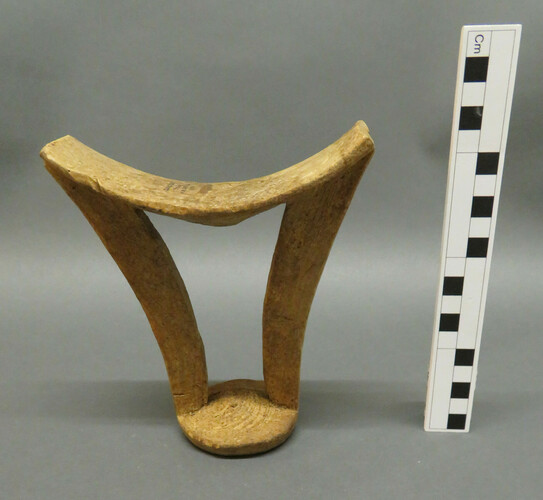 1900.30.2Light coloured wooden headrest carved from a single piece of wood. Rectangular, concavely curved seat, with wider middle section. The supports are narrow and curved and attached to a round foot with flat bottom and raised centre on top. [MOBB [OPS move] 21/3/2017]1900.30.2
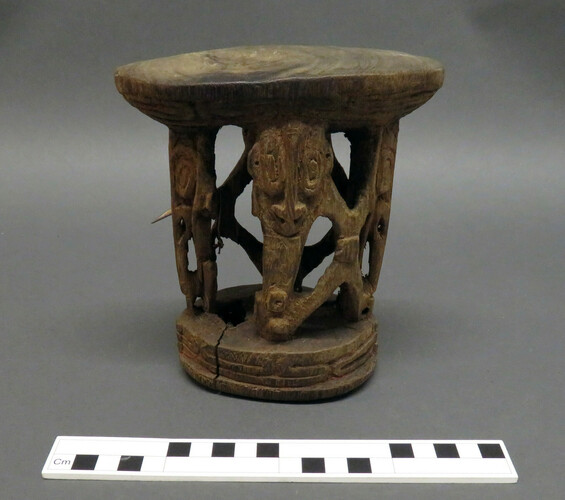 1922.60.2Carved wooden headrest. On the seat and the base there are carved patterns in relief. The centre support of the headrest is hollowed out, with two bird and two human figures carved into the wood. [EH [OPS Move] 24/3/2017]1922.60.2
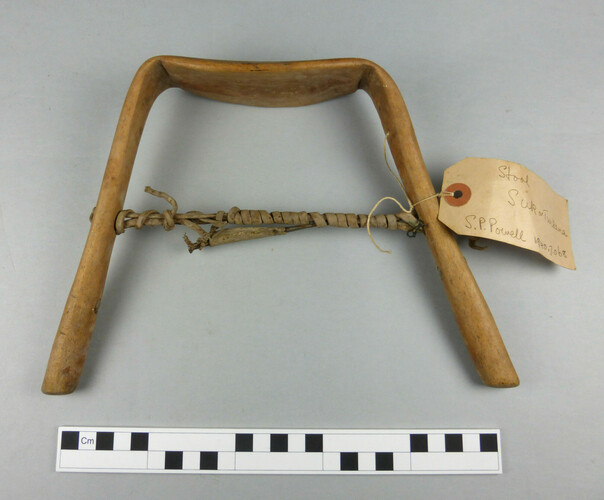 1940.7.068Wooden stool or headrest with rectangular, concavely curved seat. Two splayed legs, both of which are perforated and connected with a strap made of a strip of twisted leather, bound with leather. There is a nail in a stitched leather pouch attached to the strap. [EH [OPS Move] 27/3/2017]1940.7.068
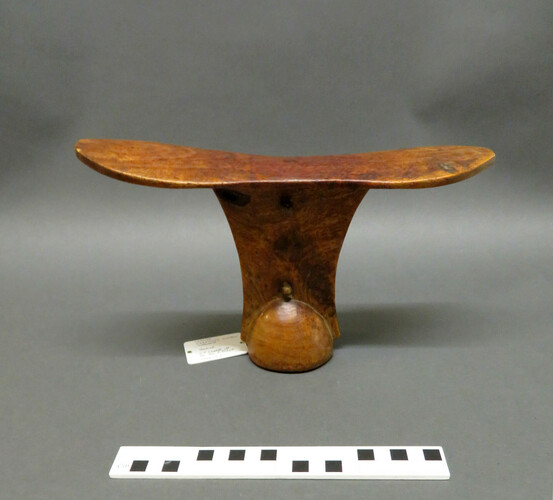 1992.19.2Headrest carved from a single piece of wood, comprising a flat, bi-lobed seat, circular base, shaped like an inverted cup, and a thin wooden sheet support connecting the two. The support is perforated in two places and a carrying strip of leather is threaded through the holes and tied. [JC [OPS Move] 22/3/2017]1992.19.2
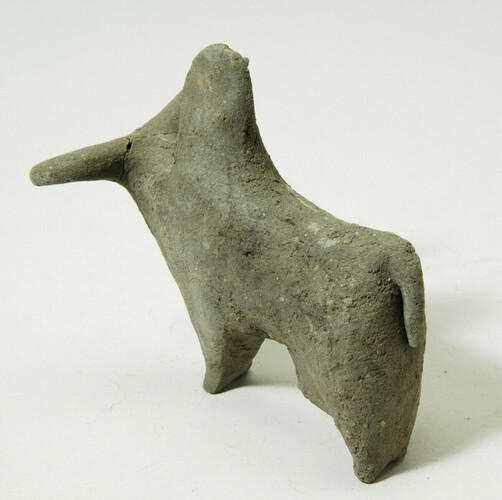 1936.10.88Hand modelled clay ox with humped back and trained horns, used as a toy [RTS 5/10/2004].1936.10.88
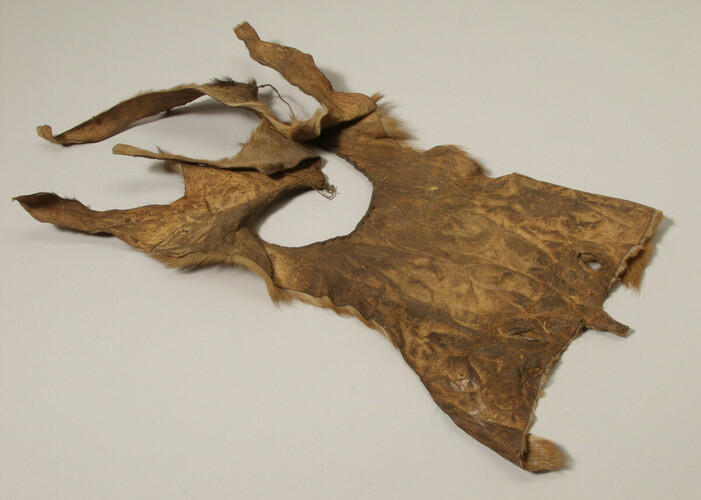 1979.20.142Bushbuck skin; orange-brown hair with paler markings, worn around the neck by men and women during dances. [EC 'DCF 2004-2006 What's Upstairs?' 6/10/2005]1979.20.142
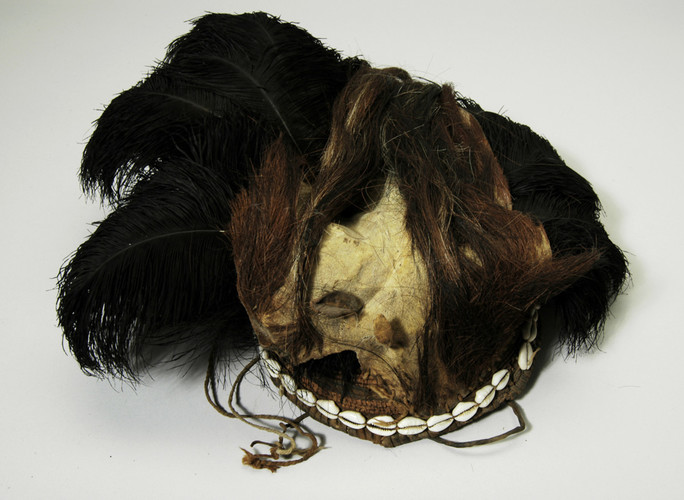 1928.67.1Headdress of the prophet, Car Koryom, made of basketry base covered with cowrie shells, ostrich feathers and animal hair [RTS 28/1/2005].1928.67.1
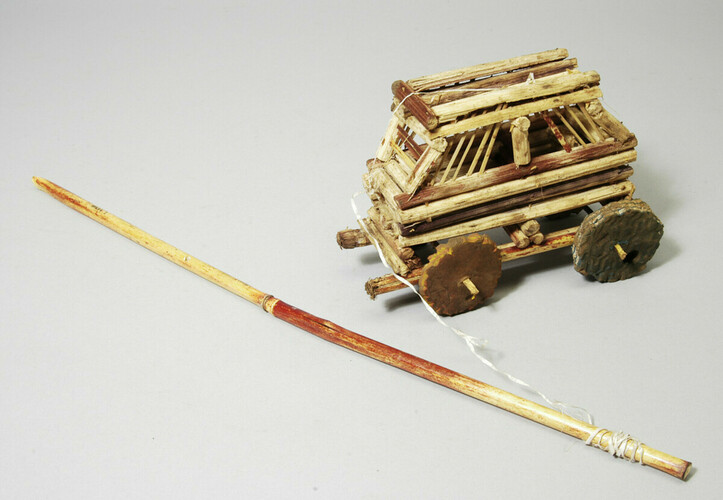 1998.9.4.1Toy car made from cassava stalks. Used with a stick for pushing it along, attached by a plastic string [1998.9.4 .2] [RTS 26/9/2005].1998.9.4.1