
- Collection type
- Object
- Description
- Barkcloth, unpainted. [MJD 18/06/2013]
- Long description
- Barkcloth, unpainted, light yellowish white in colour. The cloth is made of one layer. The cloth has fine parallel beater marks. [MJD 18/06/2013]
- Geographical reference
- Date / Period
- Date made: Before 1886
- Date collected
- By 1886
- Acquisition information
- Transferred: 19/04/1886
- Materials and processes
- Material Bark Fibre Plant, Material Mulberry Leaf Plant, Material Bark Cloth Textile Plant, Process Beaten
- Dimensions
- Length: max 4740 mm, Width: max 1620 mm
- Object numbers
- Accession number: 1886.1.1247
- Research and responses
Definitely not 'Forster' number 145. Number 145 reads, 'a jagged spear'. Therefore, this object has not been designated a proper 'Forster' number. [ZM 17/6/2004]
During a research visit on 8/6/2004 Associate Professor of Botany Will C. McClatchey and Al Keali'i Chock both from the University of Hawaii identified this barkcloth as probably Hawaiian because of the watermark, which is a distinguishing feature of Hawaiian barkcloths. [ZM 17/6/2004]
Examined during a research visit in April 2007 by Wendy Arbeit who noted that this is definitely not from Tonga because there is not the layering of the fibres typical of Tongan barkcloths. This cloth is one layer, has the sharp vertical imprint from the beater and is really smooth, which is typical of cloths from Tahiti and Hawaii. [ZM 25/4/2007]
Julia Gresson, Deputy Head of Conservation at the Horniman Museum and previously Head of Conservation at Auckland Museum looked at this barkcloth on the 20 June 2012 with HR and JU. We could not find any evidence of watermarks on it, as mentioned by McClatchey and Chock above, and are of the opinion that this barkcloth is from Tahiti. [JU 20/06/2012]
This barkcloth was examined by Adrienne Kaeppler, Smithsonian Institute, on 13-14 June 2013. She noted the fine beater marks. She stated it was probably made of paper mulberry. Due to the presence of such fine beater marks it is probably Tahitian. [MJD 18/06/2013]
Search terms: Barkcloth
Further items to explore
 1901.63.13Very large piece of brown bark cloth with geometric black patterns on one side: lines with a panel of circle patterns in the centre.1901.63.13
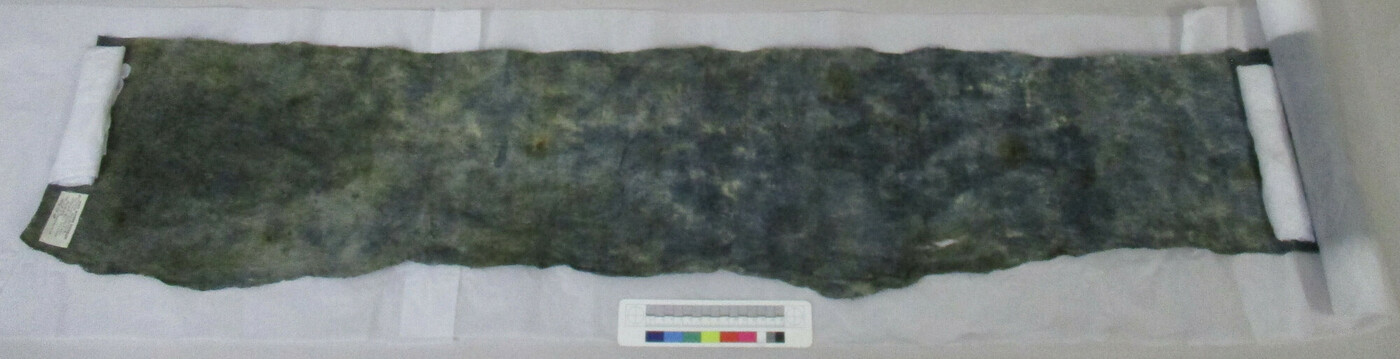 1894.26.49Barkcloth; 'stained blue'. It is darker in places and has patches of brown. [AB [OPS Move] 14/7/2017]1894.26.49
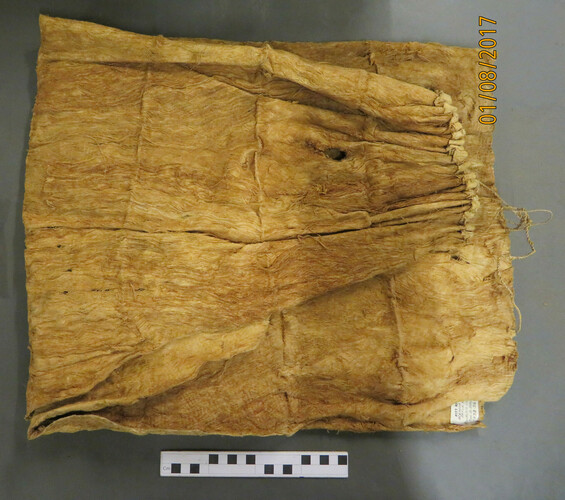 1938.36.582Cloak, made from a single piece of barkcloth which has been doubled over at the top and gathered with a fibre cord stitched through and pulled. Made in bands joined together. A section has been cut way at the stitched end. [CW [OPS move] 1/8/2017]1938.36.582
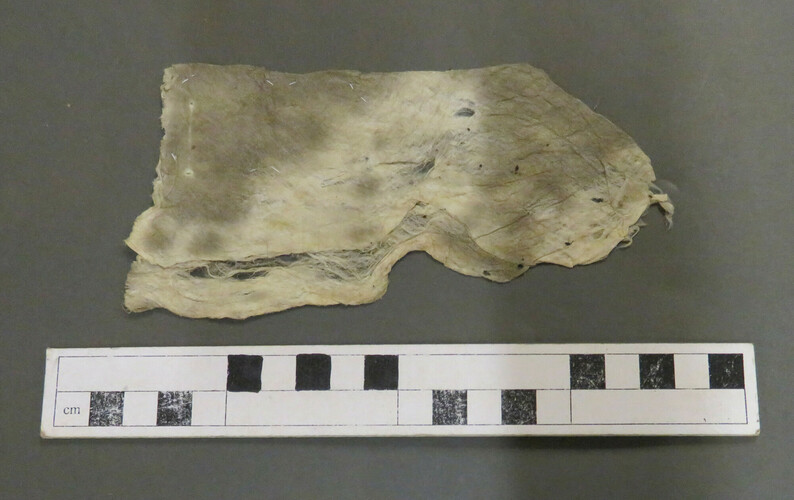 2005.138.1Specimen of white barkcloth. Piece with two straight edges and patches of grey in the fibre. [AF [OPS move] 25/7/2017]2005.138.1
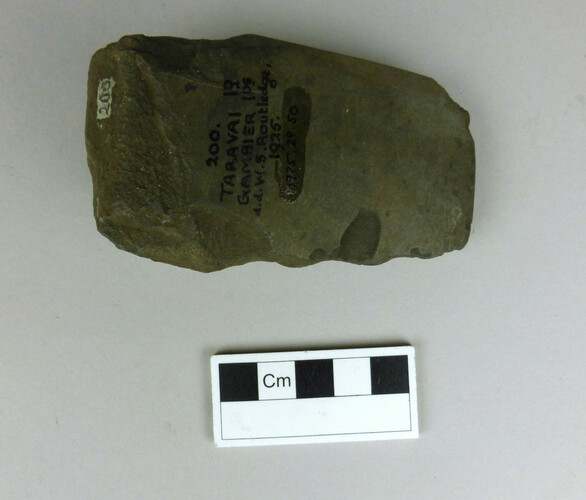 1925.29.50Ground adze-blade.1925.29.50
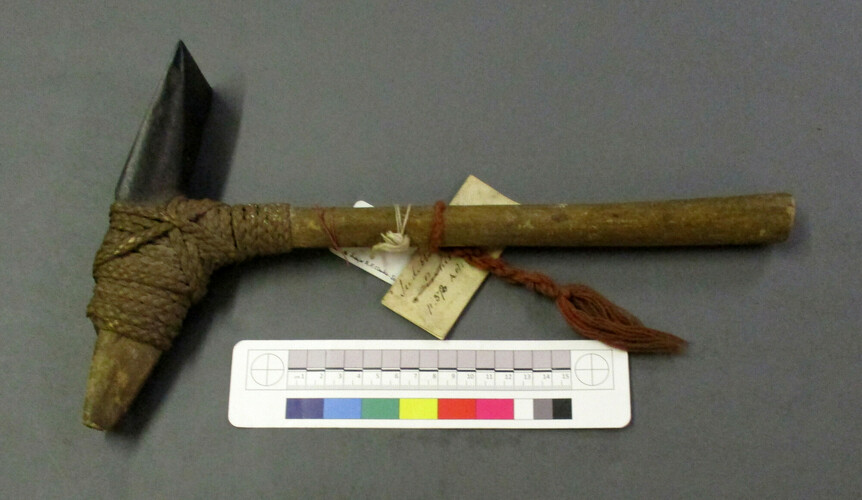 1975.10.3Black stone bladed adze. Bound with sennit to wooden handle, sennit is twisted and plaited. Length of twisted red wool fringe tied on handle. [FB 10/04/2014]1975.10.3
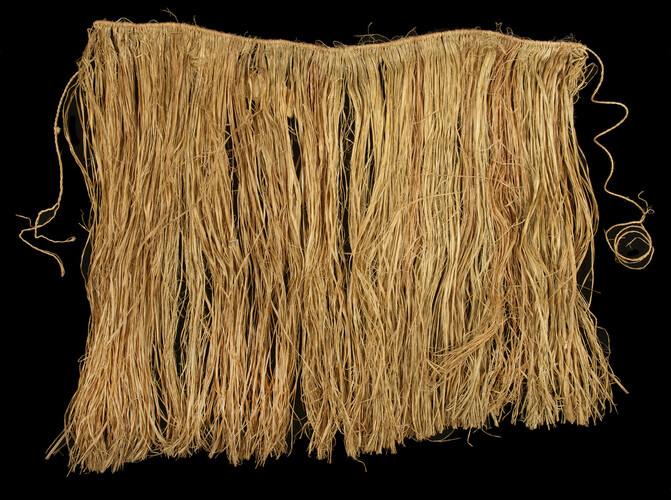 1886.1.1179Plant fibre skirt made from bundles of fibre tied to a waistband. [FB 06/11/2014; JC 14 3 2015]1886.1.1179
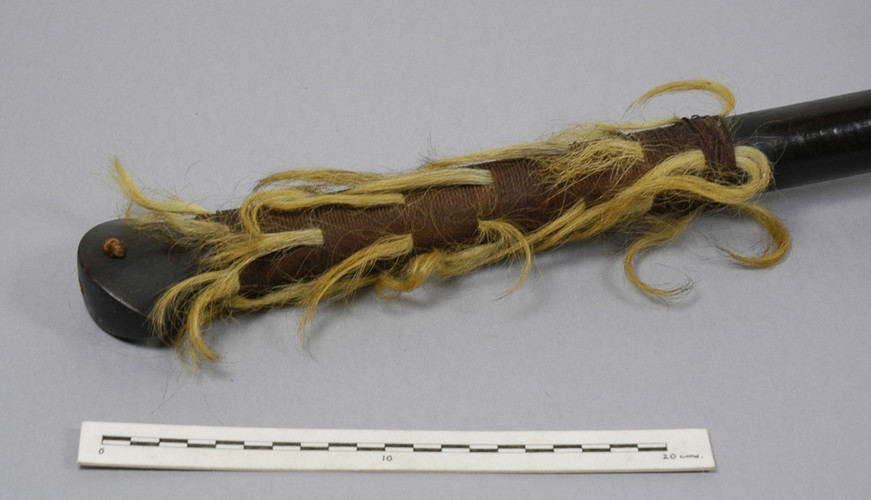 1884.12.269Club of highly polished dark wood with wide carved head. [SM 23/03/2007]1884.12.269