
- Collection type
- Object
- Description
- Arrow with shaft of reed with dark wooden arrow head tapering to a sharp point. [MJD 20/2/2009][JU 12/06/2013]
- Long description
- Arrow with shaft of reed with dark wooden head tapering to a sharp point. The head is secured to the shaft with plant fibre (probably hibiscus). [MJD 20/2/2009; JU 12/06/2013]
- Person
- Field collector Johann Reinhold Forster
- Field collector Georg Forster
- PRM source Ashmolean Museum, University of Oxford
- Date / Period
- Date made: Before 1774
- Date collected
- 1773-1774 ?
- Acquisition information
- Transferred: 19/04/1886
- Materials and processes
- Material Reed Plant, Material Wood Plant, Material Grass Fibre Plant, Process Carved, Process Bound
- Dimensions
- Length: max 461 mm arrow head, Length: max 980 mm
- Object numbers
- Accession number: 1886.1.1185 Other numbers: Forster 152 ?
- Associated publications
- Listed according to the 'Forster list' numbering system in 'From the Islands of the South Seas 1773-4: An Exhibition of a Collection Made on Capn. Cook's Second Voyage of Discovery by J.R. Forster- -A Short Guide (Oxford: Pitt Rivers Museum, no date[1970]). The text from the 'Forster' manuscript is followed by the following notes: '152. A bundle of arrows. Three are similar to those from Malekula (No.144). The fourth [1886.1.1197?] is three pronged, used for fishing (the normal method) or bird-catching. Lengths: from 96cm. to 122cm.' Listed under numbers 1-11 under ‘New Hebrides...Bows and Arrows’ on page 249 of 'Artificial Curiosities': Being an Exposition of Native Manufactures Collected on the Three Pacific Voyages of Captain James Cook, R.N. at the Bernice Pauahi Bishop Museum, January 18, 1978 - August 31, 1978 on the Occasion of the Bicentennial of the European Discovery of the Hawaiian Islands by Captain Cook - January 18, 1778 (Bernice P. Bishop Museum Special Publication 65), by Adrienne L. Kaeppler (Honolulu: Bishop Museum Press, 1978): '1-11. Two bows (missing), and nine arrows, Oxford (143, 144, 151, 152). Evidence: Forster collection. Probably includes the bow and arrow depicted in official accounts of the second voyage (Cook 1777, PLate 18 [Fig. 535]). Literature: Gathercole, n.d. (1970) [see above]'. [JP 23/7/2002] Published as part of the Forster Collection on a dedicated website at www.prm.ox.ac.uk/forster (from February 2001). [JC 7 7 2005] For an account of the history of the collection of which this is part, see 'The Cook-Voyage Collections at Oxford, 1772–1775', by Jeremy Coote, in Jeremy Coote (ed.), Cook-Voyage Collections of 'Artificial Curiosities' in Britain and Ireland, 1771–2015 (MEG Occasional Paper No. 5), Oxford: Museum Ethnographers Group (2015), pp. 74–122. (Copy in RDF: Researchers: Jeremy Coote (Cook-Voyage Collections).) [JC 9 6 2016]
Search terms: Archery Weapon, Arrow
Further items to explore
 1928.69.17.3Cane arrow or crossbow bolt with leaf fletching. For associated quiver and arrows see [1928.69.17 .1 - .14] [EH [OPS move] 29/9/2017]1928.69.17.3
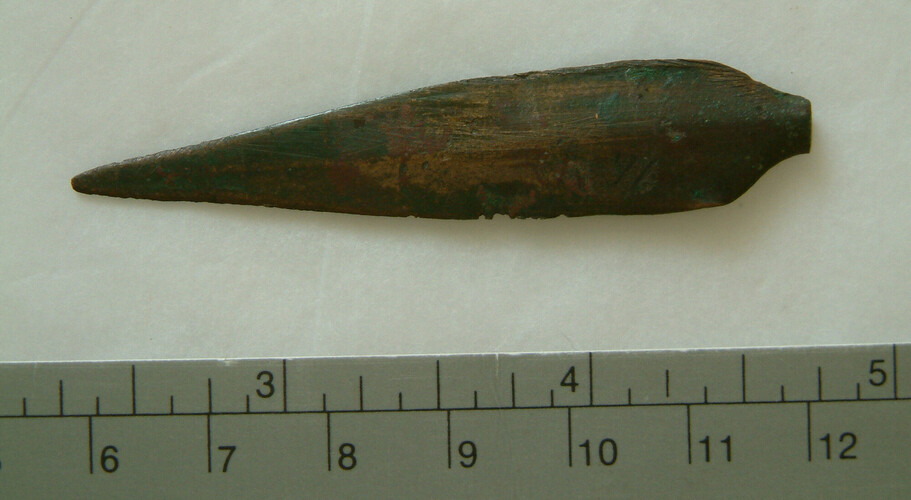 1917.36.46Arrowhead.1917.36.46
 2003.60.34Arrow. The shaft is dyed with diagonal stripes of dark brown. Bound on to one end with plant fibre is the metal arrowhead. [JP 25/3/2004]2003.60.34
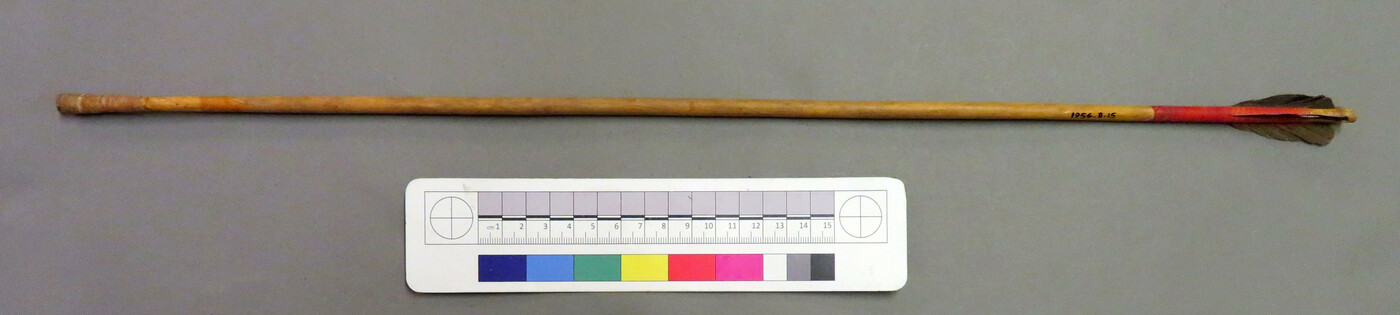 1956.8.15.5Arrow with no head. For associated quiver and arrows found within it see [1956.8.15 .1 - .7]1956.8.15.5
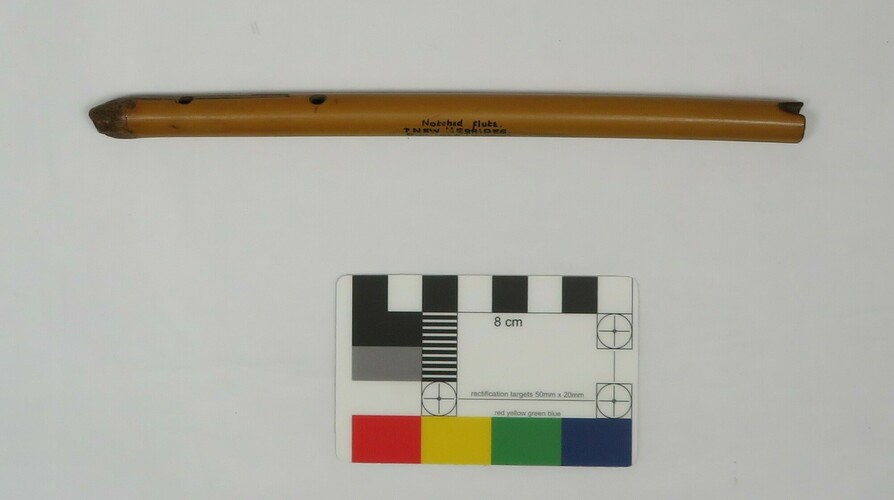 1928.52.8Small notched flute of bamboo, with 2 finger holes, closed at lower end. Two finger holes and one thumb hole, thumb is the lowest hole near the distal end of the instrument. [RR 13/1/2020]1928.52.8
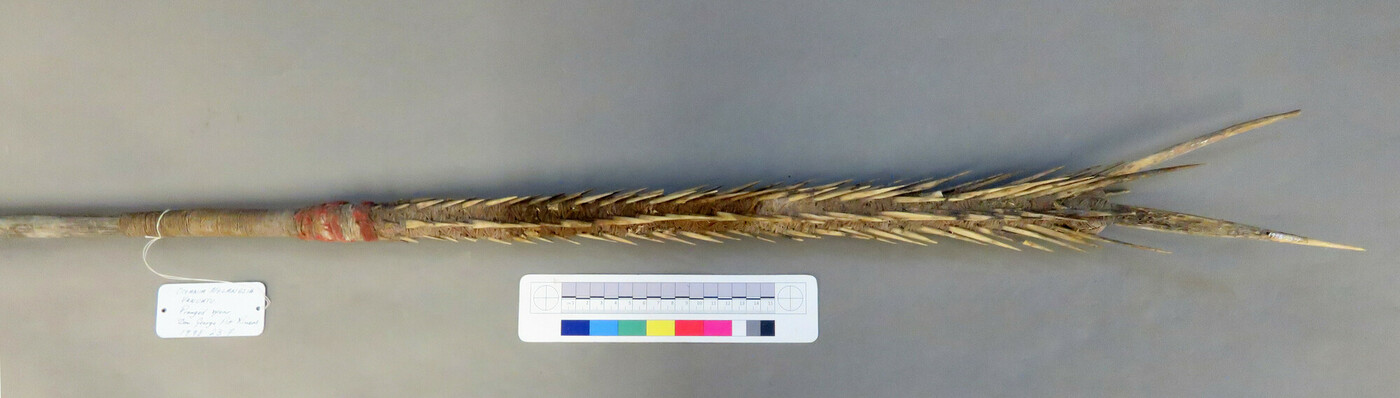 1998.23.7Wooden spear with many spiked prongs of bone bound onto the fore-end with plaited plant fibre. [MdeA / CW 29 4 1998]1998.23.7
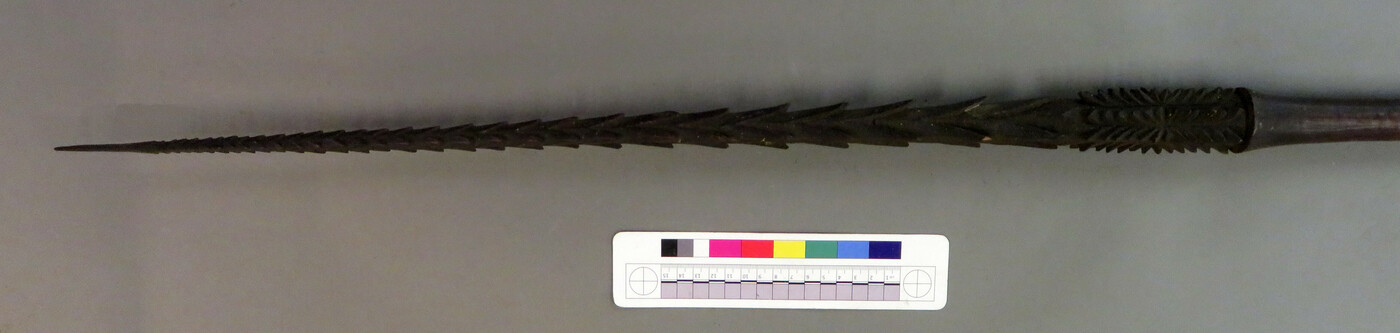 1938.23.46Spear carved from wood. The head is pointed with carved quadriform barbs, beneath the barbs there is a band of carved points. [AB [OPS move] 21/8/2018]1938.23.46
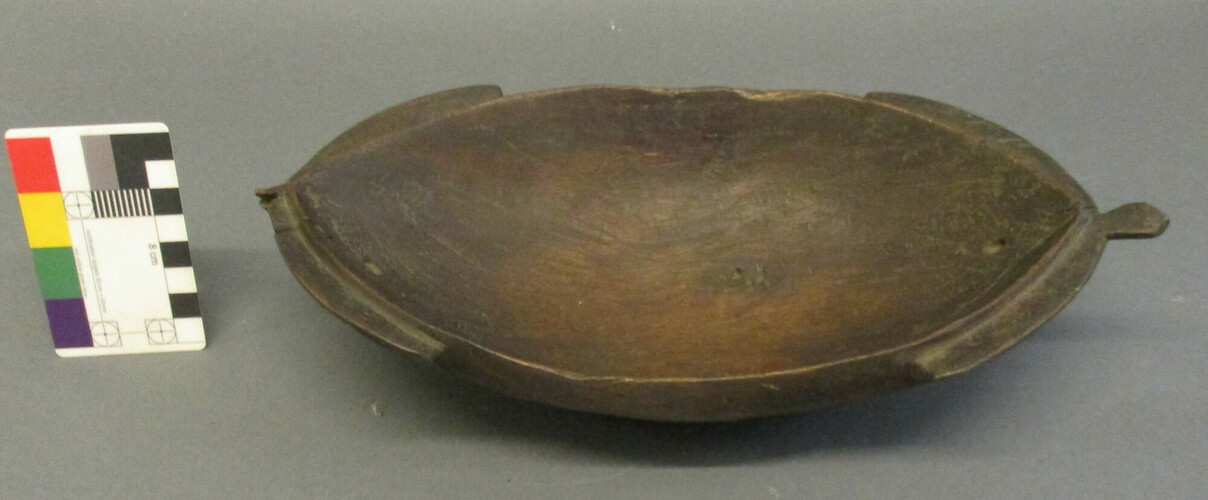 1900.49.7Lenticular carved wooden food bowl with two projections at either, one of which has been broken. Two sections where the rim has expanded. [BH [OPS Move] 30/8/2016]1900.49.7