
- Collection type
- Object
- Description
- Carved wooden paddle with flat, pointed leaf-shaped blade. Two sections of carving, one just above the blade and one mid-handle. [MOBB 2/7/2019]
- Geographical reference
- Cultural groups
- Māori
- Person
- Field collector Someone on board the HMS Endeavour (1768-1771)
- Field collector HMS Endeavour
- PRM source Ashmolean Museum, University of Oxford
- Date / Period
- Date made: Before 12/10/1769?, uncertain
- Date collected
- By 1878
- Acquisition information
- Transferred: 10/02/1886
- Materials and processes
- Material Wood Plant, Process Carved
- Dimensions
- Length: max 1670 mm
- Object numbers
- Accession number: 1886.1.1157 Other numbers: 1078 31
- Research and responses
* There is a note in the Ramsden collectors volume stating 'Retrospective numbers written in pencil down left hand column June 1975 E.S.G. Collated with A.M. but considerable problems encountered. All Ramsden seem to be in A.M.' Note that this exercise may have been the source of the confusion that occurred during Elizabeth Sandford Gunn's work on the Ashmolean collection with regard to numbers. In some instances, these numbers SEEM to have been used to number the objects (wrongly). [AP 15/7/99]
This paddle and 1886.1.1158 were examined by Steve Gibbs (Associate Professor, Toikhoukura - School of Contemporary Maori Visual Arts) on 5 June 2017. He made the following observations: That both paddles are most likely carved from Totara wood, a native New Zealand redwood used in carving. There is no painting on the blade of either paddle and no traces of pigment to suggest there ever was. Both paddles were designed to be used to paddle a war canoe (to pull water) and to be used in combat. He thought 1886.1.1157 unusual, possibly a later copy? But carrying the same tribal design systems. He had not seen the 'x' carvings on any other paddles he had seen during his research but thought that they could possibly be the marking system of the paddle's owner (or placed on the paddle by traders). The carving of the Manaia; a tribal motif that is one of the key links that ties all of these Hoe waka to the same event and location of creation, was carved with stone tools and is where the paddle was gripped for paddling. The carving makes the grip grippier when wet. However, on 1886.1.1157, the carving would not have worked to make the grip gripper in the same way and so perhaps this paddle was intended more for ceremony? These hoe waka (canoe paddles) are associated with an event that took place at 3 p.m. on 12 October 1769, the first peaceful exchange of items with Maori off a place located south of Gisborne (Turanganui-a-kiwa), Whareongaonga is the name of this natural deep sea port south of Turanganui-a-kiwa. The Maori who occupied this region at that time were known as Ngai Tahupo and Rangi-i-waho who occupied the land near Whareongaonga during this time. The paddles were exchanged in the ritual of gifting ‘Takoha' (to gift). [FB 5/6/2017]
In a note to Jeremy Coote written immediately after his visit to the PRM on 5 June 2017, Steve Gibbs writes: 'My immediate impression would be that both 'Hoe Waka' belong to the same set that was traded/gifted to Cook/Tupaia in 1769 off Whareongaonga (south of Gisborne). They have the same blade design and carry the carved manaia form. Neither have remnants of painting on the blade - which is similar to the How Waka that is in Sunderland Museum.' (Original in RDF.) [JC 7 6 2017]
Search terms: Navigation, Paddle
Further items to explore
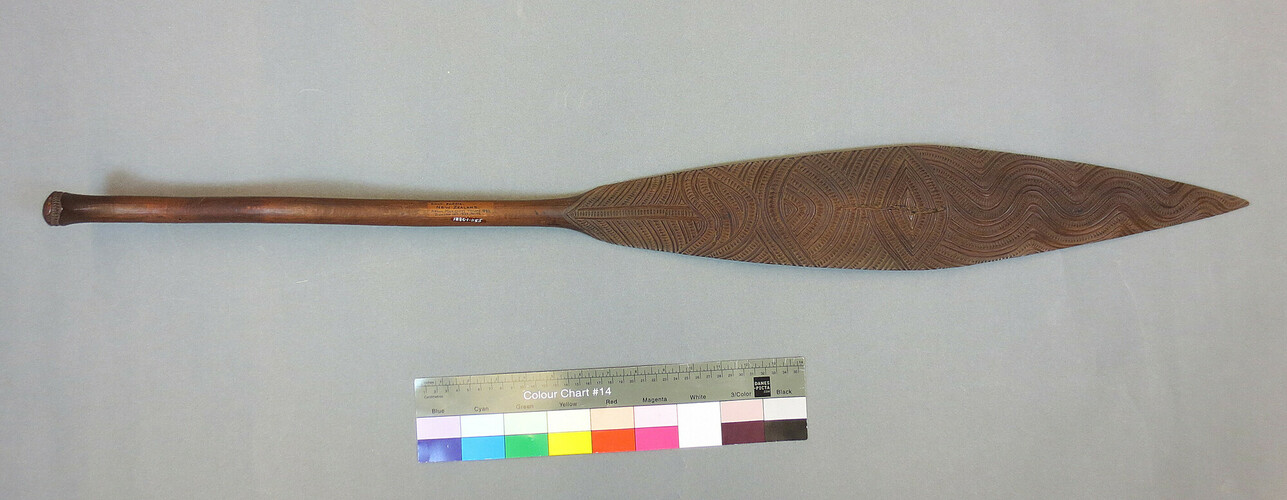 1886.1.1155Wooden paddle, curved along the shaft, decoratively carved around the grip and on one side of the blade. [ZM 30/04/2014]1886.1.1155
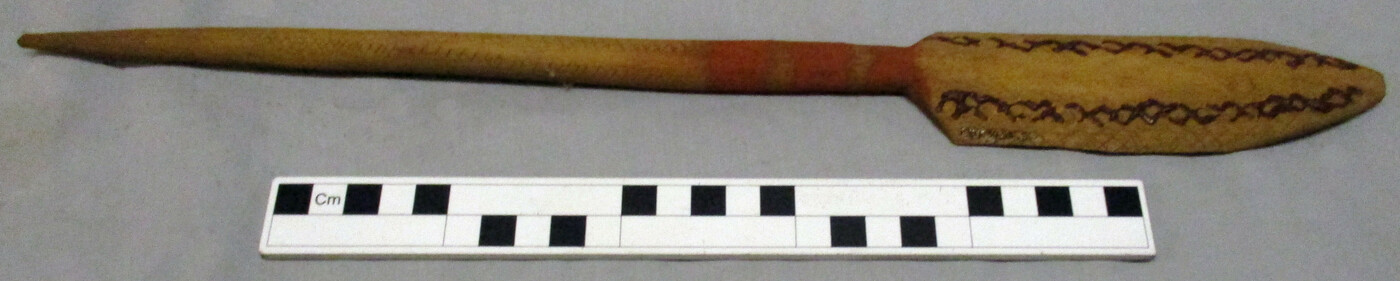 1884.54.55.5Model paddle for the canoe 1884.54.55 .1. Carved from a single piece of wood, with an oval shaped blade that is carved into a tip. On the upper surface are incised crosses in the centre and at the edges and near to the edge are two rows of resin crosses in a diamond pattern. Decorating the shaft are three bands of red pigment near to the blade and incised lines along the surface. See 1884.54.55 .1 - .9 for the other associated parts. [ASh [OPS move] 10/10/2016]1884.54.55.5
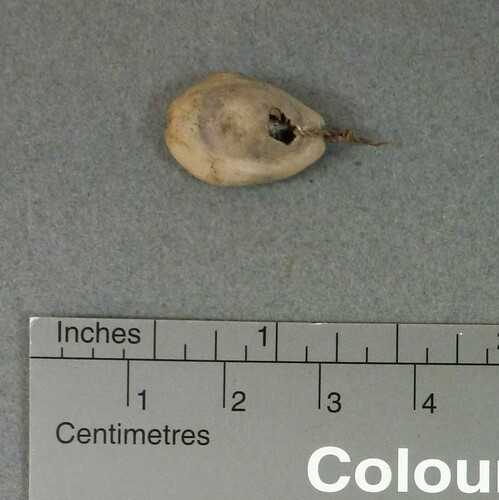 1893.42.8.6Cowrie shell ornament for the model canoe 1893.42.8 .1. Once decorating the prow or the boat itself. Plant fibre string still attached to a hole in the surface of the cowrie. For the other associated records please see 1893.42.8 .1 - .21. [ASh [OPS move] 12/10/2016]1893.42.8.6
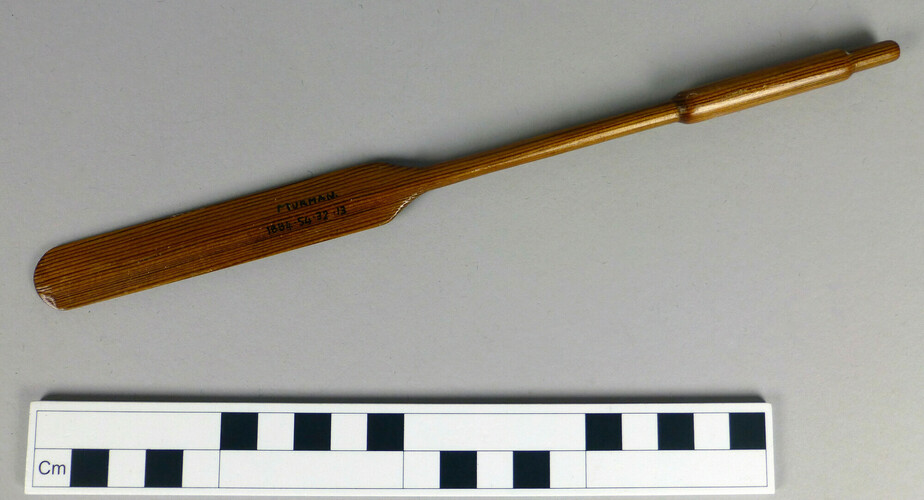 1884.54.32.13Carved and varnished wooden model oar, part of boat model 1884.54.32 [ZM 1/3/2016]1884.54.32.13
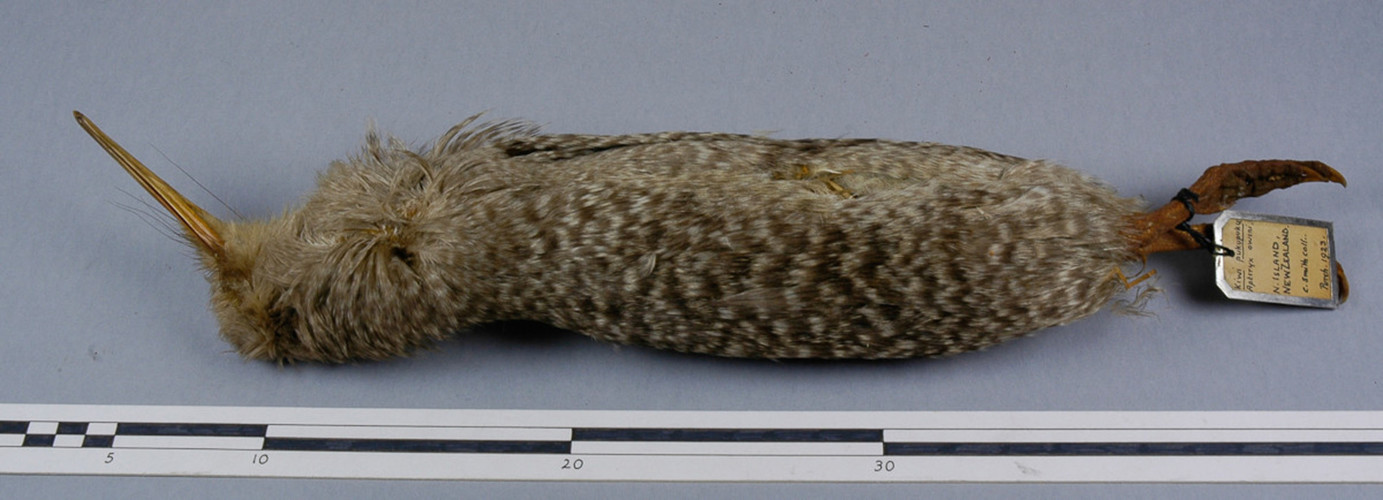 1923.87.262Specimen of Apteryx owenii, the Little Spotted Kiwi, unmounted skin. [El.B 02/06/2008]1923.87.262
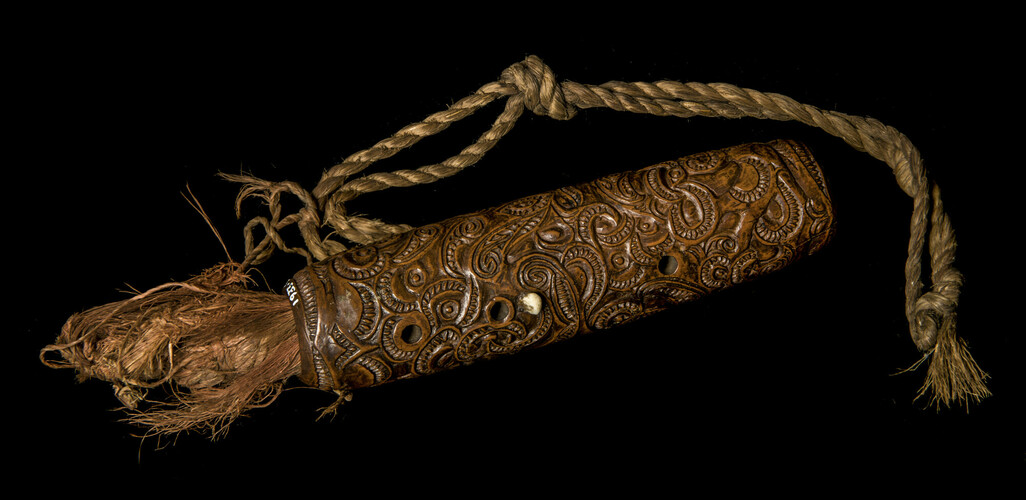 1933.5.6End-blown flute, koauau, carved from wood. Three finger-holes. Plug of fibre. [HLR; JC 14 12 2007]1933.5.6
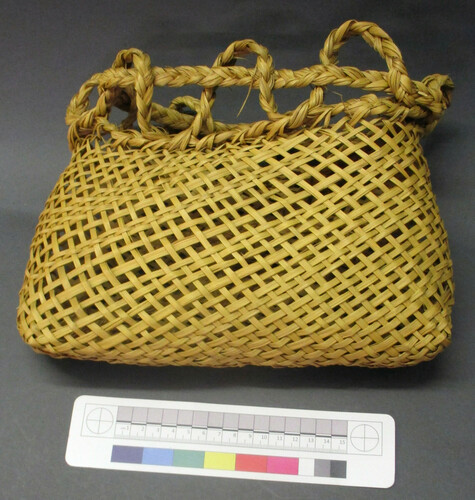 1930.85.12Openwork basket, rectangular in shape for boiling food in hot springs. The basket has a plaited openwork rim. [CW [OPS Move] 22/11/2016]1930.85.12
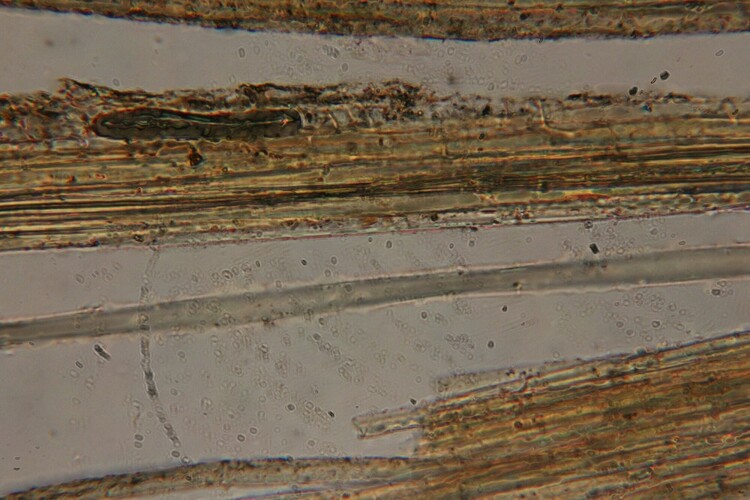 1886.1.1139.3Specimens of twisted flax tied in the middle with plaited coconut fibre. [SM (Verve) 27/05/2014]1886.1.1139.3