
- Collection type
- Object
- Description
- Printed account of the history of the Biddenden maids.
- Long description
- Printed account of the history of the Biddenden maids detailing the story of their bequest of land and money for distribution of commemorative cake. [SM 19/11/2019]
- Geographical reference
- Cultural groups
- English
- Person
- Maker Unknown Maker
- Field collector Unknown Collector
- PRM source Augustus Henry Lane Fox Pitt Rivers founding collection
- Date / Period
- Date made: Before 1875?, uncertain
- Date collected
- ?By 1875
- Acquisition information
- Donated: 1884
- Materials and processes
- Material Paper Plant, Process Printed
- Dimensions
- Length: max 260 mm
- Object numbers
- Accession number: 1884.56.100.2 PR Cat other PR nos: 2535
- Research and responses
http://www.villagenet.co.uk/highweald/villages/biddenden.php
Local legend has it that in 1100 twins were born into the Chulkhurst family , who were joined at the hips and shoulders. Elisa and Mary lived together for 34 years when one of them died. As it was impossible to separate the twins, the other died soon after. It is believed they were carried to Battle Abbey where they were buried. As part of their will, they bequeathed about 20 acres of land to be used to help the poor. This charitable event has been recorded by the church since 1538 and it is probable that it started from the maids.
http://www.godecookery.com/cookies/mocohist.html
From Anomalies and Curiosities of Medicine by George M Gould and Walter L Pyle.
http://www.zoraskingdom.freeserve.co.uk/4class1.htm Dec. 5, 2004
The " Biddenden Maids " were born in Biddenden, Kent, in 1100.
Their names were Mary and Eliza Chulkhurst, and their parents were fairly well-to do people. They were supposed to have been united at the hips and the shoulders, and lived until 1134. At the death of one it was proposed to separate them, but the remaining sister refused, saying, "As we came together, we will also go together," and, after about six hours of this Mezentian existence, they died. They bequeathed to the church-wardens of the parish and their successors land to the extent of 20 acres, at the present time bringing a rental of about $155.00 annually, with the instructions that the money was to be spent in the distribution of cakes (bearing the impression of their images, to be given away on each Easter Sunday to all strangers in Biddenden) and also 270 quartern loaves, with cheese in proportion, to all the poor in said parish. Ballantyne has accompanied his description of these sisters by illustrations, one of which shows the cake (right). Heaton gives a very good description of these maids; and a writer in "Notes and Queries" of March 27, 1876, gives the following information relative to the bequest:
"On Easter Monday, at Biddenden, near Staplehurst, Kent, there is a distribution, according to ancient custom, of 'Biddenden Maids' cakes,' with bread and cheese, the cost of which is defrayed from the proceeds of some 20 acres of land, now yielding £35 per annum, and known as the 'Bread and Cheese Lands.' About the year 1100 there lived Eliza and Mary Chulkhurst, who were joined together after the manner of the Siamese twins, and who lived for thirty-four years, one dying, and then being followed by her sister within six hours. They left by their will the lands above alluded to, and their memory is perpetuated by imprinting on the cakes their effigies 'in their habit as they lived.' The cakes, which are simple flour and water, are four inches long by two inches wide, and are much sought after as curiosities. These, which are given away, are distributed at the discretion of the church-wardens, and are nearly 300 in number. The bread and cheese amounts to 540 quartern loaves and 470 pounds of cheese. The distribution is made on land belonging to the charity, known as the Old Poorhouse. Formerly it used to take place in the Church, immediately after the service in the afternoon, but in consequence of the unseemly disturbance which used to ensue the practice was discontinued.
The Church used to be filled with a congregation whose conduct was occasionally so reprehensible that sometimes the church-wardens had to use their wands for other purposes than symbols of office. The impressions of the 'maids' on the cakes are of a primitive character, and are made by boxwood dies cut in 1814. They bear the date 1100, when Eliza and Mary Chulkhurst are supposed to have been born, and also their age at death, thirty-four years." [AP 29/09/2006]
Search terms: Commemoration, Writing, Document
Further items to explore
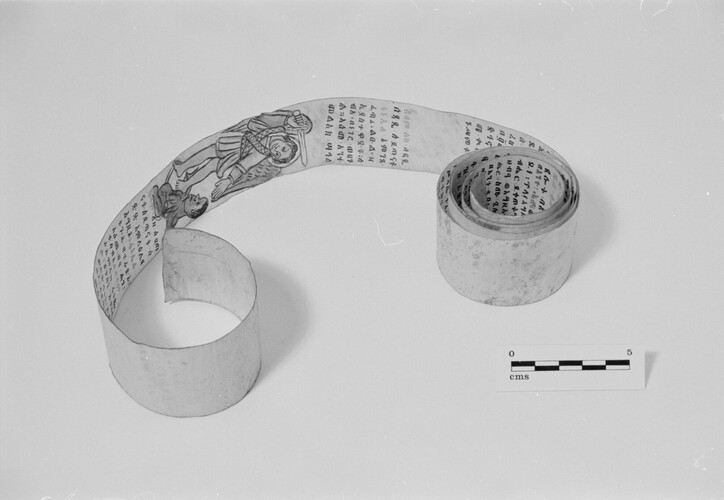 1998.26.15.2Roll of parchment incribed in Amharic and painted with figures. Apparently, such objects were worn as charms/amulets, either on the person or attached to horse-trappings.1998.26.15.2
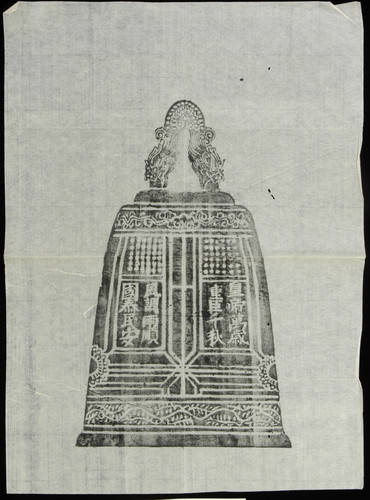 1908.82.799Print of the bell in Engaku-ji. [SM 17/12/2010]1908.82.799
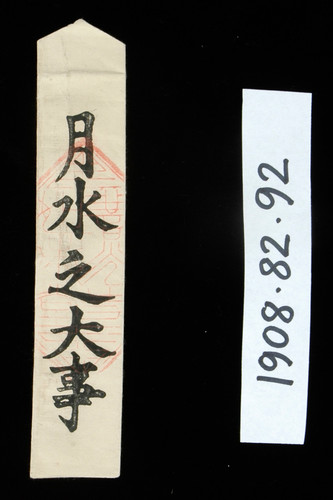 1908.82.92Amulet envelope with printed inscription in black and diamond shaped red stamp. [SM 16/10/2008]1908.82.92
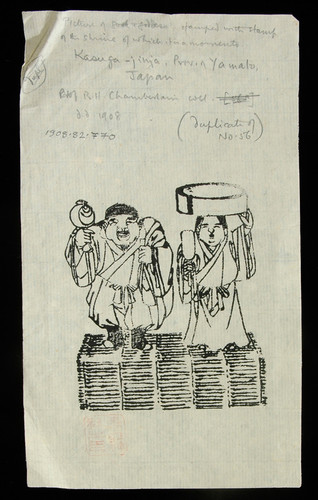 1908.82.770Paper printed with Daikoku and his wife Yakami Hime and a small red stamp [SM 16/10/2008].1908.82.770
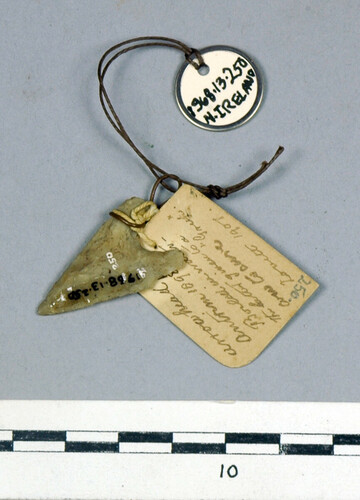 1968.13.250Flint arrow-head with barbs. [El.B 06/11/2008]1968.13.250
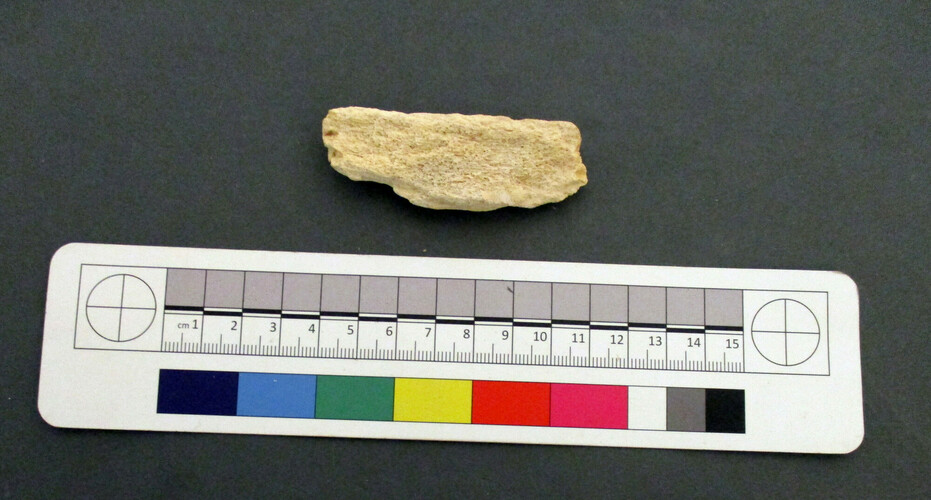 1935.46.13.70Fragment of deer antler, the upper surface lightly pitted. [CW [OPS Move] 11/5/2017]1935.46.13.70
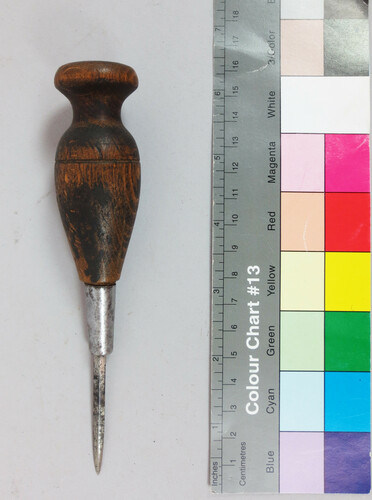 1954.5.19BSaddler’s sewing awl. [SM (Verve) 01/05/2014]1954.5.19B
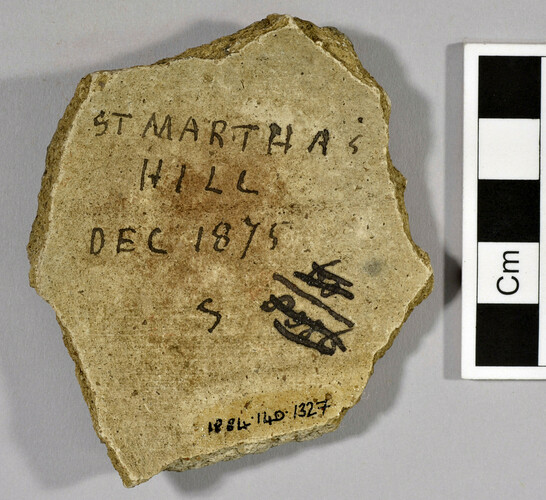 1884.140.1327Ceramic sherd1884.140.1327