
- Collection type
- Object
- Description
- Carved, wooden stamp block featuring a horse and foal design. [AFS [OPS move] 26/7/2019]
- Long description
- Carved, wooden stamp block featuring a horse and foal design. The horse stands centrally in the design, with the foal mirroring its stance, positioned between it's legs. There are two diagonal grooves on the horses neck similar to a collar/harness. Above the horse is a section of Arabic text. The design is enclosed in a zigzag border. Gold pigment remains on the design of the stamp. The wood extends out from the carved design to create a handle. The wood is stained and there is evidence of past insect damage. [AFS [OPS move] 26/7/2019]
- Geographical reference
- Date
- Date collected
- 1983
- Acquisition information
- Donated: 03/03/2016
- Materials and processes
- Material Wood Plant, Material Pigment, Process Carved
- Dimensions
- Height: max 86 mm, Width: max 97 mm, Length: max 114 mm
- Object numbers
- Accession number: 2018.37.90 Other numbers: xNY33
- Research and responses
The town of Zabid in the Tihama region of Yemen had been an important centre of the indigo dyeing industry from Medieval times, and even in the 1940s there were still over a hundred dyeing establishments in the town. By the Balfour-Pauls’ first trip there in 1983 only two of these remained – Bayt Muhammad Ali Abud and Bayt Ahmad Sa’d al-Hakami – and by 1989 Bayt Abud was the sole survivor. It was a desire to record the dyeing industry in this area that led Jenny Balfour-Paul to pursue her in-depth research into indigo. Balfour-Paul, J., 1997. Indigo in the Arab World. Richmond: Curzon, p.90. [JMC 19/08/2020]
This last step in the production of indigo-dyed cloth is described by Balfour-Paul: "In the workshops of Zabid all that remained was for the completed cloths, now in four and half metre lengths (i.e. half a taqa, shrunk by dyeing) and as stiff as cardboard, to be stamped with wooden blocks dipped in a mixture of gold powder and resin. The patterns on the blocks were a matter of pride to the dyers; some were carved with the family name and inscriptions and others with a pair of scissors, denoting the high quality of work from the Zabidi dyeshops". Balfour-Paul, J., 1997. Indigo in the Arab World. Richmond: Curzon, p.92. [JMC 19/08/2020]
There are two wooden stamping blocks from the Bayt Muhammad Ali Abud workshop among the objects donated by Jenny Balfour-Paul. For the other see 2018.37.91. For a photograph of Muhammad Ali Abud, owner of Bayt Abud indigo-dyeing workshop, demonstrating the stamping of a design onto a finished cloth in 1983, see 2018.137.909. [Joanna Cole 25/11/2022]
The Jenny Balfour-Paul collection [2018.37] was extensively researched and studied as part of the Multaka Oxford Project. The Multaka Oxford project is an inclusive volunteering programme using the collections as a springboard for intercultural dialogue about cultural heritage delivered jointly by the Pitt Rivers Museum and the History of Science Museum, University of Oxford. Any input from Multaka volunteers have been included as project notes on the database records for specific objects. [ThW [Multaka Project] 27/1/2021]
[Multaka-Oxford Project notes] From the Pitt Rivers Museum online exhibition Weaving Connections: A gold factory mark from a Zabidi indigo workshop signified the high quality of work associated with the town. Here the owner of Bayt Abud demonstrates this last step in the production of indigo-dyed cloth. He rubs the carved wooden printing block in a mixture of gold powder and resin and stamps the bundled and tied cloth. The designs on the blocks could include animals, plants, and often a pair of scissors, and would usually be carved with a family name or other inscription. [ThW [Multaka Project] 27/1/2021]
Multaka-Oxford Project notes] From the Pitt Rivers Museum online exhibition Weaving Connections Volunteer Sally Barakjl said: ‘Yemen is well-known for having pure-bred Arabian horses. This is reflected in the horse and foal design of this engraving (xylography).’ [ThW [Multaka Project] 27/1/2021]
Multaka-Oxford Project notes] From the Pitt Rivers Museum online exhibition Weaving Connections Volunteer Jenny Balfour-Paul writes: ‘Even in the 1980s Yemeni men could be seen wearing new turbans arranged to ensure the gold factory mark was clearly visible.’ [ThW [Multaka Project] 27/1/2021]
- Associated publications
- Balfour-Paul, Jenny, Indigo in the Arab World, Routledge, 1997 [AF [EFCF project] 23/8/2019] Balfour-Paul, Jenny, Indigo: Egyptian Mummies to Blue Jeans by , British Museum Press, 1998 [AF [EFCF project] 23/8/2019]
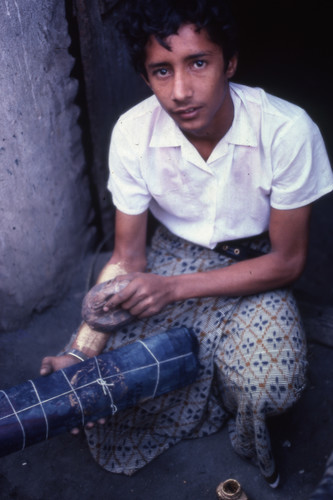
Further items to explore
 2024.22.60.3Ink pad.2024.22.60.3
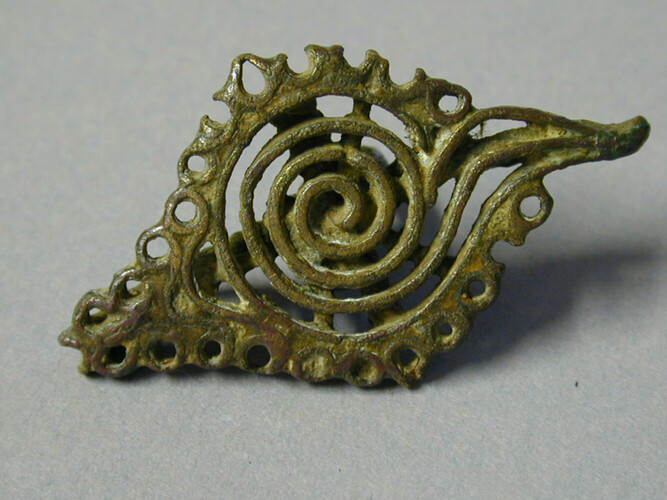 1930.35.13Brass stamp for imprinting designs on faces or bodies of Hindu devotees.1930.35.13
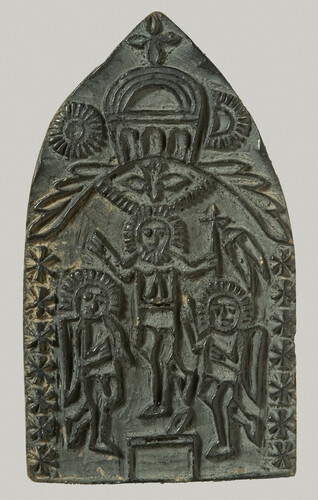 1910.71.1Tattooing stamp, made of wood, in shape of a pointed arch.1910.71.1
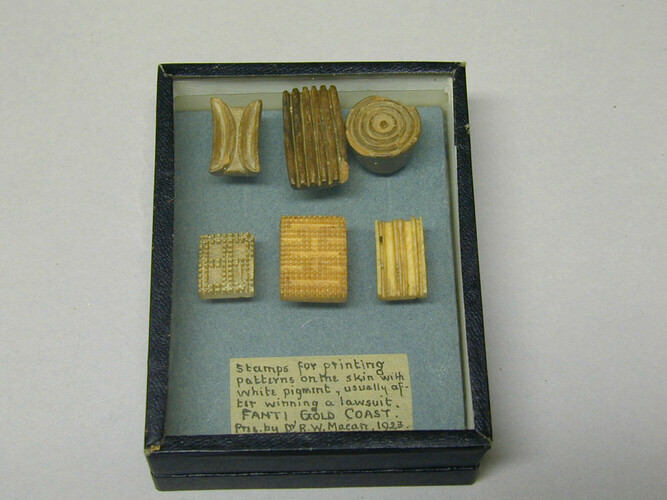 1923.55.31Wooden stamp carved with designs.1923.55.31
 1907.33.6Shark jaws. [AB [OPS Move] 26/7/2016]1907.33.6
 2018.37.103A pair of anklets consisting of two hollow silver rings. [AFS [OPS move] 29/7/2019]2018.37.103
 2018.37.76Pair of embroidered panels for sirwal bottoms (in two parts), consisting of black and green textile embroidered with red, green and metallic cotton thread.2018.37.76
 2009.137.1A circular strip of woven material used to squat or sit comfortably on the ground.2009.137.1