
- Collection type
- Object
- Description
- Ceramic pucará figure of a horse. [JMC 16/7/2018]
- Long description
- Ceramic pucará figure of a horse. The horse has a hollow, tubular body and thick, arching neck, with four solid, cylindrical legs. The horse’s head, ears, tail and ridged mane have been hand-modelled, with impressed circles for the eyes and carved out nostrils and mouth. The horse wears a bridle on its head and a saddle on its back, although there is a large, circular opening where the seat of the saddle should be, and a looped handle in front of this. The figure is almost entirely painted white and has been decorated all over with bands of green glaze and wavy lines and spirals of red paint. Glaze and paint have also been used to define the reins, saddle sides, facial features and other decorative trappings the horse may have worn. Eight ceramic rosettes have been applied to the figure, these are on the horse’s front, forehead, nose, rump, two on top of the head either side of the mane, and two either side of the saddle. [JMC 16/7/2018]
- Cultural groups
- Quechua
- Date / Period
- Date made: Before 1964
- Date collected
- 1962 - 1964
- Acquisition information
- Donated: 27/06/2018
- Materials and processes
- Material Pottery, Material Pigment, Process Fire-Hardened, Process Glazed, Process Painted, Process Modelled, Process Impressed
- Dimensions
- Height: max 239 mm, Width: max 95 mm, Length: max 290 mm
- Object numbers
- Accession number: 2018.107.2
- Research and responses
There is a photograph of a similar pucará bull on p.74 of the Peruvian Official Tourist Bureau brochure (see RDF). The accompanying text reads "Post-Hispanic pottery has produced forms universally admired, all of which have Western European themes, such as the so-called Pucará bull and the Ayacucho churches. These two examples fulfill religious functions, the first native and the second Indo-Hispanic. The bull superseded a god called Amaru (serpent) who lived in the waters at the center of the earth. Legends today still tell of this god, but it is said that he has the form of a bull and not a serpent, as he used to be imagined until quite recent times. The ceramic bull serves as an offering to the gods of the mountains and also guards and protects the crosses which are placed on the roofs." p.75-6. [JMC 13/7/2018]
Search terms: Figure, Vessel, Animal Figure
Further items to explore
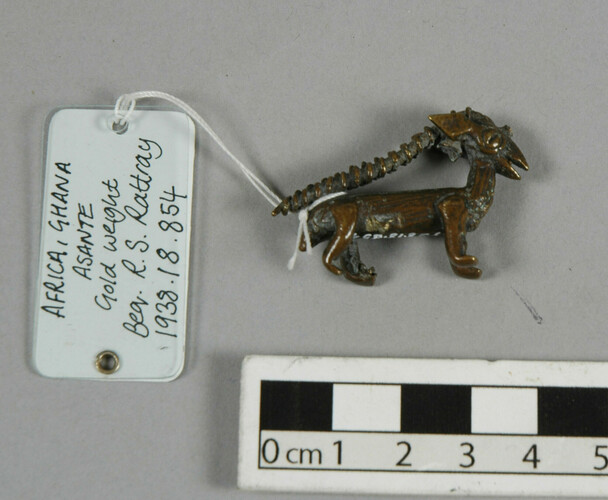 1938.18.854Copper alloy weight in the form of an antelope with twisted horns that run from the back of head to tail. [MJD 19/08/2008]1938.18.854
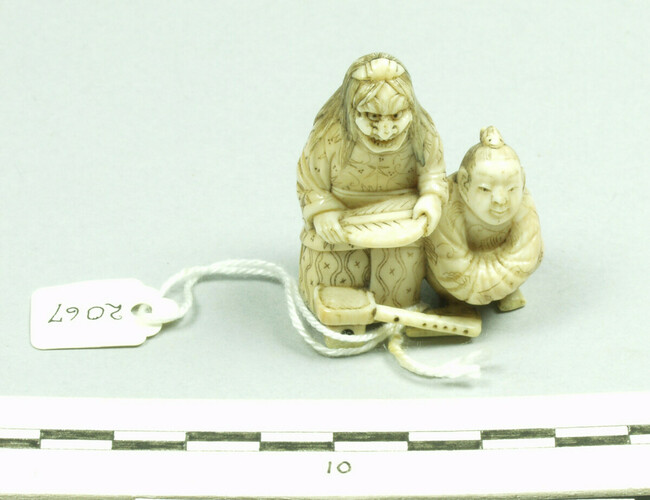 1980.34.2067Ivory netsuke of figure with long hair and a mask, with a small table and flute at his feet. Has an attendant on his left, who bears a fish on his head. [El.B 'DCF 2004-2006 What's Upstairs?' 3/5/2005]1980.34.2067
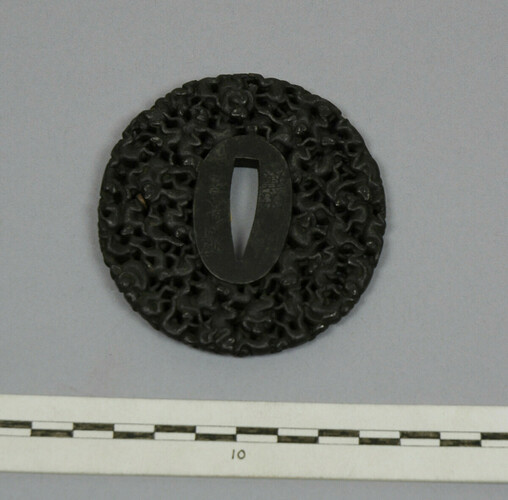 1929.89.20Round metal sword guard ornately decorated with a monkey design. [ZM 15/8/2005]1929.89.20
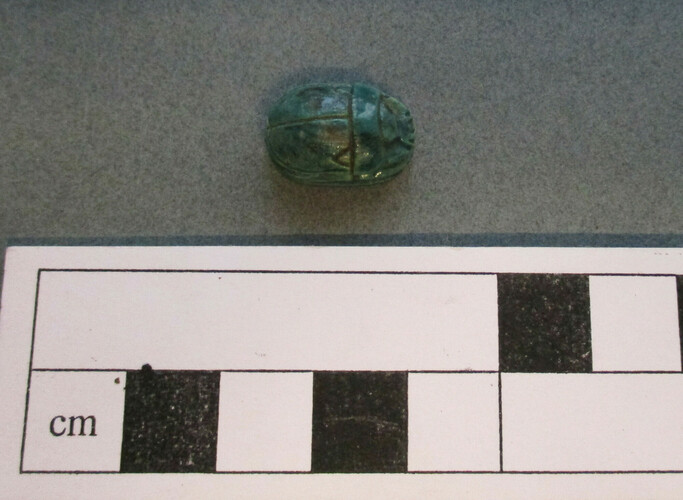 1985.54.722Amulet. Faience green scarab, perforated. Used as a cure for all illnesses. [SB [OPS Move] 08/03/2017]1985.54.722
 1933.75.31Textile strip1933.75.31
 1966.1.1389Textile fragment1966.1.1389
 1919.59.30Stone fish-hook shank1919.59.30
 1997.2.36Woman's rectangular shawl1997.2.36