
- Collection type
- Object
- Description
- Wooden disc, from animal trap. [SM 27/11/2007]
- Long description
- Wooden disc, from animal trap. Trap component carved from a single piece of brown wood (Pantone 7505C), oval in plan view, with a flat underside and slightly convex upper surface. The sides have been cut flat in some places, but are of irregular width. A u-shaped notch has been cut into one end. The object is complete and intact, but has small cracks running in the direction of the wood grain, and two cuts in the upper surface where part of the wood has been gouged away. It has a length of 135.7 mm, a width of 119.4 mm, a maximum thickness of 21.5 mm and a minimum thickness of 4 mm at the outer edge, with a weight of 153.4 grams. For the associated objects see 1934.8.11 .1 - .6 [RTS 13/4/2004].
- Cultural groups
- Dinka
- Person
- Field collector Percy Horace Gordon Powell-Cotton
- Field collector Hannah Powell-Cotton
- PRM source Percy Horace Gordon Powell-Cotton
- Date / Period
- Date made: Before 1933
- Date collected
- 3rd May 1933
- Acquisition information
- Donated: 1934
- Materials and processes
- Material Wood Plant, Process Carved
- Dimensions
- Depth: max 21.5 mm, Width 119.4 mm, Length 135.7 mm, Weight 153.4 g
- Object numbers
- Accession number: 1934.8.11.3 Other numbers: 2224
- Research and responses
Fanamweir is now located in the administrative district of Warab in the Southern Sudan. Powell-Cotton made ethnographic films during his 1932-3 shooting expedition to southern Sudan; footage included a Dinka hunter setting a trap, which is described by his wife Hannah: "In a game track a Dinka hunter laid a noose and set its weighty spring-trap, formed like a bow strung with twisted hide" (Mrs Powell Cotton, "Village Handicrafts in the Sudan", Man 34 (112), pp 90-91). There are several photographs of a Dinka man demonstrating the use of this trap in the Pitt Rivers Museum collection, which are probably stills taken from this footage; see Photograph Accession Numbers 1998.207.3.1-9. These have explanatory notes written on the back of each print, which identify the various parts of the trap with the letters A to J. A was the Bow (1934.8.11.1), C seems to be a stick that takes the tension when the trap is set; G is a small loop that the end of C is fitted through as the trap is set, and this is attached somehow to H, which is the wooden disc, 1934.8.11.3, while J may be one of the group of pegs. The trap was set by placing the wooden disc in the ground, covering it with stones, and arranging the hide noose around it. The bow was set up a small distance away in a depression in the ground with the bow string facing the disc, and a longer stick pulled over the string to fit into a small loop at the disc end; this stick was then tied to the pegs and the trap set, then covered over with earth.
Dang (plural deng) is a Dinka word meaning bow (D.G. Beltrame 1880, Grammatica e Vocabolario della lingua Denka, p. 190 gives definition as 'arco, schioppo, lancia); Nebel defines the term dhang, pl. dhèng, as ‘bow, rifle’ (Nebel 1979, Dinka-English Dictionary, p. 27). See also Schweinfurth 1873, The Heart of Africa, where dang is used to described a bow-shaped type of parry shield. The Nuer also use the word to describe a type of staff with curling ends, which may be related to this form [RTS 22/6/2005]
Search terms: Hunting, Trap, Hunting accessory
Further items to explore
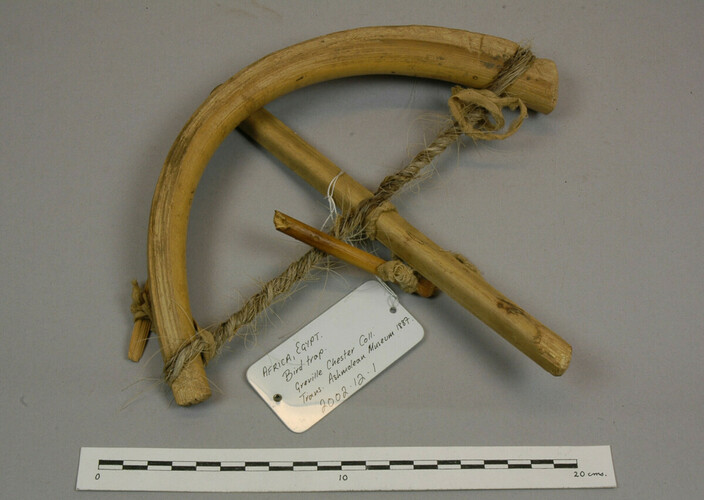 2002.12.1Bird trap made from a curved piece of wood that has twisted ?hair rope tied between the two ends. [SM 26/11/2007]2002.12.1
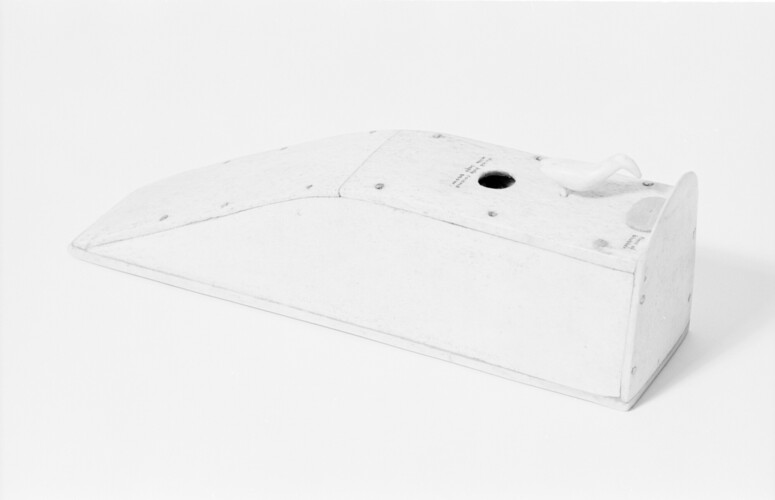 1906.76.3Bone model of a gull trap, built in the form of a snow house with model bait and gull on the roof. [El.B 04/11/2011]1906.76.3
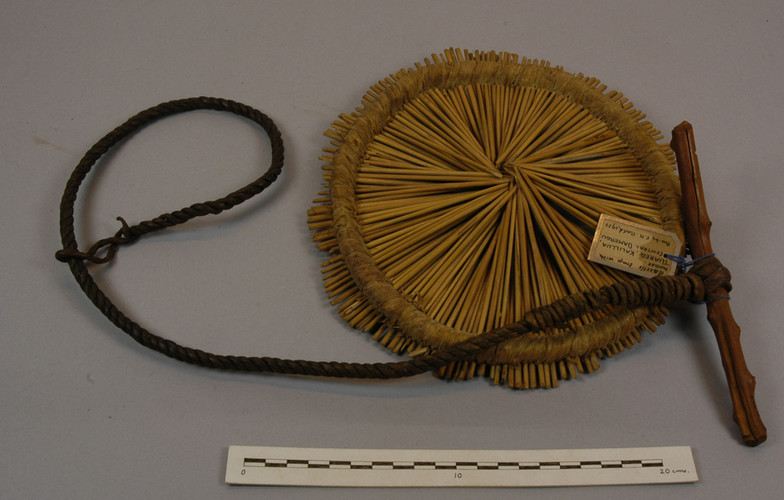 1923.36.38.1'Wheel' trap for gazelle [.1] consisting of a large number of sharpened sticks bound in a ring and a hide noose [.2]. [SM 27/11/2007]1923.36.38.1
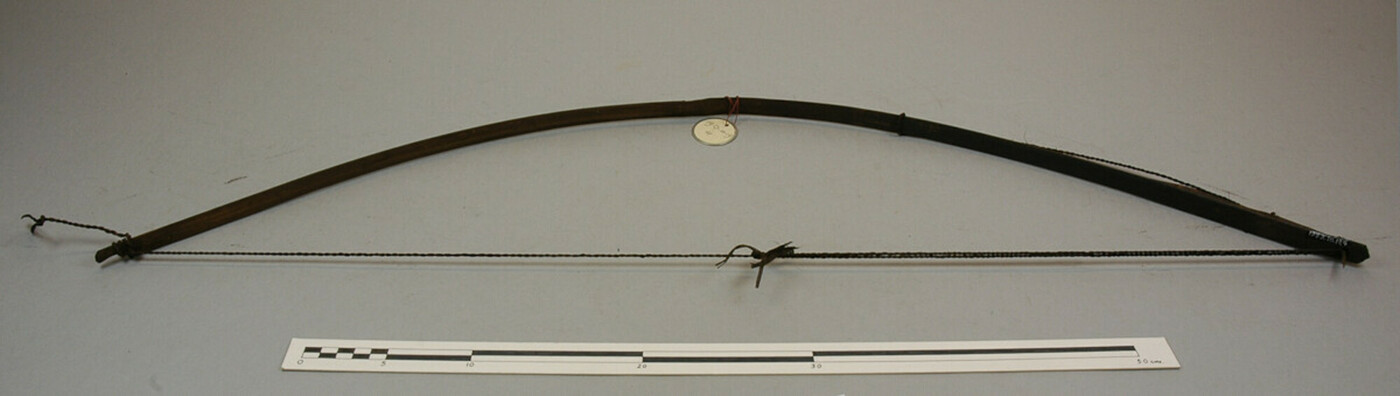 1953.10.19.4Bow string trap, made from a curved piece of split bamboo with a plant fibre string and thorn. [SM 05/11/2007]1953.10.19.4
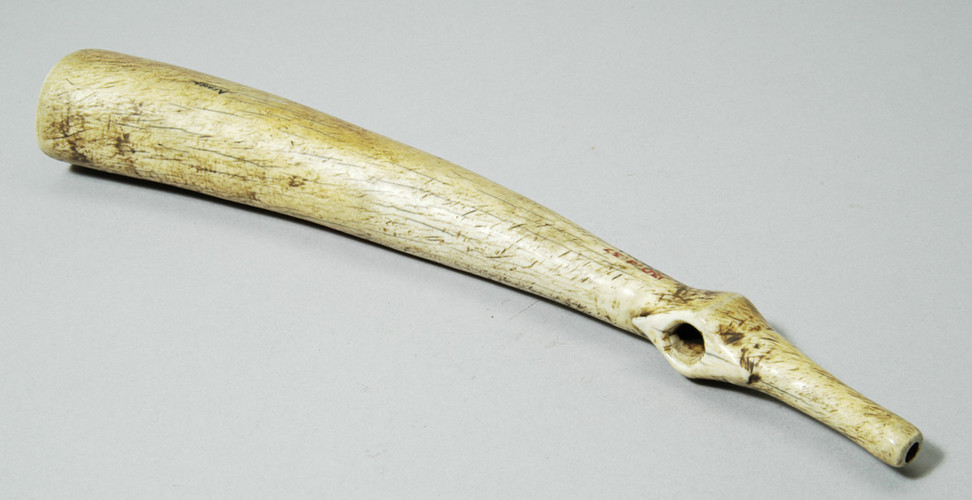 1884.112.3Ivory side-blown trumpet with lozenge-shaped mouthpiece setting with circular opening on the concave side, and fingerhole at proximal end [RTS 3/12/2004].1884.112.3
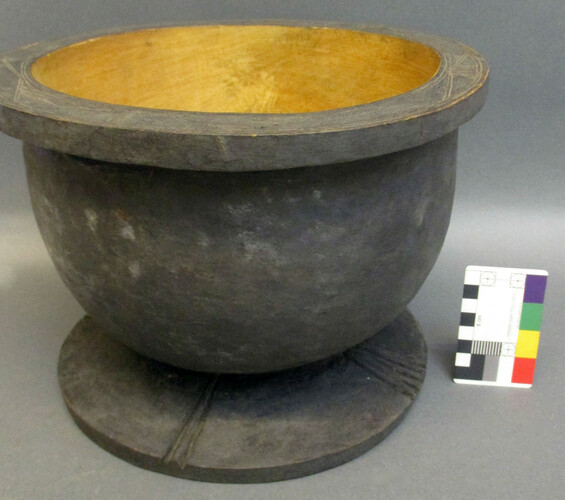 1948.2.131Globular wooden bowl on flat base. Base has incised lines and the flat rim is decorated with incised lines, forming a geometric design. [RM [OPS move] 20/9/2016]1948.2.131
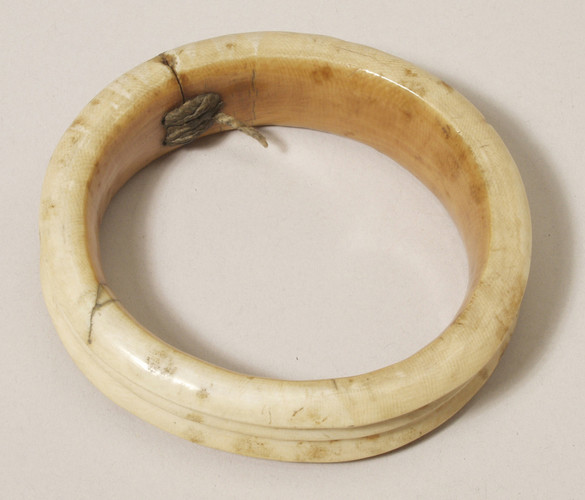 1903.16.107Ivory penannular armlet tied across opening with string [RTS 25/3/2004].1903.16.107
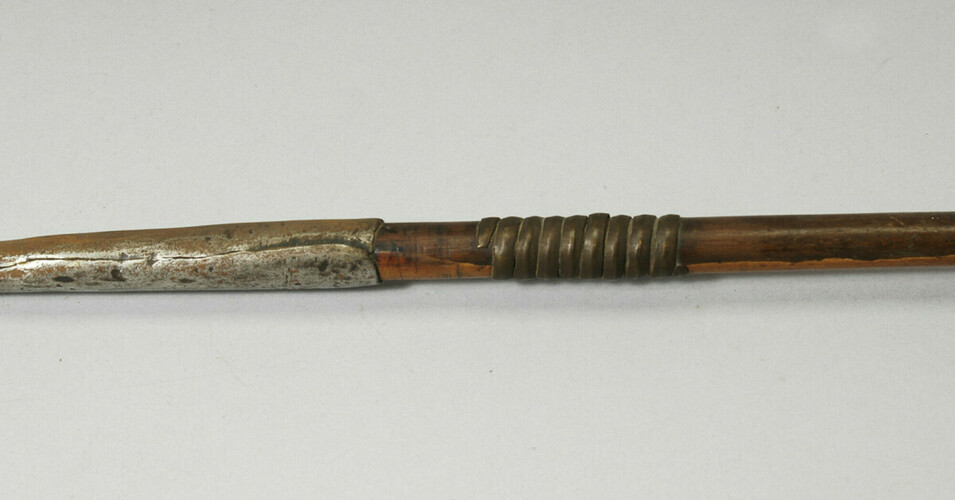 1946.8.89Spear with socketed leaf-shaped iron blade on a segmented cane shaft with decorative metal binding [RTS 8/8/2005].1946.8.89