
- Collection type
- Object
- Description
- Daruma doll, egg-shaped figure made of paper mache and painted with a red cloak and a face, with an inscription on the bottom. [El.B 25/11/2013]
- Geographical reference
- Cultural groups
- Japanese
- Person
- Field collector Walter Leo Hildburgh
- PRM source Wellcome Institute
- PRM source Wellcome Historical Medical Museum
- Date / Period
- Date made: Before 1985
- Date collected
- by 1985
- Acquisition information
- Loaned: 1985
- Materials and processes
- Material Papier-Mâché Paper Plant, Material Pigment, Process Painted, Process Written
- Dimensions
- Height: max 95 mm, Width: max 70 mm
- Object numbers
- Accession number: 1985.53.739
- Research and responses
Daruma dolls are based on Bodhidharma, the founder of Zen buddhism. He lived in the 5th or 6th century and was thought to be bearded with traditional red monk robes, which the doll’s design is based on. Daruma dolls are good luck charms (engi), but some regard them as folk toys or collector’s items. At the end of the year, the daruma used as amulets are traditionally removed from their place and burned or brought to a temple.
Appearance
Everything about the appearance of daruma dolls is linked to Bodhidharma and Japanese proverbs, from their traditional red colouring respresing Bodhidharma's monk robes, to their self-righting ability, which portrays the proverb “Nana korobi, ya oki”- fall down seven times, get up eight. Daruma dolls are a physical manifestation of perseverance and good fortune dates back to the 17th century, when farmers in Takasaki made daruma dolls as amulets in the hope that they would ensure a successful silk harvest (the outcome of which was thought to be luck-based). It is believed that the reason for daruma dolls’ rounded body shape is to portray Bodhidharma, who is said to have suffered the loss of his arms and legs during a nine-year meditation.
The eyes of daruma dolls are blank so that you can fill in one of the eyes to make a wish and fill in the second once the wish has been fulfilled. The eyebrow shape on the daruma doll is supposed to depict cranes, while the beard depicts turtles (both animals represent longevity in Japanese culture). The reason for this choice stems from the Japanese proverb: “The crane lives 1000 years, the turtle 10,000”. Today daruma dolls come in a variety of colours and designs, including dolls based on characters from pop culture such as Hello Kitty. Because of this, daruma dolls are now popular collectors items and are more regularly purchased as souvenirs rather than for their initial purpose as amulets.
Materials and processes
Before they were commercialised, daruma dolls were made from a variety of materials such as carved wood, chiselled stone, clay, and diluted rice paste. Today, daruma dolls are manufactured by specialists (often farmers during off-season) and are typically made of a special type of hand-made papier-mâché called washi, which is created by beating chemicals and fibres by hand, then drying it in the sun. The daruma moulds are then dipped into the washi and a circular clay plate is placed at the bottom as the weight. The dolls are then dried, and handpainted. Around 80% of daruma dolls today are still made in the Gunma prefecture, where Takasaki is located. Since daruma are handmade and hand-painted, no two dolls have the exact same design.
Role as folk toys
Daruma dolls have a secondary function as toys, which likely began in Edo-period Japan. As Kyburz explains in his article “Omocha": Things to Play (Or Not to Play) with on Japanese folk toys, the function of a daruma doll as a toy lies, “not in its figurative representation of the stout, bearded Zen monk…but in its physical structure of an okigari (tumbler)” resulting in their secondary function as toys almost by accident. As dolls with a playful, kinetic structure reminiscent of American Weeble toys, daruma dolls are remarkably similar to the folk toy akabeko, the red nodding cow. Akabeko is based on the legendary cow that helped to transport materials for the Enzo-ji temple in 807 CE and refused to leave after it was completed due to her dedication to duty and Buddha. Akabeko figurines, like daruma dolls, are irresistibly playful and you can’t help but tap their bobble heads, making them sway up and down agreeably. However, unlike daruma dolls, when akabeko figurines were first created in the 16th century, “play” was their primary function, as they were created as children’s toys or decorative gifts for political dignitaries.
Due to frequent smallpox outbreaks in Japan during this period, both akabeko figurines and daruma dolls began to be viewed as prophylactic toys to prevent smallpox in children. The term “red treatment” was coined to describe the belief that all red coloured objects could act as a preventative and curative measure for smallpox, from red home furnishings to red decorations in the rooms of smallpox patients. In Japanese culture, this stemmed from the belief that Hōsōgami, the smallpox demon, was either fearful of or attracted to red hues, with some communities believing that hōsōgami was a smallpox spreader and others considering him to be smallpox healer. While belief in Hōsōgami was limited to Japanese culture, the use of red treatment was a global phenomenon and European monarchs including King Charles V of France and Queen Elizabeth I of England were known to have worn red whilst suffering from smallpox. Although the use of red toys as objects for protection and play appears to be less widespread than “red treatment”, akabeko and daruma dolls are not the only folk toys with dual functions in Japan- many Japanese folk toys have play as their secondary function, and there are others that weren’t intended for play at all. Whilst the folk toy akabeko was created as, “primarily a toy, but with a double purpose- to amuse and protect,” the use of daruma dolls in prophylactic dollplay was secondary to their function as amulets. Nevertheless, the use of daruma dolls as prophylactic playthings is part and parcel of their history as wards of protection and good luck.
https://livejapan.com/en/article-a0002401/
https://www.japantimes.co.jp/culture/2021/08/12/arts/olympics-daruma-dolls/
https://www.youtube.com/watch?v=srdZwarhVcw
Nisizawa, T. (1939), Japanese Folk-Toys (Translated by S. Sakabe), Board of Tourist Industry Japanese Government Railways.
Punsmann, H. (1962). Daruma, a Symbol of Luck. Folklore Studies, 21, 241–244. https://doi.org/10.2307/1177354
Historically, Daruma or Bodhidharma is considered to be the founder of Zen Buddhism. Daruma dolls, egg-shaped figures painted with a red cloak with the face looking out, are popular as good luck charms. The eyes are often empty when bought, one eye is painted in when a wish is made, and the other when the wish is granted. See http://www.onmarkproductions.com/html/daruma.shtml [El.B 25/11/2013]
Search terms: Religion, Figure, Writing, Amulet, Inscription
Further items to explore
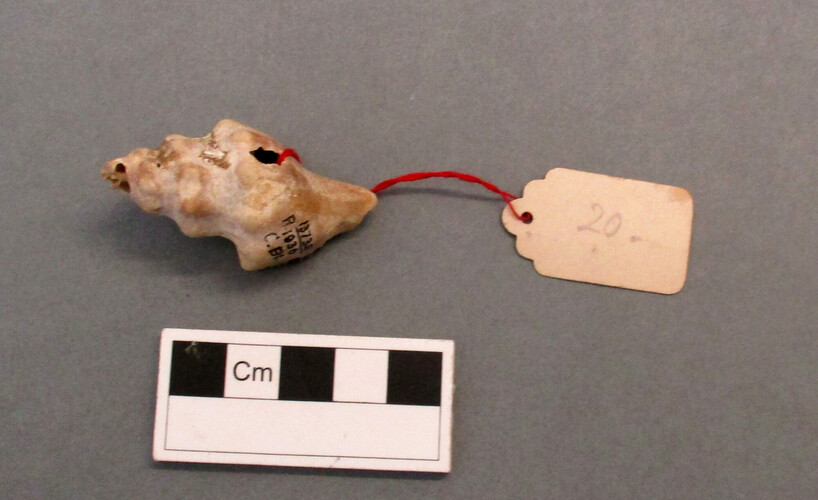 1985.54.812Amulet, spiral-type univalve shell, very worn and perforated. For severe pain in the lower half of the back. [JC [OPS] 09/03/2017]1985.54.812
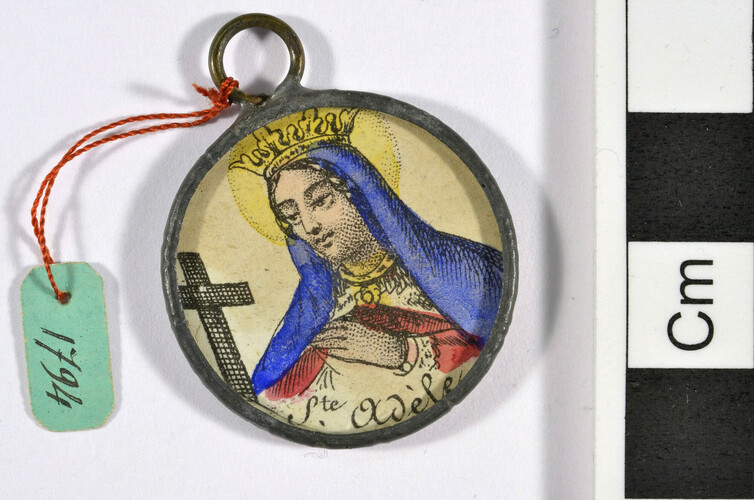 1985.52.915Amulet, lead medallion, with a figure of St Adèle holding a cross, painted in ink on paper, with 'Ste Adèle' written below, with a loop for suspension. [ACA 18/04/2012]1985.52.915
 1985.52.2678.7Amulet, textile label, which would have been stitched onto something else as there are four perforation marks. Rectangular in shape with a French inscription printed in black ink around an image of the Sacred Heart. See the records 1985.52.2678 .1 - .9 for the other associated amulets. [ASh [OPS move] 3/2/2017]1985.52.2678.7
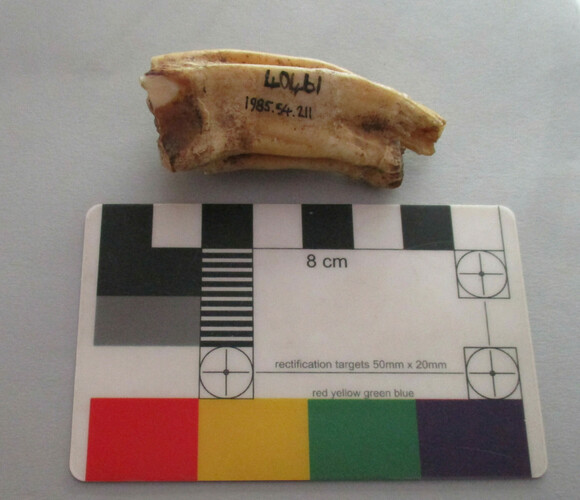 1985.54.211Amulet. Tooth with long root. [BS [OPS Move] 2/3/2017]1985.54.211
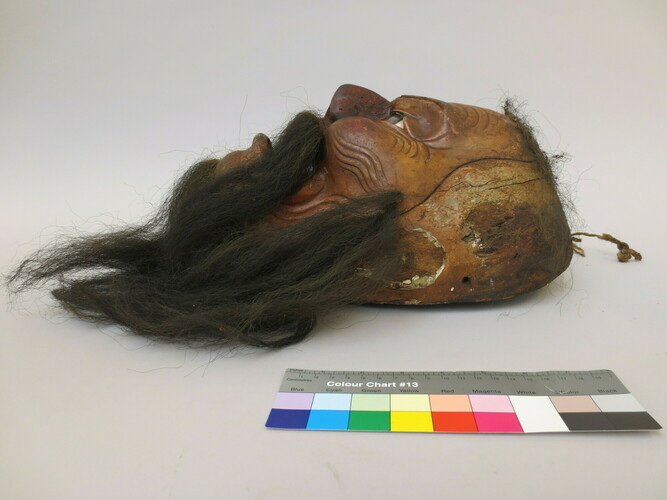 1959.2.2BMask of the demon queller. Carved and painted with a long beard and moustache. [SM (Verve) 16/04/2013]1959.2.2B
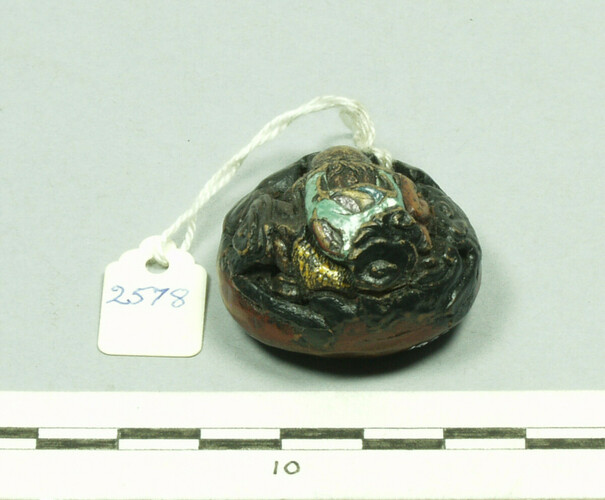 1980.34.2578Netsuke toggle comprised of a pottery figure looking through clouds, set in a wooden frame. [N.B. 'DCF 2004-2006 What's Upstairs?' 18/5/2005]1980.34.2578
 1941.4.58.4Shoulder protection, part of suit of Japanese armour. [El.B 12/4/2007]1941.4.58.4
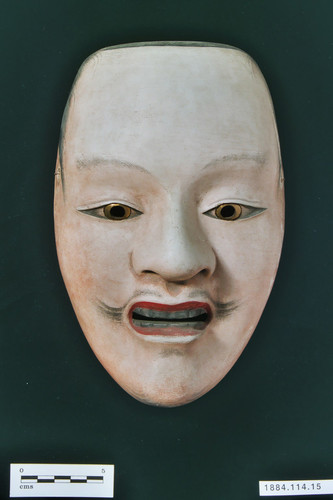 1884.114.15Noh mask depicting the face of a young god.1884.114.15