
- Collection type
- Object
- Description
- New button, shallow conical with large fluting extended to tim, plain peak.
- Geographical reference
- New Mexico Navajo Nation
- Cultural groups
- Navajo
- Date / Period
- Date made: Circa 1940
- Date collected
- 1940
- Acquisition information
- Purchased: 1940
- Materials and processes
- Material Silver Metal
- Dimensions
- Diameter: max 24 mm
- Object numbers
- Accession number: 1947.4.137B Other numbers: Collecotr's group 21
- Research and responses
Related Documents File - Letter from collector to Beatrice Blackwood, dated 21 July 1940: 'The trip to Navajo country (3,000 miles) was most interesting - depressing - illluminating. I spent almost two months on the reservation, made copious notes, and have since been busy putting together a report for the Indian Association. Just today is the report finished, and I have had a chance to open up your box and check through and label the articles I collected fro you. Dorothy Stewart refunded me $200.00 - the amount spent in making your collection. I believe you have already communication with her about that. I have provided her with a duplicate list of the goods. Mrs. Van Stone has very graciously provided storage space in the basement of her museum for all the articles. The blanket collection has been thoroughly moth-proofed, sealed in an air-tight carton and strongly crated. It is clearly marked with the name and address of your museum. Every article is tagged with a number corresponding to its number on this list. Similarly, the silver has been labeled, wrapped, boxed and stored with Mrs. Van Stone. She is putting them with other articles you have stored there. Now about the specimens: ... As for the silver: due to the terrible poverty on the reservation the Navajos (for the past five years) have been unabl to redeem their "pawn". Consequently, these fine belts, bracelets, etc. are rapidly leaving the reservation. I did not try to buy expensive pieces: such as the concho belts, squash-blossom necklaces, or heavily turquoised bracelets. I believe I remember you mentioning that you had bought several very good pieces and purchasing but one or two of such would, of course, have taken all the funds we had. I tried to purchase silver that indicated the development ofthe craft among the Navajos. The collection of "crude" rings is the most complte that I know of. People have not been interested evidently in obtaining these most primitive examples of Navajo workmanship. Therefore I was able to obtain quite a group of them. Also, I invested heavily in the finest rings that I could find in the area where the crudest were purchased. I think these are as good as any I know of. On a road map (which I have packed with the silver) I have indicated the main areas of Navajo silversmithing. My belief is that Spanish smiths spreading Westward from the Rio Grande North to the San Juan - taught the Navajos the craft, and that it centered - in early days - in the district that is roughly the Chaco Canyon country. Later, with the coming of the railroad, and the building of the trans-continental highway (66) - Albuquerque-Gallup-Phoenix: Navajo silversmithing moved southward and became localized in and around Gallup. The ring collection is largely from the Chaco Canyon-San Juan drainage country and covers the early period. ... Buttons: I invested heavily in these - buying 90-odd. First, because they show variety of workmanship and design; second, because they are rapidly becoming unobtainable; third, because they were within our funds. I am sorry that I was able to obtain only four examples of mould or "cast" silver. These pieces are all buttons, and good ones. Cast work is very expensive - and rarely to be purchased at any price. However, you should surely have a "cast" belt buckle, bow guard, and bracelet. ... I will write you more in detail about the trip itself. ... I was in over 150 hogans - most of them keeping me for long hours of discussion. ...'
Included: 'Specimens of Navajo weaving, weaving tools, etc. purchased for Oxford University Museum, June 1940. Stored until further notice at the New Museum c/o Mrs. Bertha Van Stone, Santa Fe, New Mexico, U.S.A. ...' and 'Specimens of Navajo silver-smithing purchased for Oxford University Museum, June 1940; stored until further notice at the New Musem c/o Mrs. Bertha Van Stone; Santa Fe, N.M.' [Carbon copy of latter also in file.]
Photocopy of 'From Indian Fair to Indian Market', by Bruce Bernstein, in El Palacio, Magazine of the Museum of New Mexico, Vol 98, Number 3.
Photocopy of Urgent Navajo Problems: Observations and Recommendations Based on a Recent Study by the New Mexico Association on Indian Affairs, published in Santa Fe, August 1940.
Road map entitled Coronado: Cuarto Centnnial 1540 - 1940.
Many related papers and notes without identifying numbers or references. [MOB 15/1/2002]
Other information - Additional information supplied by Lauris and James Phillips 5/7/2000 - Made of thin metal. Probably made circa 1940. [MdeA 13/9/2000]
Further items to explore
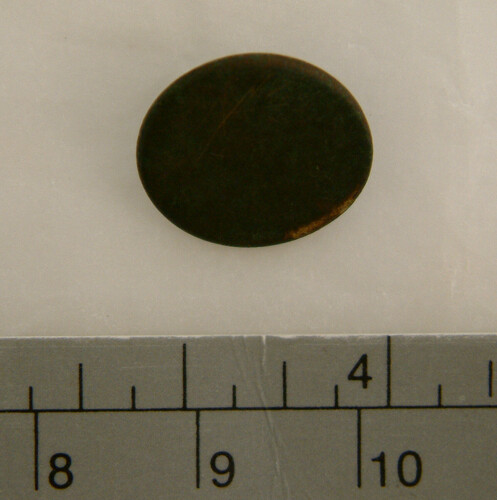 1915.50.11Circular bronze button.1915.50.11
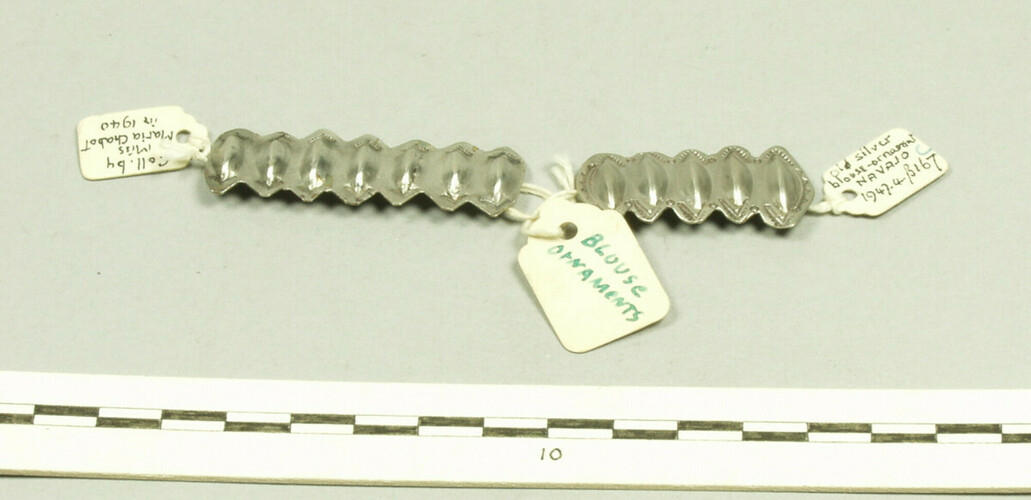 1947.4.166BOld blouse ornament, flat plate notched on both sides with 7 raised pointed-ovals. 2 shanks.1947.4.166B
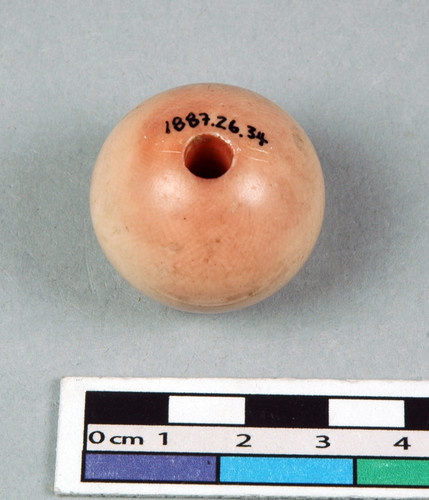 1887.26.34Button for hat to denote status of mandarins. Made of substitute materials for daily use. Second class, imitating coral.1887.26.34
 1947.4.103BButton made from US 10c piece dated 1900. Shank attached to reverse. Buttons made from coins are typical of this area.1947.4.103B
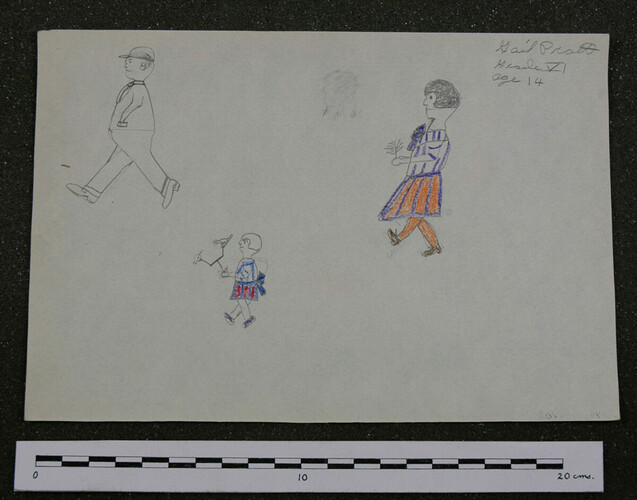 1994.15.1454Drawing in pencil and coloured crayon of a man, woman and child. [SM 04/03/2008]1994.15.1454
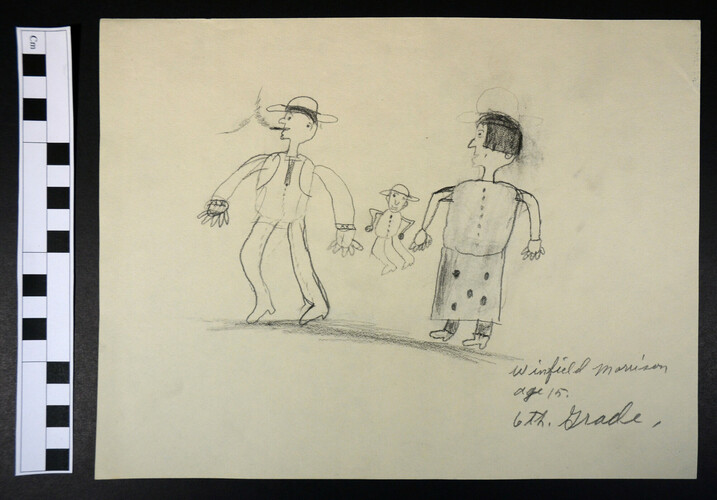 1994.15.754Drawing by child of three figures in pencil. [MJD 12/01/2015]1994.15.754
 1921.91.205Cylindrical bird bone bead.1921.91.205
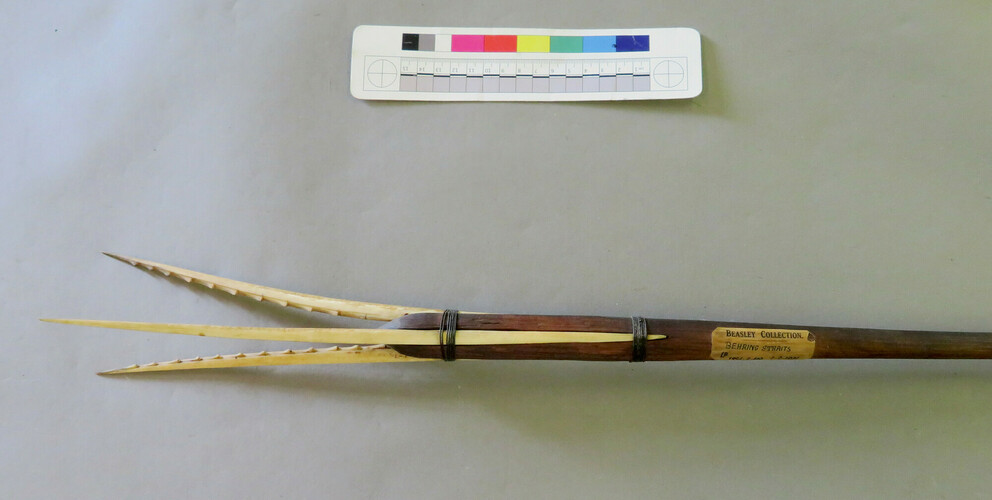 1941.2.100Spear with wood shaft with three barbed slightly curved bone points set into grooves on the shaft and bound to it with two bands of sinew binding. [RH [OPS move] 5/9/2018]1941.2.100