
- Collection type
- Object
- Description
- Horn dish with incised linear design and a small perforation at the handle. [ZM 14/11/2005]
- Long description
- Horn dish with incised linear design and a small perforation at the handle. The dish is shaped like a large scoop with a bevelled edge and extended flat handle on one end. The end of the handle is squared, and there is a perforation. Along the edge/rim of the vessel is an incised pattern comprised of three parallel lines that extend upward at an angle, and then downward at angle, repeatedly. On the outside of the spoon, a single line is incised just below the rim. The inside and outside of the dish is smooth and the grain of the horn is clearly visible. [CAK 19/04/2010]
- Geographical reference
- British Columbia Haida Gwaii (Queen Charlotte Islands) NW Coast
- Cultural groups
- Haida
- Date / Period
- Date made: Before 1882-1890
- Date collected
- Between 1882 and 1890 ?
- Acquisition information
- Purchased: 02/03/1891
- Materials and processes
- Material Sheep Horn Animal, Process Steamed, Process Moulded, Process Carved, Process Perforated, Process Incised
- Dimensions
- Width: max 148 mm, Length: max 300 mm
- Object numbers
- Accession number: 1891.49.65 Other numbers: 104.I.12
- Research and responses
The following information comes from Haida delegates who worked with the museum’s collection in September 2009 as part of the project “Haida Material Culture in British Museums: Generating New Forms of Knowledge”:
This vessel was viewed alongside other horn and wood dishes on Wednesday Sept 9, 2009. This dish shares some characteristics with 1891.49.63, .64, .66 and .69. Lucille Bell observed that the holes in these dishes may function in the same way as the holes in the handles of spoons, along the dishes to be hung on a wall when not in use. Diane Brown wondered if the hole in the dish indicated where a rivet would have been, and that the dish was actually a spoon missing its handle. Gwaai Edenshaw offered that rivets were used after something had been broken, and that originally they would have been one piece. Delegates wondered if these scoop-shaped horn vessels were used for drinking out of. Vern Williams identified the horn as coming from a ram, i.e. a male mountain sheep, because 'growth rings' were visible in the spoon, a feature known to occur with male mountain goats. He wondered if the mountain sheep was Dall sheep, and noted that there are three kinds of mountain sheep found in British Columbia. Kwiaahwah Jones and Nadine Wilson compared the geometric designs incised on the spoon with weaving patterns. The 'mountain' shape, formed by two lines angled towards each other, was identified by Kwiaahwah as the designs 'mouth track of the wood worm' and 'all of our ancestors'. Nadine noted that the 'mountain' shape occurs in Raven's Tail weaving. [CAK 19/04/2010]
Although listed as a bowl, the object may be the ladle of a spoon given its general shape, lack of flat bottom and the extension of one end, onto which a handle may be attached. [CAK 05/05/2009]
Search terms: Food and Drink, Vessel, Food Accessory, Bowl, Spoon
Further items to explore
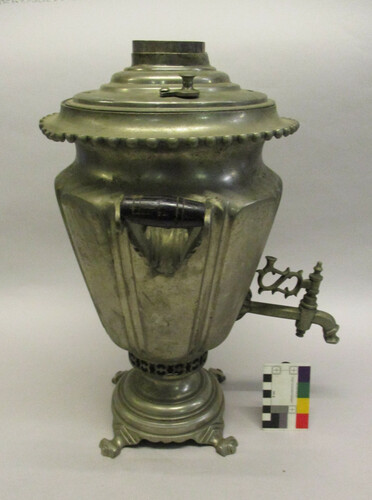 1981.35.41.1Teapot. Antique samovar, silver plated. Stands on a low pedestal; with two wooden handles. Crest incised; and inscription. For the full set of parts of the silver plated antique samovar see [1981.35.41 .1 - 1981.35.41 .4] [RM [OPS move] 22/7/2016]1981.35.41.1
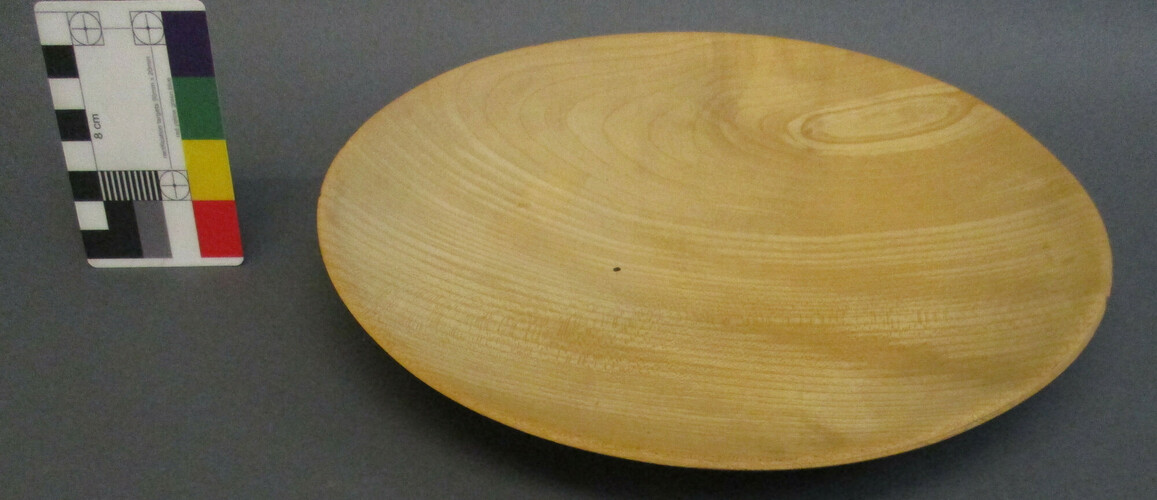 1900.2.1Undecorated circular sycamore wood dish. [BH [OPS move] 24/8/2016]1900.2.1
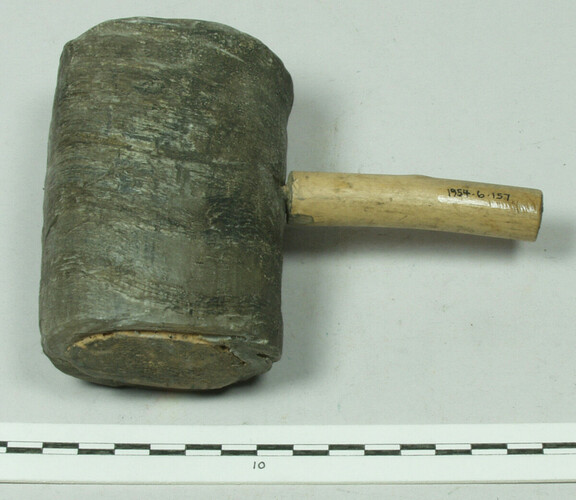 1954.6.157Container for milking goats made of a section of horn, a wooden stopper at the base, and a short wooden handle. [E.S-R 'DCF 2004-2006 What's Upstairs?' 9/12/2004]1954.6.157
 2024.22.28.14Ceramic chopstick rest in the shape of an aubergine.2024.22.28.14
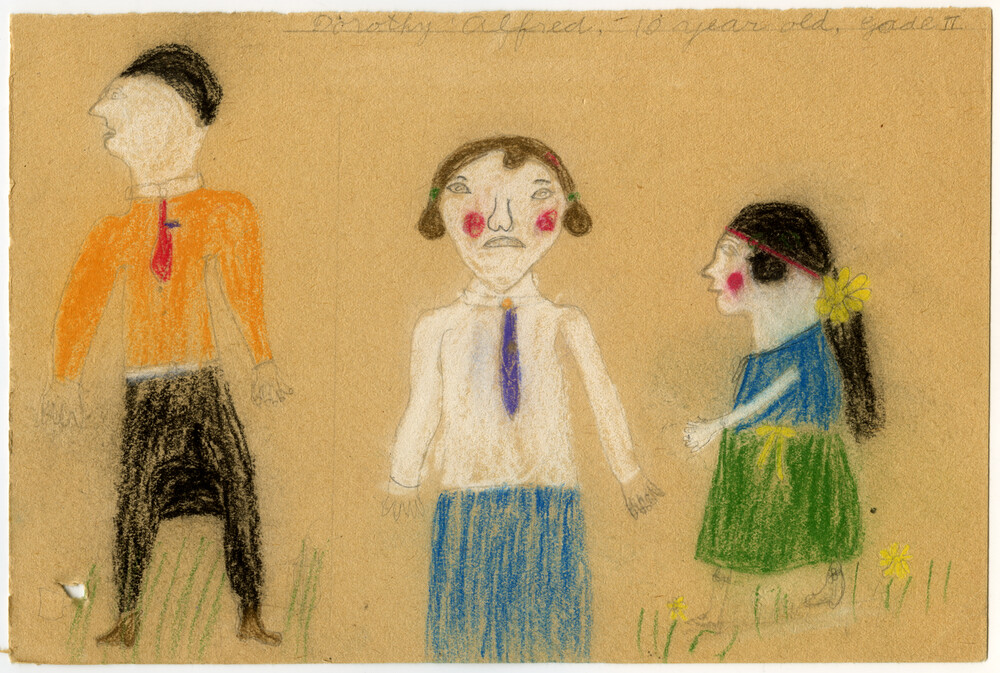 1994.15.666Drawing by child of three figures. [MJD 26/01/2015]1994.15.666
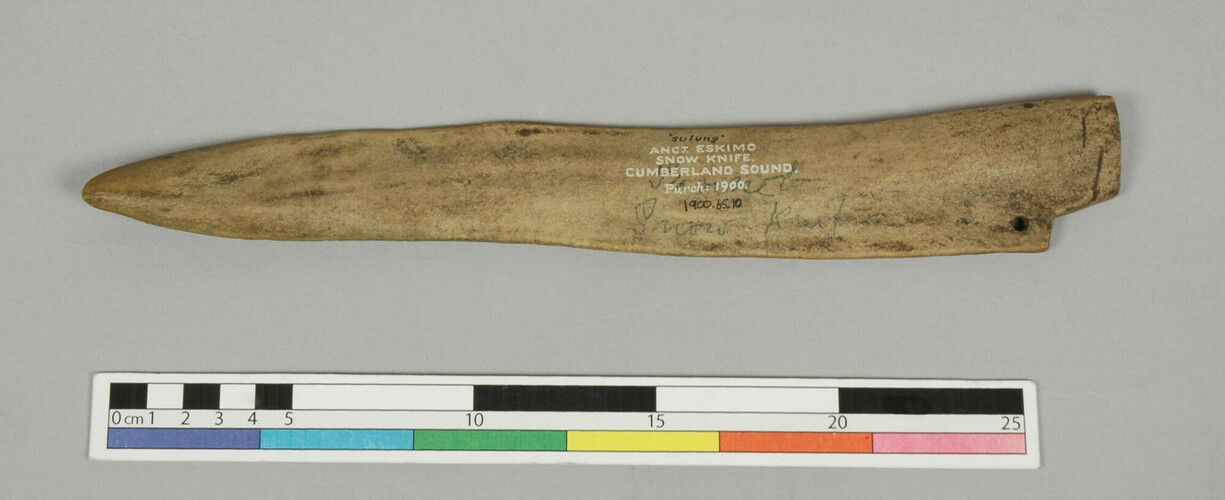 1900.65.10Snow-knife made from reindeer antler. The antler has been worked to a point. At the other end is a small section cut out to form a handle, and a small perforation next to this. [RH [OPS Move] 19/4/2017]1900.65.10
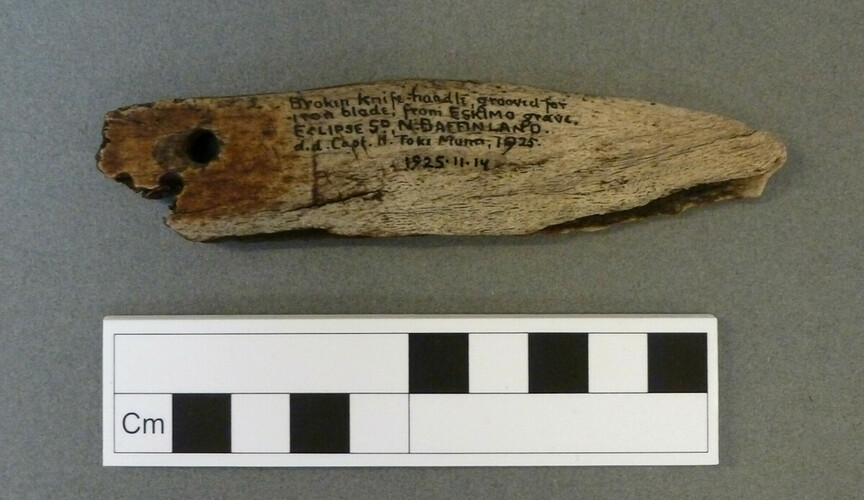 1925.11.14Broken bone knife-handle, with perforation and a carved longitudinal slit for a blade. A section of the end with the perforation appears to have broken off and the bone surface has traces of rust from the missing blade. [CW [OPS Move] 20/4/2017]1925.11.14
 1994.15.714Drawing by child of three figures.1994.15.714