
- Collection type
- Object
- Description
- Oval skin pouch decorated on one side with woven quillwork and bead fringes.
- Long description
- Hide pouch with 2 horizontal bands of quillwork and bead tassels (which end in loops of beads); more bead tassels ending in wool tufts around outer edge. Quilled strap (these may be bird quills) attached by hide thong. Beads seem to be strung on very fine hide thongs. Some hide elements on pouch are painted red. [LLP 20/8/2003]
- Geographical reference
- Cultural groups
- Nehiyawak
- Date / Period
- Date made: Before 1952
- Date collected
- By 1952
- Acquisition information
- Loaned: 05/1952 Purchased: 01/1966
- Materials and processes
- Material Animal Skin, Material Quill, Material Bead, Process Quillwork, Process Woven, Process Stitched, Process Beadwork
- Dimensions
- Length: max 650 mm incl. straps
- Object numbers
- Accession number: 1952.5.011
- Research and responses
Examined by the GRASAC research team on 11 December 2007 as part of a research project to create a digital database. This will incorporate information about collections of indigenous material culture from the Great Lakes region of North America that are housed in a number of museums on several continents; see https://icslac.carleton.ca/grasac/. The group identified this as deer or caribou hide and probably Cree because of the colours used in the beaded fringe, which also ends in loops very typical of this group. The pouch has a rounded bottom with traces of ochre on the back, the sewing is with sinew and the strap has two cords wrapped together with quills. [see researchers file GRASAC]. [ZM 07/02/2008]
Final GRASAC caption: 'Nation of Origin Reason for Attribution : Cree: The bag's two horizontal rows quillwork, not loomed, and red ochre borders on bands of quillwork suggest that it may be of Dene origin. However, the colour combinations found in its beaded fringe, and the looped ends of the tassels are characteristic of Cree items. Materials: The bag's body is made of caribou or deer hide. Two bands of quill work (done with red and cream coloured quills) and tassels made of green, red, white, blue, black and yellow glass beads, ending with wool tufts, decorate the bag's front. Hide thong attaches the quillwork and hide thong strap to the bag's body. Sinew is used in the construction of the bag's strap. Traces of ochre paint are found on the back of the bag.
Format/Techniques: This bag has a rounded, rather than the more commonly found square bottom. Its front is decorated with two bands of zig zag quillwork and beaded fringe. The ends of the beaded fringe are looped. Its strap is made two cords or thongs which are wrapped together with quills. The bag's colours, as well as the style of quill banding, and the looping of its fringe, are characteristic of Cree items.' [L Peers, 29/04/2009]
- Associated publications
- The possibility that this was formerly the property of James Bisset and acquired by Colonel Shirley via the Leamington Museum is discussed in 'Painted Coats for a Coronation? (Research Notes)' by Linda Mowat in Journal of Museum Ethnography, no. 8 (1996), pp. 109-110 (photocopy in RDF). [JC 20 5 1996]
Search terms: Bag
Further items to explore
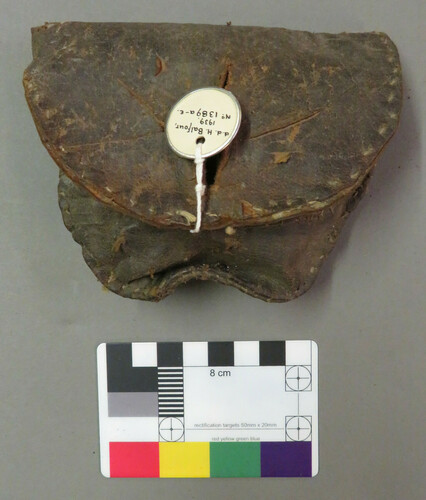 1938.35.1890.1Tinder pouch. For the associated components of this pouch see [1938.35.1890 .1 - .5] [BS [OPS move] 10/8/2017]1938.35.1890.1
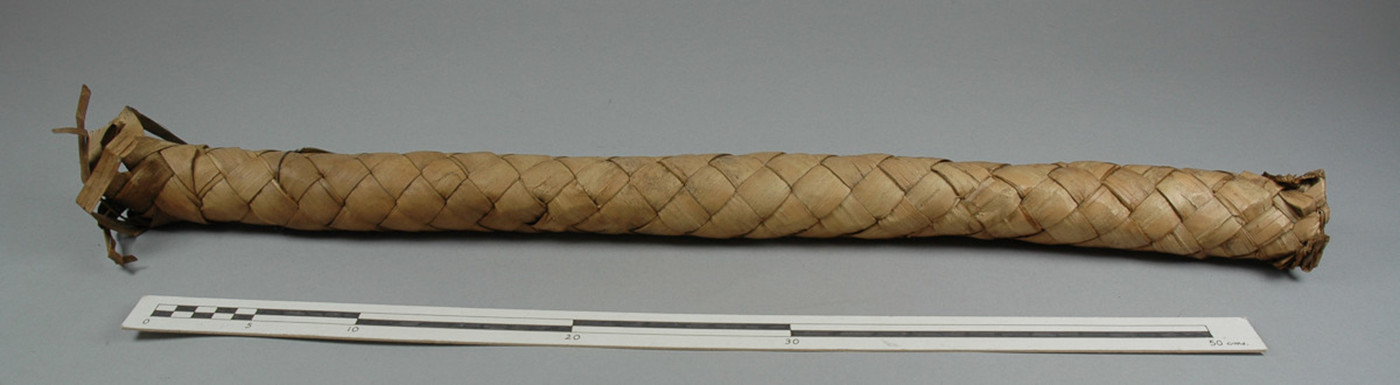 1909.67.13Salt-bag, long tube of plaited leaf-strips. [El.B 06/04/2011]1909.67.13
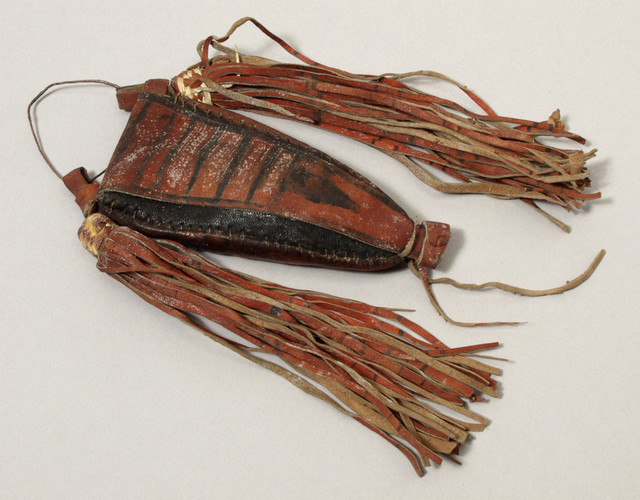 1923.36.32.1Tinder-pouch [.1] of dyed leather, containing flint [.2] and tinder [.3]. [DCF Court Team 2/12/2002]1923.36.32.1
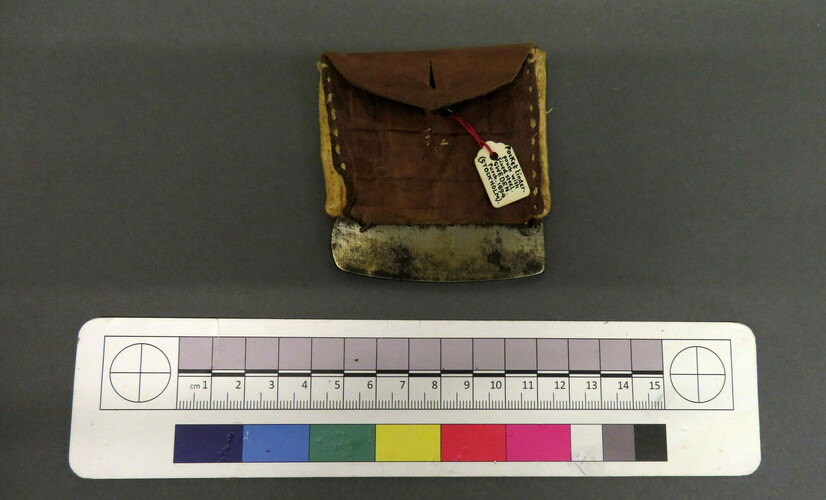 1938.35.760Pocket tinder pouch with fixed steel1938.35.760
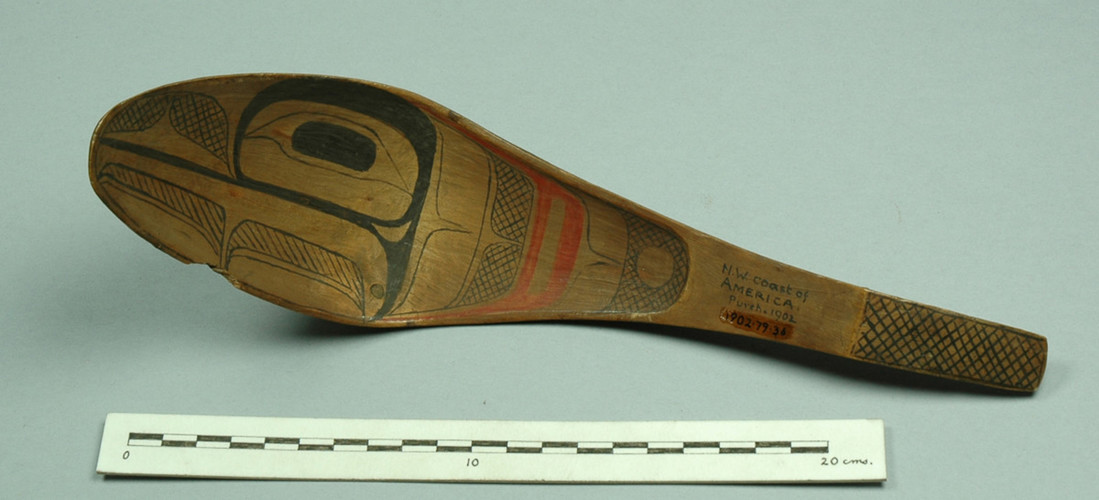 1902.79.36Large wooden spoon painted with crest designs in red and black pigments. [El.B 'DCF 2004-2006 What's Upstairs?' 20/3/2006]1902.79.36
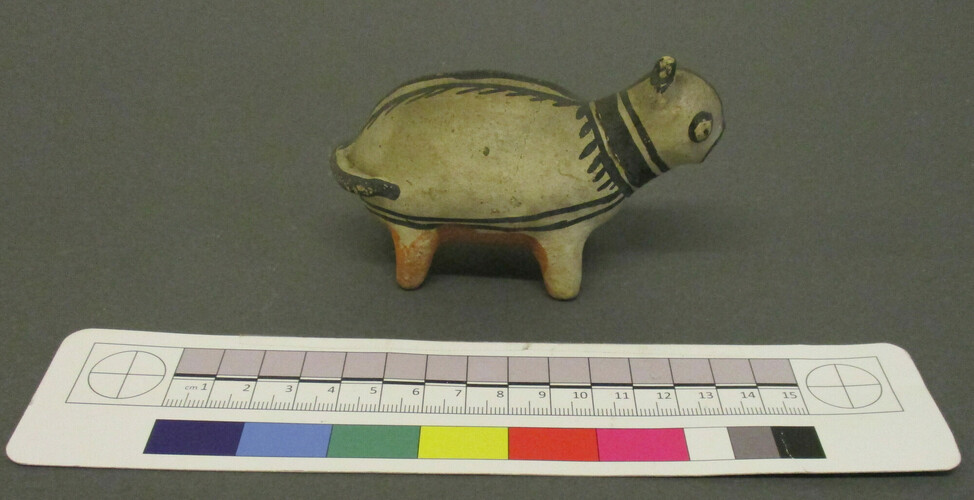 1889.39.11Ceramic figure of an animal, with painted decoration. Stood on four legs, with a round main body, along the back of which there is a painted ridge. [IL [OPS Move] 29/6/2017]1889.39.11
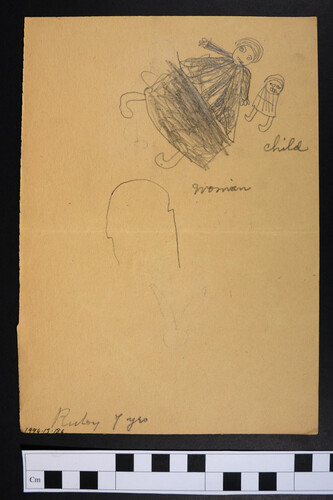 1994.15.186Drawing by child in pencil of four figures. [MJD 24/03/2015]1994.15.186
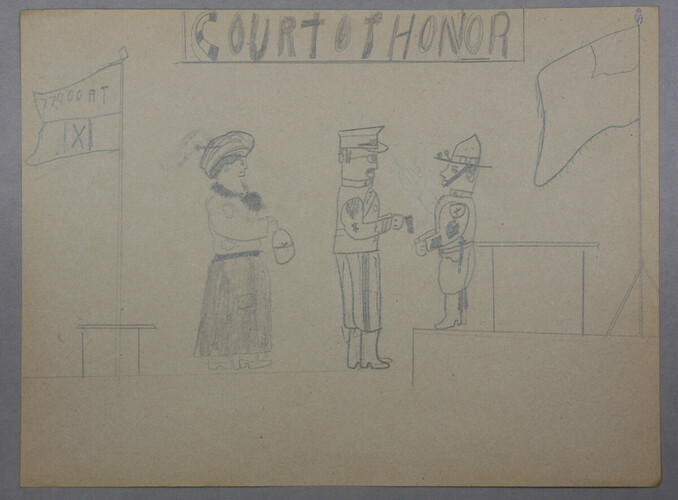 1994.15.2184Pencil drawing of a woman in patched clothes and two soldiers in uniform. [El.B 06/05/2008]1994.15.2184