
- Collection type
- Object
- Description
- Model canoe made from a single sheet of birchbark with wooden frame, decorated with porcupine quills and spruce root. [ZM 1/2/2017]
- Long description
- Model canoe probably made in the 17th century, the details of the construction indicating this was made by an indigenous canoe maker of the Micmac peoples of Canada. Made from a single sheet of birchbark over a wooden frame with porcupine quillwork along the gunwales and the thwarts. For more information about this canoe see research notes and publications. [ZM 1/2/2017]
- Geographical reference
- Cultural groups
- Mi'kmaq
- Date / Period
- Date made: Before 1656?, uncertain
- Date collected
- By 1656?
- Acquisition information
- Transferred: 09/02/1886
- Materials and processes
- Material Birch Bark Wood Plant, Material Wood Plant, Material Porcupine Quill Animal, Material Spruce Root Plant, Process Quillwork, Process Stitched, Process Carved, Process Bound
- Dimensions
- Height: max 193 mm, Width 270 mm, Length 1700 mm
- Object numbers
- Accession number: 1886.1.869.1 Other numbers: 14
- Research and responses
Identified as Micmac by Arthur MacGregor, Ashmolean Museum. [unsigned, undated]
For a visiting researcher's account (later published), see number 20 in typescript inscribed 'Notes by Dr. Ruth Whitehead, Nova Scotia Museum. Visited March 1985'. According to Whitehead, in July 1638 Georg Christoph Stirn reported a 'very ingenious little boat of bark' in the collection of Tradescant the Elder. However, no such boat is listed in Tradescant's catalogue of 1656. See RDF: Researchers: Whitehead. [MdeA 19 3 1998; JC 5 2 2009]
- Associated publications
- Listed as entry 355 on page 340 of 'Ethnological Specimens in the Pitt Rivers Museum attributed to the Tradescant Collection', by Lynne Williamson, in Tradescant's Rarities: Essays on the Foundation of the Ashmolean Museum 1683 with a Catalogue of the Surviving Early Collections, ed. Arthur MacGregor (Oxford: Oxford University Press, 1983), pp. 338−45. The entry takes the form of an edited transcription of the entry in the 'List of Anthropological objects transferred from the Ashmolean to the Pitt Rivers' museum 1886' (for which, see under ‘Primary Documentation’), with metric dimensions: '355. MODEL CANOE (1886, no. 869). "A native made model of a Canadian Indian's Birch-bark canoe, ornamented along the edges, and the tops of stretcher with yellow quill work. A very old specimen a good deal damaged many of the ribs being loose and one end broken. Length is 1.72 m. Width 275 m. Length of two paddles 0.59 m and 0.56 m.'" Not listed in the 1656 catalogue, but see pp. 21, 339, above.' Also discussed on page 339: 'No. 355, model birch bark canoe: the provenance is most likely the Nova Scotia area of Canada, the Mic Mac tribe. Although there is no appropriate reference in the 1656 catalogue, this may be the "very ingenious little boat of bark" noted at Lambeth by Stirn in 1658 (see p. 21).' [JC 17 9 2013] Described on page 90 of Micmac, Maliseet, Beothuk Collections in Great Britain / Inventory of Micmac, Maliseet and Beothuk Material Culture in International Collections: Great Britain (Nova Scotia Museum Curatorial Report Number 62), by Ruth Holmes Whitehead (Halifax: Nova Scotia Museum, 1988). Whitehead writes: '20. MICMAC. Canoe model; quill interweave. 1886.1.869 ?1650 ca. Birchbark, wood, spruce root, porcupine quills. Traditional canoe shape, strongly rockered, with hogged sheer rising from 10.4cm to 13cm at centreline. Formed from a single sheet of birchbark (Betula papyrifera), 5 feet 8 inches long, cut and folded; dewn [sic] at bow and stern with spruce root (Picea mariana), over a wooden facing, which then divides to become the gunwales. The gunwales are wrapped with alternating lengths of black and red dyed spruce root. There are five wide wooden thwarts, wrapped with spruce root, each approximately 2 cm wide; undyed white porcupine quills have been interwoven in chequered patterns in the spruce root on gunwale and thwarts. At either end there is a single thwart made of doubled and wrapped spruce root. The canoe has eight vertical cuts and folds, down from the rim, to shape it. These are sewn with spruce root, and overlaid with bands of root-wrapped bark 1.1cm wide, interwoven with porcupine quills, and sewn down with vegetable-fibre cordage, probably Indian Hemp (Apocynum cannabinum). From bow to centreline and stern to centreline, the canoe is sheathed with wood splints, 1mm thick, 43mm wide and 800mm long. There are approximately 38 wooden ribs, bent into shape, with a distance of 150mm between tip and tip; the wood itself is 3mm thick, 15mm wide, 270mm long. LENGTH: 170cm WIDTH: 27cm HEIGHT BOW: 19.3cm HEIGHT SHEER: 13cm HEIGHT, QUATERWAY: 10.4cm PROVENANCE: Micmac. Thought to have been part of the original Tradescant Collection, ca. 1650; transferred from the Ashmolean Museum. REFERENCES: In July 1638, Georg Christoph Stirn visit John Tradescant the Elder at his home in Lambeth, London, to view the curiosity collection which later became the core of the Ashmolean Museum, Oxford. There he noted “…first in the courtyard there lie two ribs of a whale, also a very ingenious little boat of bark…” Tradescant’s catalogue of 1656 does not mention the model. REMARKS: It is quite possible that this is indeed a 17th-century Micmac canoe model. The aging is much more apparent here, than on any model, including the 18th-century model in Paris, seen before. The strong rockering and the high hogged sheer are earlier, as these features decrease in size through time. The covering of the vertical cuts with bands of bark is unique to this model. The great length, and the fact that this model is formed from a single sheet of bark is impressive. The detail of the construction would suggest this piece was made by an actual canoe-maker, rather than a women making mere vehicles for quillwork souvenirs. The Recollect Father Chrestien LeClerq, living with the Gaspé Micmacs from 1675-1687, noted quill ornamentation on “their (birchbark) canoes, their snowshoes, and their other works which are sent into France as curiosities”. CONDITION: Interesting. Bow detached; section of bark broken off (both pieces still with canoe). Gunwales formerly infested with woodworm, now exterminated, but wood not yet stabilized. Thwarts damaged, one broken off (piece preserved with canoe). Break in bark at midsection on one side. Spruce root missing in places. IF THIS IS A 17TH-CENTURY PIECE, IT IS UNIQUE FOR THAT CENTURY OR EARLIER, AND CONSERVATION IS A PRIORITY. Even if this is not 17th-century, it is a large, extremely well-made piece with unique features, and deserves preservation and care.' Copy of publication in RDF: RESEARCHERS: WHITEHEAD (and a further copy in Balfour Library). The Museum also holds a copy of the draft typescript of the relevant pages of Whitehead's publication with a set of contact prints of her photographs (see RDF: RESEARCHERS: WHITEHEAD). [JC 19 2 2009] Illustrated in black and white as Figure 3.8 on page 83 of Trading Identities: The Souvenir in Native North American Art from the Northeast, 1700-1900, by Ruth B. Phillips (Seattle and London: University of Washington / Montreal and Kingston: McGill-Queen's University Press, 1998). Phillips writes (p. 82): 'The Tradescant canoe model is most likely a very early example of a purpose-made souvenir.' [JC 11 11 1999]
Search terms: Navigation, Model, Canoe
Further items to explore
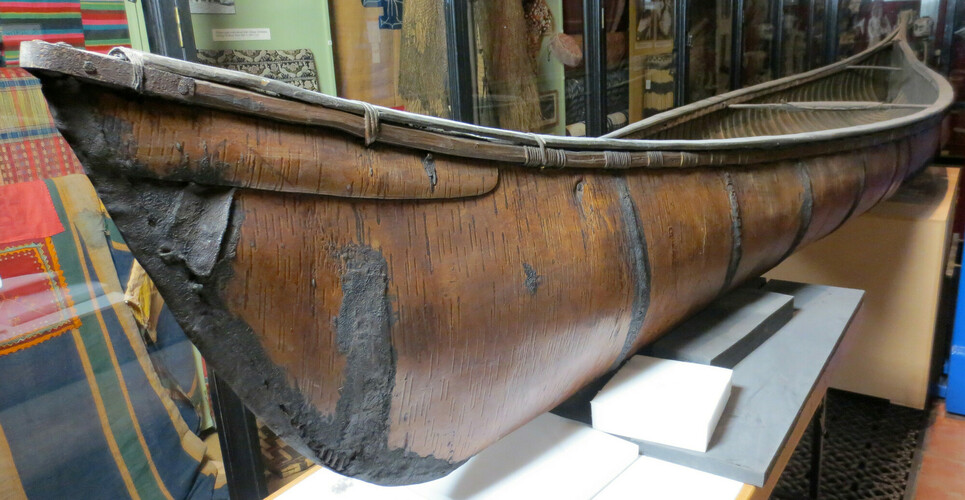 1886.1.864.1Canoe [.1], made of a single piece of birch bark [see entries 1886.1.864.1-.5] [SM (Verve) 26/06/2013]1886.1.864.1
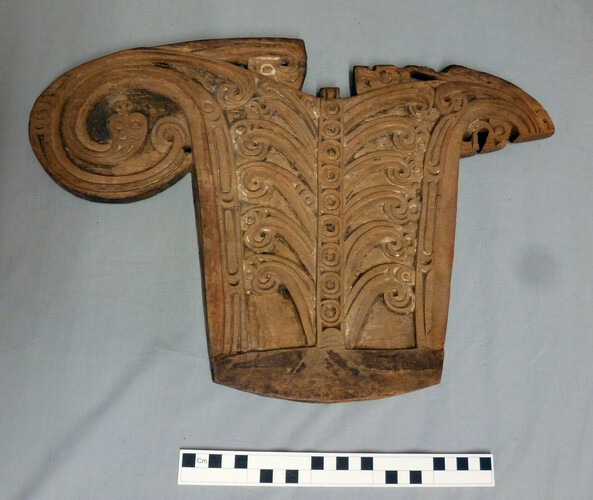 1916.46.5Canoe prow ornament carved with a decorative curvilinear design incorporating areas of perforation. The ornament is roughly T shaped. [LKG 20/05/2010]1916.46.5
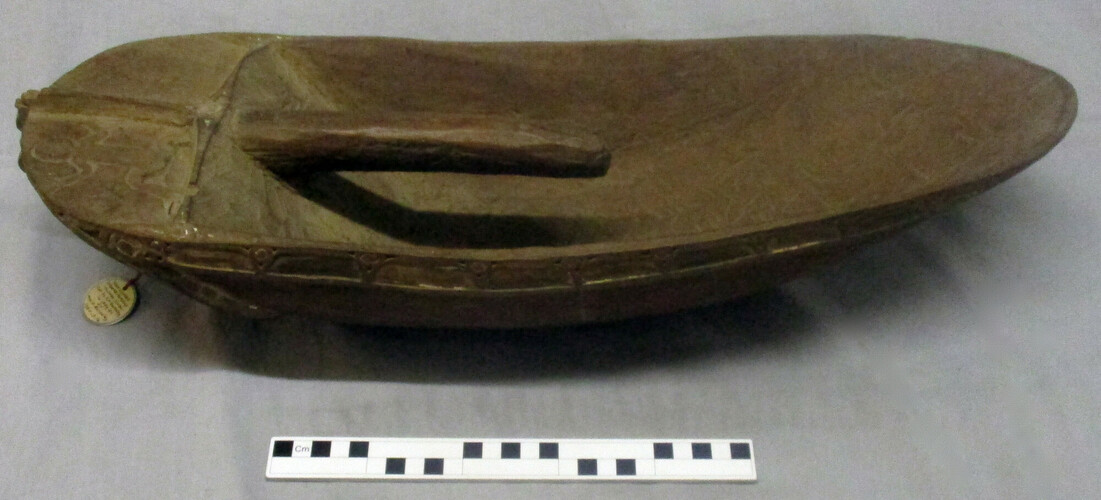 1960.3.14Canoe baler of light brown wood, with a human figure incised at the heel end. [MJD 06/05/2010]1960.3.14
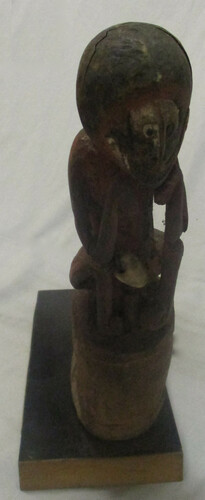 1884.62.22Wooden block or pulley for ships tackle made from wood, brown in colour. In the form of a human figure with human face and arms folded resting on knees and under chin. The figure has been painted with red, black and white pigment. [FC 03/06/2010]1884.62.22