
- Collection type
- Object
- Description
- Checked textile, one of two [see 2009.150.4 for the other]. Inner wall cover for model nomadic tent. [See 2009.150 .1-.31 for all parts of tent]. [FC 10/11/2009]
- Long description
- Checked textile, inner wall cover for model nomadic tent. The inner wall cover is made from a thin machine woven cotton textile consisting of a checked pattern of pink, blue and white squares. The weft threads are pink and white cotton yarn and the warp threads are blue and white cotton yarn. The inner wall cover is made from two lengths of this checked cotton textile, one panel is 235 mm long and the other panel is 1005 mm long. The two panels have been hand stitched together with running stitch in white cotton yarn. The top of the inner wall cover checked textile [the edge which attaches to the wooden frame forming the wall of the model tent, see 2009.150.1 & .2] is edged with two bands of black cotton textile, one is 5 mm wide and the other is 17 mm wide. These bands have been hand stitched along the length of the top and down one side of the checked cotton textile with white cotton yarn and black cotton yarn. The broader band of black cotton textile has been edged with a length of yellow textile which is folded over the edge and hand stitched with blanket stitch to the other side of the checked cotton textile with black cotton yarn. On the back of the checked textile at the top a length of cream textile 33 mm wide has been stitched along the entire length of the checked textile and down one side edge with black and white cotton yarn. Along the length of the cream textile at approximately 75 - 90 mm intervals strips of black cotton textile, 10 mm wide and 19 mm long have been stitched at either end with purple cotton thread. Through the loops of black textile a thin white cotton rope has been threaded loosely. This is so that they can be hooked over the wooden frame forming the circular walls of the model tent. The bottom edge of the checked textile and the other side edge have been seamed with white cotton yarn. There are some yellow stains in some areas of the textile. [See 2009.150 .1-.31 for all parts of tent]. [FC 10/11/2009]
- Geographical reference
- Date / Period
- Date made: By 1948
- Date collected
- 1948
- Acquisition information
- Donated: 28/10/2009
- Materials and processes
- Material Textile, Material Cotton Seed Fibre Textile Plant, Material Cotton Seed Fibre Yarn Plant, Material Rope, Process Tied, Process Stitched, Process Knotted, Process Woven, Process Twisted
- Dimensions
- Width: max 253 mm, Length: max 1260 mm
- Object numbers
- Accession number: 2009.150.3
- Research and responses
Clare Harris [Reader in visual Anthropology, Pitt Rivers Musem]: Although the object has been described by the donor as a yurt, technically speaking this is not correct as this is a Turkic term used in Central Asia and then exported to the West (hence commonly used). (See the Wikipedia entry for Yurt for more information on this.) Mongolians call the tent a gyer or ger and Tibetans call a white tent a gur. In fact there are many different terms for these portable dwellings in Tibetan - depending on their shape and colour. I suspect that the same will be true for Mongolia. The problem with the model we have been donated is that it was given to Arthur Hopkinson by a Mongolian-Tibetan trader and so could be either Mongolian or Tibetan. I don't know enough about the designs of these tents to be able to say which it is without doing some research. The other issue is that (if I remember correctly) it was presented to Hopkinson in India (probably Darjeeling or Kalimpong) and might have been made there. I am pretty sure that there was a Tibetan handicraft establishment in Kalimpong in the 1930s... The fabric used to make the internal fittings (eg bed covers) suggested to me that it might have been made in India. Monisha Ahmed has a lengthy discussion about the type of tents used by nomads in Ladakh and Western Tibet in her book "Living Fabric" (should be in the Balfour library). However, our model is not of this variety. [FC 12/11/2009]
Further items to explore
 1886.1.375.88Rope fragment made from twisted hair [.88] for Chinese Junk. [See entries 1886.1.375.1-130] [SM (Verve) 25/04/2013]1886.1.375.88
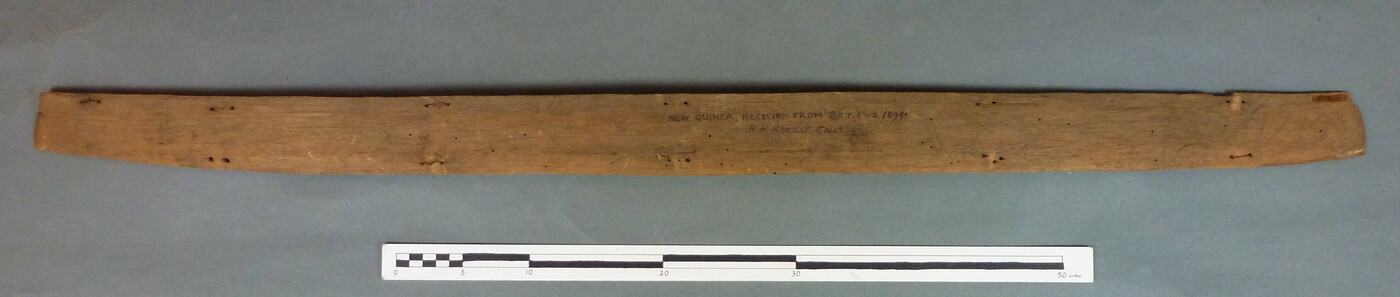 1893.42.7.2Detached side of the model outrigger canoe 1893.42.7 .1. See records 1893.42.7 .1 - .13 for all items associated with this canoe. [ASh [OPS move] 11/10/2016]1893.42.7.2
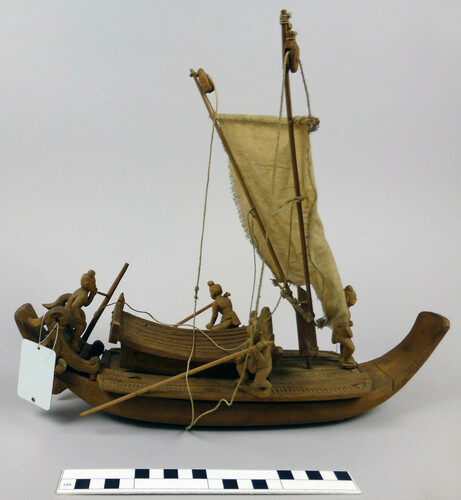 1889.29.43Wooden model boat with a single textile sail, three carved figures holding oars and one stood at the bow [ZM 16/10/2015]1889.29.43
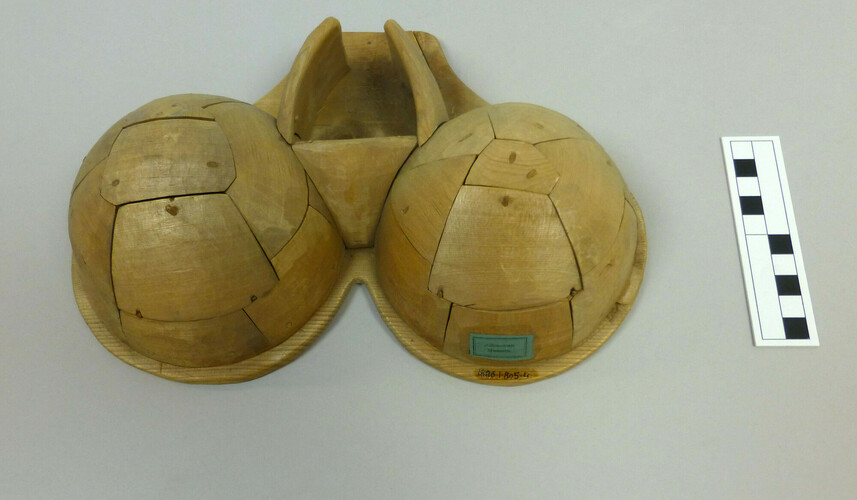 1886.1.805.4Model of a double snow house, mounted on a board. [DCF Court Team 30/1/2003]1886.1.805.4
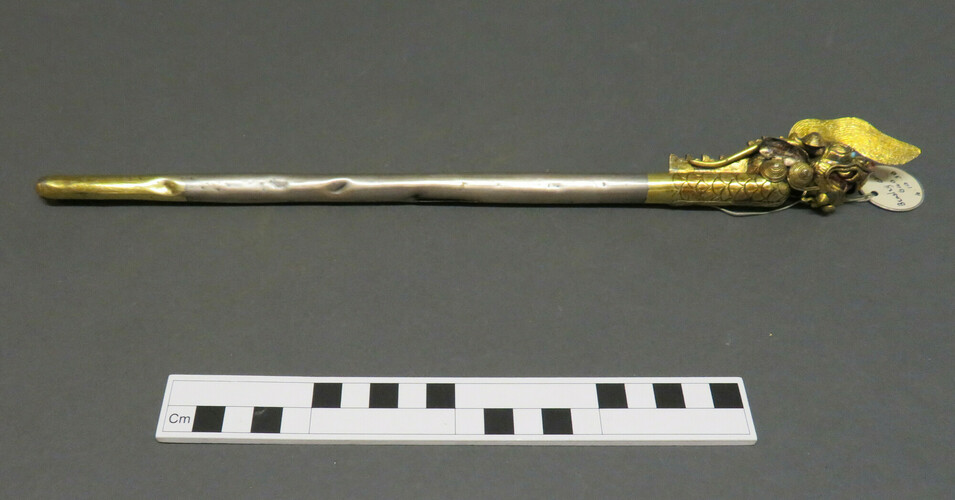 1954.6.94Rod, with a brass head in the form of head of a dragon with the eyes made from turquoise stones and the nostrils inlaid with pink glass. The mouth contains a red substance. The staff is made from silver [?] metal. [ASh [OPS move] 12/4/2017]1954.6.94
 1934.12.32.3Finial part for prayer wheel. Made of brass and with floral decoration. [AF [OPS Move] 31/3/2017]1934.12.32.3
 1922.45.36Portion of a Tibetan coin, cut in crescent form to make small change.1922.45.36
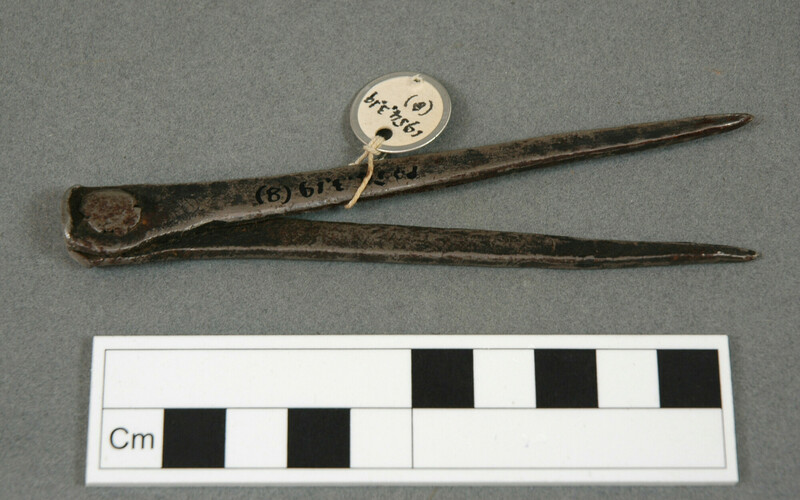 1954.3.19.8Pair of iron compasses used by a jeweller. [SM (Verve) 08/09/2014]1954.3.19.8