
- Collection type
- Object
- Description
- Ceramic rim sherd
- Long description
- Rim sherd (2 sherds glued together) of medium grain ceramic with mineral temper. [JW [Excav. PR] 22/05/2013]
- Geographical reference
- England West Sussex Worthing Findon Cissbury Ring "large pit" "13 feet deep"
- Person
- Maker Unknown Maker
- Field collector Augustus Henry Lane Fox Pitt-Rivers
- PRM source Augustus Henry Lane Fox Pitt Rivers founding collection
- Date / Period
- Archaeological period: Neolithic
- Date collected
- 1875 April
- Acquisition information
- Donated: 1884
- Dimensions
- Thick: max 5 mm, Width: max 75 mm, Length: max 85 mm, Weight 48 g
- Object numbers
- Accession number: 1884.140.1483
- Research and responses
Pitt Rivers excavated at Cissbury hillfort in September 1867, January 1868 and April, June-Sept 1875 [see Bowden, 1991]. See also 'Excavations in Cissbury Camp, Sussex; being a report of the Exploration Committee of the Anthropological Institute for the year 1875' JAI vol V p357 1876. In late summer 1867 Pitt Rivers surveyed Sussex hillforts [Thompson, 1977: 47] Cissbury was the largest camp in Sussex and he excavated there in September 1867 and January 1868 [Thompson, 1977: 48] According to Thompson this was first formal excavation he undertook. He continued his archaeological work in Sussex in 1875 when he began a series of excavations on Sussex hillforts [Thompson, 1977: 52]: ‘Throughout the spring and summer of 1875, he was excavating at Cissbury, supervising a team of four or five workers and entertaining workers [sic - ?visitors] from the Anthropological Institute, and later the Royal Society, as they came to look at the excavation.’ [Chapman, 1981: 399, referenced to Thompson] [AP 25/08/2006]
The hill fort at Cissbury Ring [TQ 1395 0805] and the flint mines [TQ 1360 0788] at the same site are recorded on the English Heritage maintained National Monuments Record under monument no's. 395595 and 395602. The records are available to view online, see http://pastscape.english-heritage.org.uk. [MN 26/06/2009]
- Associated publications
- Discussed on page 381-2 of 'Excavations in Cissbury Camp, Sussex; Being a Report of the Exploration Committee of the Anthropological Institute for the Year 1875', by A. Lane Fox, The Journal of the Anthropological Institute of Great Britain and Ireland, Vol. 5 (1876), pp. 357-90: 'The pottery in the superficial soil was of a similar character to some of that found in the ditch, but at a depth of 13 feet below the surface in the filling..., three pieces of a different description were found by me, in my previous diggings. This pottery was of two kinds, one [1884.140.1482.1 and 1884.140.1482.2] red on the outside, 1/2-inch thick, mixed with large fragments of white quartz, some of which were as much as 1/8-inch in size..., the other a fragment of the rim of a large vessel (fig. 8, Pl. xviii.) of dark brown pottery, hand-made, about 1/8-inch thick, mixed with smaller grains of quartz. This last, as shown by the fragment of the rim, must have been a vessel about 9 inches in diameter art the mouth, and enlarging to 13 inches at about 2 inches from it. The texture of this pottery found in the shaft shows it to be of coarser quality than any found on the surface or in the ditch in Cissbury. Another fragment of this coarser kind was now found 18 feet from the surface, and consequently some distance below the line of the red seam.' Illustrated in drawing as Figure 8 in Plate XVIII, captioned (page 389) as 'Fig. 8. - Fragment of brown pottery found in silting of large pit, beneath red seam; full size.' [JC 15 11 2019] A detailed account of this object is given on pages 172/174, and Stuart Piggott's line drawing of a speculative reconstruction of the vessel is illustrated as Figure 6 on page 174, of 'The Age of the British Flint Mines', by Grahame Clark and Stuart Piggott, in Antiquity, Vol. 7 (no. 26; June 1933), pp. 166-83. (Photocopy of article in RDF.). The authors write: 'Cissbury. – At a depth of 13 feet in the large pit Col. A. Lane-Fox discovered a few sherds of pottery; three are in the Pitt-Rivers Museum at Oxford [1884.140.1482.1, 1884.140.1482.2, 1884.140.1483], one in the British Museum. Of these four sherds three are small fragments of coarse ware, reddish buff in colour and averaging 1 cm. thick, with large flint grits in the paste [1884.140.1482.1, 1884.140.1482.2, and the example in the BM]. There is nothing very characteristic about these, but they compare well in texture with Neolithic pottery of the Windmill Hill class from the Trundle and elsewhere. [np] The remaining fragrnent [1884.140.1483] however is of first-class importance, and constitutes nearly one quarter of the upper part of a small bowl of a well known Windmill Hill type. As the restored drawing shows, it is a wide-mouthed vessel 8½ inches (21.5 cms.) in diameter at the rim, which is slightly moulded, and the everted neck joins the lower part with a marked shoulder 2 inches (5.5 cmms.) below the rim. The walls [172/174] are thin and the ware very fine and hard with frequent small flint grits. The interior is black, the exterior pale brown, and both surfaces are well smoothed – in fact almost burnished. [np] The pot is an excellent example of a form of Windmill Hill ware – form G – which has a wide distribution in Britain and seems to belong to the second (A2) phase of the culture. Close parallels to both form and texture can be cited locally from Whitehawk Camp, Brighton, and the type is well-known in northern England, being represented for instance by the famous bowls from the Hanging Grimston long barrow, East Riding of Yorks. The general type, although with less marked carination, occurs in the Michelsburg Neolithic culture of the continent, which appears to be parental or at all events closely allied to our Windmill Hill complex.' (See photocopy of article in RDF for references.) [JC 15 11 2019] Illustrated in a line drawing as Fig. 23 on page 119 of The Archaeology of Sussex (Methuen County Archaeologies), by E. Cecil Curwen (London: Methuen & Co., 1937). Caption (same page): 'Fig. 23. - Neolithic As bowl, restored, from Cissbury Flint Mine Shaft (1/3) After Stuart Piggott (Pitt Rivers Museum, Oxford)'. Also discussed on page 118: 'but the most important feature of all was the discovery at a depth of 13 feet of a piece of the side of a shouldered pot of Neolithic "A" type, similar to that found at Whitehawk Camp. Enough survived to enable Mr. Stuart Pifggott to draw the accompanying reconstruction (fig. 23). This proved that this particular shaft is not earlier than the Neolithic period, and there is no evidence so far to suggest a later date for any of the Cissbury mines.' [JC 15 11 2019] Illustrated in a line drawing as Figure 5.13 on page 69 of The Neolithic Flint Mines of England, by Martyn Barber, David Field, and Peter Topping (Swindon: English Heritage, 1999). Caption (same page): 'Figure 5.13 An Early Neolithic "Grimston Ware" bowl recovered from Lane Fox's excavations at Cissbury. It is now in the collection of the Pitt Rivers Museum, Oxford.' Also discussed on page 69: 'Artefactual support for 4th millennium BC mining at the Sussex sites is poor in both quality and quantity, although at the same time there is nothing directly contradictory among the surviving artefacts and documentation. Readily datable artefacts from secure contexts are few. A potsherd, recovered by Lane Fox at a depth of 13 ft (4 m), from within the fill of a shaft (according to its label) at Cissbury, has been identified as representing an earlier Neolithic carinated bowl, probably dating to the middle centuries of the 4th millennium BC (see Figure 15.3; e.g. Holgate 1995a, 133). However, its precise context and associations within the shaft fill remain uncertain. It may have represented activity which was either earlier than, or broadly contemporary with, the mining.'(Photocopy in RDF.) [JC 15 11 2019] Referred to on page 17 of 'A Time and a Place for the Grimston Bowl', by Andrew Herne, in J. C. Barrett and I. A. Kinnes (eds), The Archaeology of Context in the Neolithic and Bronze Age: Recent Trends (Sheffield: Department of Archaeology and Prehistory, University of Sheffield, 1988), pp. 9-29: 'The large rim and shoulder sherd from the upper infill of the Cissbury shaft, Sussex (Clark and Piggott 1933 [sic; 1936, see above; JC] is, as drawn, from a fine Carinated bowl.' [JC 9 12 2019] Referred to on page 133 of 'Neolithic Flint Mining in Britain', by Robin Holgate, Archaeologia Polona, Vol. 33 (1995), ppp. 133-61: 'Apart from radiocarbon dates obtained on antler picks and charcoal, the site at Cissbury can also be linked to the earlier Neolithic period by the presence of carinated bowl sherds from the fill of one of mine shafts, the earliest type of pottery known in Britain that dates from 3100 to 2800 BC (Herne 1988 [see above; JC])'. Also on page 137: 'Pitt Rivers returned to the site [Cissbury] in 1875 and investigated a further nine shafts. The fill of one shaft produced part of a carinated plain pottery vessel.' [JC 9 12 2019]
Further items to explore
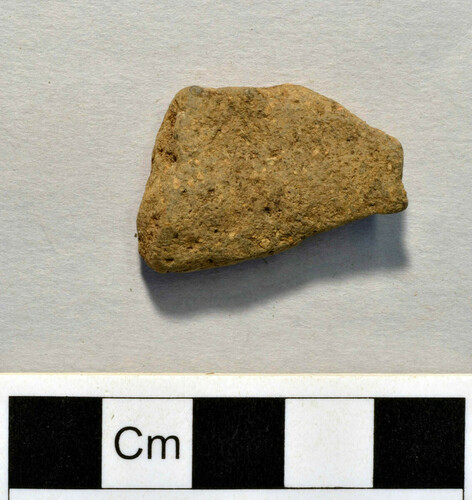 1884.136.1.157Ceramic sherd1884.136.1.157
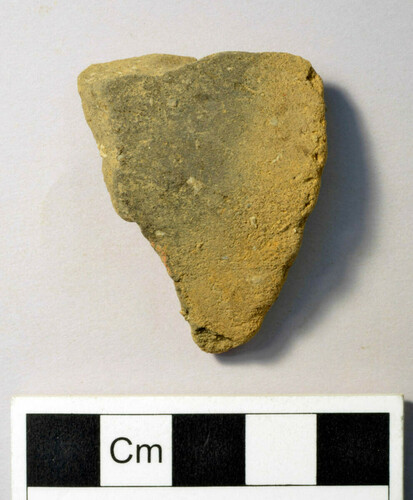 1884.137.23.88Ceramic sherd1884.137.23.88
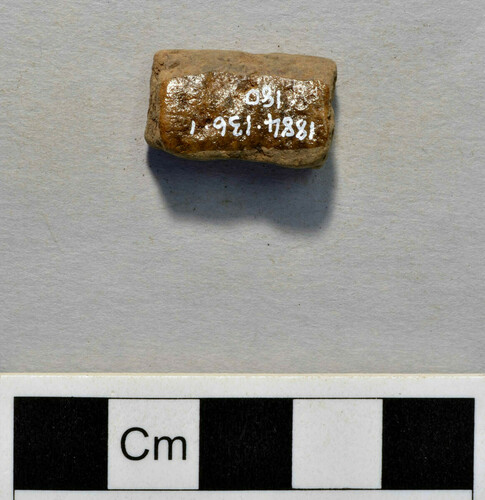 1884.136.1.180Ceramic rim sherd1884.136.1.180
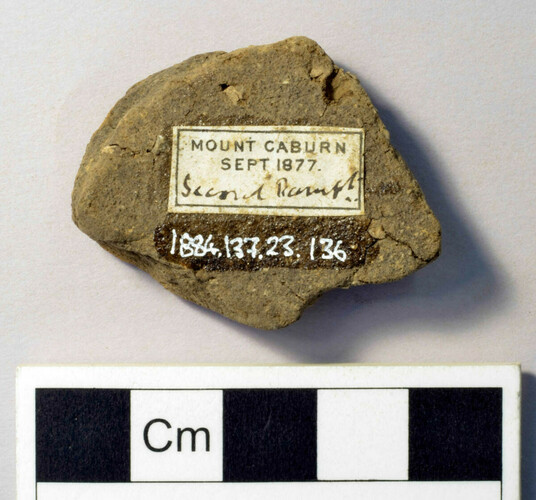 1884.137.23.136Ceramic sherd1884.137.23.136
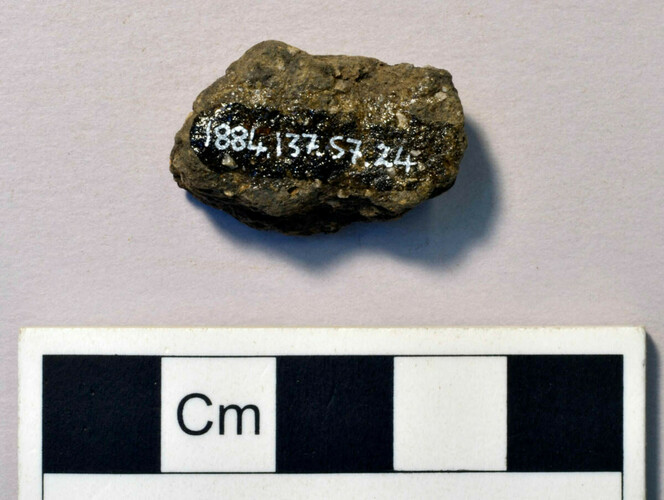 1884.137.57.24Ceramic sherd1884.137.57.24
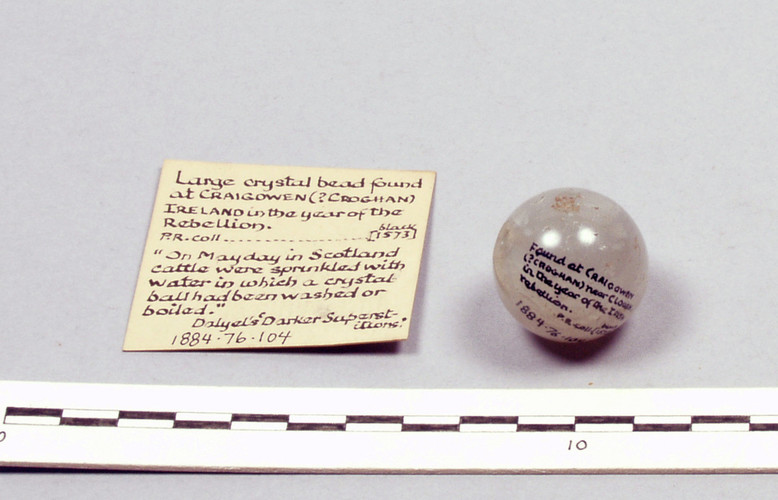 1884.76.104Perforated glass bead1884.76.104
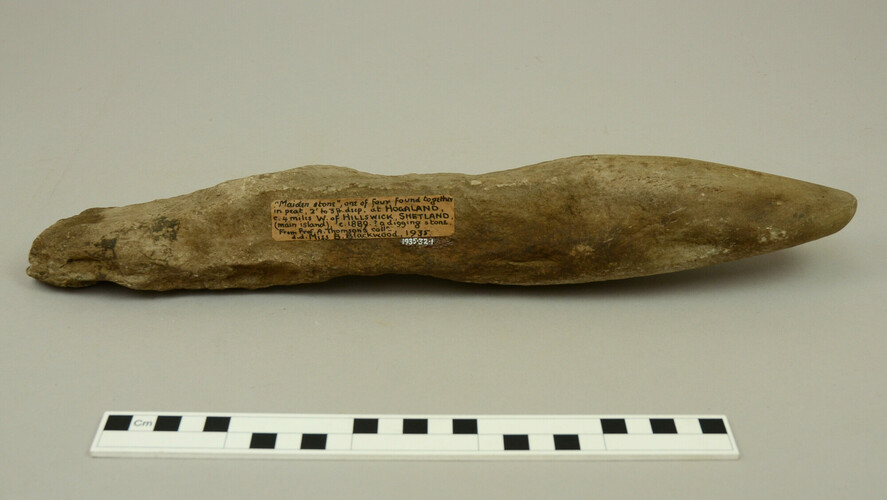 1935.32.1Rough sandstone implement.1935.32.1
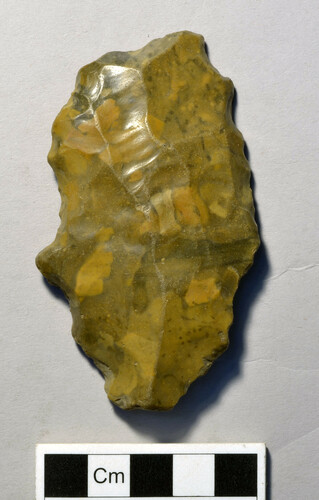 1884.122.420Stone flake1884.122.420