
- Collection type
- Object
- Description
- Ornament or amulet consisting of a strip of iron which has been rolled into two cones with a suspension loop between [RTS 24/8/2004].
- Long description
- Small ornament made from a single narrow rectangular strip of iron, hammered into shape. This strip has been bent to form a u-shaped loop at the centre, with each end then wound into a spiral that runs clockwise to the left of the loop and anticlockwise to its right. These spirals gradually rise to their centres, forming two cones with hollow undersides. The upper edge of the strip was decorated with a series of incised depressions punched into the surface and running along its entire length; the underside was left plain. The iron is currently a metallic gray colour (Pantone 421C), with traces of red ochre around the spirals (Pantone 483C). It has a weight of 28.3 grams, is 42.8 mm long and 21.4 mm wide, with a height of 17.4 mm. The strip itself is 7 mm wide and 0.5 to 1 mm thick; each cone has a base diameter of 21 mm [RTS 24/8/2004].
- Geographical reference
- Person
- Maker Unknown Maker
- Field collector Unknown Collector
- PRM source Augustus Henry Lane Fox Pitt Rivers founding collection
- Date / Period
- Date made: Before 1884
- Date collected
- ?Prior to 1884
- Acquisition information
- Donated: 1884 Found unentered: Found unentered
- Materials and processes
- Material Iron Metal, Process Forged (Metal), Process Hammered, Process Decorated, Process Incised, Process Punched
- Dimensions
- Depth 17.4 mm, Width 21.4 mm, Length 42.8 mm, Weight 28.3 g
- Object numbers
- Accession number: 1884.140.261 PR Cat other PR nos: 1539
- Research and responses
This is the object illustrated by J.G. Wood, 1868, The Natural History of Man Volume I, p. 502 (top right), and discussed on p. 503; however he attributes it to the Jur (a term which he uses generically for several south Sudanese groups); he states such ornaments are either worn by Jur or sold to the Dinka and other neighbouring tribes for food. Wood does not give the source of this object, but it may have originated with Petherick as did much of the other Zande material he illustrates. Note that he does not suggest it had an amuletic function; this information must have come either from the collector or whoever originally accessioned the object. A somewhat similar ornament is illustrated by Boccassino, and attributed to the Acholi; here the spirals appear to be flat, rather than worked into cones (R. Boccassino, 1964, "Contributo allo studio dell'ergologia delle popolazioni nilotiche e nilo-camitiche, parte quarto", fig. 32). Spirals also appear as decorative elements on other Zande objects, including 1934.8.144, a brass hair pin with spiral top, and 1884.87.25, an apron which has an iron spiral as a decorative attachment [RTS 2/9/2004].
- Associated publications
- J.G. Wood, 1868, The Natural History of Man Volume I, p. 502 (top right), discussed on p. 503 (but attributed to the Jur). [AP Leverhulme project on founding collection 1995-1998]
Further items to explore
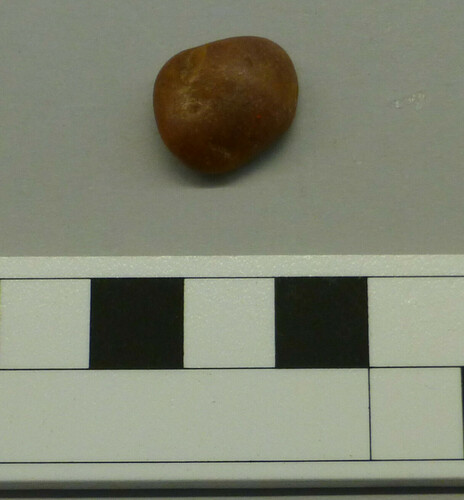 1985.54.98Amulet, made from reddish brown stone. Worn by a girl to help obtain a husband. [CW [OPS Move] 01/03/20171985.54.98
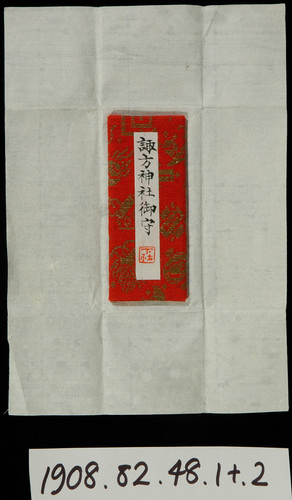 1908.82.48.1Amulet covered with red and gold woven material [.1] , wrapped in paper envelope [.2]. [SM 29/10/2008]1908.82.48.1
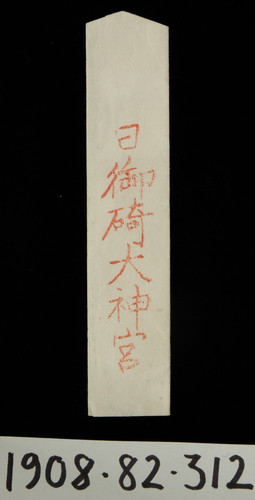 1908.82.312Amulet with 6 Japanese text characters printed on front in red. [LKG 10/10/2008]1908.82.312
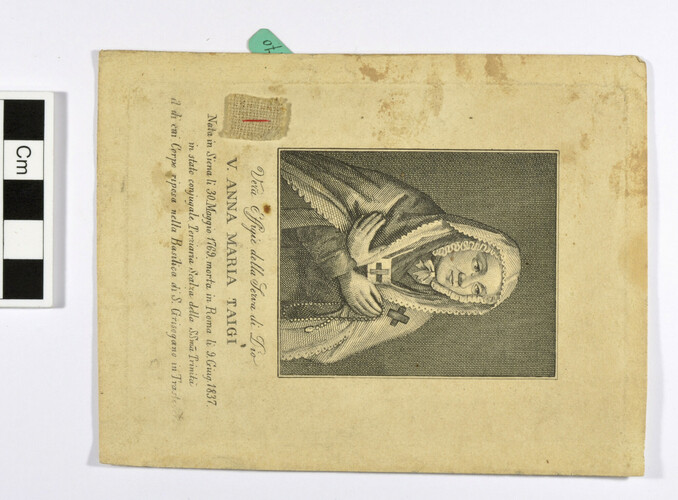 1985.52.2677.1Amulet, religious pictures with an image of 'V. ANNA MARIA TAIGI' and an inscription printed beneath. There is also a piece of textile sewn on to the piece of paper, presumably a relic. On the reverse is a circular piece of paper placed over the stitches with a crest. See associated amulets 1985.52.2677 .2 & .3, all of which were found in an envelope addressed to Adrien De Mortillet. [ASh [OPS move] 3/2/2017]1985.52.2677.1
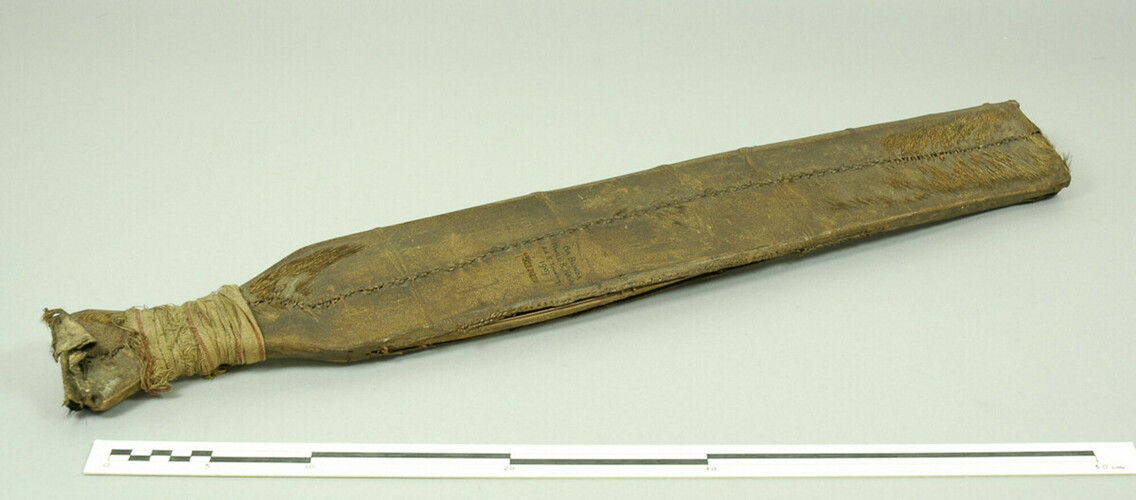 1907.21.27.2Goat-skin sheath [.2], for sword [1907.21.27 .1] Sheath has cotton textile wrapped around the base and wooden interior. [SM 14/02/2007]1907.21.27.2
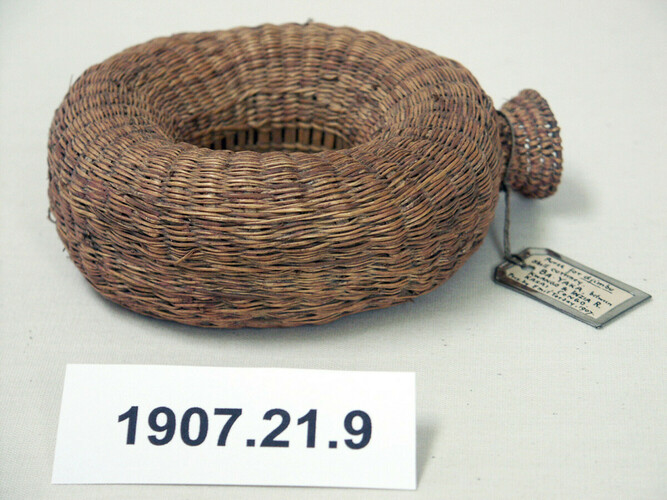 1907.21.9Ring-like basket-purse for shell money, woven from plant fibre. [LKG 17/12/2009]1907.21.9
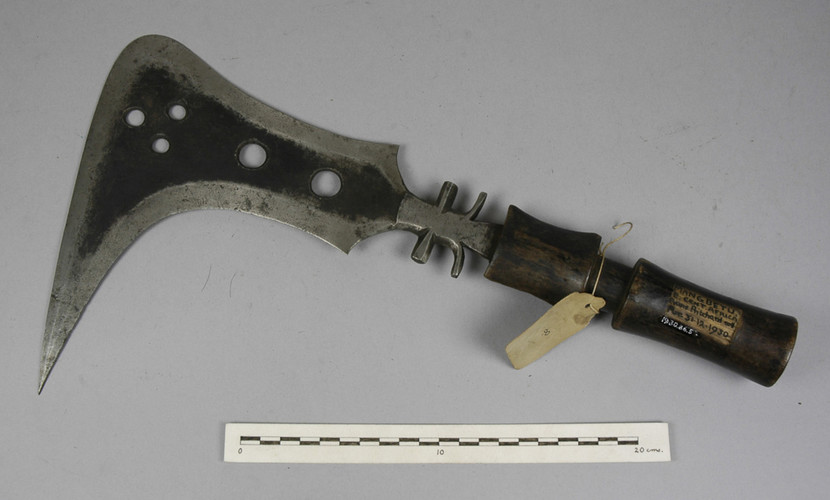 1930.86.5Knife with curved edged iron blade with long spiked tip and carved wooden handle. [SM 08/06/2007]1930.86.5
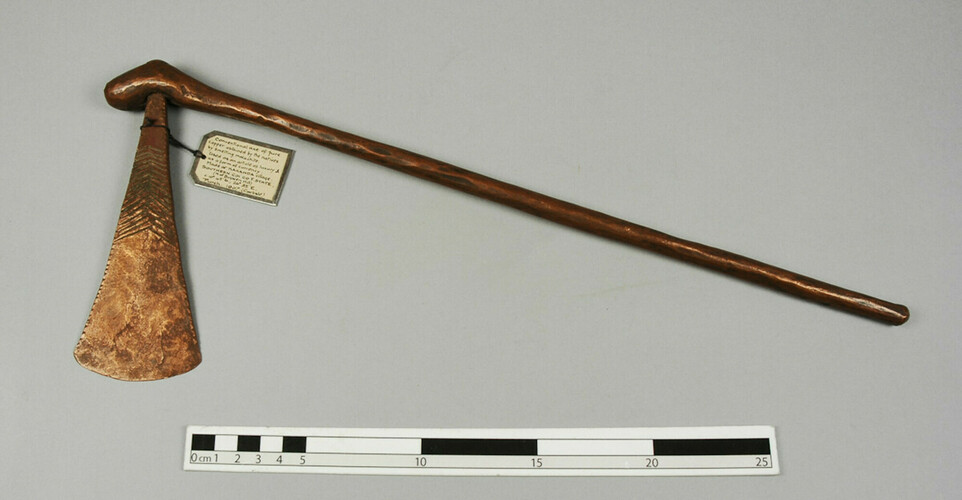 1907.82.5Copper axe with thin cylindrical handle and blade tapering out to cutting edge, used as currency and for display. [El.B 06/04/2011]1907.82.5