
- Collection type
- Object
- Description
- Kachina doll. The head of the figure is painted black with a white hand outlined in red in the centre of the face.
- Long description
- Kachina doll. The head of the figure is painted black with a white hand outlined in red in the centre of the face. Inside the white hand are three black dots. On either side of the head are two ears painted red. At the neck of the figure there is a section painted light brown / yellow, possibly representing a ruff. There are some badly damaged feathers attached to the top of the head. The figure wears a whitish shirt and a ?sash painted red, black, blue and green which hangs down one leg. The figure wears red painted boots or moccasins which are decorated with strips of leather. Pieces of black wool yarn are tied around the lower legs and wrists of the figure. The hands of the figure are painted white. In one hand the figure carries a blue rattle with a white handle and in the other a crooked stick, painted white - similar in shape to a walking stick. There is a hank of black wool yarn over one shoulder. The figure carries a black wooden pot on its back which has been nailed on and also attached with a leather strap and string. A piece of string has been tied around the body of the figure. [MdeA 28/3/2002]
- Geographical reference
- Arizona
- Cultural groups
- Hopi
- Date / Period
- Date made: Before 1965?, uncertain
- Date collected
- By 1970
- Acquisition information
- Donated: 17/07/2001
- Materials and processes
- Material Wood Plant, Material Pigment, Material Bird Feather, Material String, Material Wool Yarn Animal, Material Animal Leather Skin, Process Painted, Process Carved
- Dimensions
- Height: max 220 mm
- Object numbers
- Accession number: 2001.66.11
- Research and responses
In Janaury 2023, Ramson Lomatewama, former katsina doll carver, from Oraibi on the Third Mesa was interviewed alongside Kelley Hays-Gilpin, Curator of Anthropology at the Museum of Northern Arizona by Megan Christo for the Play! Project. This involved a general disussion of Hopi katsina dolls and a review of ten katsina dolls from the Pitt Rivers Museum collection (1913.87.83, 1913.87.72, 2008.140.1, 2001.66.6, 1913.87.67, 1973.15.1, 2001.66.14, 2001.66.11, 1992.10.1 and 2001.66.12) Below are key excerpts from this interview.
What are Katsinas and Katsina dolls?
Rasmon: “Katsinas are the physical manifestations of the spirit aspects of the Hopi reality and they're the spirits of people who come back in the Katsina form. You can have Katsinas that are birds, animals, plants, forces of nature, that type of thing, that are personified in our ceremonies...Katsina is alluding to that spirit quality, but it is also alluding to the physical Katsina that sings and dances in our ceremonies...In our culture, what we tell our young children is, when you die you turn into a katsina. So it gives you an idea of an afterlife. Hopis do have a definite concept of an afterlife. But it's that statement that grounds a child early in life, to not necessarily fear death and dying because there's no finality to this life, you are born into another place. And so this is why we say Katsina are the spirit aspects of people who have passed on. Now, the dolls that are carved, are simply renditions of the Katsinas that participate in ceremonies in the plazas and the Kivas. And early on, someone wrote that Katsina dolls are not toys, but they're learning tools for children, and that's a big mistake. The dolls that are given to girls are toys- they're meant to be played with. So, the outside world that doesn't understand what Hopi is, they're interpreting things from their reality not necessarily from the Hopi reality. So this is where you run into a lot of problems with cross cultural understanding, because they're approaching it from their mindset, not from the Hopi mindset.”
In this interview Rasmon also explained that a male katsina can identified by their sash hanging to their right.
Who carves katsina dolls?
Ramson: “In our culture, there are gender roles and responsibilities. In our culture, the males, initiated males, are the carvers. And as long as you're male, and you're initiated, you're allowed to carve dolls, because that's a privilege that you gain through the initiation process, because you're learning more knowledge and gaining more solid ideas behind the underlying reasons why we engage in these activities. Women on the other hand, generally they're the potters, they're the basket weavers. The dolls that are given to girls at our ceremonies to play with and to grow with, are carved by the Katsinas at their own homes...It's like Santa Claus is doing his thing up at the North Pole. It's all magical, right? There are parallel ideas at work in here. Now my granddaughter watches my son-in law and her uncle carve dolls, and they're doing it right in front of them, but these dolls are being marketed at art shows. So, kids grow up with that idea of ‘Oh okay, the guys carved dolls here to sell, but the Katsinas make ours’.”
What are katsina dolls made of?
Ramson explains that katsina dolls are always made fo cottonwood root. In the past, featherwork was comprised of eagle and sikyatsi feathers, but since the passing of the Migratory Bird Act, Hopi people have more limited options and will often use the feathers of more common birds like budgies and canaries.
Ramson: “Hopi carved dolls are always carved from the root of the cottonwood tree. Not from the trunk or not from the branches, but the roots specifically. And so the cottonwood root, when it's dry, it's pretty lightweight. It's probably maybe similar to the mass of balsa wood, a little heavier than balsa wood. More close to basswood, I mean they're going to be similar in in feeling the weight. So, if you look at the soles of the feet, if you can see the actual wood, you can see just like little the pores of the root in the in the wood...Back then [in 1913] they were still using the yellow feathers of a bird that we call Sikyatsi. Since the passing of the Migratory Bird Act, even Hopis can't use endangered species feathers on their dolls.”
The role of katsina dolls:
During this interview we discussed the misconception that katsina dolls aren’t played with due to their role in religious ceremonies. Ramson and Kelley explained that they are played with, to foster caring instincts in children, expecially girls, to teach children about the different types of katsinas, and to extablish and maintain a positive relationship between Hopi children and the katsina ancestor-spirits. According to both Kelley and Ramson, katsina dolls are also sometimes to infant boys and to adult women.
Ramson: "All kids are born with maternal instincts, both males and females, we're all born with paternal instincts- doesn't matter what gender you are. We already have this gift. And so kids have this already- dolls are meant to be played with. All that it’s doing is watering the future motherly, caring instinct in a little girl, and so that's why the dolls are given specifically to girls. And so they play with them, they break them. And the idea behind that is that it's okay if the feathers fall off, they're meant to do that, because that's what life is. Life generally deteriorates over time. And you know, that's an accepted part of the lifecycle, you know? We kind of have a joke about, ‘Botox is a vain attempt to preserve your life’. You know? Just go with the flow, accept your age, and leave this place with grace. And so this is what these dolls are doing. If the feathers come off, no sweat, that's what happens. If the arm breaks off, hey, as long as you are good, as long as you exhibit positive behaviours, the Katsina will bring you another one. So the same ideas are always at play here. As long as you are conducting yourself in a positive way, you exhibit positive behaviours, you're continually going to be rewarded for those things...What you're building on is the connection between you and a spiritual life, which is manifested through the Katsina, because it's the Katsina that physically gives it to the child when they're handed out at certain ceremonies. So with the Katsinas, the Katsina is physically present to give the gifts directly to the child. That's where that relationship is established."
Kelley: “And when they're older too, they are still bringing grown women dolls, but some of those dolls are very fragile and have a lot of featherwork and so their families are very proud of them. And so they're just beautiful on the walls and it represents these relationships that people have. And also just the growth of a woman and the home - the woman can remain in the home especially if she's the linage head -being an anthropologist I say that- but you know if you're the senior linage you stay in that home your whole life and so here's the gifts that the Katsina have given you for decades, maybe.”
Ramson: “My wife has gotten dolls even at her age. But it just goes to show me that in some cultures, the magic never really goes away. You know there’s still a child in there somewhere. And you've still got this magical spiritual connection with, you know, all these Katsina spirits. I mean, that never really goes away.”
Ramson also mentioned occurences when a katsina doll would be mended:
“I’ve got to make an exception though. Let's say at a ceremony where the girl gets the doll, but the arm is broken off at the get go. So then what she's told is that well, here's what you do, you take your “hooma” (white cornmeal that we use for praying). You take your doll and your hooma take it to the Kiva where that katsina came from. And the katsina already went home, they're not going to be there. But the men are going to still be there, and so you ask one of them to come out. Sp when a man comes out, no matter who it is, you ask that man, give him the white cornmeal and give him the doll and you ask that man to tell the katsinas if they can fix it back for her. And he'll say, “Okay, I'll do that.” Then, at a later time, then she'll get that same doll back but it'll be in good repair. So a spiritual repair job!”
Katsina dolls and the tourist trade
Ramson detailed the complex history between katsina dolls and the tourist trade within his Mesa, and went on to explain the origins of his own unique “funky doll” design. Once the distinction between dolls from katsinas and dolls for trade was established, carvers began to sign their designs from around the 1950s onwards, and often a carver’s initials can be found on the sole of a doll’s foot.
Rasmon: “The traditional teaching was that dolls were not to be sold. They were never supposed to be a commodity. But when the cash economy made its way onto the reservation in the late 1800s/early 1900s, there was a guy by the name of Tawaquaptewa, who was the chief of Oraibi in the late 1800s. And at that time, there was turmoil within the Hopi, as to whether Hopi should adopt the white man's ways, or should they resist and keep their own ways. So to the US government this became a militaristic view for them, because people who are willing to cooperate and adopt the white man's ways were termed ‘friendlies’. And those people who wanted to maintain the traditional ways and reject the government were then referred to as ‘hostiles’. So it's military from the get go. And Tawaquaptewa, he had this sense that I think, you know, when I think about it, at that time, people were sceptical about him. But his position, just from my reading and recollections of people who knew him, older people, he sensed that the world was changing, and we could never go back. And so slowly, the cash economy started to crawl up into the Hopi life, and sensing that, and knowing that we shouldn't be selling Katsina dolls for money. He started carving dolls that were not accurate, in terms of ceremonial markings and things. And so we started to go ahead and market those to the public, to tourists.
All the dolls that I carved for the art market were commissions. Commissions for carving dolls as an art item, not as a spiritual thing, not as something connected to ceremonial. So I've done a lot. And then, I don't know if it was in the 80s maybe? I started simplifying my dolls. I was the first guy that just started doing the funky dolls- they have a lot of funk factor. Then about maybe 15-20 years ago I started doing the Teletubbies. I made very, very minimal, maybe even no changes to the natural form of the cottonwood root. I like to research! I really like to research a lot...I've found that in, in the 1800s, most dolls were very, very simple....I didn't intend this to happen, or I didn't foresee it. But these things started selling like hotcakes, and I started doing that. And interestingly, during all those years that I was carving those dolls, no one was copying what I was doing. So I was the only guy that was doing those specific dolls. And then when my son got initiated, then I passed the torch to him...I've carved a lot of dolls for art markets, conventional looking dolls with arms and legs, kind of accurate renditions. And then I was a volunteer at Walnut Canyon National Park, right outside of Flagstaff, I was volunteering there carving dolls. I had this piece of wood that was just- at first I thought it wasn't worth carving because it was split down the middle. So it was a half-round and it was really jaggedy and funky looking. So I just started do to carve a neckline into it and just painted a pair of arms on it, nothing else. A necklace, and just real basic face markings on there, put a feather on it, and someone really wanted to buy that. You see I just put it on there for display to show what dolls were looking like 100 years ago, and someone wanted to buy it....So, I just didn't do the regular carved dolls from that point on, all I did was these dolls. And I took it to a gift shop on the reservation, the owner is an ex-hippie, ex-Jesuit priest. And I showed it to him and he just cracked out laughing. He says, “What is this?” I said, “It's historical.” And he said, “This has a lot of funk factor.” And he was selling them, so that was that was kind of the establishment of that particular market. So we just refer to them as funky dolls now. My son, he still makes living just from doing those so there's a little history in there.”
According to Ramson, this katsina doll is likely from the first mesa. In Oraibi (third mesa) where Ramson is from, this katsina is known as “Malatsvetaqa”- one that has a handprint that’s drawn. (also “Malatsmo” in other regions). This is a runner or racer katsina and appears in races as part of certain ceremonies. If he overtakes you, he slaps his blakcened hand on your back, marking you. The painted sash depicts the traditional embroidered sashes worn by real life katsinas with white speckled marks, diamonds, and shapes either side of the diamons that look like back-to back uppercase Cs.
Search terms: Toy and Game, Religion, Figure, Doll Figure, Religious Object
Further items to explore
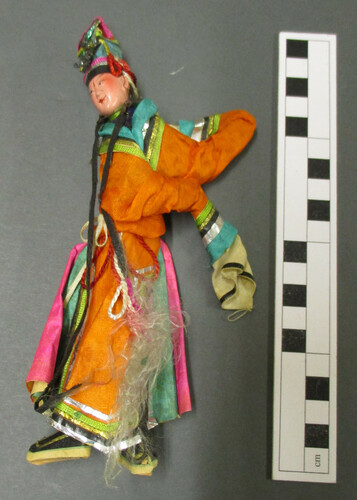 1970.24.18Male doll figure made of plaster, cardboard and textile. Orange dress, green and pink headdress [N.B. 'DCF 2004-2006 What's Upstairs?' 24/2/2005]1970.24.18
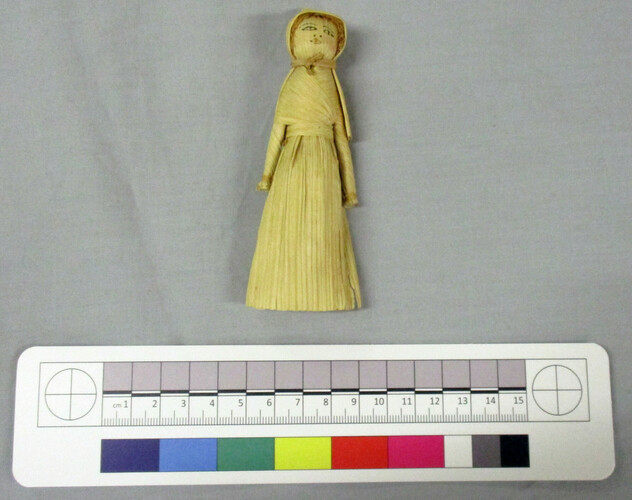 1985.36.188Doll made from palm leaf tied together to form a body and costume with a hood. The hair is made up of a light orange coloured plant fibre and the face has been drawn onto the figure. [ASh [OPS move] 15/07/2016]1985.36.188
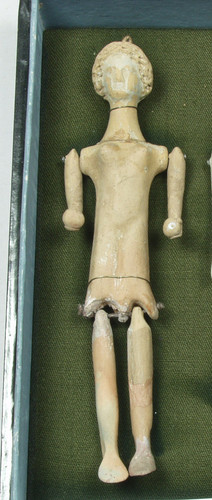 1917.53.516Jointed pottery doll holding a pottery ball in each hand.1917.53.516
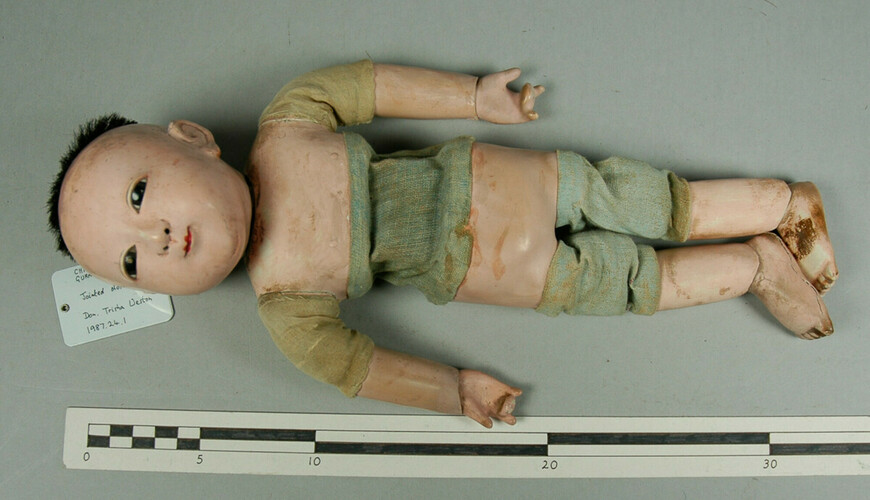 1987.24.1Doll of a boy, made of plaster, with arm, leg and waist joints of cotton textile. [El.B 23/04/2008]1987.24.1
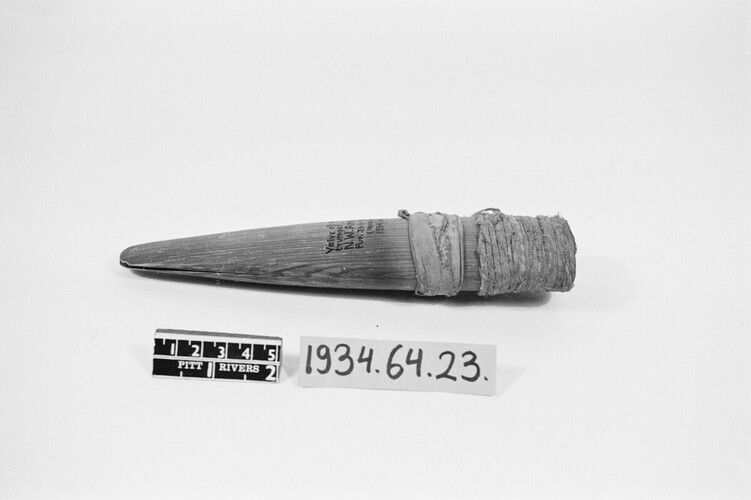 1934.64.23Large wooden oboe reed, made in 2 pieces of wood, concavo-convex in section, and bound together at the base. Said to be a moose call, but may have been enclosed in a large tube as an internal sound mechanism.1934.64.23
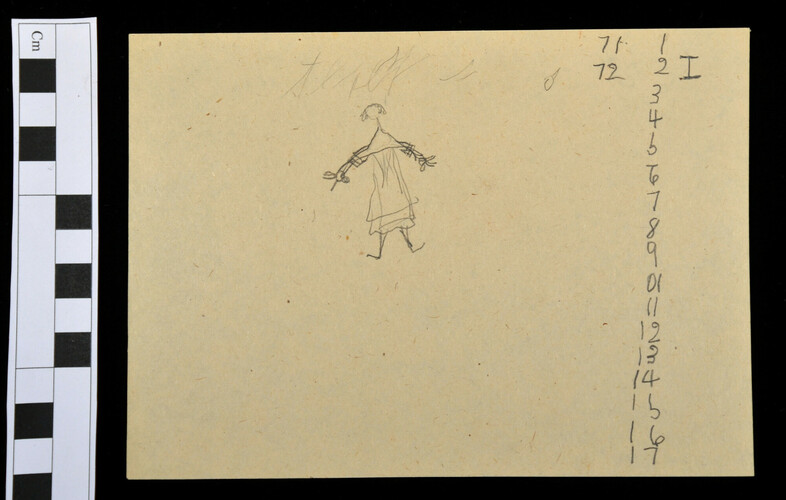 1994.15.164Drawing by schoolchild of a figure. [MJD 22/12/2014]1994.15.164
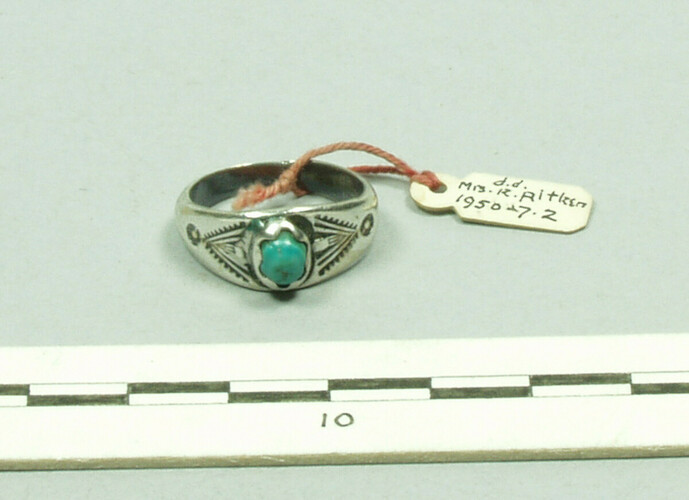 1950.7.2Silver ring with stamped design inlaid with single turquoise.1950.7.2
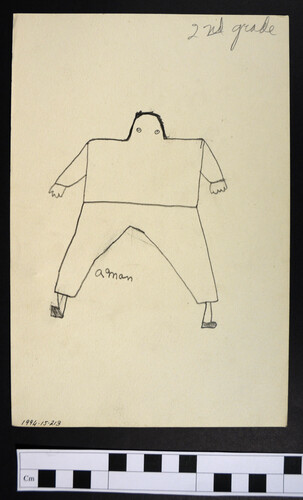 1994.15.213Drawing by child in pencil of three figures. [MJD 24/03/2015]1994.15.213