
- Collection type
- Object
- Description
- Jointed pottery doll holding a pottery ball in each hand.
- Geographical reference
- Date / Period
- Archaeological period: Iron Age, uncertain
- Date collected
- By 1917
- Acquisition information
- Donated: 1917
- Materials and processes
- Material Pottery
- Dimensions
- Length: max 145 mm
- Object numbers
- Accession number: 1917.53.516
- Research and responses
Jointed Greek pottery dolls have primarily been uncovered in Athens, Corinth and surrounding areas, as well as the Greek Islands and Asia Minor. While the examples in the Pitt Rivers Museum are unclothed, there are excavated examples of both nude and dressed dolls. These dolls have largely been uncovered at gravesites and sanctuaries dedicated to Greek Goddesses such as Artemis and Demeter.It should be noted that the original location of these dolls is undetermined, as they are thought to have been moved to deposits within the sanctuary walls after they were consecrated. The graves that the dolls have been found in are believed to belong to female children- usually because of the other funeral offerings found with them, since a determination of the sex of the individual from their bones is not always possible.
Archeologists have long debated the function of jointed pottery dolls because of their contradictory properties. Some scholars believe that, because the dolls have jointed limbs (some rarer examples have jointed knees and hips, allowing them to become seated), this is an indication that they were meant to be moved and played with. Meanwhile, others believe that their fragile materiality suggests that they were not meant for play. In Ancient Greece, dolls were closely linked to marriage rituals, and it is believed that girls would dedicate their dolls to the gods before their wedding, marking the end of their childhood. The Palatine Anthology includes an epigram about a girl named Timareta who dedicates her dolls to the virgin Goddess Diana that scholars often reference in relation to dolls. One translation of the epigram reads: “Timareta, the daughter of Timaretus, before her wedding, hath dedicated to thee, Artemis of the lake, her tambourine and her pretty ball, and the caul that kept up her hair, and her dolls, too, and their dresses; a virgin’s gift, as is fit, to virgin Dian.” However, it is also debated among some scholars that there may be a scribal error, and that a bride would actually give up a lock of her hair rather than a doll. Another epigram describes a bride giving up a lock of her hair and astragal dice before her wedding. For boys in Ancient Greece, toys were also objects that were dedicated to the Gods to mark the end of their childhood.
Although the majority of scholars can agree that dolls were linked to childhood in Ancient Greece, some argue that because the majority have been discovered at temples and gravesites, they were used only as religious votives, particularly for girls who experienced an untimely death before marriage. However, others argue that the fact that jointed dolls have been found at children’s gravesites demonstrates “ample proof that dolls were among the most precious toys.” Another school of thought asserts that jointed pottery dolls might have been used for both, perhaps with material differences between the dolls played with in life and those played with in the afterlife. There are examples of objects from Ancient Greece with “non-functional” counterparts such as terracotta balls, usually found in the graves of adolescents, which show detailed seam patterns, replicating the appearance of the original “functional” leather balls. However, Gutschke concludes that, in the case of terracotta dolls, there have been no direct parallels found made from non-perishable materials (although there are earlier examples of jointed dolls made from less perishable materials, such as wooden jointed dolls from Ancient Egypt and later examples made from bone found in Rome). Therefore, it could be assumed that either the jointed dolls used in non-funerary contexts were made from similarly perishable materials, or that the terracotta jointed dolls themselves were used as toys. This is a possibility, since terracotta jointed dolls have been excavated from courtyards and floors in domestic contexts (mostly in Olynthos).
Sources:
Elderkin, K. M. (1930). Jointed Dolls in Antiquity. American Journal of Archaeology. The University of Chicago Press. pp. 455-479. Available at: https://www.jstor.org/stable/498710
Gutschk, F. (2019). Greek Terracotta Dolls: Between the Domestic and the Religious Sphere in Hellenistic and Roman Terracottas. pp. 215–222. Doi: 10.1163/9789004384835_016.
Search terms: Toy and Game, Figure, Pottery, Doll Figure
Further items to explore
 1966.16.88.4Doll, made from wood. Wooden doll with a triangular head and an oblong body in flat white wood. The head is decorated with 4 rings in poker work, whilst the body is decorated with numerous circles within two triangles and lines scored into the surface around these triangles. The reverse is plain. 1 of 4 similar dolls with two strips of tie-dye fabric found with the dolls [1966.16.88 .5] [ASh [OPS move] 08/08/2016]1966.16.88.4
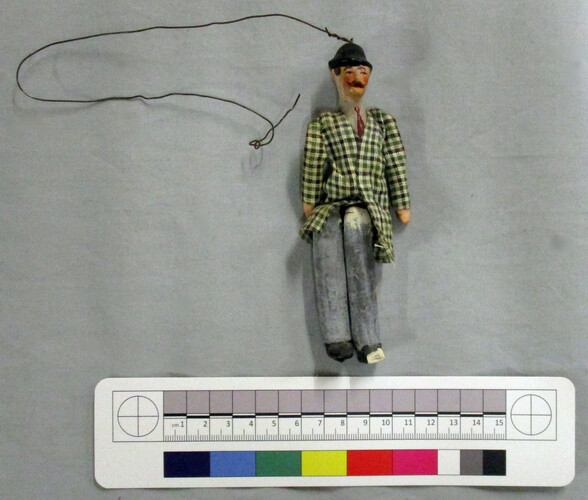 1985.36.204.3Male puppet or doll. Painted with a brown moustache and hair with the facial features highlighted. The figure is wearing a green and white tartan jacket, grey painted legs and black painted shoes. There is a metal wire attached to the top of the head. 1 of 6 dolls with painted faces and limbs, possibly Polish in origin. [ASh [OPS move] 25/07/2016]1985.36.204.3
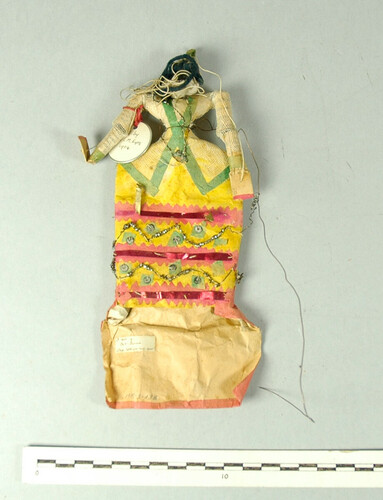 1965.3.138Puppet doll with a white bodice and a yellow and pink skirt. Decorated with silver 'tinsel', sequins and pink and green patterns. [LKG 05/10/2009]1965.3.138
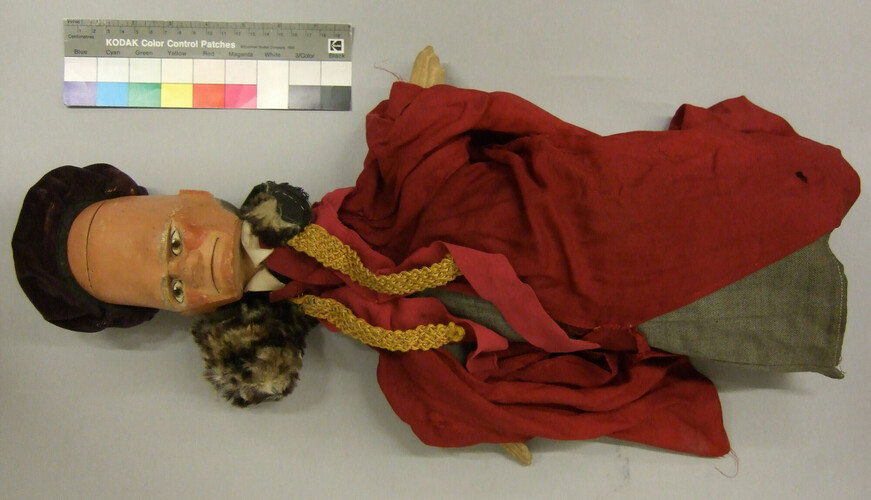 1985.36.9Hand puppet: a professor. Top of head hinged for 'operation'. Dressed in dark red gown with simulated fur hood, and purple velvet cap [SM 25/11/2008]1985.36.9
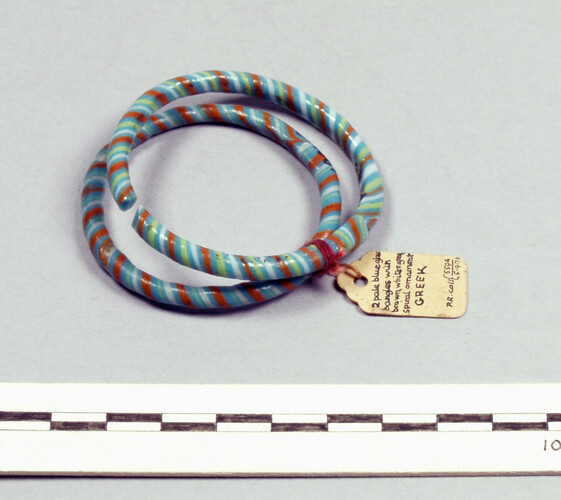 1884.82.98Pale blue glass bangle with brown, white and green spirals. Tied to 1884.82.99. [LM 'DCF 2004-2006 What's Upstairs?' 4/10/2005]1884.82.98
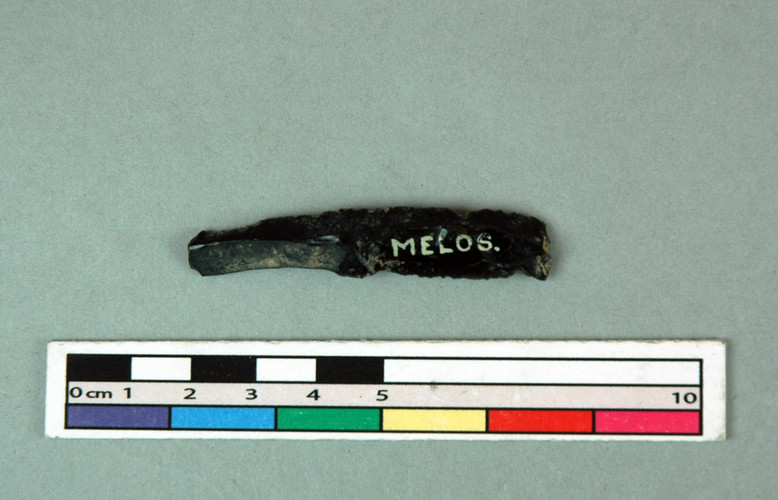 1884.132.345Obsidian blade flake with roughly parallel sides and two parallel flake scars running the length of the flake. [MN 30/04/2010]1884.132.345
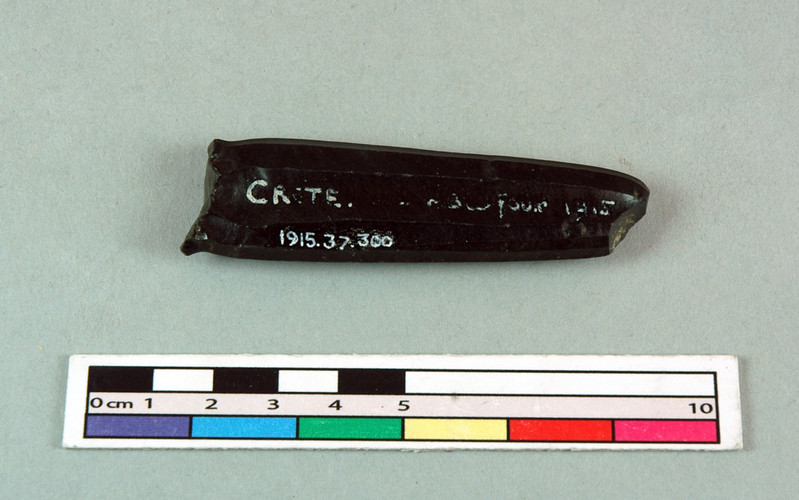 1915.37.300Obsidian core. [SM 27/06/2008]1915.37.300
 1884.37.43.1Pottery vessel [.1] with slightly rounded body, small foot and two vertically projecting handles.This object is listed as having a lid [1884.37.43 .2] which has not been located.1884.37.43.1