
- Collection type
- Object
- Description
- High-shouldered membrane jar with short neck and sloping sides, decorated with cut-out paper design. [ZM 3/8/2005]
- Date / Period
- Date made: Before 1932
- Date collected
- By 1932
- Acquisition information
- Transferred: 1932
- Materials and processes
- Material Membrane, Material Paper Plant, Process Decorated
- Dimensions
- Height: max 196 mm, Depth: max 100 mm, Width: max 195 mm
- Object numbers
- Accession number: 1932.89.177 Other numbers: 6?
- Associated publications
- Illustrated in black and white photograph as figure 56 on plate IV of ''The Tandu Industry in Northern Nigeria and its Affinities Elsewhere', by H. Balfour, in Essays Presented to C.G. Seligman, (1934), pp. 5-18. Caption (page 18) reads: 'Plate IV. 45 = A small oil-flask, made by layering membranous material over a clay core, Patna, Bengal, from Sir R. C. Temple’s collection; 46 to 48 = two similar oil-flasks, of which number 46 is in the finished state, while 47 shows the exterior and 48 the interior of a specimen which I bisected in order to reveal the hollow clay core in situ, collected by H. E. Drake-Brockman in Mirzapur, N.-W. Provinces, in 1893; 49 = oil-vessel, sireshom, made by coating a clay core with skin-scrapings, Afghanistan, from Mrs. Courtney Bell’s collection; 50 = a thick-walled oil-jar, kupa, decorated with cut-out paper patterns appliques to the surface, Punjab, from General Pitt Rivers’ collection; 51 = an ornamentally shaped jar with cover, similarly ornamented, Multan, Punjab, collected by A. Brown, c. 1895; 52 = an ornamental flask with body of which is pierced by five “tunnels”, covered with paper patterns, Multan; 53 = a drinking-mug with similar decorative surface, Multan. The two last were formally in the Plymouth Museum. 54 = an oil-jar with gadrooned surface, N. India, from General Pitt Rivers’ collection; 55 = an oil-jar, tel kuppa, of moulded membrane, with flanges to which are attached loop-handles of cane, fitted with a duct of wood and tin for pouring the oil, Bikanir State, Rajputana, from Sir R. C. Temple’s collection, 1892; 56 = a very finely made kupa, stoutly built and very strong, decorated with a small panel of cut-out paper, the whole surface being varnished over, collected by Mrs. Leslie Saunders in Beawar, Ajmere-Mewara Province, Rajpuntana; 57 = a smaller similar flask, kupi, painted and varnished same data as the last.' [MJD 01/11/2011]
Search terms: Vessel, Food and Drink, Food Accessory
Further items to explore
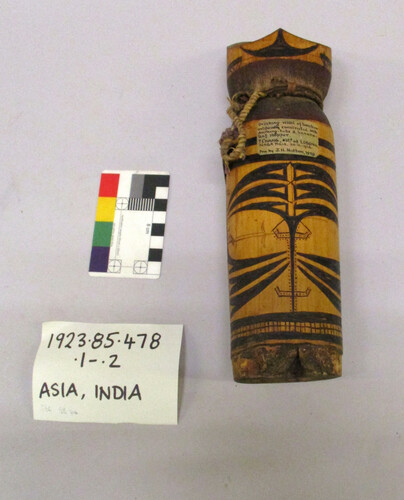 1923.85.478Bamboo drinking vessel [.1] stoppered with a banana leaf [.2] with a drinking tube [.3]. 1923.85.478
 2024.22.83Decorative plate with Kyoto Kawogawa design.2024.22.83
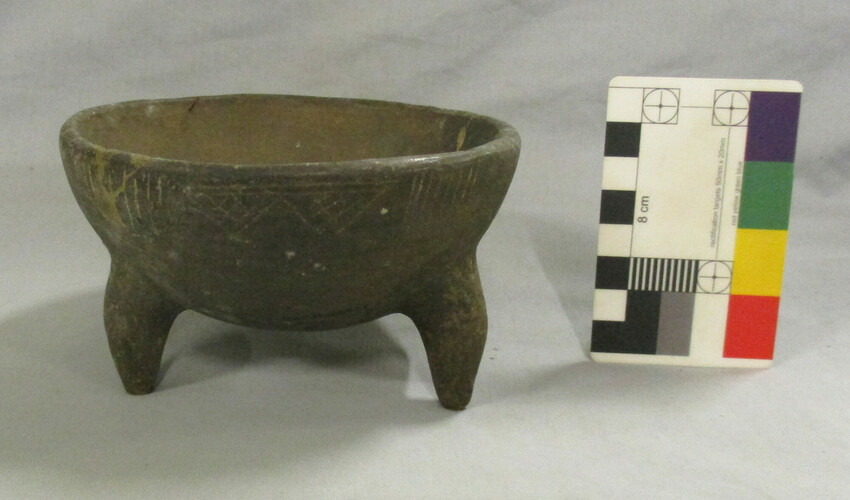 1913.3.35Chocolate-incised ware tripod vessel. From the graves near Bugaba. [ASh [OPS move] 30/03/2016]1913.3.35
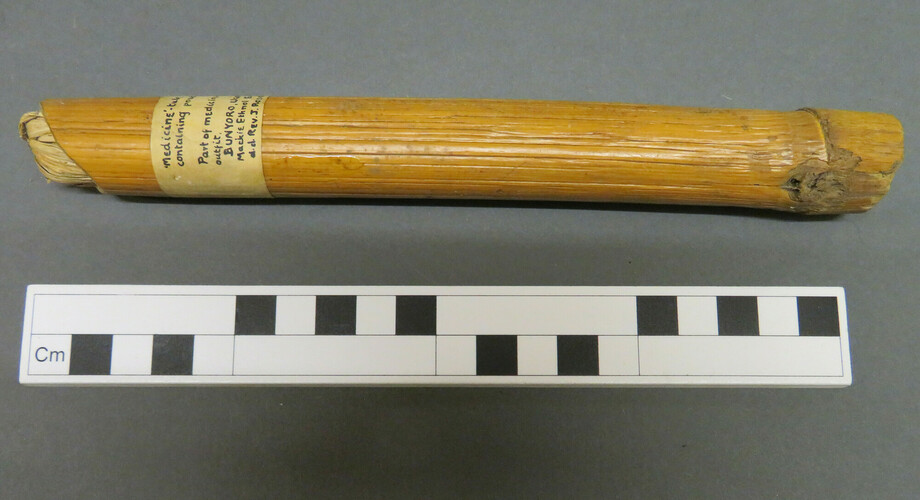 1921.9.177Bamboo tube containing powder. [ASh [OPS move] 15/5/2017]1921.9.177
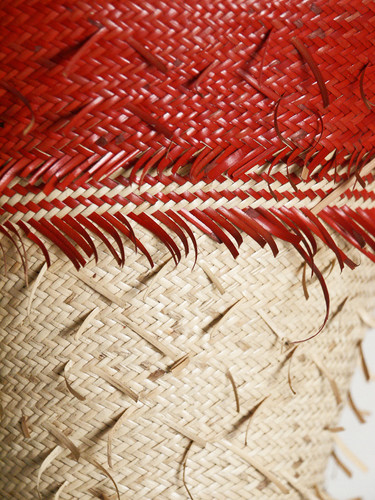 1928.69.1786Partly made gaiter of fine red and white cane strip on maker's last, consisting of 5 sections of light wood, bound with cane at the ends. [El.B 'DCF 2004-2006 What's Upstairs?' 26/10/2005]1928.69.1786
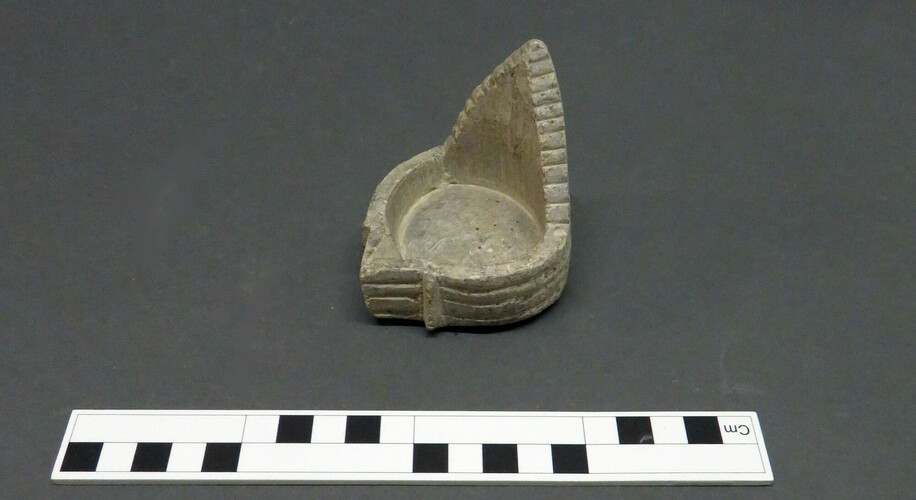 1965.3.90Shallow, grey stone lamp. Wide, pointed ovoid shape lamp with flat bottom and straight sides with three grooves running all the way around the object. Tall triangular back side which has been notched along the edges. [MOBB [OPS move] 24/3/2017]1965.3.90
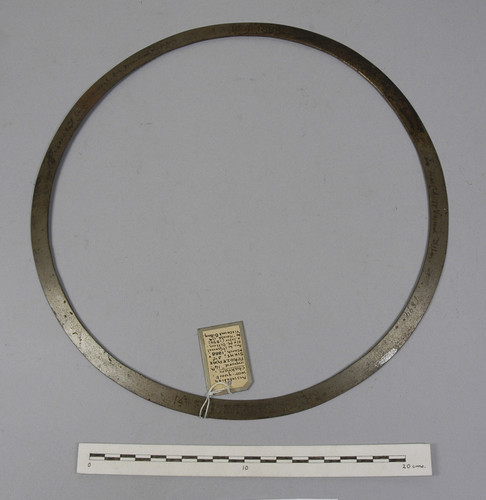 1933.78.4War quoit, chakram with inscription on one surface. [SM 05/06/2007]1933.78.4
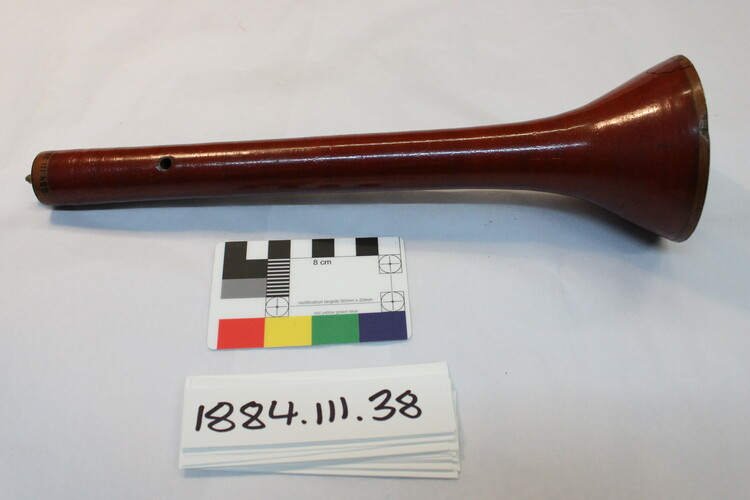 1884.111.38Oboe1884.111.38