
- Collection type
- Object
- Description
- Four glass beads [.1-.4] which are black, white and orange. Strung together by the collector. [SM 15/10/2010]
- Long description
- Four glass beads [.1-.4] which are black, white and orange. Strung together by the collector. The four beads have the same design: a band of black at one end, a band of white in the centre and a band of orange at the other end. They are tapered and are perforated through the centre. [SM 15/10/2010]
- Geographical reference
- Port Sudan [Jablonec nad Nisou]
- Cultural groups
- Czech
- Date / Period
- Date made: Before 1948
- Date collected
- By 1948
- Acquisition information
- Donated: 26/10/1971
- Materials and processes
- Material Glass, Material Bead, Material Pigment, Material Paste Glass, Process Strung, Process Perforated, Process Moulded
- Dimensions
- Length: max 23 mm, Length: max 22 mm, Length: max 21 mm, Length: max 22 mm
- Object numbers
- Accession number: 1971.15.584.1 Accession number: 1971.15.584.2 Accession number: 1971.15.584.3 Accession number: 1971.15.584.4
- Research and responses
Many beads and ornaments produced in France, Germany and the Czech Republic, thought to be opaque glass or porcelein are actually the products of a milk-paste which is moulded under high pressure and then fired, giving the appearance of glass or porcelein, but actually being a synthetic material. Ref: Picard, R and J. 1995. 'Prosser Beads: The French Connection' in Ornament 19 (2): 68 - 71. In RDF. [MO'B 22/5/2001].
This bead type may be related to the earlier term, psomit, used by Arab and European traders in mid 19th century Sudan (P. Santi & R. Hill 1980, The Europeans in the Sudan 1834-1878, p. 123). Judging by their descriptions, somit appear to be banded beads, many of which are cylindrical or barrel-shaped; imitation somit were also produced in glass in Germany and Czechoslovakia [RTS 29/1/2004].
Further items to explore
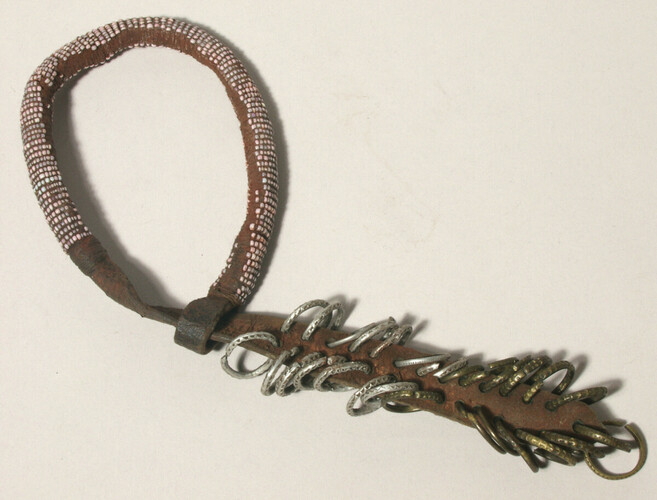 1940.7.098Baby's neck ornament made from a hide strap bound with strings of small pink beads with a projecting tail edged with decorated metal rings [RTS 16/8/2004].1940.7.098
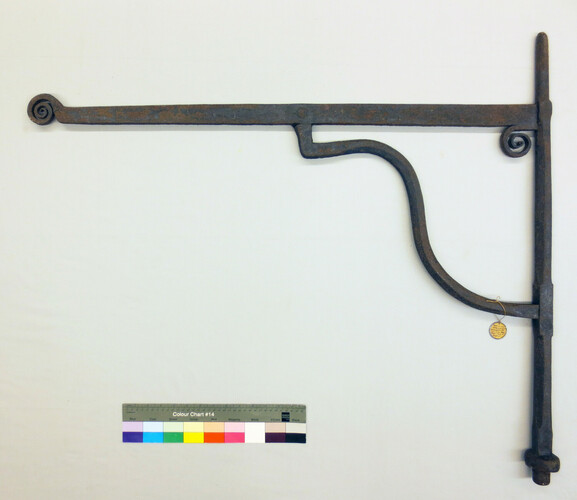 1945.11.142Wrought iron inn sign bracket [SM (Verve) 26/01/2015]1945.11.142
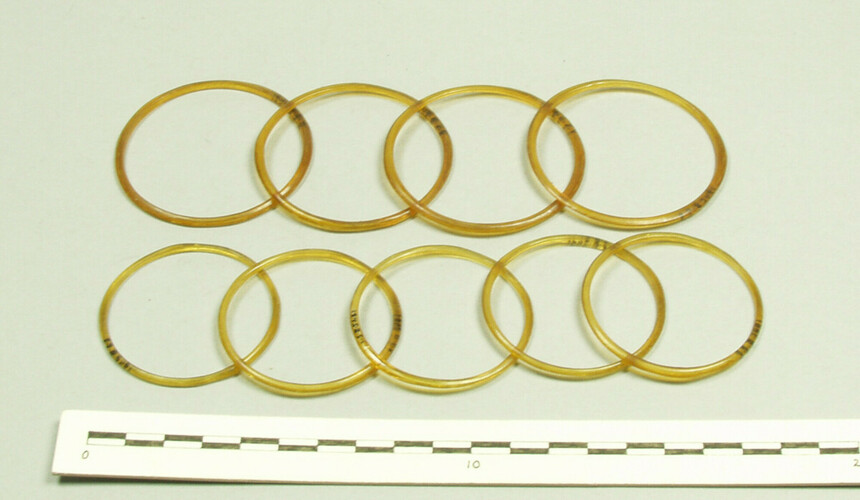 1945.8.5.1Small thin amber glass bangle. [El.B 'DCF 2004-2006 What's Upstairs?' 11/11/2005]1945.8.5.1
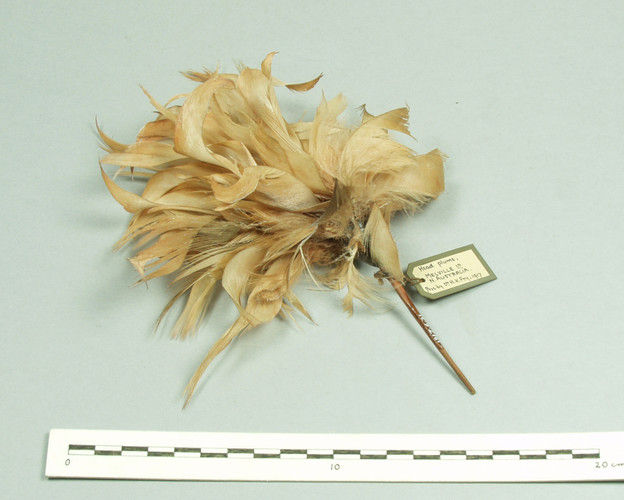 1917.6.31Pale orange plume of feathers mounted on a wooden pin with resin, some feathers loose. [ZM 11/4/2005]1917.6.31
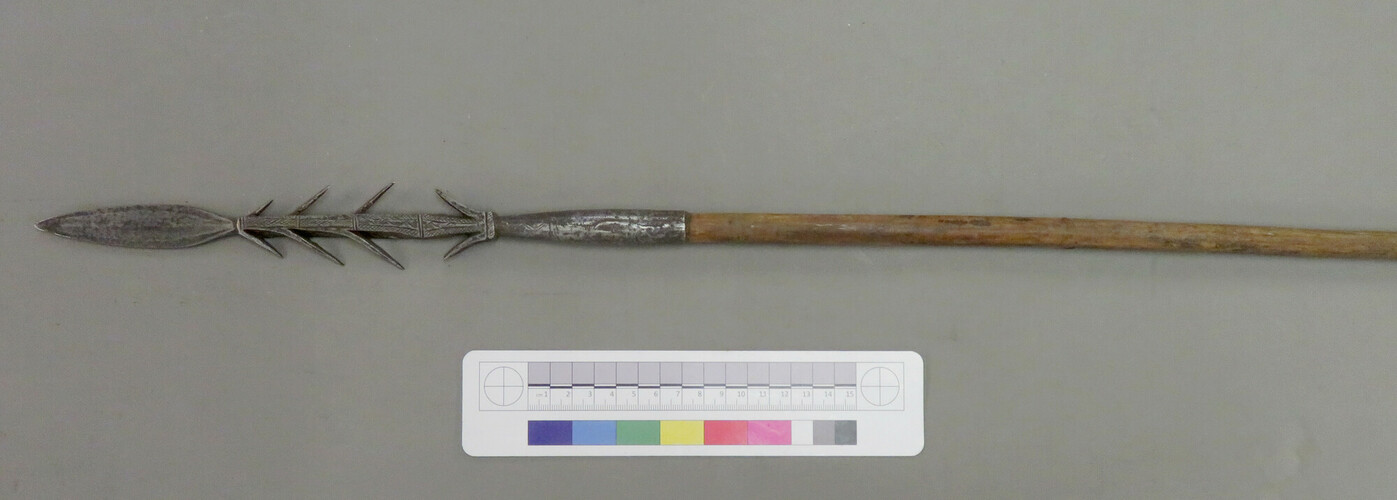 1930.71.29Wooden spear with iron leaf-shaped blade, and barbed spear head with one of the pairs of barbs pointing towards the blade. [AFS [OPS move] 5/7/2018]1930.71.29
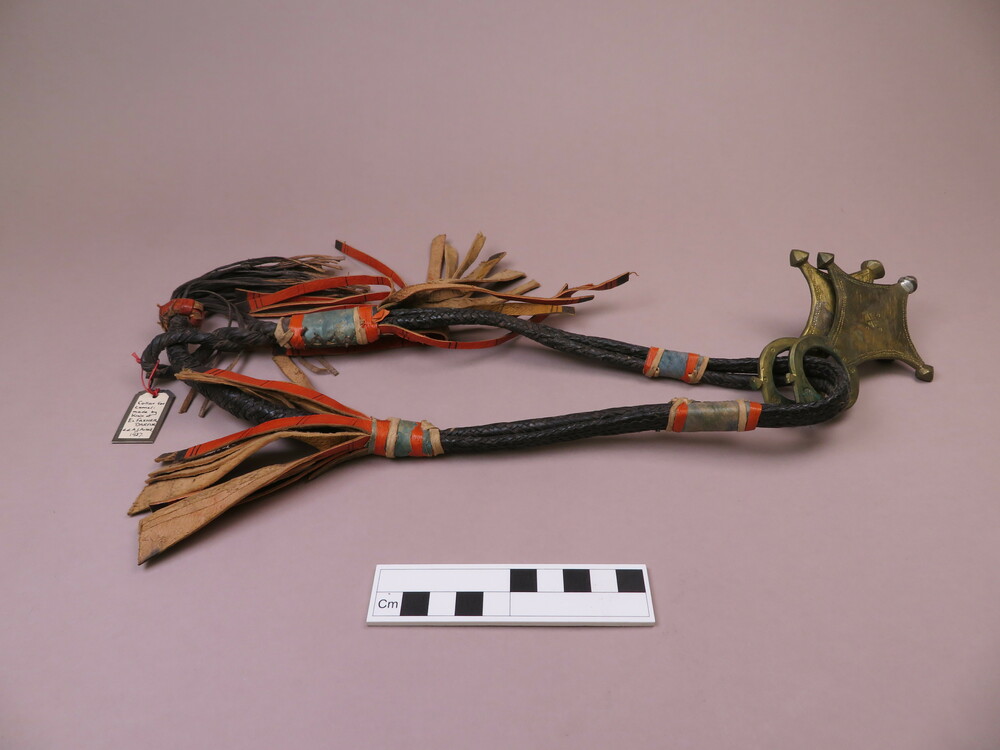 1937.35.49Camel collar with two cross pendants.1937.35.49
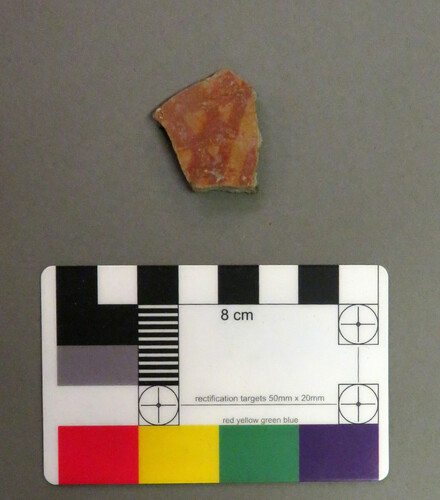 1949.12.28.11Sherd of red-brown pottery decorated with red gridlines on the outside. The inside is grey in colour. It is a body-sherd. [BA [OPS move] 28/11/2017]1949.12.28.11
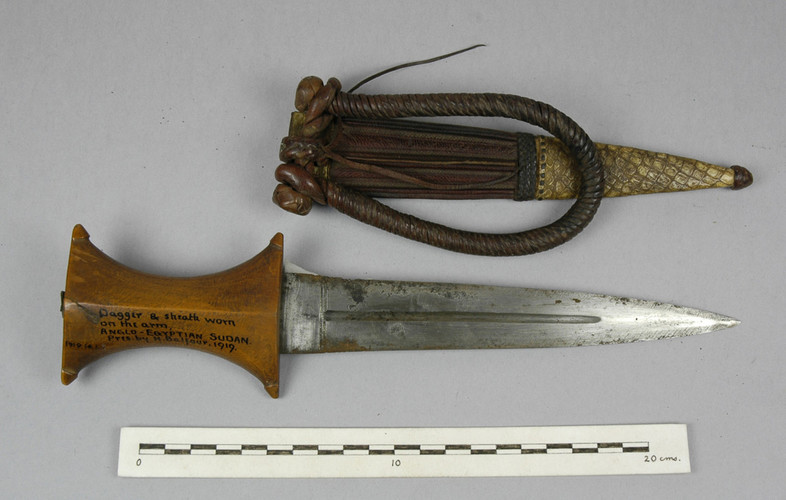 1919.14.1.1Dagger [.1] with two edged tapering blade and wooden hilt, with sheath [.2] with twisted leather carrying loop. [SM 15/06/2007]1919.14.1.1