
- Collection type
- Object
- Description
- 'Worm-knot' used for curing cattle. [DCF Court Team 5/3/2003]
- Geographical reference
- Cultural groups
- Irish
- Person
- Field collector P. Hopkins
- PRM source Dorothy Tylor
- PRM source The executors of Anna Rebecca Tylor
- Date / Period
- Date made: Before 1882
- Date collected
- By 1882
- Acquisition information
- Donated: 1921 Bequeathed: 1921
- Dimensions
- Width: max 76 mm box, Length: max 101 mm box
- Object numbers
- Accession number: 1917.53.785
- Associated publications
- Possibly one of the items discussed on pages 391-2 of 'Exhibition of Charms and Amulets', by E. B. Tylor, in The International Folk-Lore Congress 1891: Papers and Transactions [of the Second International Folk-Lore Congress held at the Society of Antiquaries, Burlington House, Piccadilly, London, from Thursday 1 to Wednesday October 7 1891], edited by Joseph Jacobs and Alfred Nutt (London: David Nutt, for the Organizing Committee, 1892), pp. 387-93. Tylor writes: 'In the north-west of Ireland, some years ago, in a village not far from Clew Bay, where I was staying, a cow was ill, and formed the topic of the conservation. It was too far to get a doctor; and the old lady who owned the cow confided to me her regret that there was not one of "them as know" in the place who could draw the worm-knot. On my enquiring what a worm-know might be, she explained that it is a peculiar knot made in a piece of twine, which being held over the back of a sick beast, and the ends pulled, if the knot draws / smoothly out, the beast will recover; but if the knot hitches, it will die. She could not make me the knot herself, but the boys could. I had several made, and I have put them under a glass shade, because they will not bear rough handling. It is a very loose knot: and my experience, in trying to play tricks with one or two of them, is, that if you once undo them you cannot get them together again, or at least I cannot. I may add that, though the knot was not available in this particular case, the cow got well. A boy was sent to nearest town, and came back with a quantity of Epsom-salts, which was given to her.' Possibly one of the 'Charms' listed under Tylor's name on page 460 of 'Catalogue of the Exhibition of Objects Connected with Folk-Lore in the Rooms of the Society of Antiquaries, Burlington House: Prepared by the Chairman of the Entertainment Committee', same publication, pp. 433-60. [NB Tylor suggests here that the ones he exhibited are ones he had made, but it may be that those exhibited included the three examples provided to him by P. Hopkins (i.e. PRM 1917.53.785 -.787). Those he was given by James Mooney in 1897 (i.e. PRM 1917.53.788 -.789) could not have been among those exhibited.] [JC 7 12 2007] Mentioned in Ellen Ettlinger, Folklore vol 54, no. 1, (March 1943) pp 227-249, 'We come now to the last group which comprises charms, and it seems to me that they are nowhere better represented than in the Pitt Rivers Museum. I found it helpful to arrange the specimens according to the classification: Imitative and Contagious Magic. [Sir James Frazer, The Golden Bough 3rd ed. Part i (London 1911) vol i p 52] Imitative Magic means that any desired effect can be produced by merely imitating it. ... The third example was used to find out whether diseased cattle would recover. "Worm-knots" or "snaaidm na Peiste" that is, loose knots of a special kind "were held by certain skilled people in Ireland in front of, and parallel with, the beast. The ends were pulled and if the knot came undone, which it ought to do theoretically, the beast would recover - but if the knot jammed, the beast would die. [PRM and TK Penniman thanked for info] As such worm-knots were also applied for curing any knot or contortion of the bowels, which is supposed to be the cause of gripes or colic, it is evident that the illness ought to disappear correspondingly with the knot. During the procedure invocations of the Holy Trinity and of Saints were reported.' [p 244-5]
Search terms: Medicine, Specimen, Animal Gear
Further items to explore
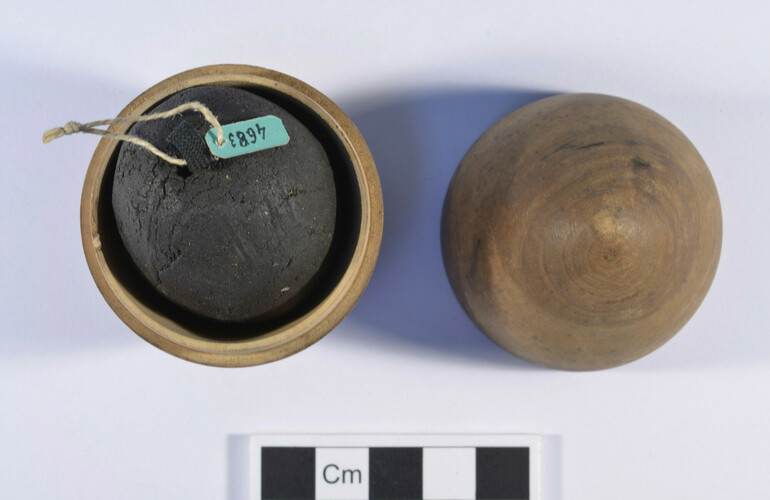 1985.52.2351.1Amulet, black iron oval ball with a textile loop for suspension, inside an oval two-part wooden box [1985.52.2351 .2-.3] that opens. [RB 30/07/2012]1985.52.2351.1
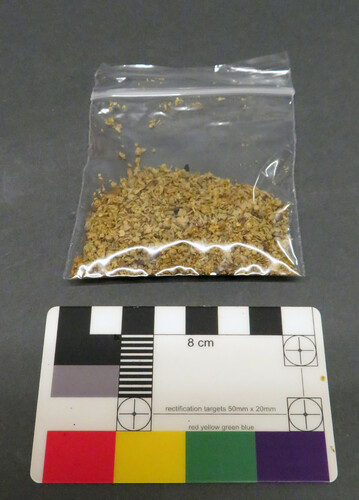 1985.54.1899Medicine; ground up plant matter, seeds and wood. Used to cure stomach pain. [ASh [OPS move] 15/09/2017]1985.54.1899
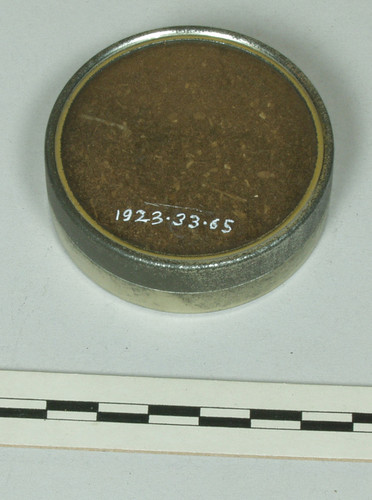 1923.33.65Brown powder for a philtre: in glass topped tin.1923.33.65
 1921.9.23Leaf bundle of medicine, belonging to rain-maker.1921.9.23
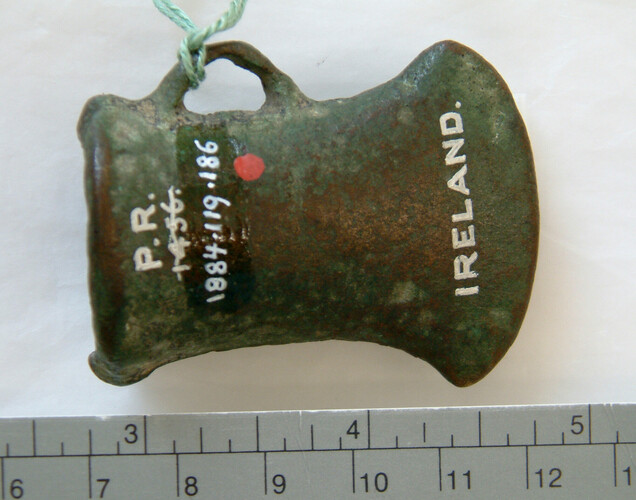 1884.119.186Bronze socketed axe1884.119.186
 1884.125.338Stone axe1884.125.338
 1884.119.359Bronze spearhead with straight tapering edges. There are two rivet holes on the socket.1884.119.359
 1884.140.1692Stone axe1884.140.1692