
- Collection type
- Object
- Description
- Amulet, black iron oval ball with a textile loop for suspension, inside an oval two-part wooden box [1985.52.2351 .2-.3] that opens. [RB 30/07/2012]
- Long description
- Amulet, black iron oval ball [.1] with a textile loop for suspension, inside an oval two-part wooden box [.2-.3] that opens. The oval ball is magnetic, and according the related French document it is comprised of a mixture of iron, gummy substances, and balsamic, but that it was more commonly known as a 'steel ball'. [RB 30/07/2012]
- Geographical reference
- Rhône-Alpes Isère Saint-Pierre-de-Chartreuse
- Person
- Field collector Unknown Collector
- PRM source Wellcome Institute
- PRM source Wellcome Historical Medical Museum
- Date / Period
- Date made: Before 1931
- Date collected
- By 1931
- Acquisition information
- Transferred: 1985
- Materials and processes
- Material Iron Metal, Material Plant Sap, Material Wood Plant, Material Textile, Material Resin Plant, Material Mineral, Process Carved
- Dimensions
- Width: max 39 mm, Length: max 63 mm
- Object numbers
- Accession number: 1985.52.2351.1 Other numbers: 4683
- Research and responses
1985.52.2351 .1- .3 was accompanied by French document which provides detailed information about what the object was used for and how it was used. It also states that it consists of a mixture of iron, gummy substances, and balsamic ['nous pouvons dire qu'il se compose d'un melange de fer et de substances gommeuses et balsamiques'], and that it was more commonly known as a steel ball ['Boule d'acier']. [RB 30/07/2012]
According to Martin (1995, p.199), balls weighed 100g at the beginning of production in 1826, 85g around 1880, and 60g during Spanish production. This ball (1985.52.2351) weighs 85g, and therefore dates to around 1880. Jean Martin (1995) Les formules des boules d'acier vulnéraires. Revue d'histoire de la pharmacie, 83e année, N.305, pp.196-200. French language, hard copy held in RDF. [CB 29/08/2012]
- Associated publications
- This amulet was selected for the Small Blessings project website [http://web.prm.ox.ac.uk/amulets], online text as follows: The Carthusian Order was founded by Saint Bruno in AD 1084 at La Grande Chartreuse, a monastery in a remote area of the French Alps. In 1737 the Carthusian monks began making a herbal liqueur which they sold as a medicinal ʻelixir of long lifeʼ. Chartreuse liqueur is still made today following the ancient recipe, and is known around the world. Between 1826 and 1920 the Carthusian monks also made steel balls like this one (known as a boule dʼacier or boule minérale in French), which they sold as medicinal treatments for a wide range of problems. According to the printed instructions that accompanied the steel balls, flakes could be soaked in lʼeau-de-vie (a clear, colourless fruit brandy) and applied to compresses to treat cuts, bruises, sprains and fractures, or dissolved in water to make an eyewash to treat eye infections. Added to herbal tea or chicken broth, the remedy could be drunk as a treatment for almost any ailment, from headaches and stomach complaints to hysteria and hypochondria. The monksʼ recipe for the steel balls included 50 pounds of iron or steel filings, 30 pounds of tartar, and 2 oz of pulverised amber (these quantities made approximately 25 steel balls). These ingredients were heated on a stove, stirred, and moistened with wine spirits. Once the mixture was black and dry it was pulverised and passed through a sieve. Aromatic and balsamic resins were then added, and the mixture was again put on a hot stove, moistened with lʼeau-de-vie, and stirred well. It was then worked a little in the hands and put in moulds. Using a small instrument, the monks made a hole at the top of each ball, and inserted a small ribbon. Once set, the balls were removed from the moulds, cleaned, polished, and left to dry for two or three days before being stored in a cabinet. This recipe was kept a guarded secret until 1993, when Brother Marie-Bernard, an archivist at La Grande Chartreuse, was authorised to make it public. [CB 29/08/2012]
Search terms: Religion, Medicine, Box, Amulet, Religious Object, Lid
Further items to explore
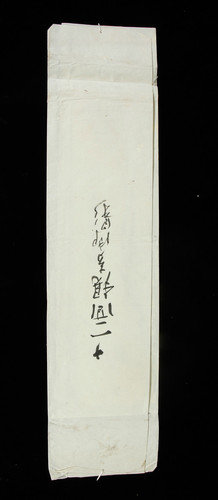 1908.82.635.1Printed picture of Kannon [.1] standing on a plinth, inside a folded paper envelope [.2], with hand written inscription. [SM 14/10/2008]1908.82.635.1
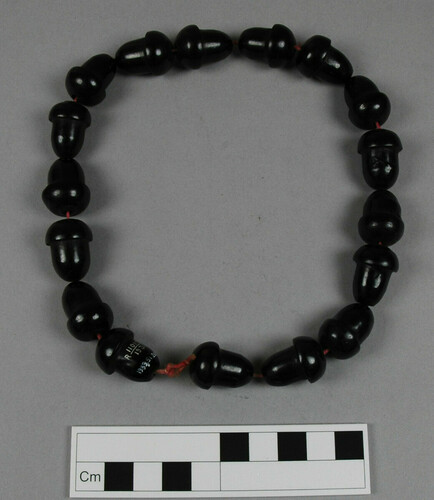 1985.51.265Necklace of 17 carved wooden acorns strung together on red coloured string. Used as an amulet against lightning. [SM 03/02/2011]1985.51.265
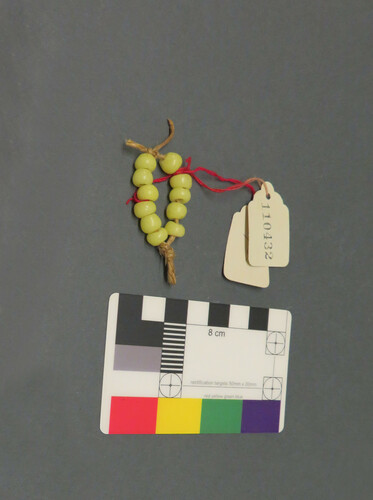 1985.54.1238Amulet; twelve light yellow glass beads strung on red thread. Used as a cure for one who has an illness caused by the evil-eye. For young children (boys) only. [SB [OPS Move] 29/08/2017]1985.54.1238
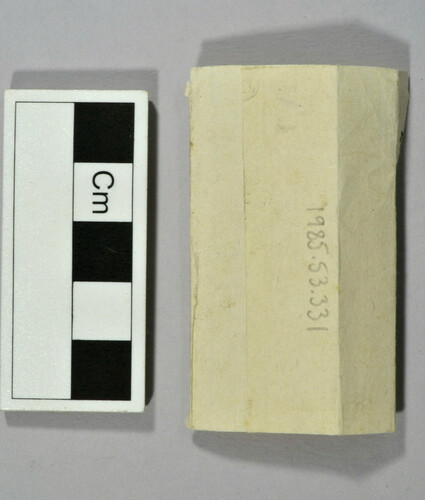 1985.53.331Paper, glued to form a band, with characters in black ink and decorative border. [MJD 20/03/2013]1985.53.331
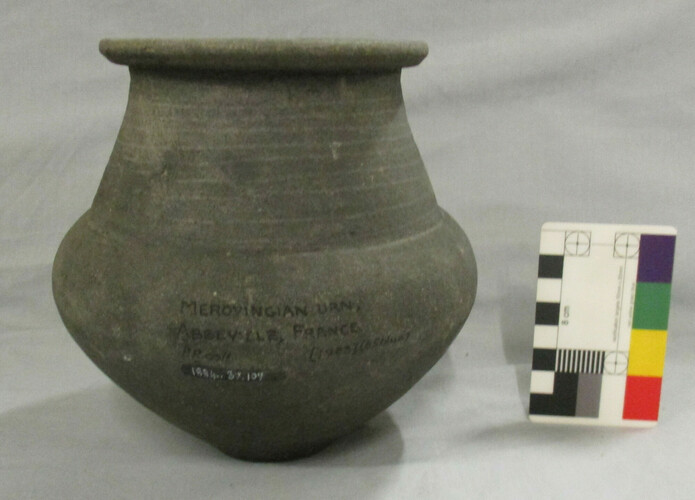 1884.37.109Wheel-made urn of dark grey ware with a globular, tapering to base, rounded body and a neck tapering to mouth and striated at the neck. [ASh [OPS move] 06/05/2016]1884.37.109
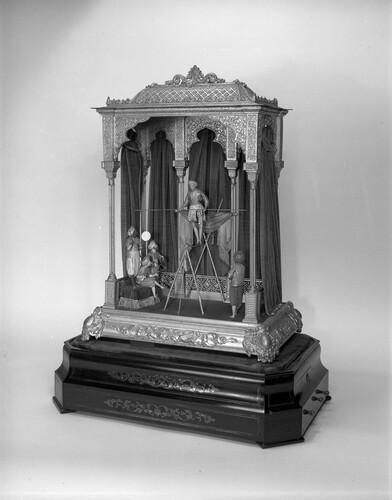 1940.9.02Musical box with 5 automaton figures of entertainers inside a gilded pavilion. [GB 10/10/2007]1940.9.02
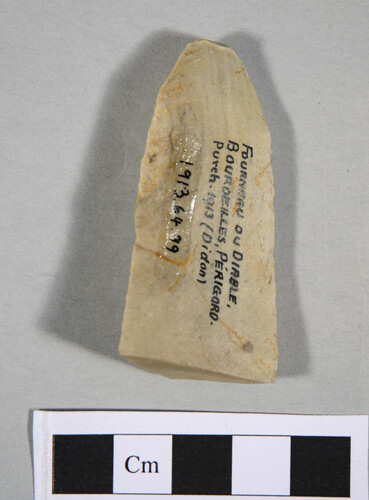 1913.64.99Stone tool; scraper1913.64.99
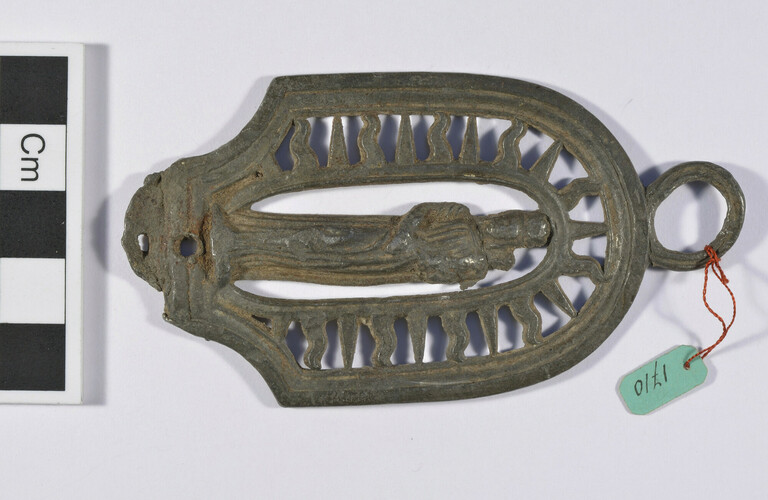 1985.52.879Amulet, fragment of a Holy water stoup, in lead, with the figure of the Virgin Mary with Child, with a loop at the top for suspension. [ACA 17/04/2012]1985.52.879