
- Collection type
- Object
- Description
- Straight bladed sword [.1] with leather bound hilt and leather sheath [.2] with attached leather belt.
- Long description
- Straight bladed sword [.1] with leather bound hilt and leather sheath [.2] with attached leather belt. The blade is made of iron or steel and has a central rib on both surfaces. The belt is attached through a hole in the front of the sheath. The sheath has a ring-shaped iron chape. [SM 03/09/2007] Sword and scabbard typically Maasai, and still used today. Local names for sword is Sime (Swahili) Olalem (Maa) Local names for sheath is Ala (Swahili) Enchashur (Maa). The sword is culturally symbolic of manhood and an important part of a man’s outfit. A man is not completely dressed without his sword, as the Maasai feel they must be on guard all the time and ready to fight. When a visitor comes to your home, you take your sword down and put it by the bed, thereby inviting him to stay with the family. Most importantly, if you need something, you leave your sword in someone’s home and they must give you a cow, in this way it can be used by the poor [ThW [Living Cultures Project] 17/3/2021]
- Person
- Field collector Unknown Collector
- PRM source Ipswich Museum
- PRM source Patricia Margaret Maclaren Butler
- Date / Period
- Date made: Before 1940
- Date collected
- By 1940
- Acquisition information
- Purchased: 1966
- Materials and processes
- Material Animal Leather Skin, Material String, Material Iron Metal, Material Steel Metal, Process Forged (Metal), Process Covered, Process Stitched, Process Bound, Process Perforated, Process Knotted
- Dimensions
- Length: max 578 mm sword, Length: max 595 mm sheath
- Object numbers
- Accession number: 1966.1.156.1 Accession number: 1966.1.156.2 Other numbers: R.1940.4 R1945-4B
- Research and responses
'Sword and scabbard typically Maasai, and still used today. Local names for sword is Sime (Swahili) Olalem (Maa) Local names for sheath is Ala (Swahili) Enchashur (Maa). The sword is culturally symbolic of manhood and an important part of a man’s outfit. A man is not completely dressed without his sword, as the Maasai feel they must be on guard all the time and ready to fight. When a visitor comes to your home, you take your sword down and put it by the bed, thereby inviting him to stay with the family. Most importantly, if you need something, you leave your sword in someone’s home and they must give you a cow, in this way it can be used by the poor.'
The information used to describe this object has been reviewed through a process of consultation with Maasai representatives and community elders as part of The Maasai Living Cultures Project. Living Cultures started in 2017 and is a partnership between Maasai representatives from Tanzania and Kenya, the Pitt Rivers Museum and InsightShare, an Oxford-based NGO. The project is working to represent the history and narratives behind artefacts held in museum collections. Over the course of three years (2017, 2018, 2020) Maasai delegates have visited the museum to discuss how their culture is represented and how the Museum speaks about Maasai communities in its displays, databases, and education programmes. [ThW [Living Cultures Project] 16/3/2021]
Further items to explore
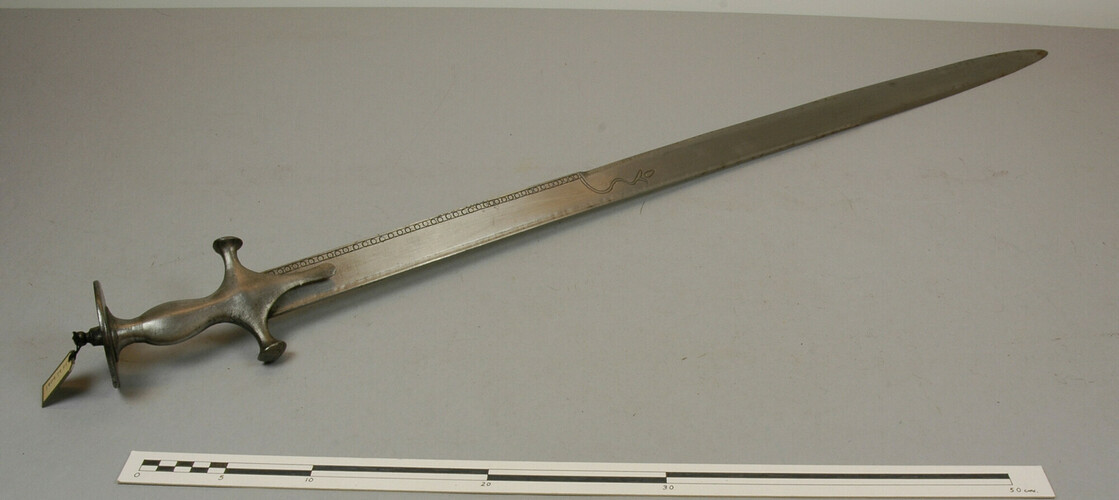 1909.79.35Talwar sword with straight single-edged blade, also sharpened along the distal third of the back edge. The blade is decorated with a row of stamped circles and an engraved floral motif. Indo-Muslim hilt with disc pommel. [LM 07/11/2007]1909.79.35
 1884.23.8Shark tooth weapon. [AB [OPS Move] 19/6/2017]1884.23.8
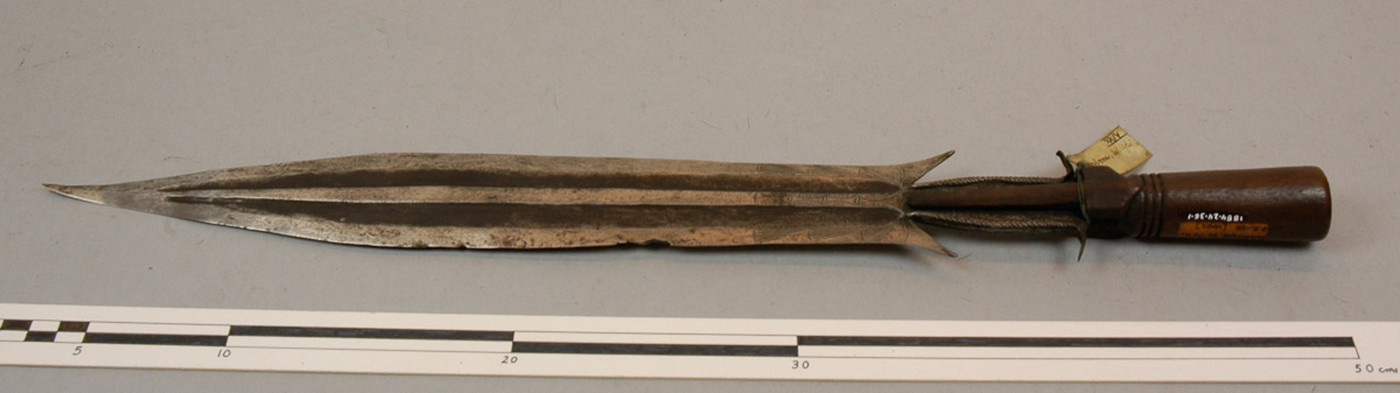 1884.24.36.1Iron leaf-shaped sword or dagger, barbed with wooden hilt, double barbed at base and incised with geometric patterns. [with sheath 1884.24.36 .2]. [El.B 07/11/2007]1884.24.36.1
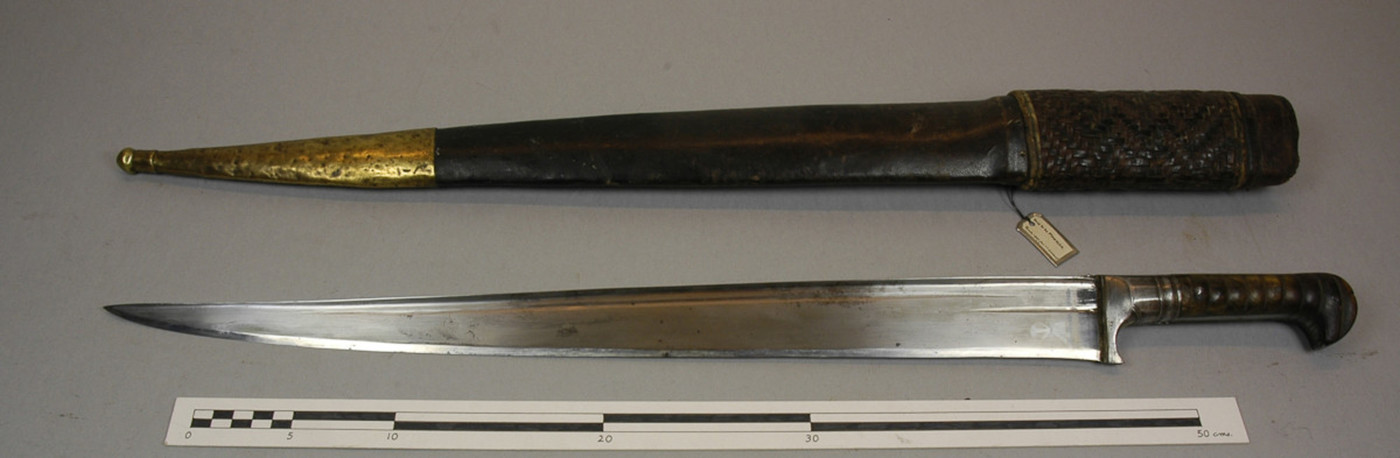 1907.72.48.1Sword [.1] with single edged blade and horn hilt, in a leather bound sheath with brass chape. [SM 14/11/2007]1907.72.48.1
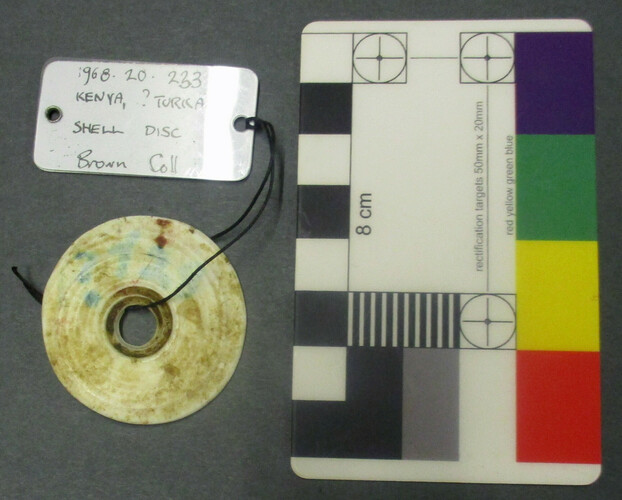 1968.20.233Flat shell disc with perforation in the centre and twisted fibre attached [now missing [BS [OPS Move] 16/11/2016]. [FC 12/08/2010]1968.20.233
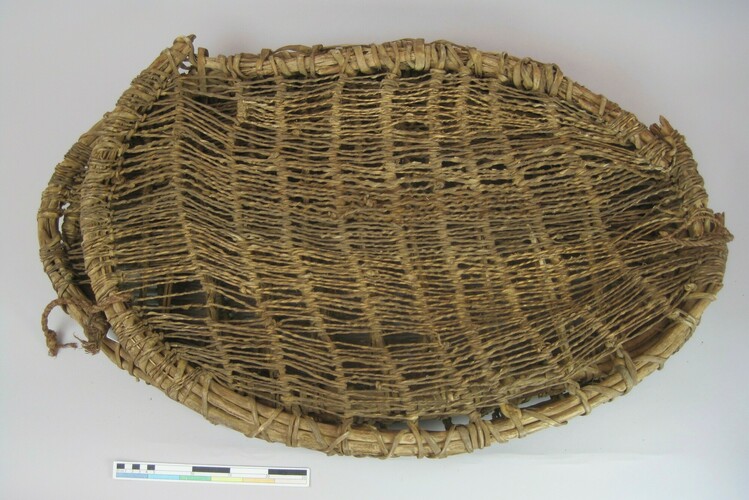 1999.20.75Donkey panniers, made of animal hide on a wooden frame. Three secured together with rope. [JC 6 7 1999]1999.20.75
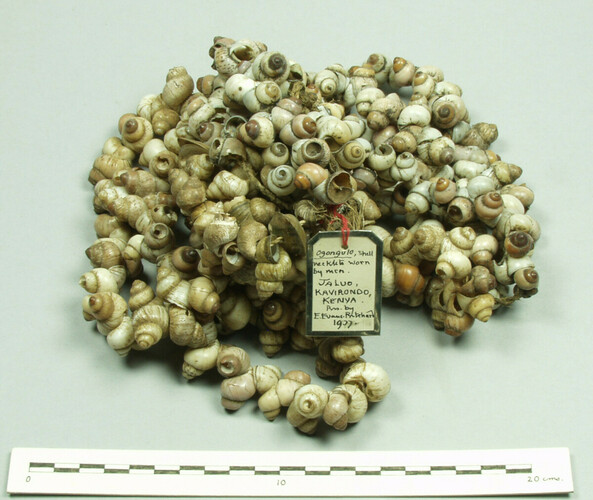 1937.34.30.1Three neck ornaments consisting of strings of perforated snail shells: two short [.1-.2] and one long [.3]. [N.B. 'DCF 2004-2006 What's Upstairs?' 4/8/2005]1937.34.30.1
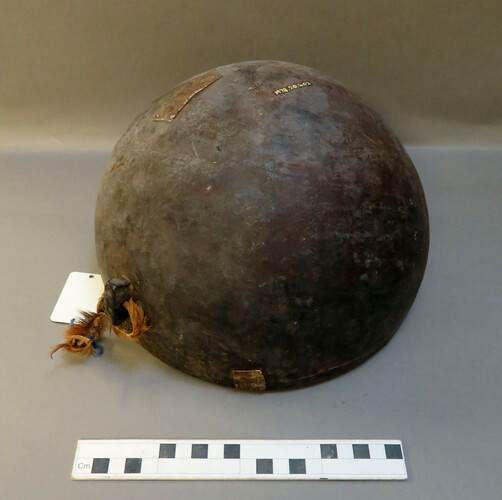 1978.20.402Wooden bowl. Circular with a rounded base. Black in colour. There is a perforated lug on the side with a hid loop passing through. Local aluminium repairs. [AB [OPS move] 2/11/2017]1978.20.402