
- Collection type
- Object
- Description
- Three neck ornaments consisting of strings of perforated snail shells: two short [.1-.2] and one long [.3]. [N.B. 'DCF 2004-2006 What's Upstairs?' 4/8/2005]
- Cultural groups
- Luo
- Date / Period
- Date made: Before 1936
- Date collected
- 1936
- Acquisition information
- Donated: 1937
- Materials and processes
- Material Snail-Shell Animal, Material Shell, Material Sisal Fibre Plant, Material Wood Plant, Process Strung, Process Tied, Process Perforated
- Dimensions
- Length: max 350 mm, Length: max 720 mm
- Object numbers
- Accession number: 1937.34.30.1 Accession number: 1937.34.30.2 Accession number: 1937.34.30.3
- Research and responses
Examined by Gilbert Oteyo and Jeremy Coote in September 2002 as part of the British Academy funded project 'Luo Histories and Material Culture at the Pitt Rivers Museum': Ornaments consisting of snail- and bivalve shells strung and/or tied on sisal fibre. There are also a few small (15 mm long) pieces of wood (perhaps of a symbolically significant species) tied on here and there between the shells. Such ornaments were worn from the neck, over the shoulder, down the back, and around the waist by members of the Mumo cult who had been possessed by spirits from Lake Victoria. Such ornaments were also worn by people attending funerals. When the person wearing such ornaments moved the shells made a rattling noise. Also, air moving through the shells (especially if the wearer was running) made a further noise interpreted as being made by spirits and thus considered frightening by Luo. Such an ornament can be seen being worn in a photograph in the Museum's collections taken by E. E. Evans-Pritchard (EP: L.112). [JC 20 9 2002]
Search terms: Ornament, Status, Music, Religion, Death, Neck Ornament
Further items to explore
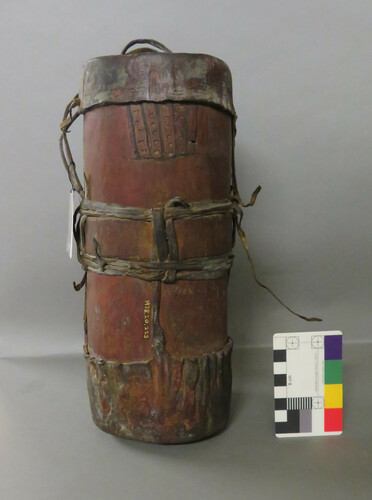 1978.20.223Wooden butter or ghee vessel. Cylindrical with hide caps at both ends secured by hide bindings around the body and a hide handle. Some incised decoration. [AF [OPS move] 1/11/2017]1978.20.223
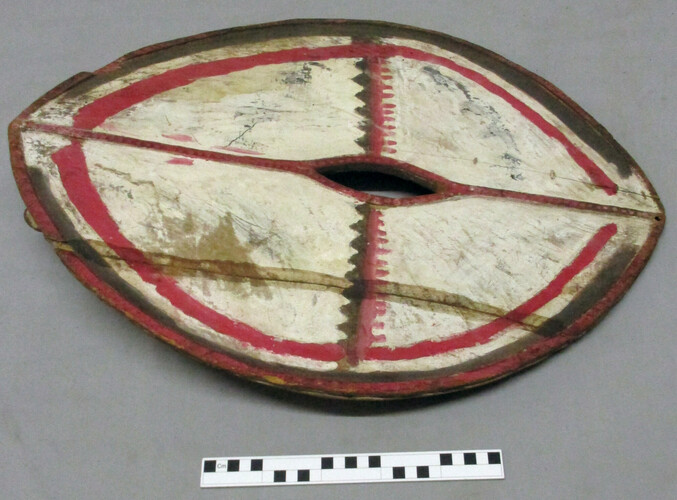 1966.1.32Elliptical shaped wooden dance shield with arm hole and incised bands of chevron decoration painted with pink, white and brown pigments. On the reverse the shield is decorated with painted designs in red and brown over white pigment. [CW [OPS move] 17/8/2016]1966.1.32
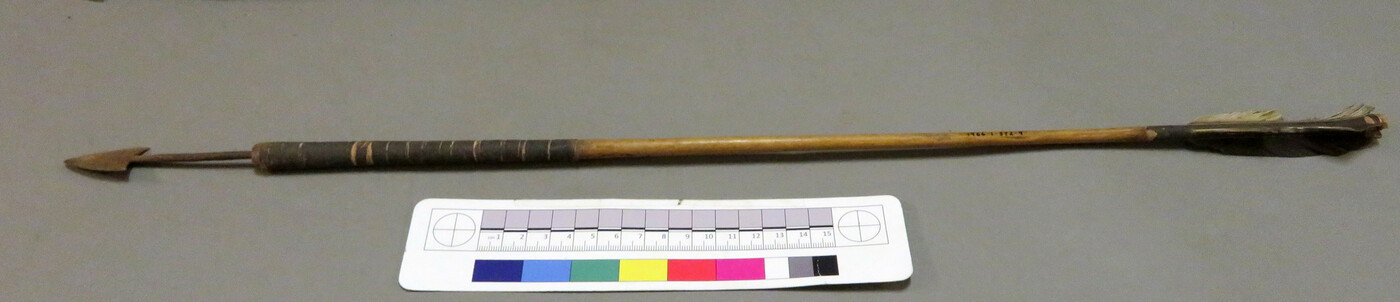 1966.1.372.9Arrow. With tanged triangular metal head, fixed into a wooden shaft bound with sinew. It has feather fletchings and a notched end. [AB [OPS move] 10/10/2017]1966.1.372.9
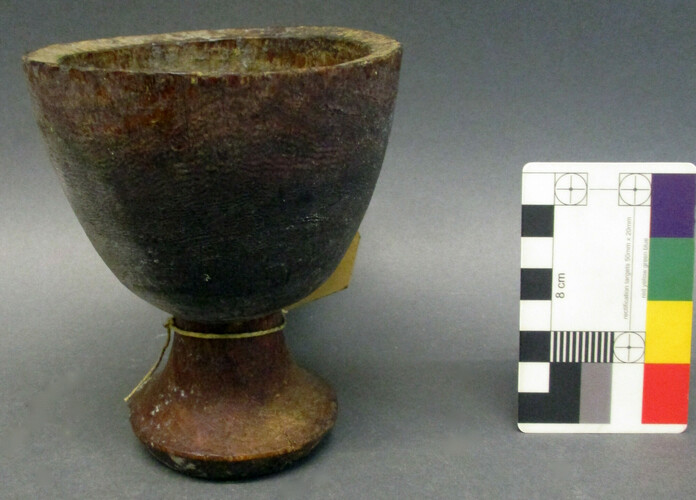 1953.8.33Carved wooden chalice shaped cup with a flat, pedestal base and a flat rim that is angled slightly towards the internal of the cup.1953.8.33