
- Collection type
- Object
- Description
- Paper board game buppo-sugoroku with yellow cover and Japanese characters all over the board surface [.1]. Also includes plain white envelope [.2] with 5 characters printed on the surface. [E.S-R 'DCF 2004-2006 What's Upstairs?' 26/1/2005]
- Geographical reference
- Date / Period
- Date made: Before 1885
- Date collected
- By 1885
- Acquisition information
- Donated: 1917
- Materials and processes
- Material Paper Plant, Material Pigment, Process Drawn
- Dimensions
- Length: max 1018 mm, Length: max 253 mm
- Object numbers
- Accession number: 1917.53.490.1 Accession number: 1917.53.490.2
- Research and responses
The difference between e-sugoroku and ban-sugoroku:
There are two versions of the game sugoroku: ban-sugoroku and e-sugoroku (these are entirely different games). Ban-sugoroku is like backgammon, played by two people, whereas e-sugoroku is a game of luck and can be played by several people. E-sugoroku has many different versions, including the popular themes of travelling and the various stages of life. The basic rule is just like snakes and ladders: after rolling a dice, you can progress (or sometimes have to rest, or go back) according to the numbers you get. The first person who reaches the goal is the winner. In modern Japan, e-sugoroku is more popular than ban-sugoroku, with people making their own unique versions of the game e.g. using the game to increase children's vocabulary.
Etymology of Sugoroku:
双六 sugoroku means 'twice six'. The original game of sugoroku used two dice, and if both dice reveal a six, the player has achieved the highest score.
History of ban-sugoroku:
It is possible that Ban-sugoroku’s origin stems from the ancient Persian game Nard (formerly nardašir). It is believed that the earliest known reference to nardašir appears in the Babylonian Talmud (ancient Jewish text) compiled between 300-500AD, which names the game “Nardashir” but does not explain how it is played. Nard and its rules are mentioned in The Pahlavi Texts (~498-590 AD) by the Persian Grand Vizier of the Sassanian emperor Khusro I, Bozorgmehr:
“Among the rulers of this millennium, Ardashir was more capable and most wise and I will name this (game) backgammon (New-Ardashir – Nardashir) in Ardashir’s name. I will make the board of the backgammon (Nardashir) like the Spandarmad (earth goddess, one of six manifestations of Ahura Mazda) earth. And I will make 30 pieces like the 30 night and day, I will make 15 white, like the day, and I will make 15 black, like the night. I will make one single die as the turning of the constellations and the revolution of the firmament.”
Nard/backgammon spread to Japan in the 7th century. The earliest known Japanese document containing the word 'sugoroku' appeared in 689- it is a legal document to ban the game by Empress Jito, when the game was used for gambling.
History of e-sugoroku:
There is no clear origin of e-sugoroku, but it is possible that the game originates from the Ancient Hindu game Moksha Patam (the earliest surviving example dates back to the 18th century). It is possible that versions of the game arrived in Japan through China, as spiral-format board games were produced in China during the Tang period (618-907). Similar to Moksha Patam with its religious themes, early versions of e-sugoroku such as Buppō-sugoroku (buddhist sugoroku) features hell at the bottom of the board, and paradise at the top. E-sugoroku was particularly popular in the Edo period due to the cheap wooden block printing technology available at the time.
Touraj Daryaee (2016), On the Explanation of Chess and Backgammon Abar Wizārišn ī Čatrang ud Nihišn Nēw-Ardaxšīr, Translated From Middle Persian by Touraj Daryaee, UCI Jordan Center for Persian Studies, pp. 21-22.
Board and Table Games from Many Civilizations by R. C. Bell (1960)
Andrew Topsfield (1985), "The Indian Game of Snakes and Ladders" in Artibus Asiae 46:3, pp. 203–226.
Rebecca Salter (2006). Japanese Popular Prints: From Votive Slips to Playing Cards, University of Hawaii Press, pp. 164.-165
A letter in the Archive, Tylor correspondence C6, from Chamberlain to Tylor dated 1 April 1885, lists a series of Japanese games sent to Tylor. This includes "1 Buddhist Do." [i.e. ditto "sugoroku"]".
- Associated publications
- For information on Japanese games: Griffiths (or Griffins), Vol. II, and Chaplin-Ayrton, Vol. V, Pt. I, 'Transactions of the Asiatic Society of Japan'. [CF 30/4/2001]
Search terms: Toy and Game, Board Game, Envelope
Further items to explore
 1884.140.1838Wooden bow bound at intervals along its length with bands of plant fibre and one section decorative paper. The bow is strung. [FB 1/8/2017]1884.140.1838
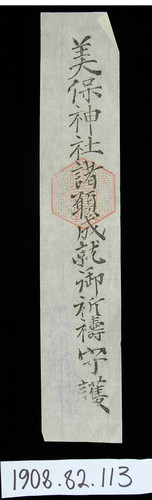 1908.82.113Amulet for accomplishing various desires, a paper strip with a printed inscription in black ink and a red hexagonal stamp. [SM 17/10/2008]1908.82.113
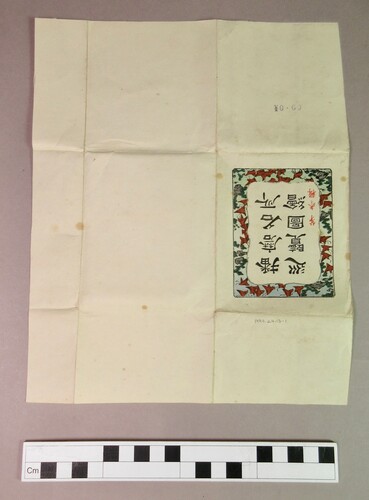 1997.24.13.1Rectangular printed envelope containing five smaller printed envelopes.1997.24.13.1
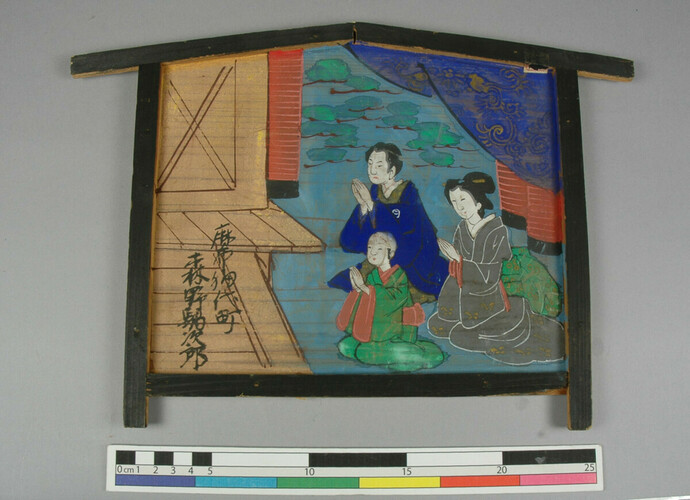 1892.21.8Religious offering, painting on wood of a family kneeling in prayer, with frame resembling a house. [El.B DDF Body Arts Project 2010/2011 02/12/2010]1892.21.8